

Kosovo – Turkey: New Turkish golden generation seals return to the World Cup after 24 years with technical imposition (0-1)
Which European team in the playoffs would you most like to see at the 2026 World Cup? Many people would answer Turkey, due to the number of talented players in this new golden generation. 24 years after 2002, they managed to reach the World Cup again, going through Romania in the playoffs and now past the resilient Kosovo side. Aktürkoglu scored the heroic goal, but the key to victory lies in the technical imposition.
Tactical analysis and match report by Marcus Arboés.
Kosovo, coached by Franco Foda, stood out for its solidity and organization, building a team without much spotlight but capable of competing with the best. For the decisive clash, with few important absences such as Rrahmani and Paqarada, the coach repeated the 5-3-2 outline from the 4-3 win against Slovakia: Muric (Sassuolo) in goal; Dellova, Hajziri and Hajdari in the defensive line; Vojvoda (Como 1907) and Gallapeni as fullbacks; Hodza, Rexhbecaj (Augsburg) and Muslija forming the midfield; Asllani (Hoffenheim) and the experienced captain Muriqi (Mallorca) as the attacking duo;
On the other hand, Turkey also entered the match with absences. Without Demiral and Simsir, Vincenzo Montella counted on the return of Çelik and made changes compared to the previous game against Romania, setting the team up in a 3-4-2-1 formation. Çakir (Galatasaray) remained in goal; Yuksek (Fenerbahçe), Kabak (Hoffenheim) and Bardakci (Galatasaray) formed the back three; Çelik (Roma) played on the right and Kadioglu (Brighton) as the left fullback; Kokçu (Besiktas), Çalhanoglu (Internazionale) and Arda Güler (Real Madrid) controlled the midfield, with Yildiz (Juventus) playing wide on the left wing and Aktürkoglu (Fenerbahçe) as the central striker.
Turkey’s technical imposition
The work of Vincenzo Montella has stood out since before the last Euro, in 2024, because the team imposes itself technically against any type of opponent, even if it ends up losing duels and exposing itself. With a starting eleven made up of players with this level of quality, the coach built a base combining experienced players and young gems who have been standing out at European giants, such as Güler and Yildiz. By the end of the night, Aktürkoglu was the hero with the goal that took Turkey to the World Cup after 24 years, but there is a story behind it
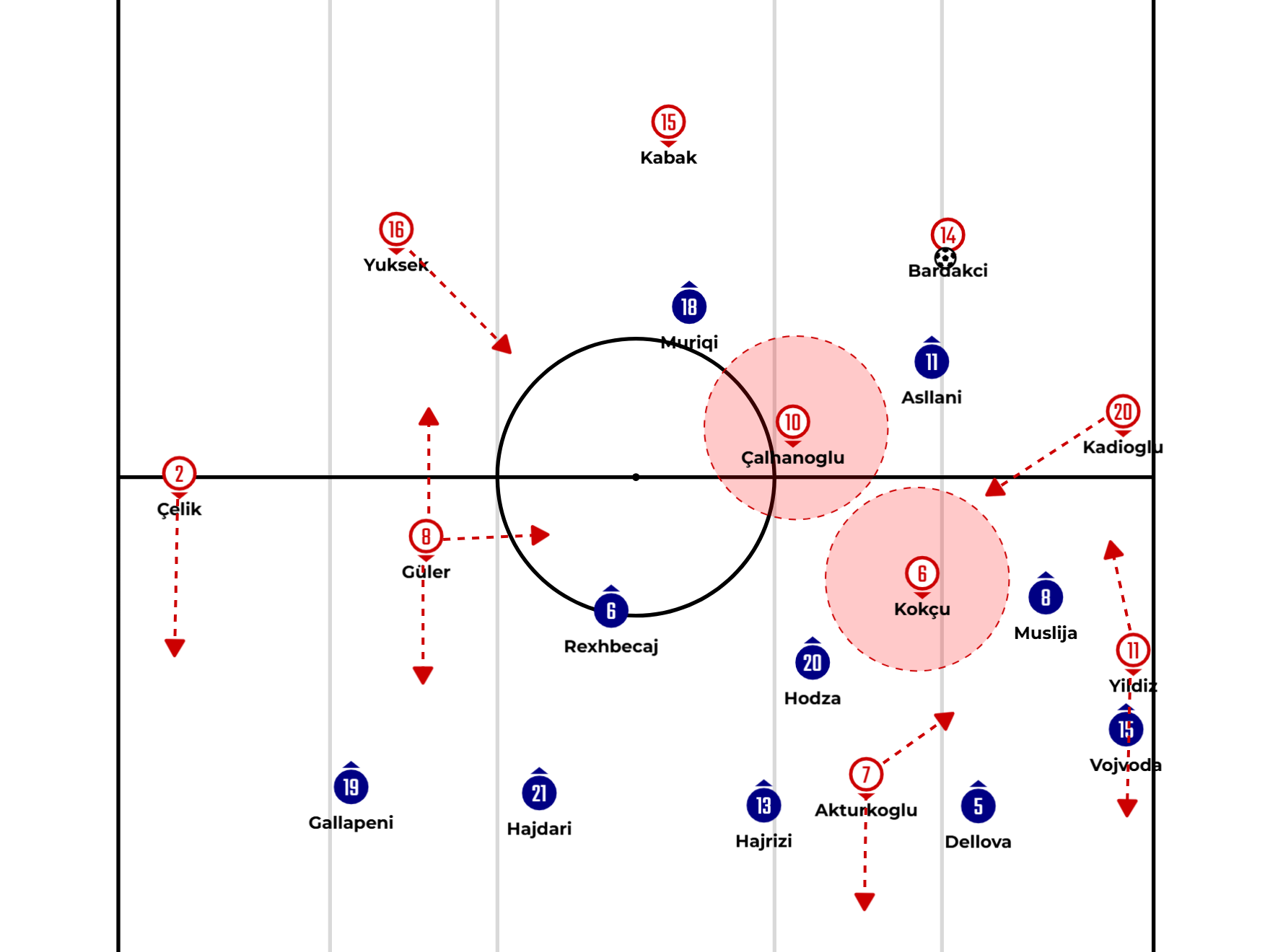
Turkey build up in a 3-4-2-1 or asymmetric 3-4-1-2 shape with the technical players moving closer together.
Even though the goal came early in the second half, the main pattern seen in the match had already been dominant since the first half. Turkey’s build up follows a slightly more relational model, where the tactical structure becomes more fluid and players do not hold fixed positions, meaning they do not need to occupy specific zones according to the system. Despite that, it started from a 3-4-2-1, with Güler acting more as a number ten and Yildiz wide on the left wing.
The build up, through the middle or the left, always started with Çalhanoglu and Kokçu. On the right, Yuksek stepped up from the defensive line as a false pivot and Arda Güler dropped as a playmaker, also able to float inside in a left sided build up, using Kadioglu as support. Regardless of which side the team started the build up, the midfielders provided width support, but always leaving two players holding position on the opposite side. The key was creating through short, supported play, generating advantages from the players’ technical quality.
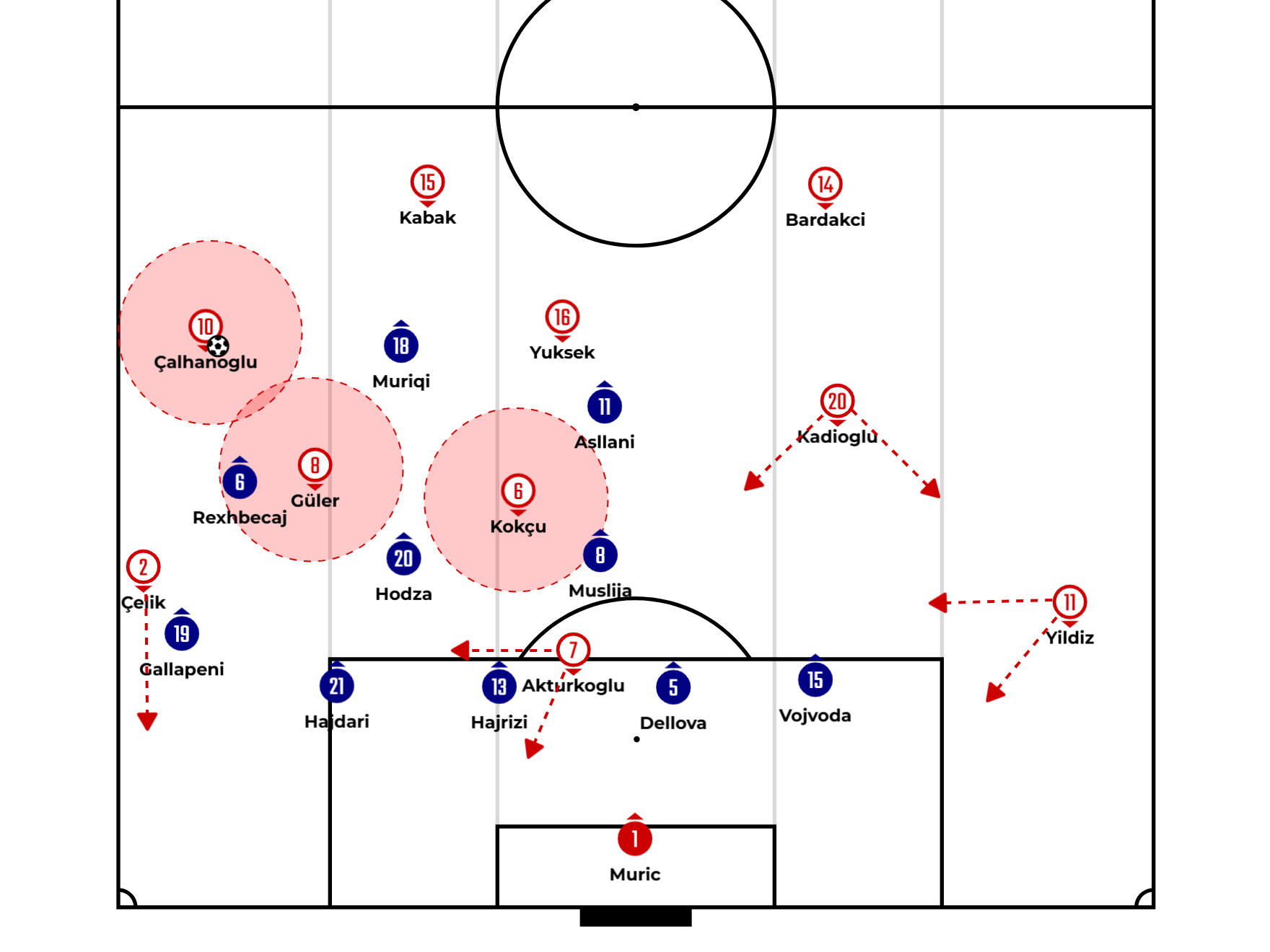
Turkey in the offensive phase, progressing from the right side in the opponent’s half.
The closer to goal, the more we could see situations of the team attacking with positional freedom. Güler floated wherever the ball was to influence the final pass, with Çalhanoglu acting as the base support in build up and Kokçu attacking space, even arriving inside the box. In attacks from the right, Yildiz stayed wide on the left to provide width. In attacks from the left, Çelik was the widest player on the opposite side.
To deal with the short play and protect the box at different heights, Kosovo defended in a 5-3-2 shape, dropping the wingbacks into a back five through a zonal pressing scheme with long tracking runs. Asllani, in the first defensive line, dropped deeper than Muriqi to try to match Turkey’s numerical superiority around the ball. Even though they managed width well and limited situations for Yildiz in one against one or Çelik on overlaps, they were still heavily affected by the quality of short passing from Güler and Çalhanoglu.
Did Kosovo have a chance to qualify?
Despite the technical imposition and overall superiority, also due to having a stronger squad, Turkey had a relatively balanced match because Kosovo created danger through quick attacks and counterattacks. The main way to generate danger, besides transitions, was attracting Turkey’s high pressing block into their own half to progress through positional organization from the goalkeeper.
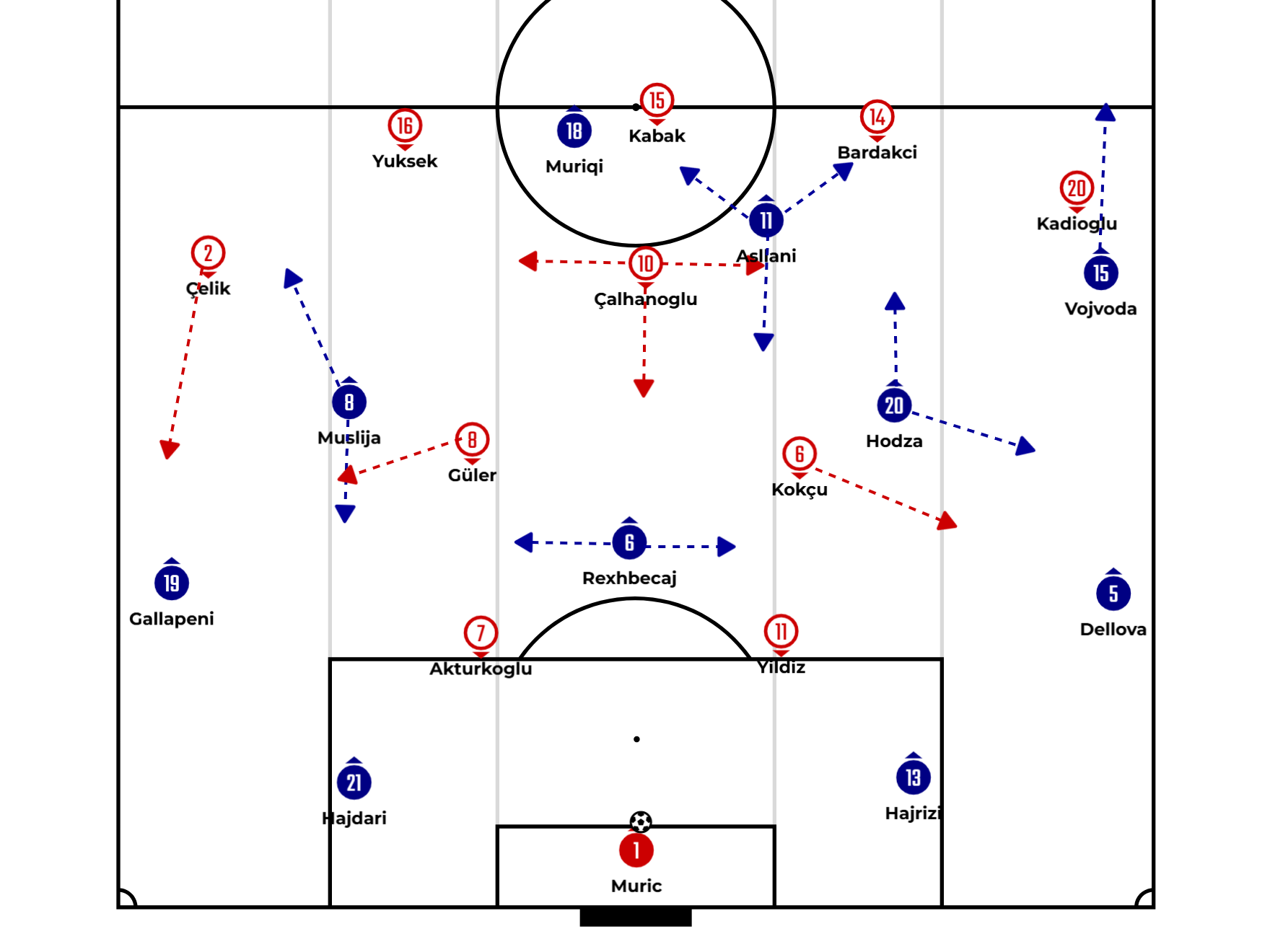
Kosovo short build up in a 4-3-3 shape against Turkey’s high block in a 5-3-2 formation.
Playing with three center backs and two wingbacks, Kosovo built from their own half using an asymmetric positional structure. Right center back Dellova moved wide to the right, allowing right wingback Vojvoda to push up like a right winger. This created an initial 4+1 shape. Rexhbecaj acted as a positional pivot in a midfield triangle with Muslija on the left and Hodza on the right.
Hodza had the role of moving wide so that Asllani, playing inside, could drop to receive unmarked. Muslija, on the other hand, took advantage of Çelik’s forward runs to stay wide on the left wing, or dropped into Arda Güler’s shadow. The idea was to use forward support to play vertically and attack the space behind Turkey’s defense. The issue was that the team protected depth very well.
In the 5-3-2 formation, the front players formed a square where Güler and Kokçu were responsible for jumping to press wide, while Çalhanoglu played at a deeper level, protecting the space behind the first line. Even when exposed and stretched, the three defenders and Kadioglu managed to protect depth well. When that structure was broken, Kosovo managed to create one or two clearer chances.
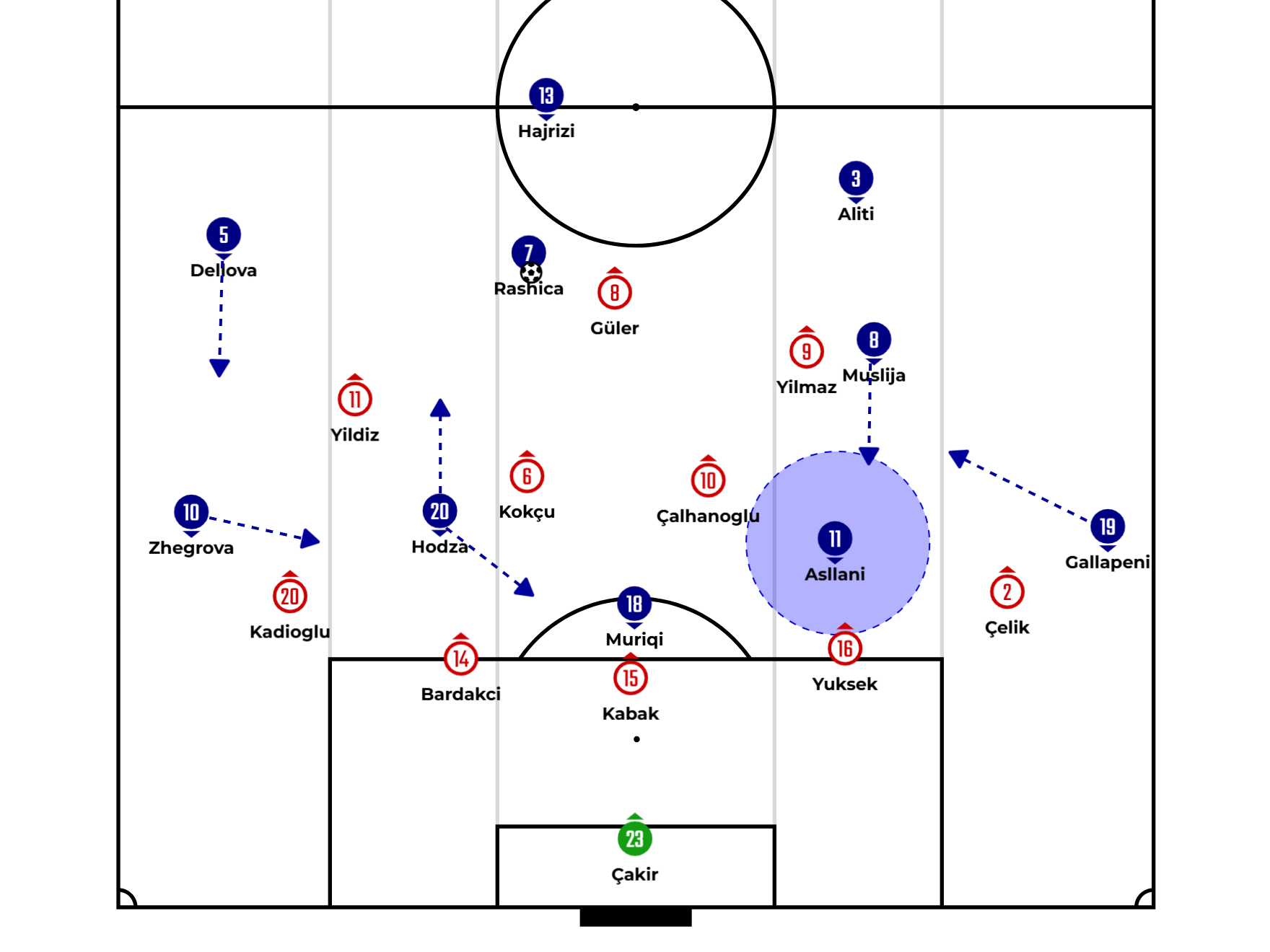
Kosovo attack in a 3-2-5 shape in the final stretch of the match.
Despite the technical imposition and preference for short play, Aktürkoglu’s winning goal came from a counterattack. After that, Kosovo tried to impose themselves higher up the pitch using a positional 3-2-5 shape. The center backs positioned themselves high in the attacking half, with the first pivot, later replaced by Rashica, initiating the play.
From midfield forward, players in the final third rotated lanes and positions, but always maintaining a positional structure close to this system. The idea was for one player to switch lanes to attract marking, creating space for another. However, Turkey defended well in a zonal 5-3-2. Even with the introduction of Zhegrova (Juventus), who has become a bench option for the national team, they were unable to create a major chance.
Takeaways
The main reason Turkey did not suffer major threats after taking the lead in the second half is that Kosovo struggled to attack consistently. Even though Turkey is not a defensive powerhouse, the team managed to defend by keeping possession through the technical quality of its players. It was a qualification built entirely on technical imposition.
Kosovo failed to achieve the dream, while Turkey finally secured a place in the World Cup after 24 years, when they had a strong and memorable campaign in the 2002 World Cup. Now, in 2026, they will face Australia, Paraguay and the hosts United States in Group D.


Comments