
Manchester City – Arsenal: City’s Momentum Reels Arsenal In (2-1)
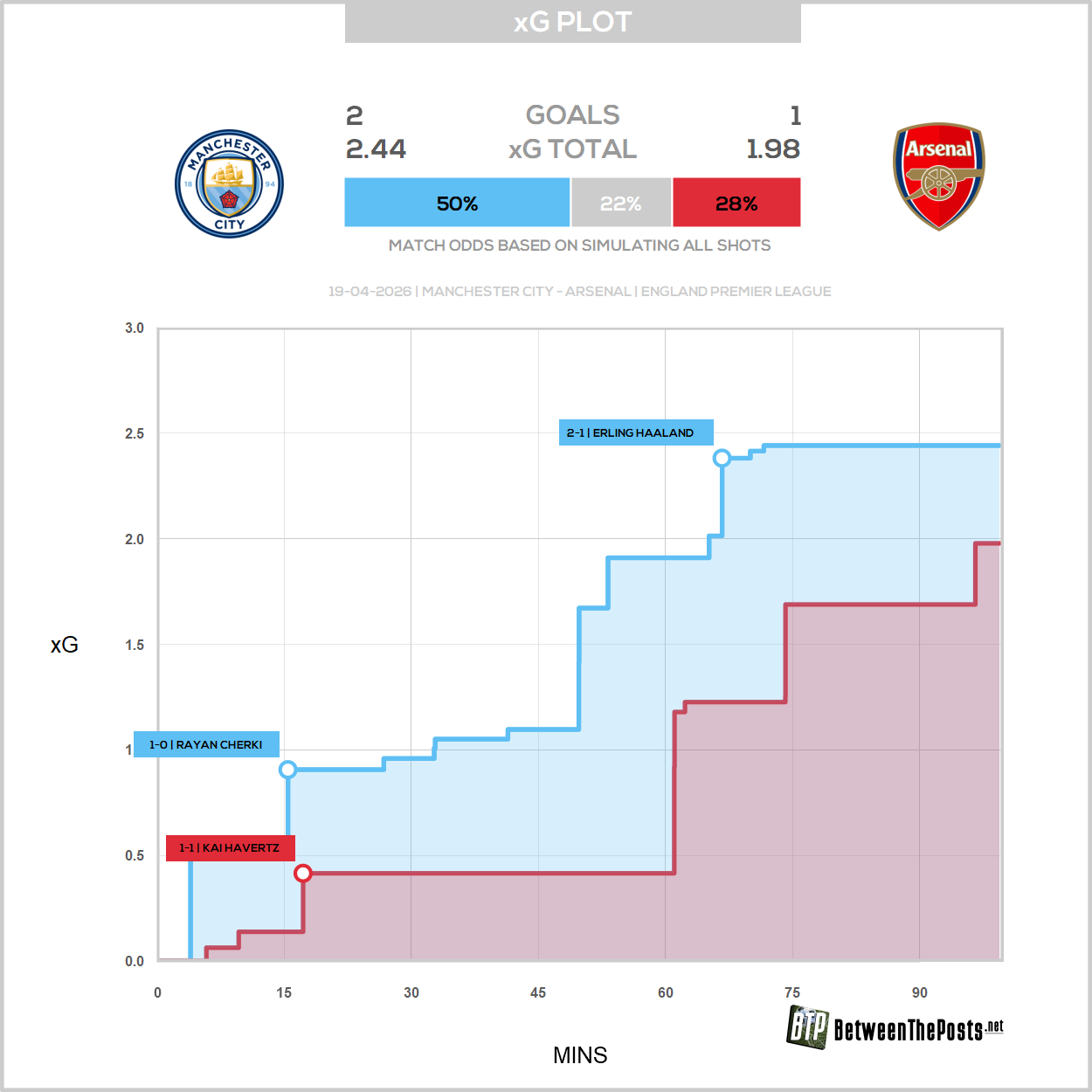
Arsenal arrived with a high pressing approach here, and Mikel Arteta attempted a solution to Manchester City’s own high press. However, City’s attacking quality proved too much, as Rayan Cherki’s and Erling Haaland’s decisive strikes helped City close the gap in the Premier League title race to just three points with a game in hand.
Tactical analysis and match report by Josh Manley.
We decided to make this article free to read. If you want to support our work, consider taking a subscription.
Arsenal have held a comfortable lead in the title race for much of the season, but in recent weeks they have started to look shaky, and their margin for error has narrowed. Coming into this game, they now found themselves in a situation where defeat at the Etihad Stadium would leave them just three points ahead of Manchester City with Pep Guardiola’s side having a game in hand.
City lined up in a 4-2-3-1 shape here, continuing with the arrangement that has served them well in the latter part of the season. Matheus Nunes, Abdukodir Khusanov, Marc Guéhi, and Nico O’Reilly formed the back four, with Rodri and Bernardo Silva as the double pivot. Rayan Cherki started at number ten, flanked by wingers Antoine Semenyo and Jérémy Doku, in support of striker Erling Haaland.
Mikel Arteta also used a 4-2-3-1 shape, with a back four of Cristhian Mosquera, William Saliba, Gabriel Magalhães, and Piero Hincapié. Martín Zubimendi and Declan Rice partnered in central midfield with Martin Ødegaard at number ten. Noni Madueke, Kai Havertz, and Eberechi Eze then completed the frontline.
Arsenal press high
Arteta may have been tempted to take a more cautious approach out of possession given the stakes of the game and the opposition, but this was not the case. Arsenal came out with the intention to press City high, especially early on in this game, looking to disrupt the possession rhythm of the hosts.
Arsenal’s press was relatively man-oriented. Rodri often dropped low for City, between the center-backs, and Rice would often attempt to get close to him, meaning that he ended up level with Ødegaard and Havertz – initially the most advanced players in Arsenal’s 4-4-2 starting shape without possession.
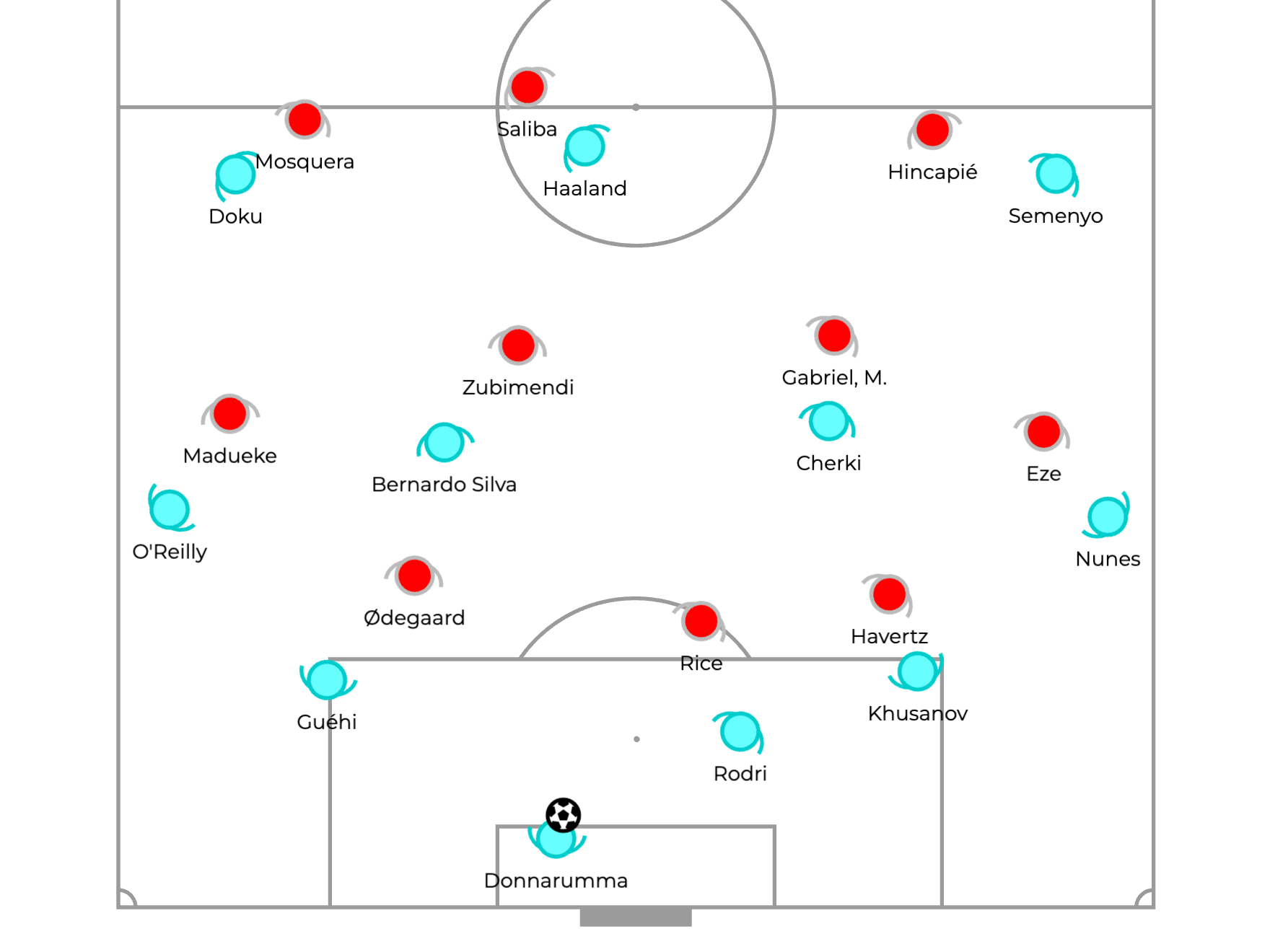
Arsenal’s high press.
City then often had Cherki and Bernardo Silva in right and left central midfield positions respectively. Zubimendi would start off marking Bernardo Silva, while Gabriel would push out of the defensive line to mark Cherki, sometimes choosing to follow the Frenchman when he dropped even deeper, and sometimes choosing to drop back. This gave Cherki a couple of opportunities early on to create overloads and help break the Arsenal press when Gabriel elected not to track him further from his position.
On the right side there was some variation for Arsenal. Sometimes it would be more practical for Madueke to jump up to pressure Guéhi rather than Ødegaard. In this case, Ødegaard would drop back slightly into midfield to get closer to Bernardo Silva, while Zubimendi would be tasked with sliding over to close down O’Reilly at left back. It was also possible for Mosquera to jump onto O’Reilly, in which case Zubimendi would drop back to cover Doku.
Overall, Arsenal’s high press helped prevent City from gaining comfortable control of the game. It also led directly to a goal when Havertz was able to close down Gianluigi Donnarumma and deflect his attempted clearance into the City net. This came shortly after Cherki had opened the scoring for City with a magical dribble into the Arsenal box followed by a well-placed finish.
A familiar battle
In the EFL Cup final just a few weeks ago, a key part of the tactical battle was City’s 4-2-4 high press and Arsenal’s inability to find a solution. The Gunners lacked tempo and ideas against Guardiola’s pressing scheme and ultimately paid the price. Guardiola went with the same idea in this game, and Arteta met it with some adjustments this time around.
In the cup final, Arsenal had struggled with their double pivot being in the cover shadows of City’s forwards. In this game, Arteta changed to a single pivot, with Zubimendi sitting deeper, while Rice actually moved slightly further forward in the buildup.
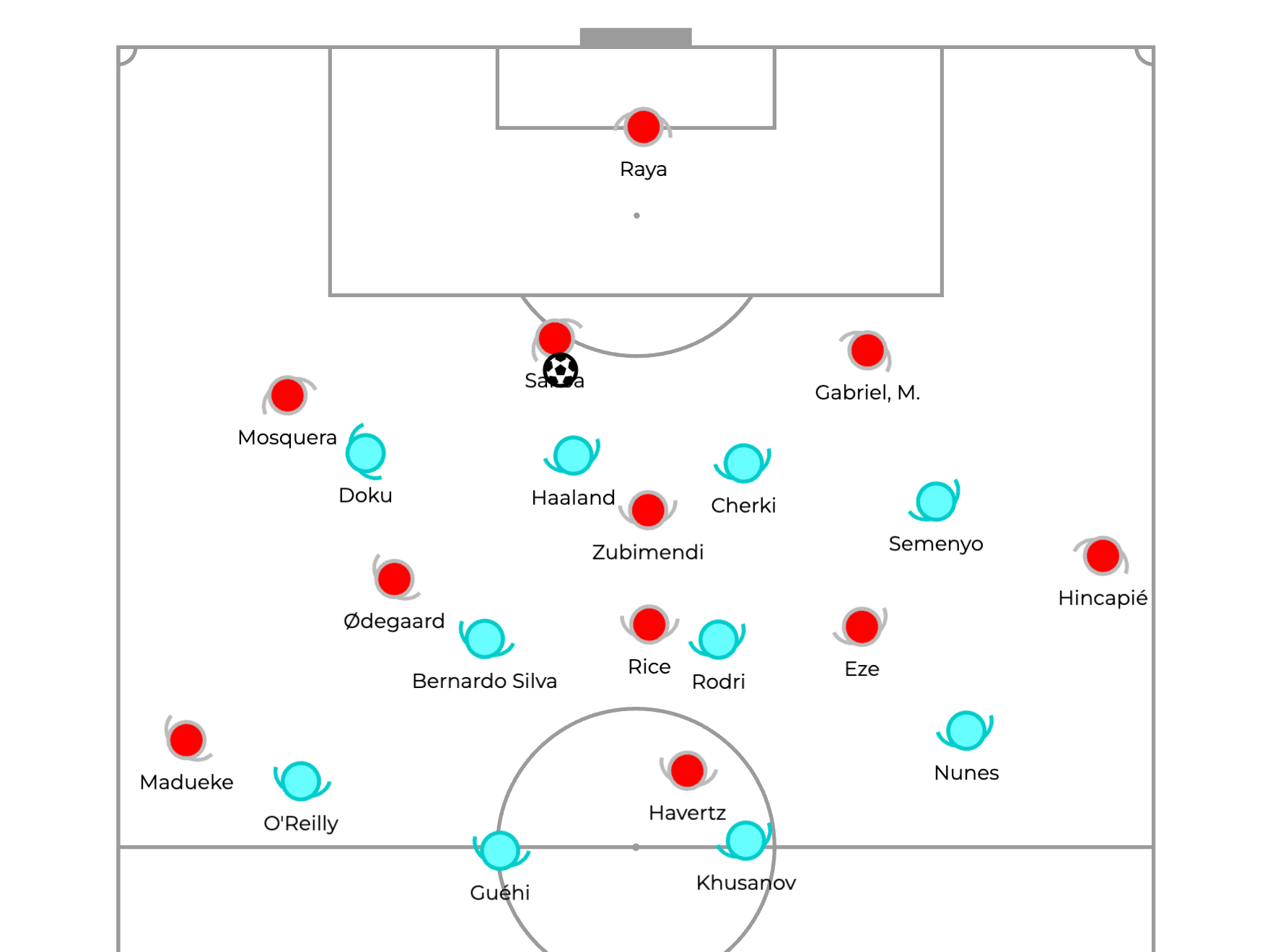
Arteta’s approach against Guardiola’s 4-2-4 pressing scheme.
In the first line, Arsenal would usually have three players, with Mosquera tucking in from the right. Hincapié on the left meanwhile would push up to provide the width, allowing Eze to indent into the left halfspace. Meanwhile on the other side, Ødegaard would start from the right halfspace but regularly drop deep to get involved in circulation, while Madueke held the width on the right.
The idea from Arteta here was an interesting one. With City’s 4-2-4 shape, the central midfielders can have fairly large spaces around them. Arteta therefore tried to exploit this with the trio of Ødegaard, Rice, and Eze across the halfspaces and the center, essentially trying to create a three-versus-two in this line and gain a positional advantage.
Arsenal did not quite exploit this setup as well as they might have been able to. The circulation at the back was still slightly slow, and the chances to punch the ball through to their attacking midfielders were not always pursued quickly enough.
Haaland has the last laugh
As the game went on, City were able to get into more established possession phases in Arsenal’s half. Arsenal would drop into a more zonal 4-4-2 defense, although still with some man-orientations, while City formed a 3-2-4-1 shape, although with some variations.
These variations were often created by the roaming behavior of Bernardo Silva. He was given the freedom to move into higher positions between the lines to help push Arsenal’s midfield back, or he could also drift into wider positions.
Cherki started as the right-sided number ten but often rotated with Semenyo, whereby the Ghanaian would move into an inside-forward position on the right, pushing Hincapié deeper and narrower, creating space for Cherki on the wing.
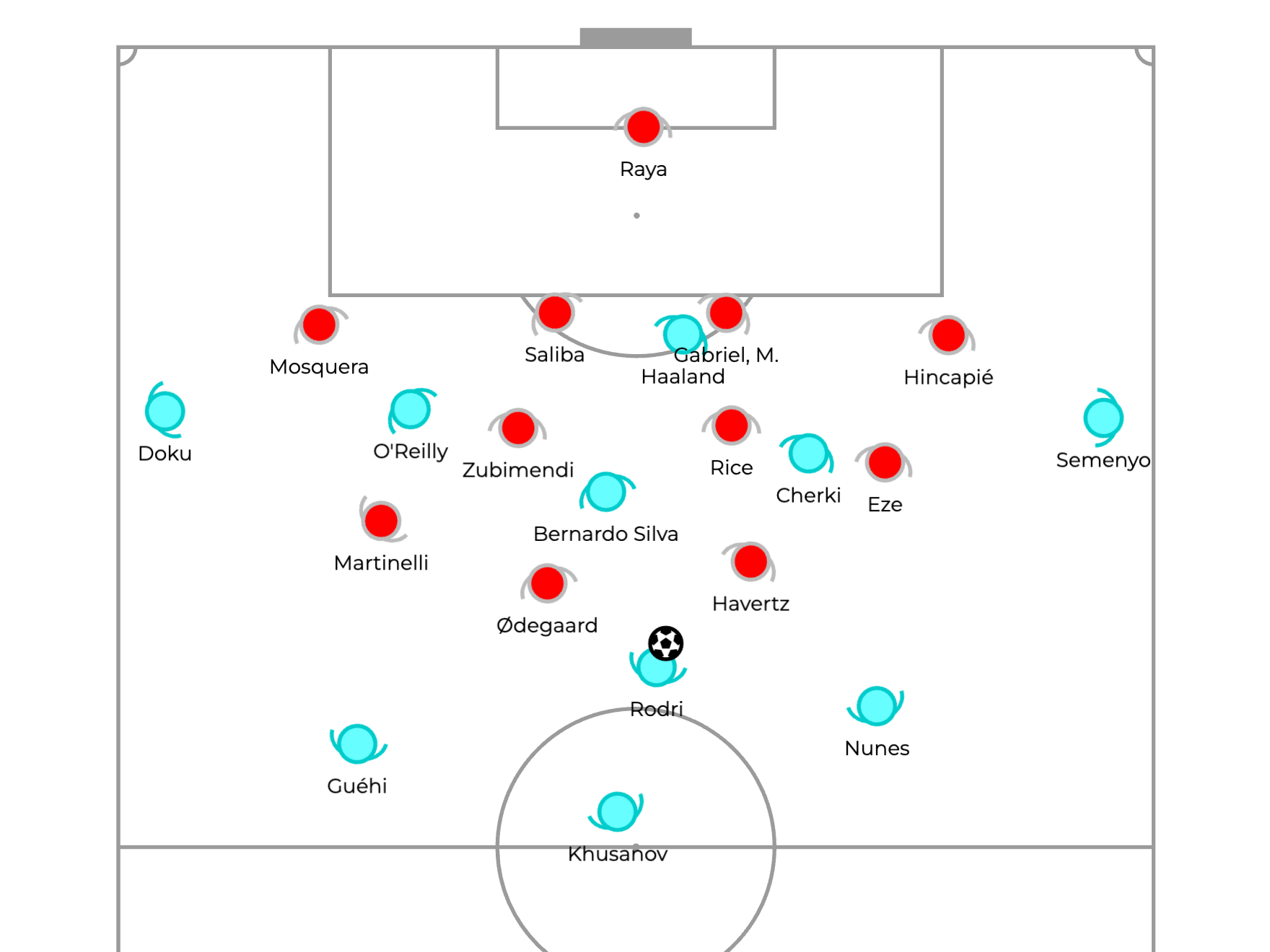
City’s shape in established possession.
On the left, Doku was the nominal winger, but he also occasionally moved inside, especially in the second half, clearing space for O’Reilly on the outside. The more important dynamic between these two though was the underlapping of O’Reilly when Doku had the ball out wide. It was this that would eventually play a role in City’s decisive second goal, where Doku found O’Reilly’s underlap, and O’Reilly’s ball across found Haaland at the far post.
Arteta had already made one change at half time, bringing Gabriel Martinelli on for Madueke. This also accompanied an adjustment to the pressing scheme, as Martinelli would more often try to jump to Guéhi, while Rice remained deeper and Ødegaard acted as a number ten. This sometimes left O’Reilly free on the left when Zubimendi could not cover this side or Mosquera could not jump – this happened most notably in the buildup to City’s second goal.
More changes would come for Arsenal going into the final stages of the game. Ben White and Leandro Trossard replaced Mosquera and Eze, and Viktor Gyökeres later replaced Zubimendi with Ødegaard moving back into central midfield.
City tried to manage the game by keeping their possession share relatively high rather than getting pushed deep. It was only in the final few minutes that they were forced to face Arsenal crosses in a low block. The key chance late on was Havertz’s header which went over the bar, meaning Arsenal ultimately headed back to London with a defeat.
Takeaways
City were not dominant in this game, but there were some big performances in their team, and they took their chances when they came. Bernardo Silva was outstanding with his tireless work on both sides of the ball in central midfield. O’Reilly also continues to be exceptional as a marauding presence from left back. City will face Burnley in midweek with the chance to go top of the Premier League on goal difference.
Arteta will need to find a way to pick his Arsenal team up after this one. The performance level was good enough for a point here – they were not tactically outplayed. Unfortunately for the Gunners, they were unable to be clinical in the final third.
Use the arrows to scroll through all available match plots. Click to enlarge.
Check the match plots page for plots of other matches.


Comments