
Bayer Leverkusen – Bayern Munich: Kane and Díaz fire Bayern to DFB-Pokal Final (0-2)
Bayern Munich moved one step closer to a domestic double as they secured a commanding 2-0 victory over Bayer Leverkusen at the BayArena. In a high-stakes DFB-Pokal semi-final, Vincent Kompany’s side displayed the pure tactical maturity and clinical edge that has defined their season. Goals from Harry Kane and a late stoppage-time strike by Luis Díaz were enough to silence a raucous Leverkusen crowd, booking Bayern’s place in the Berlin showpiece.
Tactical analysis and match report by Aderemi Qoyum.
We decided to make this article free to read. If you want to support our work, consider taking a subscription.
Kasper Hjulmand’s Bayer Leverkusen lined up in a 3-4-2-1 structure with Mark Flekken in goal. The defensive unit featured Jarell Quansah, Robert Andrich, and Edmond Tapsoba. Lucas Vázquez and Alejandro Grimaldo operated as the wing-backs, flanking a central midfield duo of Aleix García and Exequiel Palacios. In the forward line, Nathan Tella and Ibrahim Maza supported lone striker Patrik Schick.
Bayern Munich, coached by Vincent Kompany, responded with their established 4-2-3-1 structure. Manuel Neuer started in goal, protected by a back four of Josip Stanišić, Dayot Upamecano, Jonathan Tah, and Konrad Laimer. Aleksandar Pavlović and Joshua Kimmich anchored the midfield, while Michael Olise, Jamal Musiala, and Luis Díaz provided the creative spark behind the clinical Harry Kane.
Kimmich dictates as B04 pressing fails
The opening exchanges were dominated by Bayern’s complex ball circulation. In the deep phase, Joshua Kimmich frequently dropped between the center-backs to create a 3-1 build-up shape. This movement proved problematic for Aleix García, who struggled to track Kimmich’s deep rotations, granting Bayern an easy path to progress the ball into the middle third. Initially, both Josip Stanišić and Konrad Laimer maintained disciplined, deeper positions to offer defensive security in a 4-2-4 progression shape. Therefore, when Kimmich drops, Laimer moves more centrally and Stanišić rotates with Olise. The fullbacks only look to overlap or underlap Olise and Díaz when the tactical opening was clear.
Leverkusen attempted to disrupt this rhythm with a high-intensity man-to-man press. Lucas Vázquez was tasked with following Laimer, Jarell Quansah tracked Luis Díaz’s movements, and Nathan Tella stayed tight on Stanišić. Additionally, Edmond Tapsoba and Robert Andrich were responsible for tracking the between-the-lines movements of Jamal Musiala and Harry Kane respectively, as both Bayern players frequently looked to drop deep to receive. Despite this aggressive tracking, Bayern’s technical security and rotations allowed them to play through the pressure, eventually forcing Leverkusen into a deep 5-4-1 defensive block.
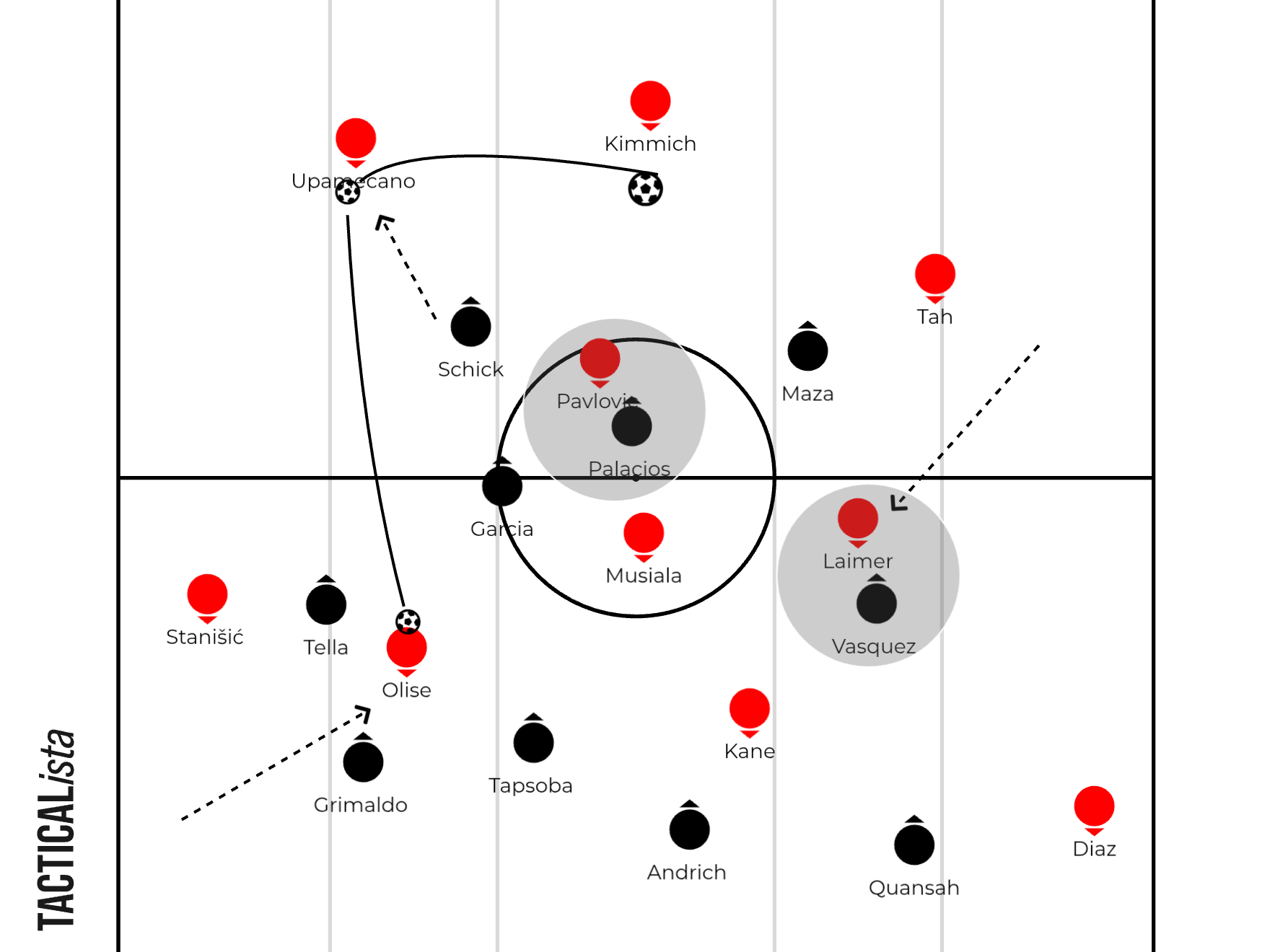
Minute 25′: Kimmich drops between both CBs. Laimer moves into midfield. Stanišić pushes slightly high as Olise drops deeper to receive.
High-press dominance
Bayern’s dominance was further established by their own defensive work rate. When Leverkusen attempted to build in a 4-2-4 shape, Bayern went full man-to-man. In possession, Lucas Vázquez pushed high and wide on the right while Tella held the width on the left, but every Leverkusen player was met by a designated Bayern marker.
The front three pressed Leverkusen’s back three, while Musiala and Kimmich shadowed Palacios and García respectively. Stanišić and Upamecano rotated duties between Tella and Grimaldo; as Grimaldo tucked into midfield, one of Upamecano Stanišić followed him aggressively while the other stayed on Tella. Bayern’s physical superiority in these duels restricted Leverkusen to zero shots and just 39% possession in the first half.
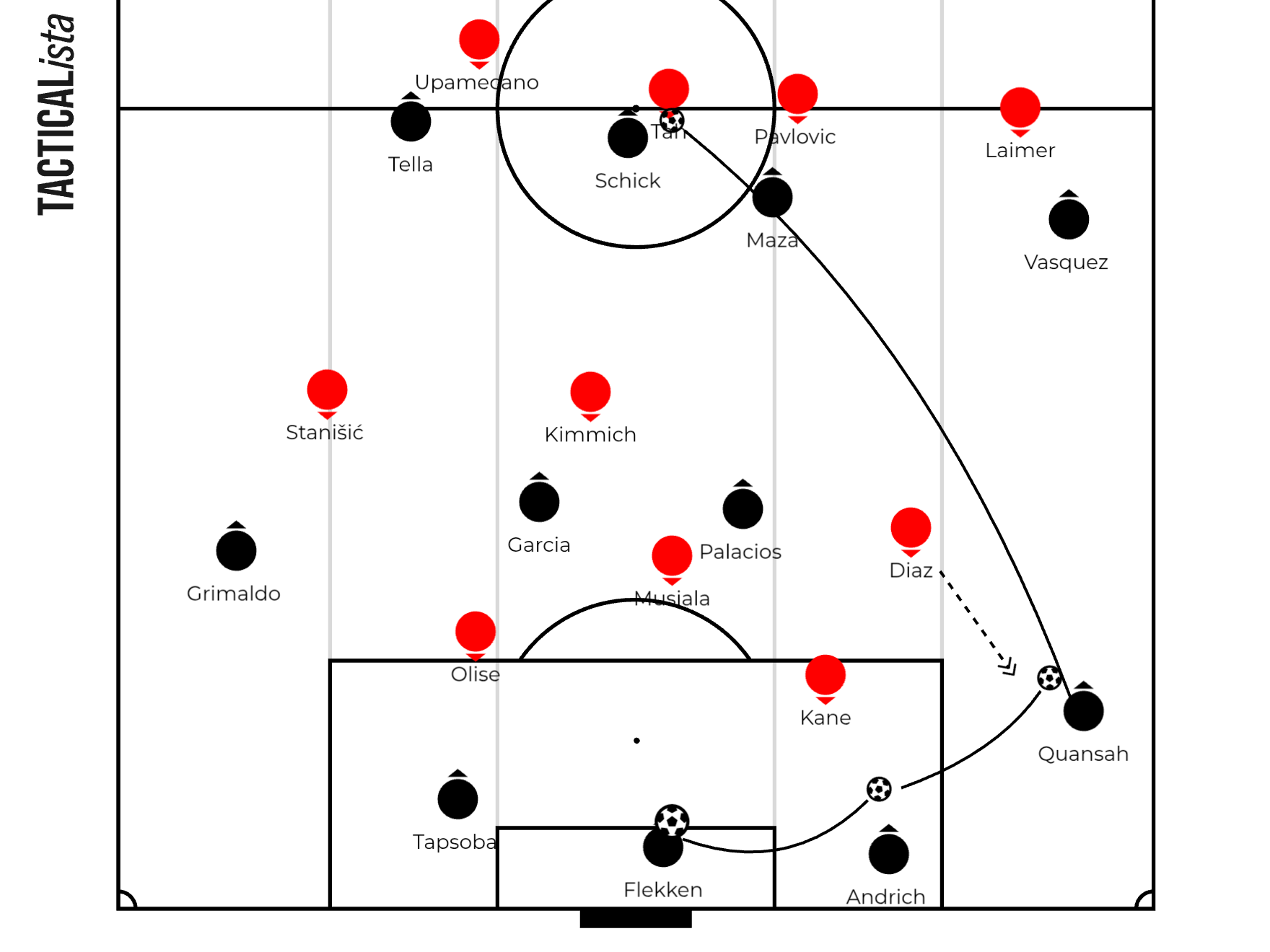
Minute 14′: Diaz presses Quansah as he receives, forcing him to go long to Schick who eventually lost his aerial duel against Tah
This relentless pressure directly led to the opening goal in the 22nd minute. After Dayot Upamecano dispossessed Nathan Tella to stop a rare Leverkusen transition, Bayern won a throw-in high up the pitch. The throw was taken with lightning speed; Michael Olise flicked the ball into the path of Jamal Musiala, who drove toward the byline. Musiala’s sharp cut-back found Harry Kane, who blasted the ball into the net to give the visitors a deserved lead before the interval.
Leverkusen’s resurgence and the creative void
Bayer Leverkusen emerged for the second half with significantly more aggression, managing to dominate large stretches of play. If not for the heroics of Mark Flekken—who produced a string of fine saves to deny Bayern—the tie might have vanished earlier. A key feature of their resurgence was the tactical flexibility of Nathan Tella and first-half substitute Poku; the duo was asked to switch positions several times, as both were versatile enough to function as the right wing-back and the left attacking midfielder. Alejandro Grimaldo also found more freedom, drifting inward to influence play; his best contribution came in the 52nd minute, playing a pass from the right to Tella, whose goalbound effort was brilliantly saved by Manuel Neuer.
Despite this territorial gain, Leverkusen’s attacking shape remained flawed. By allowing Grimaldo to roam freely into midfield and having their left attacking midfielder drift wide, they consistently left the left half-space empty unless Maza drifts there. This lack of structural presence in the final third, combined with a general lack of creativity against Bayern’s organized block, meant their pressure often felt hollow. While they limited the scoreline for long periods, they lacked the clinical final pass to truly threaten a comeback.
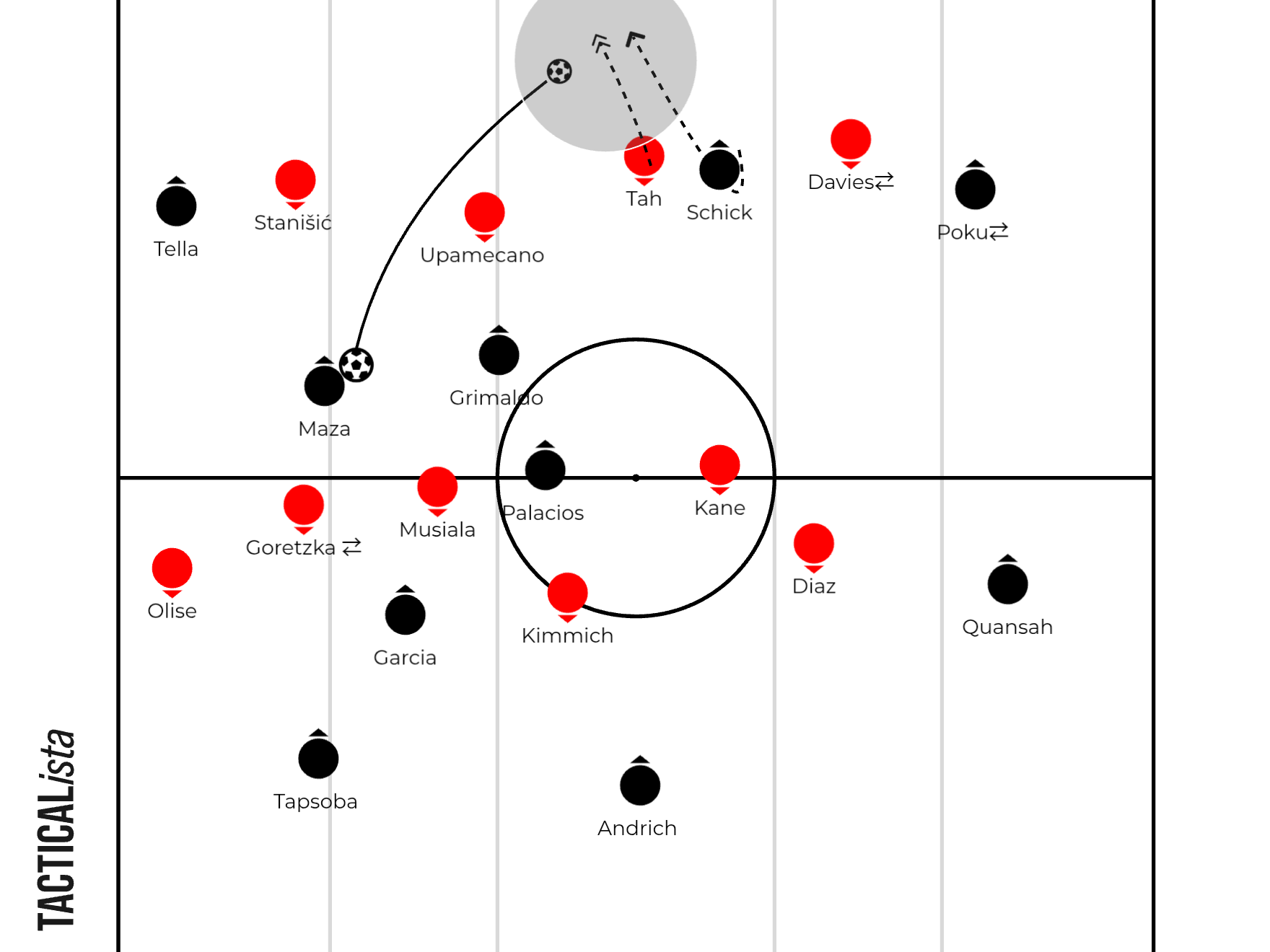
Minute 76′: Maza carries the ball from deep and tries to find Schick with a through ball. Schick thinks he’s fouled by Tah but nothing doing.
Tactical changes, VAR and victory
In the final minutes, both teams made key substitutions based on their goals. Culbreath replaced Tella, and in the 84th minute, Leverkusen brought on Tillman for Andrich to strengthen their attack, while Bayern introduced Min-jae Kim for Musiala to solidify their defense.
Kompany’s changes weren’t just personnel-based—they involved tactical shifts. Kim moved to right-back, Stanišić pushed higher, Kane dropped into midfield to support Kimmich, while Goretzka was pulled deeper into defence by Maza. Olise was shifted to play as the lone center forward, with their late minutes OOP shape looks like a 5-4-1.
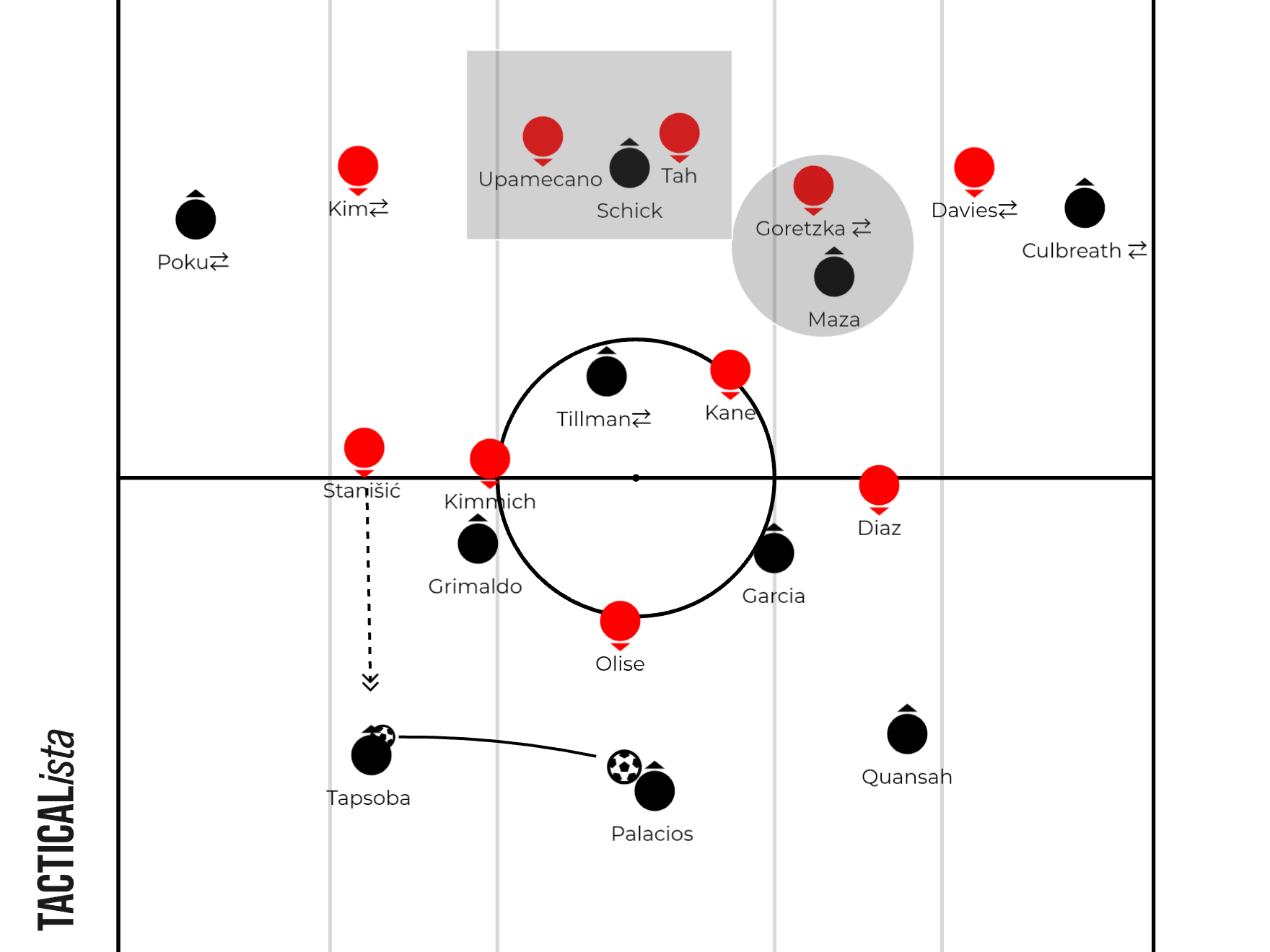
Minute 87′: Bayern in their new defensive shape to secure the lead
The final blow arrived in the third minute of second-half stoppage time. As Leverkusen committed every body forward in a desperate attempt to force extra time, Bayern launched a clinical counter-attack that exploited the massive gaps left by the hosts’ offensive gamble.
Leon Goretzka surged into the vacant space and squared the ball to Luis Díaz. The Colombian winger clipped a composed finish past the onrushing Flekken. Though initially flagged for offside, a VAR review confirmed that Díaz was level, mathematically ending Leverkusen’s cup run. The result leaves Bayern as firm favorites for the final, having showcased a masterclass in both high-pressing and second-half game management.
Takeaways
Bayern Munich were the definition of a complete side, neutralizing Leverkusen’s threat through a relentless man-to-man press and superior physical dueling. Their 0.24 xG reflects a perfect defensive performance. Bayer Leverkusen will rue their lack of offensive penetration; while their second-half adjustments allowed them to dominate the ball, their structural issues in the half-spaces and a lack of creative depth left them toothless when it mattered most.


Comments