
Manchester United – Liverpool: Mainoo To The Rescue (3-2)
Michael Carrick’s Manchester United side sliced through Liverpool in the first half with their transition play from a 4-4-2 low block shape. However, self-inflicted errors early in the second half gifted Liverpool a route back into the game. United found their footing again though, with Kobbie Mainoo netting the winner as United secured their Champions League qualification for next season.
Tactical analysis and match report by Josh Manley.
We decided to make this article free to read. If you want to support our work, consider taking a subscription.
A meeting between Manchester United and Liverpool always carries extra weight for both teams. On this occasion, the match happened to also be of high importance for the race for Champions League football, as United had the chance to mathematically ensure their qualification with a win here.
Michael Carrick lined his side up in a 4-2-3-1 shape here, with a back four of Diogo Dalot, Harry Maguire, Ayden Heaven, and Luke Shaw. Casemiro and Kobbie Mainoo partnered in central midfield with Bruno Fernandes as number ten. Bryan Mbuemo and Matheus Cunha then started in the wide positions either side of Benjamin Šeško.
Liverpool had injuries to contend with coming into this game. With a lack of options up front, Arne Slot opted for a 4-4-2 starting shape with two false nines. The defensive line consisted of Curtis Jones, Ibrahima Konaté, Virgil van Dijk, and Andrew Robertson. Ryan Gravenberch and Alexis Mac Allister partnered centrally, while Jeremie Frimpong and Cody Gakpo were the wingers. Dominik Szoboszlai and Florian Wirtz then started as the front two.
United’s flying start
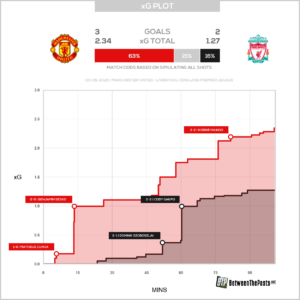
The game got off to an ideal start for United. Cunha’s half-volley from the edge of the box found the corner of the net after six minutes. Then, fewer than ten minutes later, Šeško was able to divert the ball home to finish off a lethal United counter-attack.
United were able to cut through Liverpool’s defense on a regular basis in this game, especially during the first half. In possession, United were happy to attract Liverpool’s high press and try to exploit the space behind.
Liverpool often tried to move into a diamond shape when pressing, as Szoboszlai and Wirtz would pressure United’s center-backs and one of Gravenberch or Mac Allister would jump to United’s deepest midfielder – either Mainoo or Casemiro.
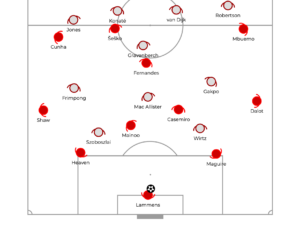
United’s deep buildup versus Liverpool’s high press.
The key strategy for United was the vertical passes into the front four for third man combinations, or playing shorter combinations in deeper areas and then switching the play once Liverpool’s press had been attracted.
Once United had the ball in the middle third, they often formed a back three with one of Mainoo or Casemiro dropping between the center-backs. This helped provide stability against Liverpool’s front two and allowed United’s wide-splitting center-backs the chance to carry the ball into the space alongside Liverpool’s front two.
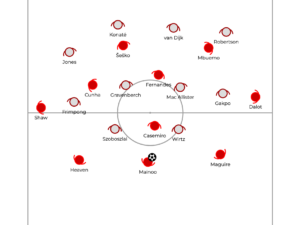
Mainoo drops between the center-backs in United’s middle third possession.
United tended to conclude their attacks fairly quickly though, rather than sustaining possession for long periods. Their early lead helped facilitate this, as it put the impetus on Liverpool to take risks in attack.
Carrick’s counter-attacking strategy
Being able to sit deep in this fashion seemed to suit United. Under Carrick, they have shown a lethal ability with fast-break attacks, whether in attacking transition or after drawing the opponent’s press.
There were some high pressing phases, but United more often sat back in a zonal 4-4-2 shape without the ball. Fernandes and Šeško usually tried to stay close to the midfield to support the team’s compactness, while Mbuemo often tracked Robertson deeper on United’s right.
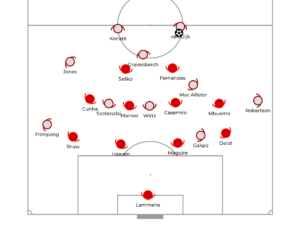
United’s zonal 4-4-2 low block.
Liverpool’s attack was focused on central combinations. Wirtz and Szoboszlai would drift between the lines, and Gakpo often inverted to take up a striker position or join the aforementioned duo between the lines.
Frimpong and Robertson held the width while Jones from right back usually played in a more reserved position, slightly indenting, mainly tasked with supporting ball circulation.
Liverpool had some neat sequences with their combinations through the center but struggled to finalise attacks due to a lack of presence in the box. United could therefore usually extinguish these attacks in central areas and launch their own transitions, where Liverpool’s rest-defense and counterpressing game was somewhat weak. Carrick’s side often targeted the space left behind Robertson on the right, where Fernandes and Mbuemo would both focus their attacking movements.
United almost self-destruct
United made a change at half time, with Amad Diallo replacing Šeško who had picked up a knock. Almost immediately, Amad was involved, but not in the way that he would want. His intercepted pass in midfield allowed Szoboszlai to carry the ball forward in transition and eventually find the bottom corner of Senne Lammens’ net to make it 2-1.
The goal was an unnecessary one to concede from United’s point of view. It was not only Amad’s careless pass, but it was also a sequence where Mainoo and Casemiro had both moved ahead of the ball in a moment of indiscipline, meaning that there was no number six to help delay the attack. Finally, Dalot and Maguire both played unsavoury roles in allowing Szoboszlai to advance with the ball too easily.
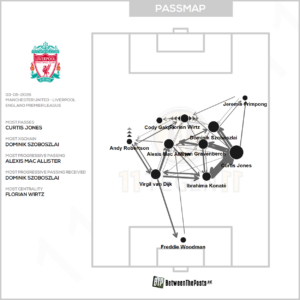
Lots of right-sided circulation in Liverpool’s passmap, but it led to little.
Things got worse for United soon afterwards, and it again came from an individual error. This time it was Lammens whose loose pass gave the ball away to Mac Allister, who had fooled the Belgian keeper by feinting one way with his pressing movement before going the other. Gakpo applied a simple finish into an empty net to make it 2-2.
While the first half had been a relatively controlled affair for United, able to soak up Liverpool’s pressure and hit them on the break, this period of the second half became more chaotic after the two Liverpool goals. United themselves were now conceding transitions, and overall there was a feeling that the game was slipping away.
Despite this lack of control, it was still United who were actually creating the better chances in this period. Eventually, United began to play their way back into the game and put pressure on Liverpool, looking for a third goal.
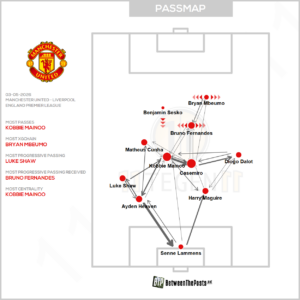
Mainoo was central to United’s possession play.
Eventually this arrived courtesy of Mainoo’s expertly guided half-volley from the edge of the box after a well-constructed United attack which Mainoo himself had been a key conductor of. United were able to sink back into their deep 4-4-2 shape and see out the rest of the game on the counter-attack without conceding any major chances.
Takeaways
United started this game excellently and blew Liverpool away in the first half with their transition attacks from a stable low block setup. The second half goals were pretty much entirely self-inflicted, and the eventual winner from Mainoo was deserved in terms of the overall standard of their play over the course of the game.
Liverpool showed some neat possession play, as they often have this season, but looked toothless in attack. Defensively, they were fragile in transition against United’s counter-attacking setup.
Use the arrows to scroll through all available match plots. Click to enlarge.
Check the match plots page for plots of other matches.


Comments