

Estudiantes – Racing Club: Estudiantes fail to progress to the quarter finals following surprise defeat to Racing (0-1)
A knockout tie with much at stake for both clubs gave rise to the intensity shown by the players in the game. Both teams, having a direct approach with the ball, gave numerous chances. Estudiantes’ second-half momentum amounted to nothing after they conceded late in the game, as margins decided this one.
Tactical report and match analysis by Ebuka Ogoegbunam.
Estudiantes finished first in Group A to make the Apertura playoffs. They faced Racing Club, who finished sixth in their standings and with home advantage, the task was made harder for their opponent. Both teams fought for the chance to make the quarter-finals. Estudiantes maintained an unbeaten streak of eight games before coming into this fixture. Racing, on the other hand, were winless in seven of their previous games in all competitions and seemed to be heavy underdogs.
Estudiantes looked to build on their new form with Alexander Medina’s strong selection. Fernando Muslera stayed in goal, protected by a back four of Eros Mancuso, Santiago Núñez, Leandro González Pírez and Tomás Palacios. Ezequiel Piovi and Gabriel Neves played in the midfield position, connecting the lines between defence and attack. Facundo Farías played slightly higher in midfield behind the striker, with Edwuin Cetré and Mikel Amondarain filling the left and right wing positions, respectively. Guido Carrillo led the line in attack
Racing Club had Facundo Cambeses in goal with a backline of Gastón Martirena, Marco Di Césare, Marcos Rojo and Gabriel Rojas. Santiago Sosa and Alan Forneris occupied the middle of the park, with Adrián Fernández and Matías Zaracho playing on the wings. The front two of Adrián Martínez and Tomás Conechny started together to lead the line for Racing.
Racing’s early control:
Racing had early control against the home team. On the ball, they set up in a 4-1-3-2 shape, but this shape wasn’t stagnant. This shape allowed multiple rotations between the forwards in the two attacking lines. The wingers tucked into the pockets while the fullbacks occupied wide positions. Estudiantes’ 4-4-2 block didn’t apply consistent pressure on Racing center backs during their press.
Farías and Carillo led the press, with one striker looking to put pressure while the other covered the Racing pivot. Estudiantes’ mid-block was very narrow. They conceded much space in wide areas while squeezing the spaces in the middle of the pitch. This allowed Racing to find their fullbacks during build up through their first line of build-up.
The Racing center backs often played a huge role in switching passes to these fullbacks. Sosa dropped into the last line to stretch the first line and give the team more angles to find their fullbacks. Racing enjoyed making multiple progressions with their fullbacks.
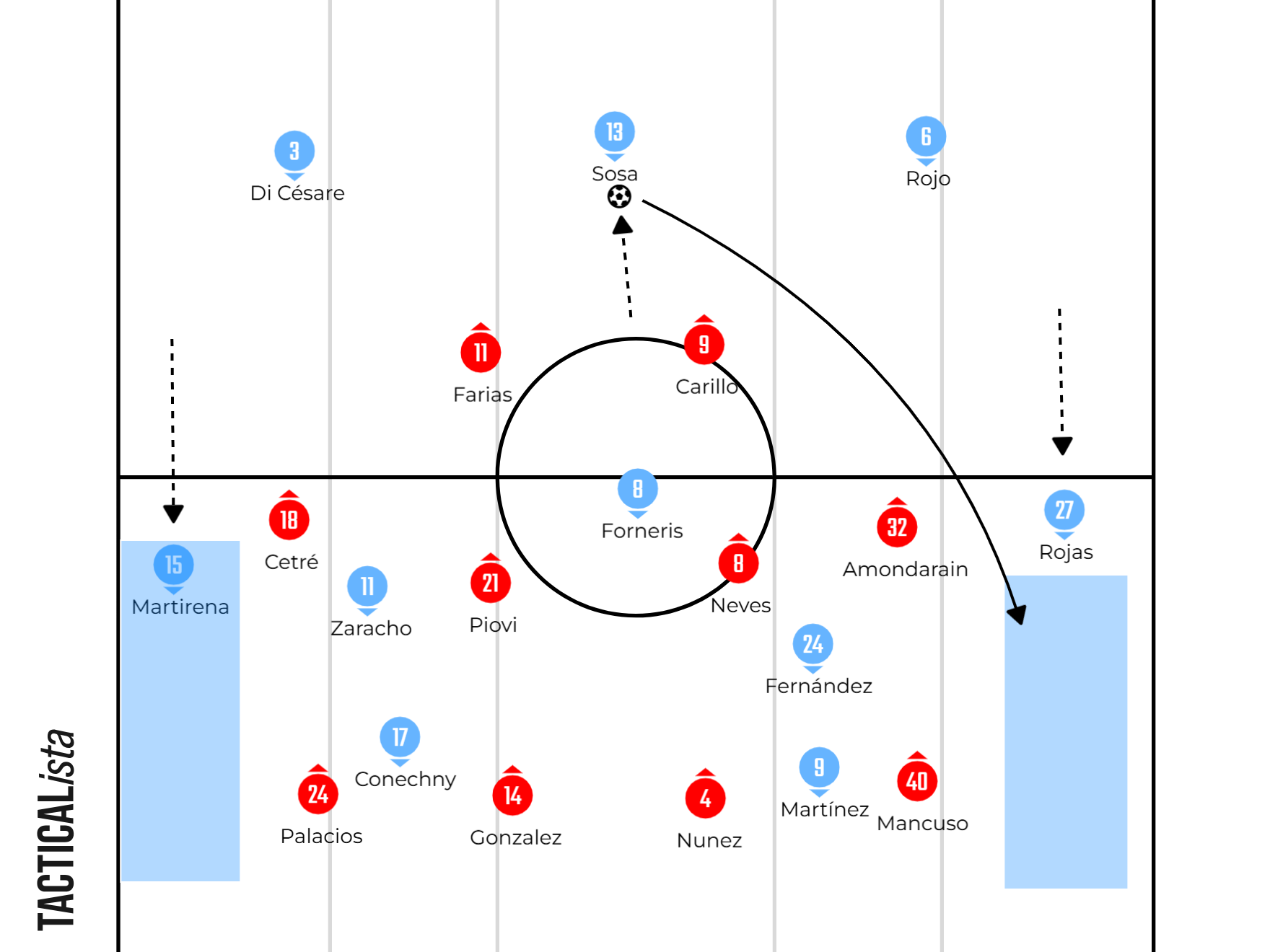
Sosa drops into the first line of build-up and plays into the wide areas where the fullbacks occupy.
The players in the pockets and the strikers did well to combine with the fullbacks in these wide areas. Multiple rotations and quick movements in these wide areas generated a lot of crosses for Racing. Although they failed to take advantage of these crosses to the box, they repeatedly made these attacking sequences time and time again from the left side of the pitch.
Racing found some openings in the central areas. The players between the lines and the forwards were very direct. They always looked to find each other behind the opposition’s defensive line. Estudiantes, being tight to their markers, conceded spaces in their block due to the movements of Racing’s forwards. The two strikers and the two players in the pockets made movements to manipulate the opponent’s block.
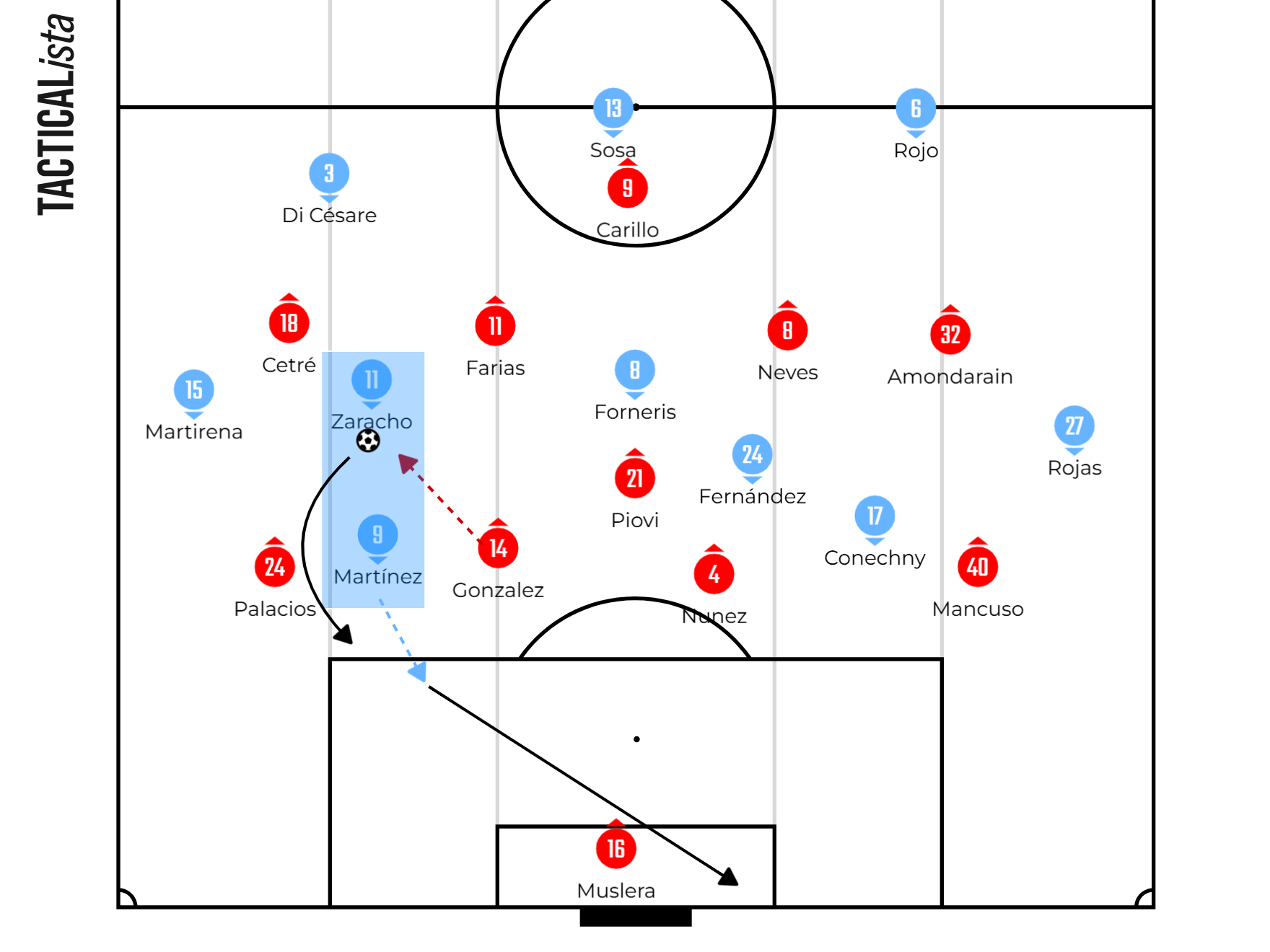
Zaracho and Martinez are drawing the backline and attacking the space behind.
Racing were very aggressive off the ball. Whenever they lost the ball, their intensity in their counterpress helped suffocate Estudiantes when they tried to play through pressure. Racing dominated the first half with and without the ball, but the second half wasn’t the same.
Estudiantes’ second-half pressure
Estudiantes’ 3-1-6/3-2-5 rotations on the ball didn’t cause much threat in the first half. At times, the left back stayed low, while the right back pushed high up but they couldn’t pose much of a threat to Racing. They lacked that penetrative action from their frontline early but used momentum to climb their way back into the game.
Estudiantes’ fullbacks pushed up at times with the right fullback being more adventurous than his counterpart on the other wing. Amondarain tucked in narrow, joining Farias between the lines while Mancuso was high up, maintaining alongside Cetré on the other flank. Racing pressed with a 4-1-3-2 shape and put pressure with a more zonal approach.
Estudiantes overloaded Racing in the second line of build-up. Neves and Piovi overloaded Forneris, but Racing’s wingers helped out zonally. They shifted ball side and covered the closest pivot within their zone. This allowed Racing to cover the central areas more and neglect the wide fullbacks. Racing applied pressure when the Estudiantes’ center backs moved the ball side to side. This made it easier for them to execute their zonal pressing scheme.
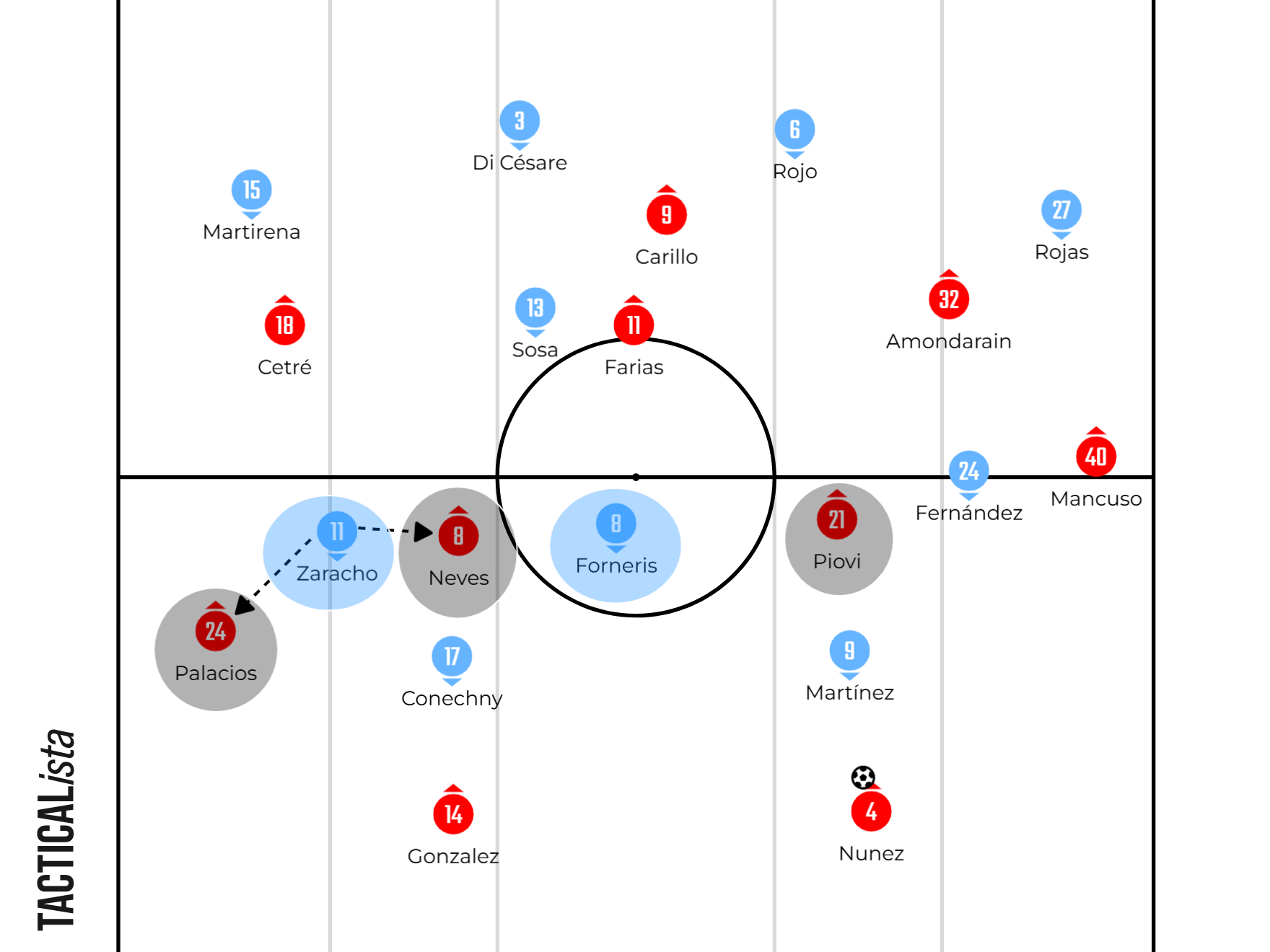
Zaracho switches his marker to Neves to manage the overload Estudiantes had in midfield.
Estudiantes went long as a result of this. They didn’t find many openings until the game opened up for both teams. Both teams began to concede spaces for each other later on. Estudiantes gained more momentum by drawing fouls and retaining the ball for longer periods while attacking with intensity. Racing always had the chance to counter and catch their opponent off guard but they failed to do so.
Late in the game, Racing scored the winning goal through a corner. Rojas crossed from the corner and found the head of Sosa at the backpost. This late in the game, it seemed like the dagger for Estudiantes after a better second-half performance. Racing held on to their lead and claimed the win, shocking a few while being the underdogs.
Takeaways
Estudiantes controlled large spells of the second half, but their inability to consistently penetrate Racing Club ultimately proved costly in a tightly contested knockout encounter. Racing’s aggressive first-half approach, built on wide overloads, fluid rotations, and intense counterpressing, gave them early superiority and disrupted Estudiantes’ attempts to progress through midfield. Their fullbacks and forwards combined effectively in wide spaces, repeatedly stretching Estudiantes’ narrow defensive block and creating dangerous crossing situations.
As the game progressed, Estudiantes gradually wrestled back momentum through improved possession control and higher attacking intensity. Their structural rotations in possession and midfield overloads helped them sustain pressure, while longer periods on the ball pushed Racing deeper in the second half. However, despite the territorial dominance, clear-cut chances remained limited. Racing’s compact zonal pressing and defensive discipline prevented Estudiantes from finding the decisive breakthrough in central areas.
The match eventually turned on fine margins. Just as extra time seemed possible, Racing capitalized on a set-piece situation, with Santiago Sosa’s late header delivering the decisive blow. It was a harsh ending for an Estudiantes side that showed resilience and second-half improvement but lacked the cutting edge required to turn control into goals.
For Racing, the victory highlighted the value of tactical discipline, intensity without the ball, and efficiency in decisive moments. Despite entering the tie as underdogs and struggling for form beforehand, they executed their game plan effectively and earned progression to the quarter-finals. Estudiantes, meanwhile, leave the competition frustrated that their late momentum and strong recent form could not translate into a winning performance when it mattered most.
Match plots will be added as soon as possible


Comments