

Bahia – Grêmio: Rogério Ceni’s substitutions change the game, but Bahia are denied by the Brazil National Team goalkeeper (1-1)
At the beginning of the week, Brazil and the rest of the world stopped to watch Neymar’s World Cup call-up, but one major surprise was goalkeeper Weverton, who was part of the last World Cup squad with the Brazil National Team as a backup, though he had been struggling in his career recently. He was called up one day after shining in the draw between Bahia and Grêmio. Both teams, coming from poor runs of results, faced each other on Matchday 16 and drew, although Bahia, coached by former goalkeeper Rogério Ceni, made substitutions that significantly changed the flow of the game.
Tactical analysis and match report by Marcus Arboés.
Despite sitting in the upper part of the table and having started the year very well, Bahia came into the match after four winless games in the Brasileirão and an elimination against Remo in the Copa do Brasil, which forced some changes, as important names such as Jean Lucas had lost space. Rogério Ceni lined the team up in a 4-3-3 formation with: Léo Vieira in goal; Gilberto (former Benfica), David Duarte, Kanu and Luciano Juba (Brazil preliminary squad) in the defensive line; Acevedo as the holding midfielder, Erick as the advanced midfielder and Éverton Ribeiro (former Brazil National Team) as the number ten; up front, Ademir on the right wing, Erick Pulga on the left wing and Willian José (former Betis) as the target man.
Grêmio still have not found their way under coach Luís Castro. It is a team that fluctuates a lot, even while managing to get results. However, for this match, they had several absences due to physical issues, such as Marlon, Balbuena (Paraguay), Pavón and Arthur (former Juventus). Because of that, the team was lined up with: Weverton as goalkeeper; Duud, Wagner Leonardo and Viery as the back three; Marcos Rocha at right fullback and Pedro Gabriel at left fullback; Noriega and Leonel Perez as the double pivot; Willian (former Chelsea) on the left wing, Enamorado on the right wing and Carlos Vinícius (former Fulham) as the striker.
A clash of positional styles
The match between Bahia and Grêmio ended in a draw, but the goals only came in the second half. In the first half, Bahia had a certain level of control, but the main highlight was being able to observe different perspectives of offensive organization through positional structures.

Bahia’s positional play in a 3-2-5 formation creating numerical superiority out wide
Although this is not often remembered, Bahia are a City Group club, where teams around the world follow a methodological, tactical and player development culture in which positional play (juego de posición) is the established football culture guiding all the work. Essentially, it is through this style that Bahia seek advantages while maintaining possession.
To understand how the team plays, it is interesting to note that, regardless of the principles, Rogério Ceni organizes his side according to the players’ characteristics. In the 3-2-5 shape, Gilberto plays as a build-up fullback on the right side of the back three during the first phase. Left fullback Luciano Juba moves inside into the second line next to holding midfielder Escobar. The wingers stay wide to provide width, while Erick pushes forward as a midfielder attacking the box and Éverton Ribeiro drops deeper with more positional freedom to influence the build-up.
This setup means Bahia constantly use Éverton Ribeiro’s freedom to create numerical superiority, especially on the right side, using positional rotations while maintaining the structure, with mobility aimed mainly at giving Ademir an advantage out wide to attempt crosses. Through this dynamic, Willian José headed a free chance but was denied by a spectacular save from Weverton, perhaps the best save in the Brasileirão so far. The Grêmio goalkeeper had already stopped another clear opportunity during a faster attacking move.
In positional play, players position themselves according to the opponent’s movement, operating in the shadow of the markers from the next defensive line. Therefore, they tend to organize themselves by rationalizing the spaces on the pitch and, because of that, follow a positional structure, meaning they organize themselves through zones. Grêmio also organize themselves positionally, but it does not function in the same way.
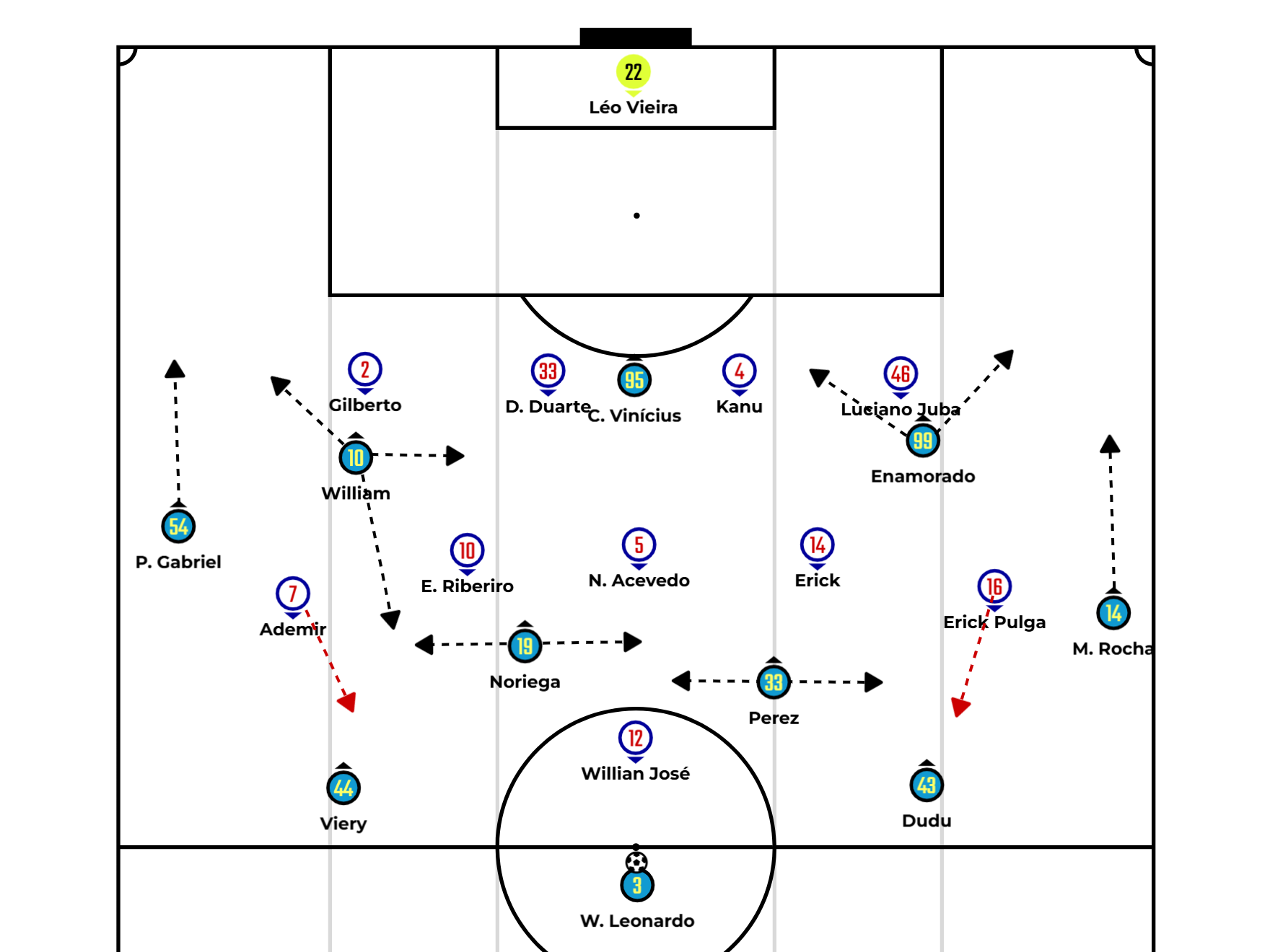
Grêmio’s positional attack in a 3-4-3/3-2-5 formation against Bahia’s zonal defense in a 4-5-1.
Luís Castro is a coach from the Portuguese football school, where positional football is prioritized. It is also tactically organized through zones according to players’ positions while maintaining the tactical structure, but it does not follow the same logic of positioning according to the opponent’s movement. In Portuguese football culture, positional/zonal football is more stretched, vertical and tends to be more physical.
If the team defended in a 5-4-1 shape with zonal pressing, that same formation also conditioned the way the team behaved in possession, and that structure did not change throughout the match. The back three handled the build-up with the fullbacks staying very wide in the outside corridors, while the wingers occupied the half-spaces, though with different functions. Willian played with his back to goal, dropping deeper to help in the build-up, but ended up being ineffective. Enamorado played starting from his zone, attacking spaces outside or inside through direct balls.
The team seemed clearly set up for a more reactive approach, but when in possession, they were noticeably rigid and lacked creativity. Their best situations came when one of the midfielders managed to switch play toward the opposite fullback. In the end, all the attackers delivered poor performances in the first half.
Bahia’s substitutions change the game, but are not enough
In the second half, before the first goal, Luís Castro brought on Gabriel Mec, a youth academy player who had recently been starting, replacing Willian and slightly changing Grêmio’s attacking profile. They even managed one move from a quick short build-up, but without much danger. The opening goal only came after the substitutions, with Viery scoring a header from a corner that itself originated from another set piece, meaning the substitutions did not have much impact on the goal itself.
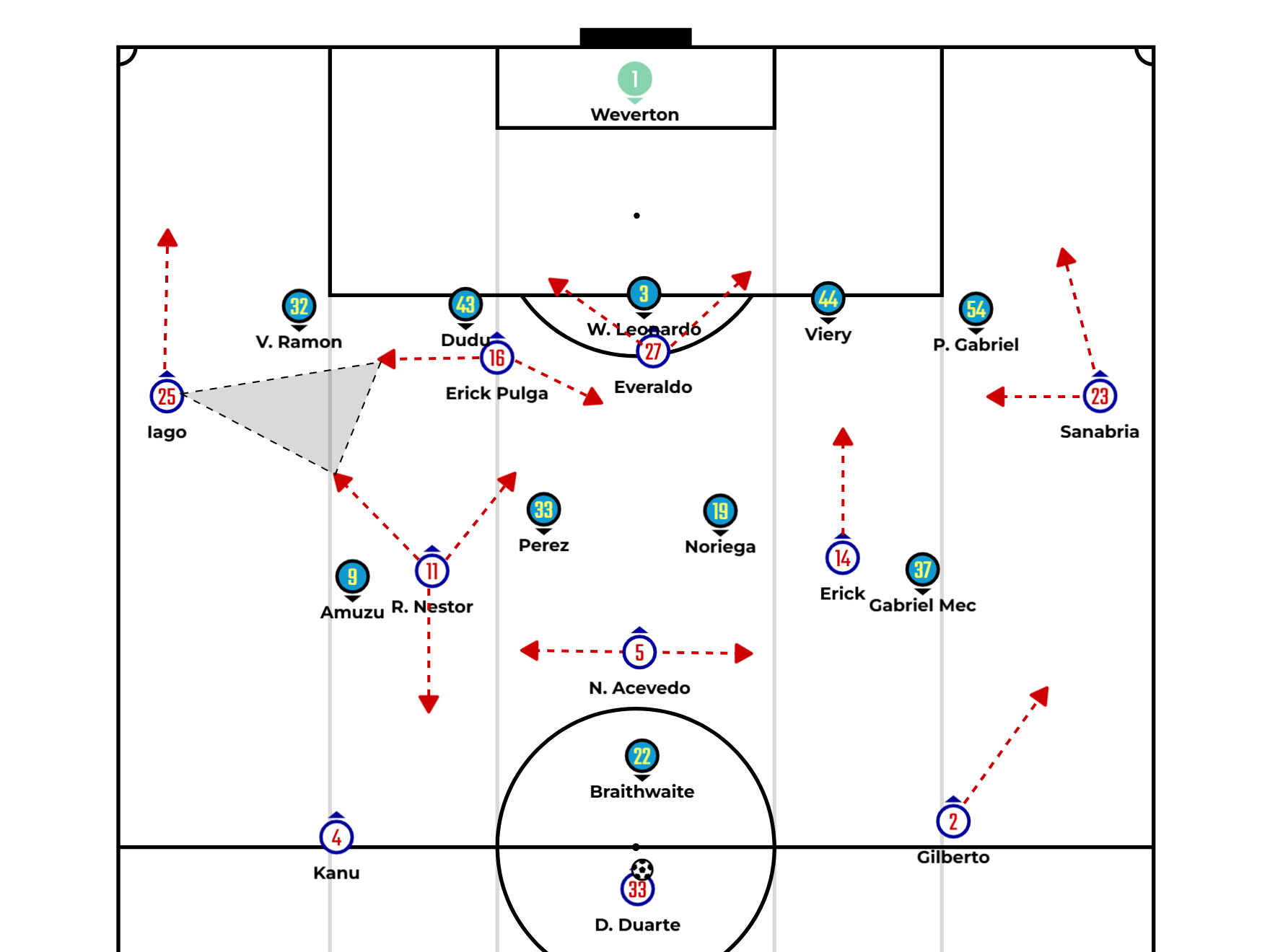
Bahia change their offensive structure into a 3-3-4 outline, with the left fullback staying wide and Erick Pulga acting as a second striker.
Around the 60th minute, both teams made several changes. Luís Castro did not alter his team’s structure, only changing personnel: Amuzu replaced Enamorado because of his better short combination play, Braithwaite (former Barcelona) replaced Carlos Vinícius because of his greater mobility, and that was basically it. Rogério Ceni, meanwhile, made impactful structural changes to Bahia compared to the tactical pattern from the first half.
Everaldo replaced Willian José. Luciano Juba picked up an injury and Iago, who is not a build-up fullback, came on to play wide on the left side. As a result, Erick Pulga was moved to play as a free second striker between the lines, in the same area Éverton Ribeiro had occupied. The team’s number ten was also substituted, with Rodrigo Nestor coming on, a deep-lying midfielder/playmaker who prefers to play facing forward. From there, Bahia formed a midfield trio, with Erick on the right side dropping deeper next to Rodrigo Nestor on the left, who dropped to form a “double pivot” with Acevedo. That substitution, together with Sanabria replacing Ademir, changed the game.
Right after conceding, Sanabria received the ball in advantageous situations twice, unbalancing one play individually through dribbling to create danger out wide, and in another action playing a cutback pass from the wing toward the edge of the box, where Nestor arrived facing goal and nearly scored. Shortly after, during an offensive transition, Bahia won the ball back and Rodrigo Nestor started the counterattack, later receiving the ball again as the final playmaker before releasing Erick Pulga down the left wing, who assisted Sanabria attacking the space behind Grêmio’s defense on the opposite side.
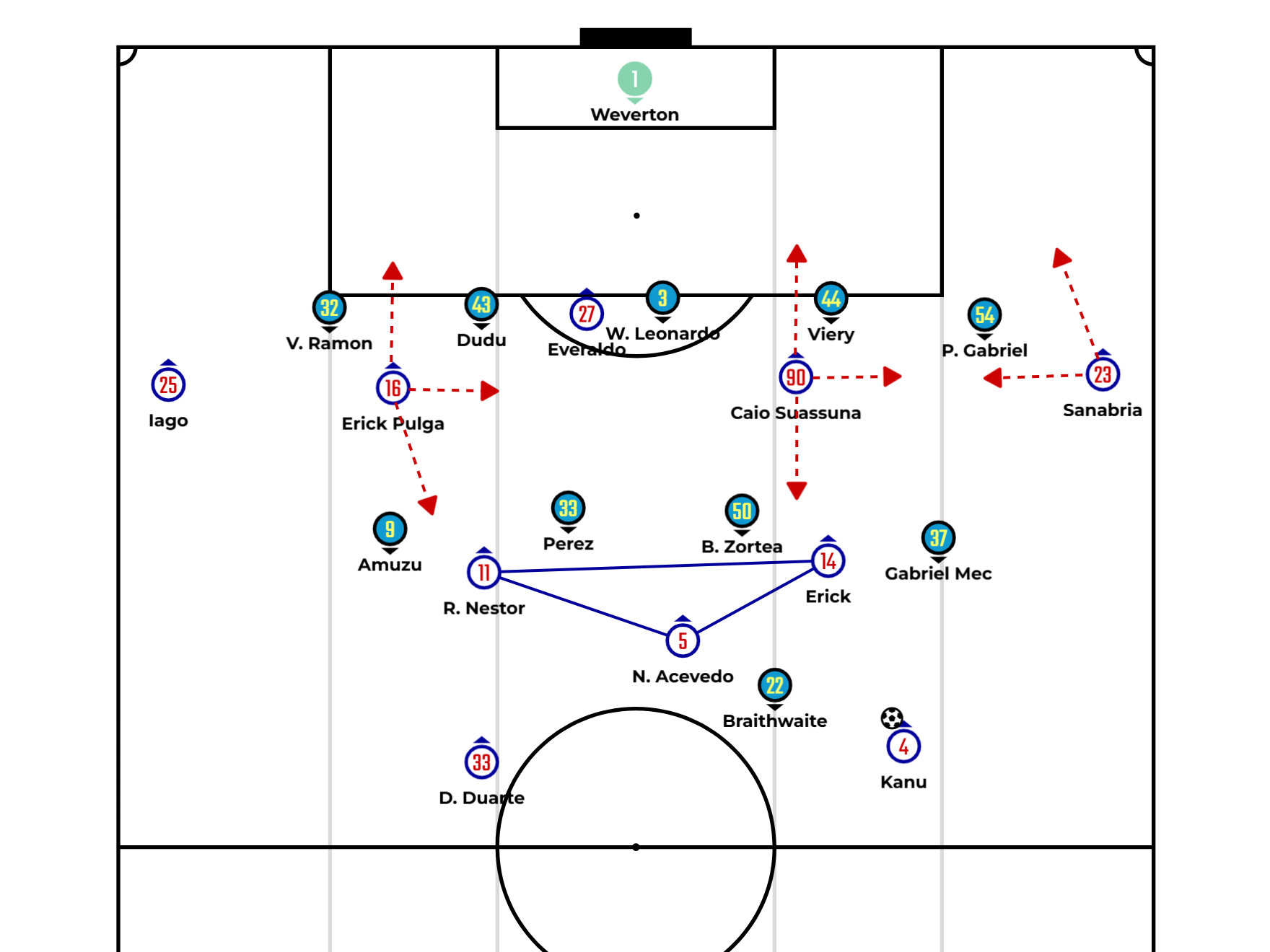
Final stage of the match, with Bahia using two strikers and two wingers.
Grêmio became practically inoperative and dependent on counterattacks, while the substitutions produced no effect, and they still needed to refresh the team by removing more physically exhausted players. Bahia therefore became even more dominant. Rogério Ceni removed Gilberto, the right fullback who had been part of the back three, and introduced Caio Suassuna, another inside forward. Caio and Erick Pulga started performing similar functions, offering support with freedom between Grêmio’s last two defensive lines and dragging markers to create space for the wide players, especially Sanabria, or for midfielders attacking frontal shooting positions.
As a result, Bahia started attacking in a 4-3-3 that transformed into a 2-3-5 shape. The three midfielders constantly rotated positions, alternating heights and functions while always looking for each other to create central superiority through the support of the attackers before then finding Iago or Sanabria, especially the latter, who was having an inspired night, on the flanks. Rogério Ceni’s team created at least four or five more chances, but were denied by poor finishing, the woodwork and goalkeeper Weverton, who did not celebrate a victory, but was the best player on the pitch and, on the following Monday, celebrated his World Cup call-up with the Brazil National Team.
Takeaways
Despite drawing away against an opponent capable of imposing themselves at home, Grêmio continue looking more downward than upward in the standings. The team remain stuck on 18 points, the same total as Corinthians, who sit inside the relegation zone, missing the opportunity to climb two or three positions because, once again, they failed to hold onto a lead. In the next rounds before the World Cup, they face direct clashes against Neymar’s Santos and Memphis Depay’s Corinthians.
Bahia continue suffering from conceding too many goals. This time, even while playing better and despite the substitutions having a significantly positive impact, they still had to chase the result and settled for a bitter draw, extending their winless run in the Brasileirão to five matches. Now in crisis, they face direct clashes against Coritiba and Botafogo before the World Cup.


Comments