

River Plate – Belgrano: Belgrano Win The Apertura After Late Comeback Against River Plate (2-3)
Belgrano’s early start to the game was cut short after River’s opener. River’s control, thereafter, put them in a position to dominate the game, with Belgrano’s defensive approach making this easier. Nicolás Fernández sparked a comeback in the second half following his introduction. His two late goals sealed the Apertura for Belgrano.
Tactical analysis and match report by Ebuka Ogoegbunam.
River Plate came into this game as favorites with wins against Rosario, Gimnasia and San Lorenzo to make it into the finals. Clean sheets in back-to-back games showed great emphasis on River’s brilliant display defensively. Belgrano, who were seen as underdogs, proved many wrong by making it this far. The team gained confidence from results and looked to prove many wrong, one last time in this tournament.
The last time these two sides met earlier this season, River Plate emerged victorious with a 3-0 win at home. Galván’s brace was crucial in that win as River Plate would have loved to emulate that same scoreline. Belgrano, however, are in a better place than they were earlier this season when these two sides met. They had a chance to get revenge on opponents back in the final
River’s head coach, Eduardo Coudet started Santiago Beltrán in goal with a back four of Fabricio Bustos, Lucas Martínez Quarta, Lautaro Rivero, and Marcos Acuña. Fausto Vera and Aníbal Moreno played in the middle, linking the defence to attack. Ahead of them, an attack of Juan Cruz Meza and Tomás Galván on the wings with striking force of Facundo Colidio and Joaquín Freitas leading as the front two.
Belgrano, on the other hand, had Thiago Cardozo in goal. The defensive line was made up of Agustín Falcón, Leonardo Morales, Alexis Maldonado and Adrián Spörle. Adrián Sánchez and Santiago Longo partnered together in midfield. Juan Velázquez and Emiliano Rigoni operated on the left and right wings respectively. Lucas Passerini and Lucas Zelarayán started in attack as the front two.
Two Sides of Momentum in the First Half
Belgrano started the game with intent and intense attacking pressure. They set up in a 4-2-3-1 shape in possession. Zelarayán had the role to roam around the frontline to find space and generate attacking sequences. River Plate wanted to put pressure whenever they lost the ball. They wanted to be aggressive but while doing so, Belgrano took advantage of the spaces they conceded in defense.
Belgrano often attacked from the left side of the pitch, involving the left sided players, Velázquez, Spörle and the orchestrator in attack, Zelarayán. They generated opportunities using runs in wide areas and combined well to put River under pressure early.
River attacked with their wingers in narrow positions while the fullbacks occupied wide areas. Galván and Meza overloaded the middle of the pitch to try and find attacking combinations in the attacking pockets. Acuña was given the license to push forward, but his positioning in attack put his team under pressure in transition. Belgrano looked a threat in transition when River weren’t set defensively.
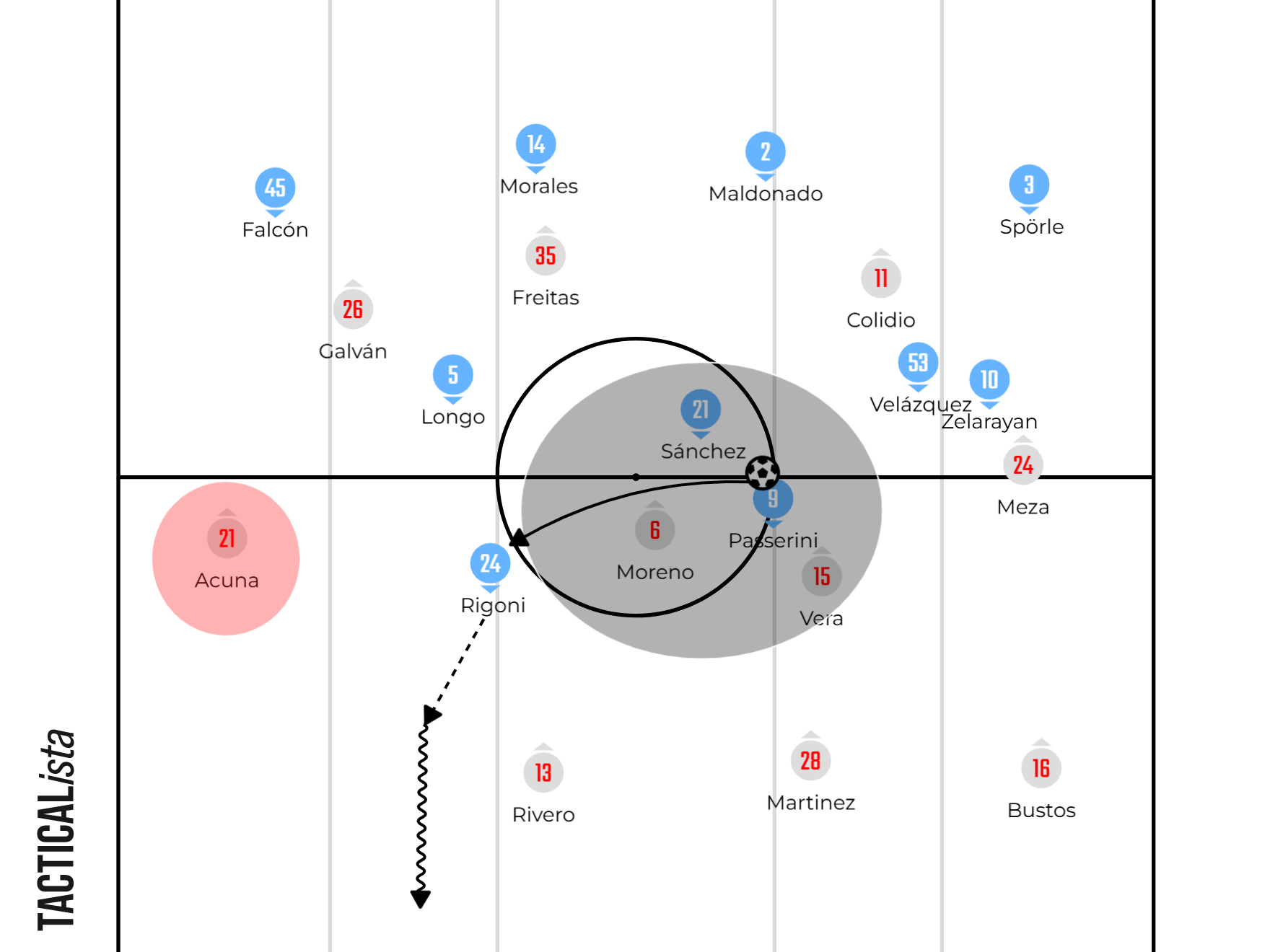
Belgrano attacking the space in behind when Acuña is positioned higher up the pitch.
Belgrano nullified River’s central overloads by defending compact, starting from the first line of the press. Zelarayán and Passerini led the press with the aim to cover both River Plate’s pivots. River’s setup 3-2-5 setup often changed to a 3-1-6 setup when one of the pivots dropped into the first line of build up.
Although Belgrano hardly put pressure on the center backs, the back three in the first line made it harder for Belgrano to retain their compact block if they wanted to put pressure.
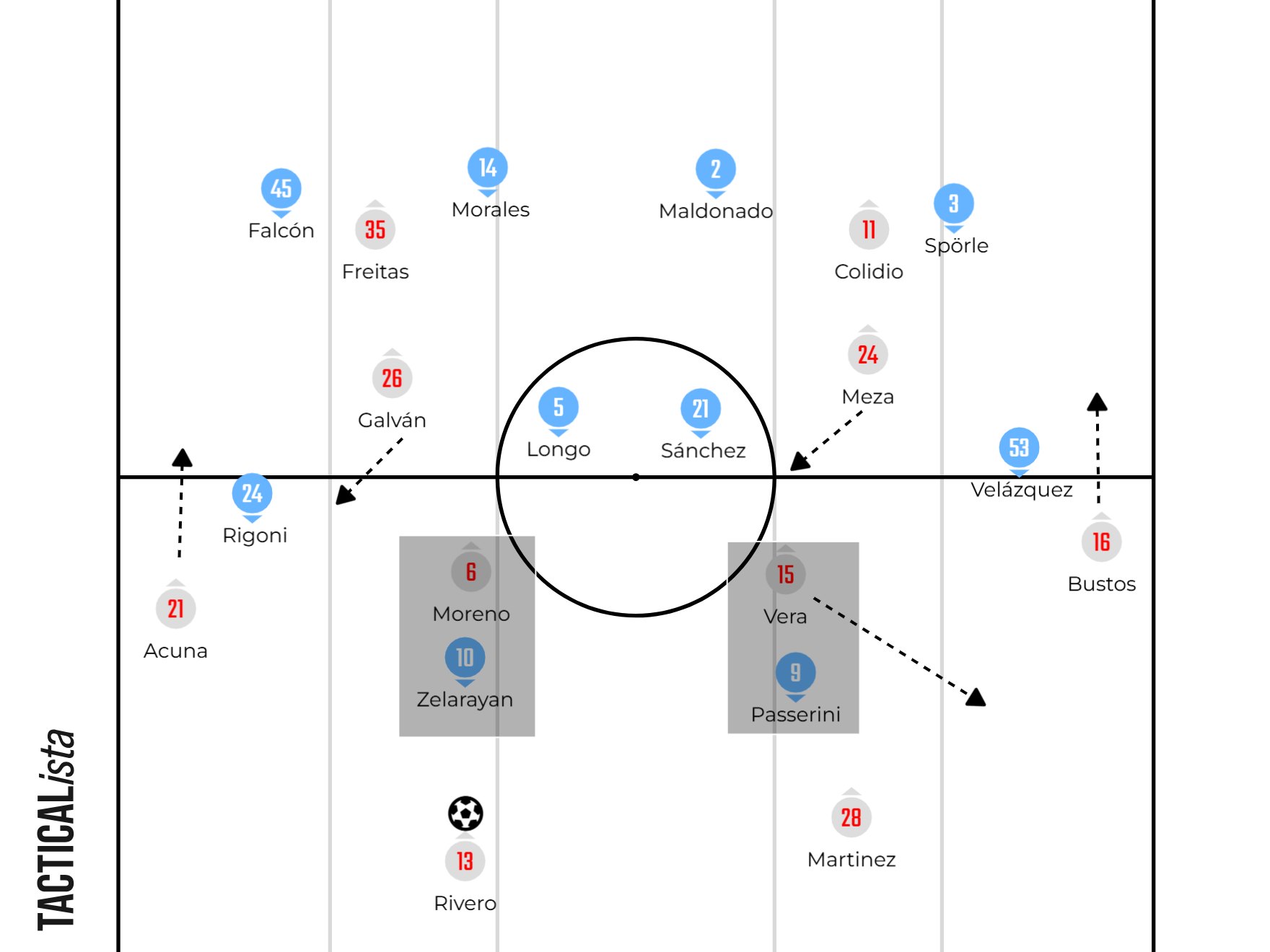
Belgrano’s forwards covering River’s pivots to maintain their shape defensively. River Plate’s rotations were aimed to destabilize the Belgrano block.
While Belgrano hesitated to put pressure on River’s center backs, the River center backs had time on the ball during build up. Belgrano did well to limit the passing lanes and forced the defenders to play long balls. For River Plate, this was also a good way for them to get up the pitch.
Colidio and Freitas positioned themselves in the wide channels where they engaged the Belgrano center backs. Belgrano’s fullbacks often had the attention of the River wingers. This freed up the channels for the strikers to make runs.
Attacking these channels from long balls was a medium of transition and progression for River Plate. It was clear that the wide areas were key areas for them to constantly exploit the Belgrano defence.
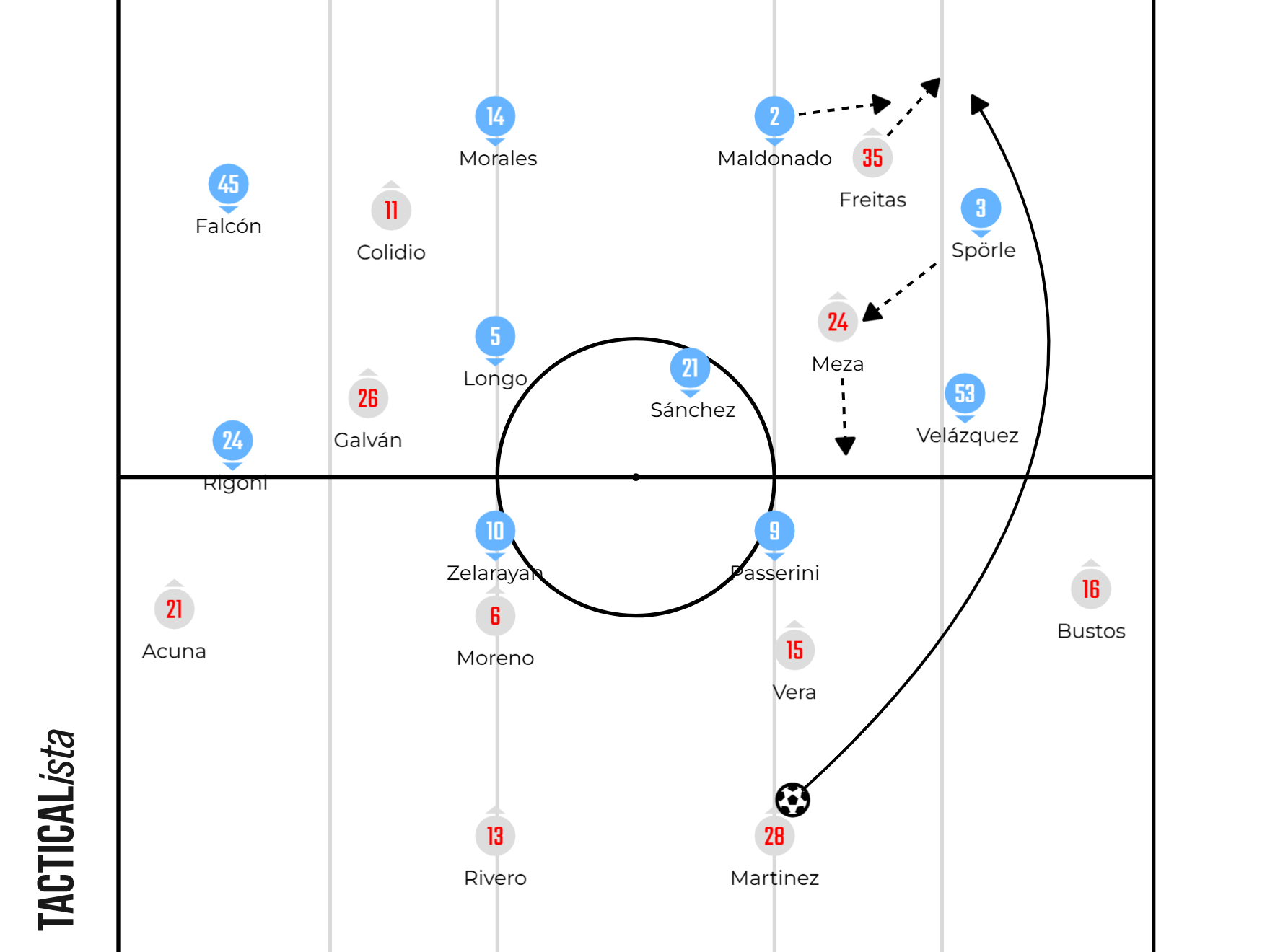
River’s center backs playing long balls into the channels for the strikers.
River regained momentum as the game went by. In build up phases, they were more patient in keeping the ball in the deeper areas while moving the ball quickly from side to side to move the option.
River Dominate Until The Last Moments
Belgrano had failed to take any of the chances they generated earlier in the first half and when River got momentum, it was only a matter of time. River Plate’s opener came from similar wing play dynamics. The combination of the left back and left winger came into play. Acuña received the ball in a wide area attracting his marker, Falcón, who was the Belgrano right back.
Galván made an underlapping run beyond the defensive line with Rigoni on his trail. Acuña plays a pass into the path of Galván with Rigoni looking to get onto the ball. Rigoni misjudged the speed the ball and allowed Galván to get to the ball in the half space. Galván’s cross found Colidio for a tap in, to put River ahead.
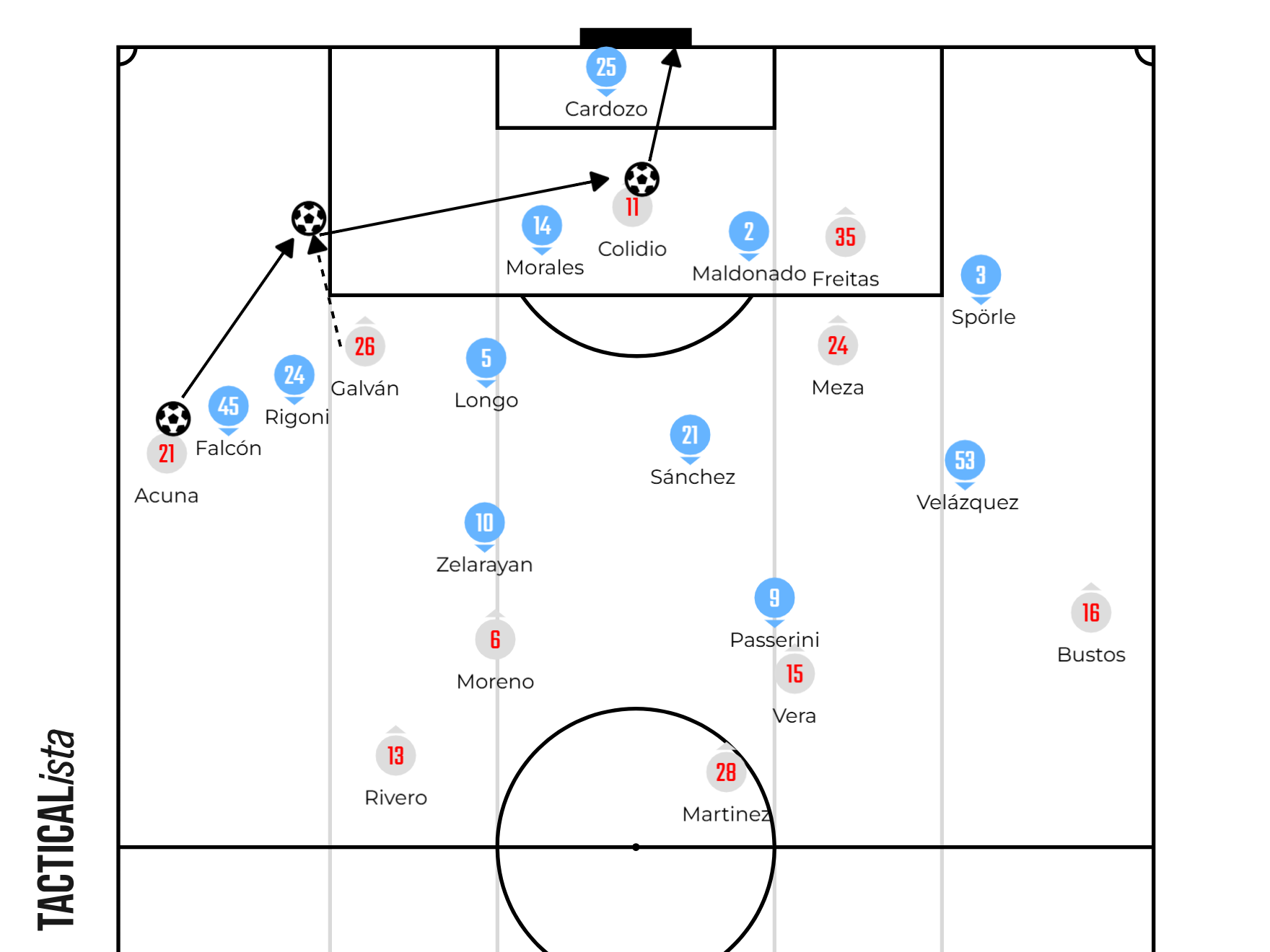
River’s first goal. Galván’s half space run to find Colidio’s run in the box.
Belgrano falling behind in the game gave room for more urgency in their press. They were more aggressive pressing from the front. Although, Belgrano wanted to put pressure, they didn’t want to destabilize the defensive line. The overloads River had in the middle third caused them to have extra passes of progression when Belgrano put pressure.
Belgrano found an equalizer through a corner. Zelarayán’s delivery found the head of Morales in the box who heads the ball in the back of the net. Belgrano got redemption after falling one goal behind and the game was on. Belgrano didn’t look to build up momentum from their goal and defended the last line with much numbers.
The Belgrano wingers kept more attention to the River fullbacks. Most times, it looked like a back six, with the wingers dropping into the backline. Belgrano preferred to concede momentum towards the end of the first half. The limited numbers in the middle and the emergence of space in the middle third allowed River to progress up the pitch. Belgrano did well to limit River’s attacks in the last line with the numbers in that zone.
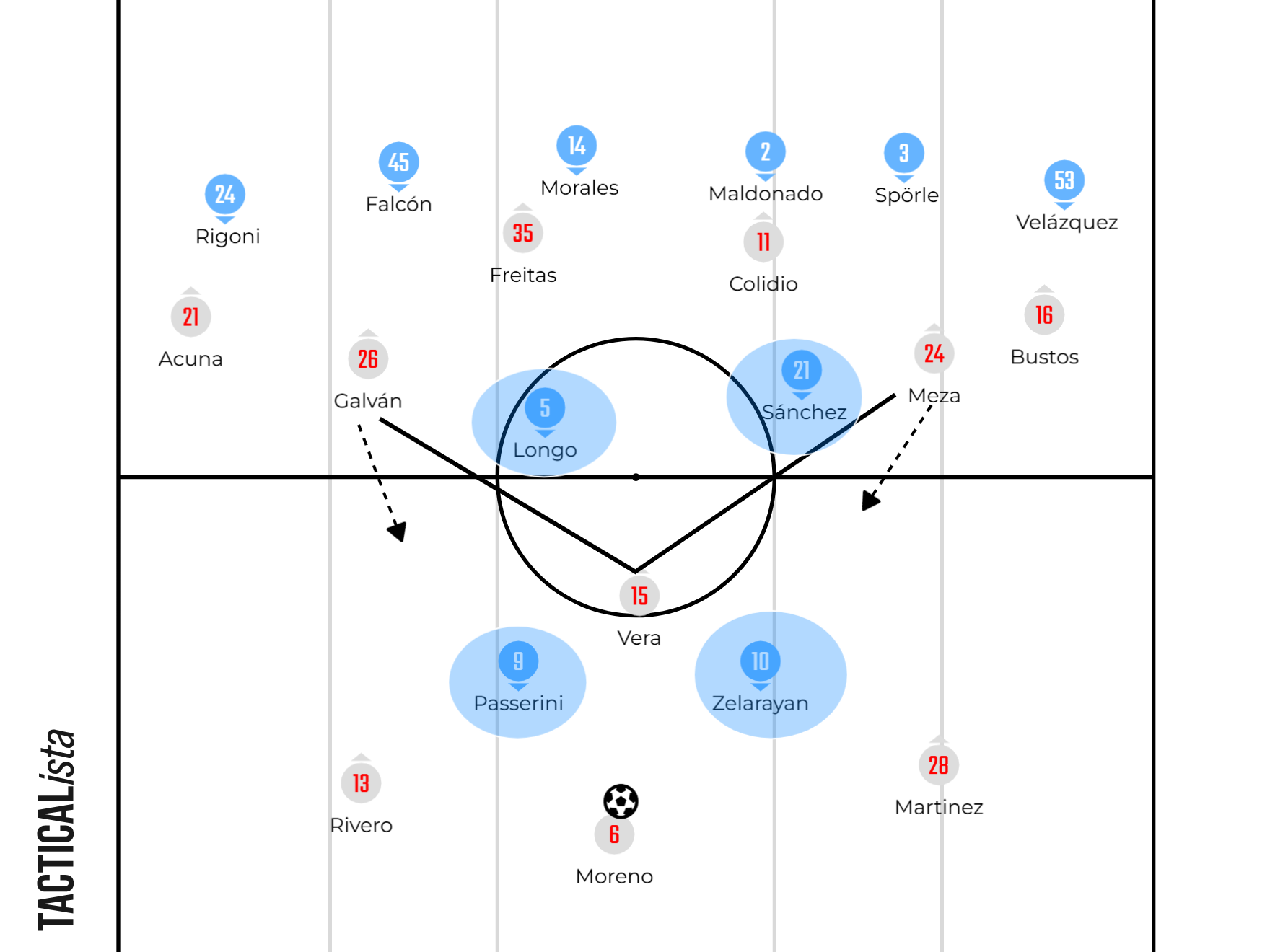
River’s overloads in the middle helped them to progress when Belgrano lacked numbers in the first two lines of engagement.
With River expected to have more control, they eventually took the lead. Colidio drove the ball in transition to find Galván on the left, who placed the ball into the bottom corner. River regained the lead and looked to hold on to their lead. They dropped into a 4-4-2 mid-block and allowed Belgrano to have more of the ball in settled phases.
Belgrano switched up to a 3-1-6 with their fullbacks high up and Sanchez dropping into the first line of build up. They weren’t able to generate many entries as River’s defensive line looked solid.
The moment that changed the game was the introduction of Nicolás Fernández late on. He came on and immediately changed the score line. He converted the penalty that was awarded to Belgrano after the ball struck the arm of Rivero in the box.
Not long after, the two substitutes combined for the winning goal. Franco Vázquez, who was later subbed onto the pitch crossed the ball to the box. Fernández got to the end of the cross, unmarked in the box, to put the ball into the net. After this goal, it felt like Belgrano had won it. River Plate’s late surge proved no threat as Belgrano survived to become champions of the Apertura.
Takeaways
River Plate controlled most of the Apertura final through central overloads, wide combinations, and structured build up play. Their 3-2-5 shape allowed them to dominate possession, while Acuña and Galván combined effectively on the left to create attacking opportunities.
Belgrano initially threatened in transition, targeting spaces left behind River’s advancing fullbacks, but eventually dropped deeper to defend compactly. River’s control earned those two goals and a strong defensive shape late on. However, the introduction of Nicolás Fernández changed the game completely. His late impact, including a penalty and winning goal, inspired Belgrano’s comeback as they showed resilience and efficiency to secure the Apertura title.
Match plots will be added as soon as possible.


Comments