
Belgium – France: Olise Maintains Zidane’s Winning Start (0-1)
Two old rivals would meet at the start of new eras. Mark Van Bommel’s Belgium would play host to Zinédine Zidane’s France. Like in their playing careers, where they briefly met during their respective times at Barcelona and Real Madrid, there was a clear clash of styles on display: the speed and directness of Belgium versus the slick control of France.
Tactical analysis and match report by Nick Hartland.
We decided to make this article free to read. If you want to support our work, consider taking a subscription.
Belgium were off to a winning start under Mark Van Bommel, dispatching Italy 2-0 away from home. The era of Rudi Garcia’s careful approach was replaced with a far more direct style. As Nicolas Raskin described it, “It’s a great philosophy of the game, modern, attack-minded, with a high press.” And while we rarely hear the opposite from players when a new manager comes in, the evidence from the game suggested there was more than a little truth to the statement.
Similarly, the Zinedine Zidane era was up and running with a win as France came away from İzmit with a 1-0 win over Türkiye. Kylian Mbappé was the goal scorer, but his winning strike would be pyrrhic as he injured himself in the process and would have to be sent home. Zidane was pleased enough with the result, even if the process left much to be improved: “It wasn’t perfect, that’s for sure, but we will try to improve, and I’m happy to start with a win.”
Van Bommel largely kept faith in the side that beat Italy and stuck with the 4-2-3-1 formation. Senne Lammens was in goal, with Joaquin Seys, Nathan Ngoy, Brandon Mechele, and Timothy Castagne in defense. The double pivot was made up of Roméo Lavia and Youri Tielemans. Ahead of them were Mika Godts and Diego Moreira on the flanks, with Kevin De Bruyne as the number ten. Charles De Ketelaere was the lone striker.
Zidane experimented with an almost completely different line-up, albeit keeping the 4-3-3 shape. In goal, Mike Maignan was one of two survivors, behind a backline consisting of Andy Diouf, Maxence Lacroix (the other survivor), Jérémy Jacquet, and Pierre Kalulu. In midfield, Lucas Da Cunha, Edouard Camavinga, and Maghnes Akliouche. Up front, Bradley Barcola, Esteban Lepaul, and Désiré Doué.
Kevin De Bruyne: The Architect of Speed
There were two contrasting approaches to selection from the new managers. In the red corner, Van Bommel went with continuity and building on the positives from the first win, while in the blue corner, Zidane looked to test out the unique depth available to France by blooding three debutants (Jacquet, De Cunha, and Diouf, as well as a first start to Lepaul). Despite a much-changed side, the core principles remained the same as in the win over Türkiye.
France wanted to press from their starting shape, with Lepaul leading the movement. This would merge into a man-oriented press, with the midfield keeping tight to their assignments. Like against Italy, Belgium looked to De Bruyne’s movement to bypass the press. He would drop deep into space to create a central overload and tension within France’s defensive system, over which player needed to pick him up and pay attention to his movement.
Van Bommel had his side fully embrace verticality and speed, and looked to exploit France’s willingness to push high up the pitch in numbers and hit them before they had a chance to retreat into a more solid defensive shape. De Bruyne would set the tempo when he received the ball in these deeper spaces. He aimed to slip a pass past the defensive line for a runner to latch onto.
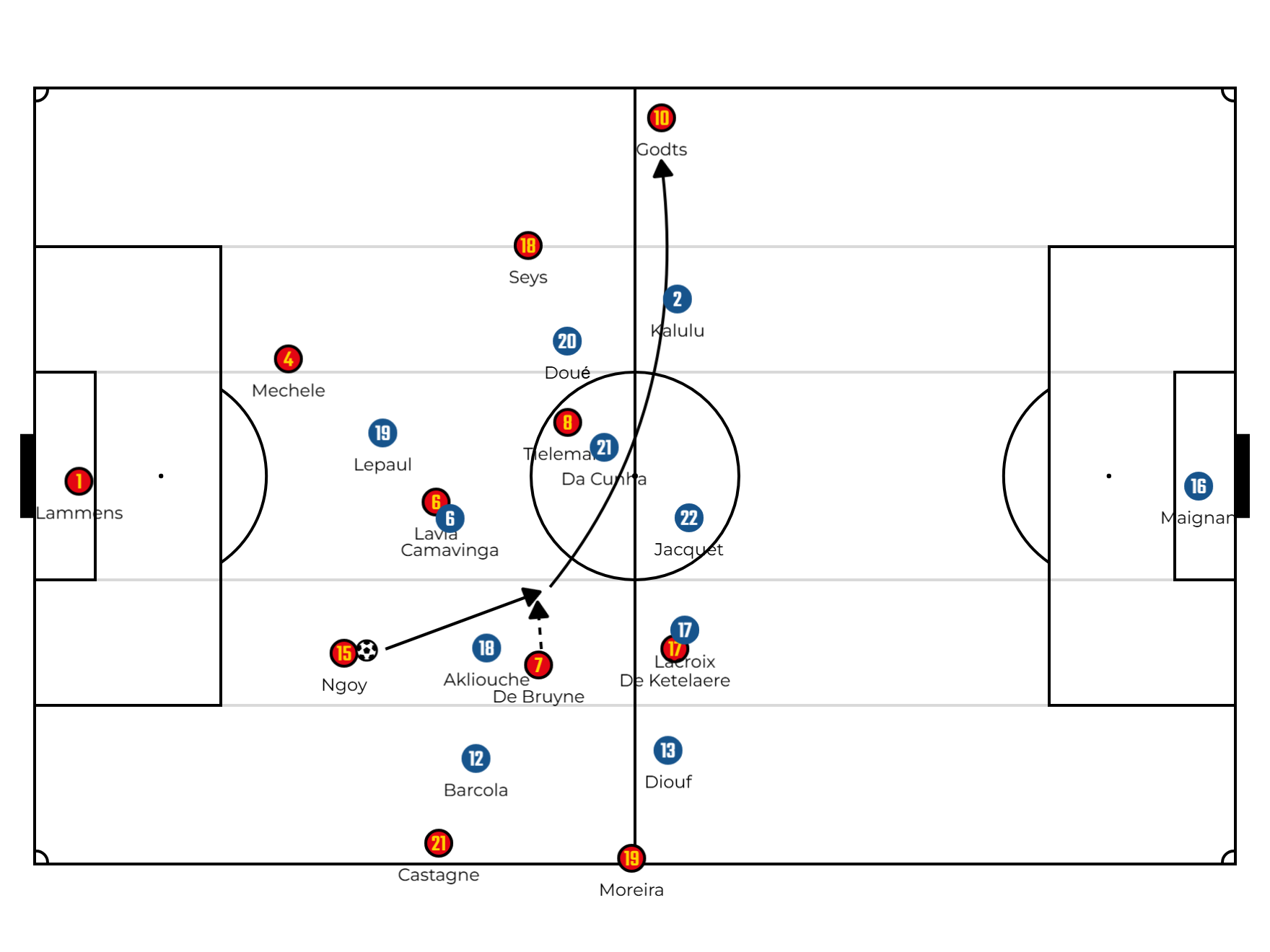
36th minute: France look to block central access with the midfield tight to their assignments. Akliouche scans and sees De Bruyne as he turns his head; De Bruyne makes the move and facilitates the quick attack.
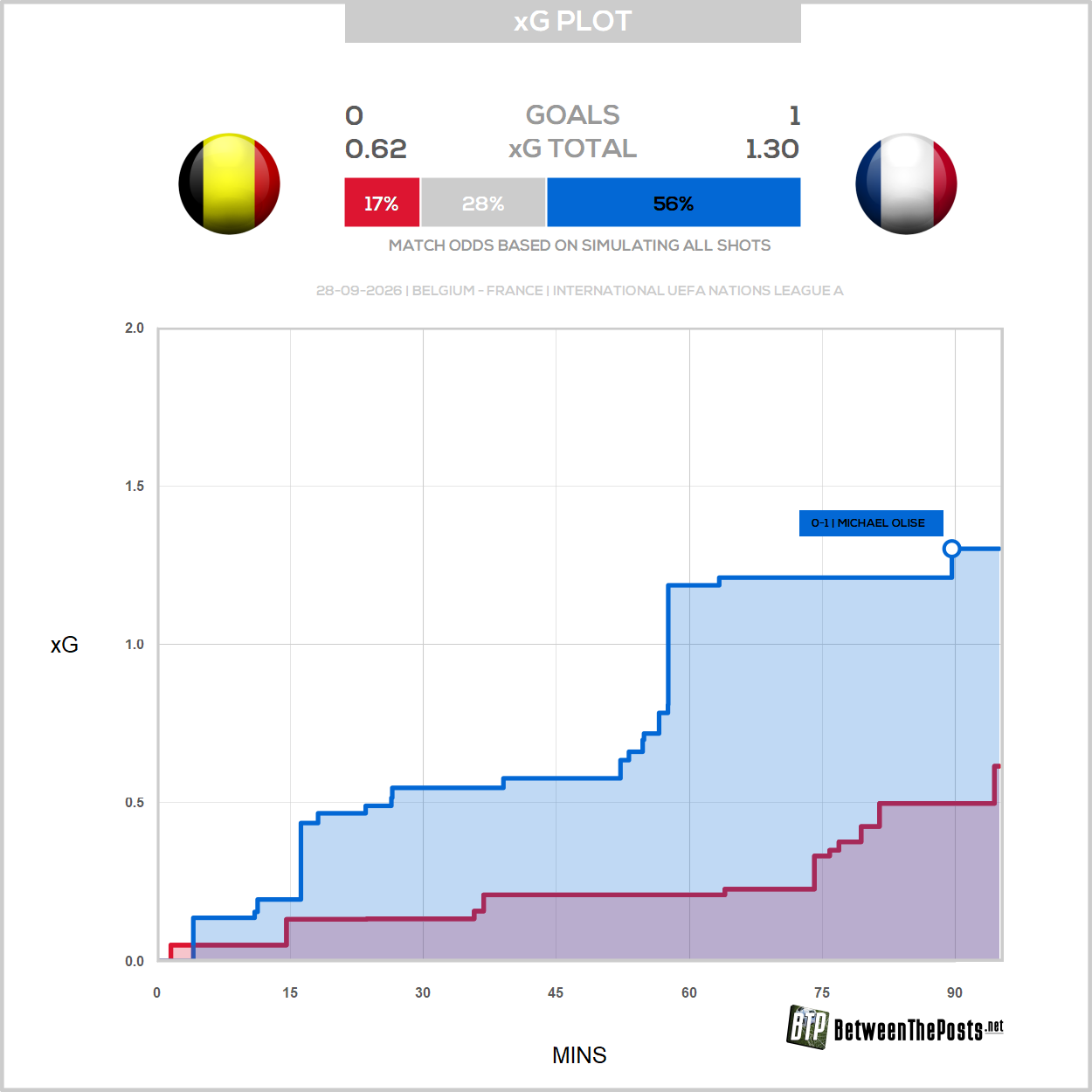
Belgium looked good; they were creating positive scenarios and dangerous situations. However, it wasn’t always picked up on in the expected goals plot. The reason why was fairly simple. Often, Belgium would do everything right up until the final third, where the final pass or cross would be hit just out of reach of the receiver, so that they didn’t even get the chance to register a shot.
Mon Dieu, Mon Doué
Belgium would also situationally press France high, but spent the majority of the game in their zonal shape, somewhere between a medium and low block (4-4-2/4-5-1). This left France to dominate possession, ending the night with 63%. Control of the ball was a theme that also cropped up against Türkiye. However, unlike with the poor pitch in İzmit, the King Baudouin Stadium’s surface was far more accommodating to the game Zidane hoped to instil.
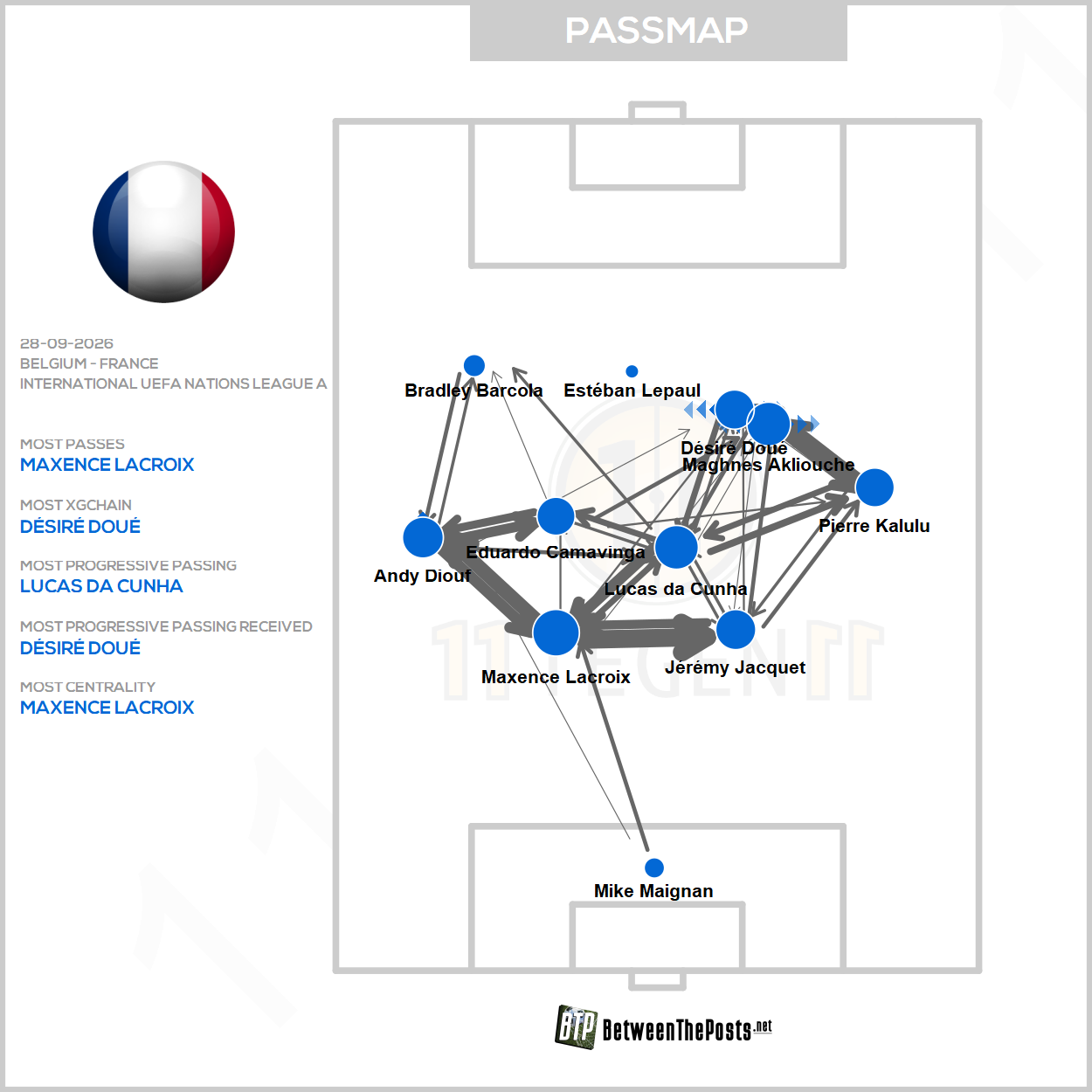
In possession, there were recognizable patterns at work in Zidane’s structure. In the center, his midfield trio formed a diamond with the striker: Lepaul as the tip and De Cunha as the base. Out wide, his wingers and fullbacks maintained double width. The aim was to create tension within Belgium’s zonal defense. This was done by spacing threats and splitting Belgium’s focus between the center and the wings.
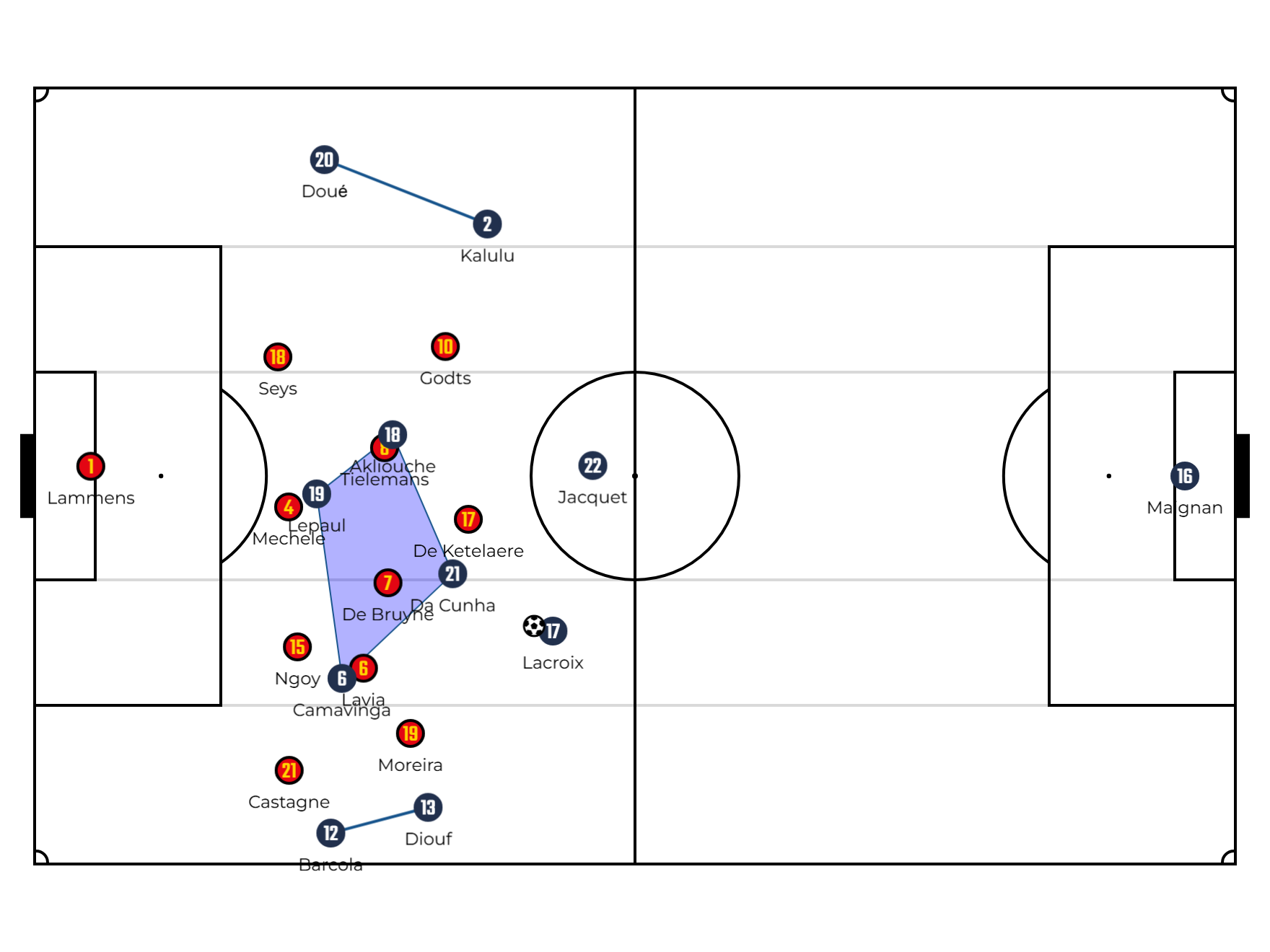
25th minute: A look at France’s in-possession system. A diamond in the center formed with the striker and double width on the wings.
In this system, France were patient with the ball, shifting it from side to side and probing Belgium’s block. Once in the final third, they were fairly reliant on individual brilliance. Without Mbappé, Ousmane Dembélé, or Michael Olise on the pitch, Doué took up the creative mantle and had a stunning game. Defenders couldn’t get close to the ball when it was with him, and when he fired a shot, it was always inches from success as he hit both the post and crossbar.
It was perhaps telling that France’s most threatening moments came in transition (like against Türkiye and more generally during the entirety of the 2026 World Cup). In the moments when they weren’t operating within a rigid structure and were instead allowed to let fly. In the 21st minute, a counter-attack led by Barcola should have seen the Frenchman awarded a penalty after he was fouled in the box by Ngoy. However, the referee was feeling lenient.
Belgium’s brief rally
Neither manager made an alteration at half-time, and so the shape of the game didn’t change too much at the start of the second half. Doué was once again the main threat for Les Bleus while Belgium looked dangerous on the break.
It would take until the 63rd minute for Van Bommel to change things as he took off Moreira and De Bruyne for Hans Vanaken and Dodi Lukébakio. Five minutes later, he’d add to his changes with Maxim de Cuyper for Seys, which saw Zidane finally respond by bringing on Dembélé for Lepaul.
Of the two head coaches, Zidane’s substitution looked to have the bigger immediate change on the structure of his team. As a less orthodox number nine, Dembélé was more willing to drop deep and help with the construction of attacks. Whereas Lepaul often looked isolated during the match. Dembélé also brought fresh legs and renewed energy to the way France pressed. However, the momentum of the match was soon in Van Bommel’s favor.
Belgium rallied with around 15 minutes to go as the game stretched; mistakes were creeping into France’s game and they were finding it harder to make recovering runs to defend against Belgium’s relentlessness in transition. A big error on the ball from Camavinga likely should have led to the hosts opening the scoring in the 73rd minute. However, the counterattack would come to nothing as Lukébakio was denied by Maignan.
Olise to the rescue
Shortly after this, Zidane again turned to his bench with the introduction of Rayan Cherki and Olise for Akliouche and Barcola. It was a straight swap between Akliouche and Cherki, but Olise went out on the right, meaning Doué moved to the left. The aim was to take momentum away from Belgium and to add more threat to the attack, which it partially did. Belgium were stifled, but the attack was still not quite clicking.
However, when the system failed, France could rely on something else they had in abundance: individual brilliance. When you have that, even a half chance can become something more. On the counter, Olise picked up the ball in France’s half and then ran the length of the pitch in the 88th minute. On the edge of Belgium’s box, he stroked his shot into the bottom left corner to give Les Bleus the win.
Takeaways
Van Bommel could leave this game with the knowledge that the performance was good, but the execution was lacking. It felt like a game that was decided by fine margins. In principle, Belgium seem to have found a good system; it may just take a few games for it to fully click. They also don’t have the same luxury that France have with the depth of their bench, and are still quite reliant on the ageing and fragile legs of De Bruyne.
Two wins out of two for Zidane, and each won by the same 1-0 scoreline. There were moments when the team seemed to connect, and you could see the vision Zidane has for the side, which was all the more impressive considering this was France’s B-team. However, there remained questions about a system that seemed to work most effectively in the moments when the team were freed from it.


Comments