

Atlético – Flamengo: A late equalizer leaves Flamengo with the title practically secured (1-1)
The Brasileirão is reaching its final stretch and Palmeiras is paying a very high price for its recent slip-ups. While Palmeiras was being defeated by Grêmio, Flamengo extended the gap to five points with a late equalizer against Atlético Mineiro, a team closing the year with a frustrating domestic campaign after losing the Copa Sudamericana final.
Tactical analysis and match report by Marcus Arboés.
Last weekend, Atlético Mineiro watched Lanús from Argentina celebrate the Copa Sudamericana title, the South American equivalent of the Europa League, after a dreadful 0-0 followed by penalties. Sampaoli’s mission became finishing the Brasileirão with dignity. To do that, he made some changes in his starting eleven: Everson in goal; Renzo Saravia, Vitor Hugo (former Fiorentina), and Alonso (Paraguay National Team) in defense; Natanael and Guilherme Arana (former Sevilla) as fullbacks; Alexsander (former Al-Ahli) and Franco as holding midfielders; and a front three formed by Dudu, Bernard (former Everton), and the team’s main player, Hulk (former Porto).
Amid several narratives, including Palmeiras’ own coach saying the league was already lost and that the team would rest players for the Libertadores final on Saturday, Filipe Luís fielded a rotated side, resting some key names: Rossi in goal; Emerson Royal (former Milan), Danilo (former Juventus), Léo Pereira, and Ayrton Lucas in the back line; Evertton Araújo and Erick Pulgar (former Chile National Team) as holding midfielders with Carrascal (Colombia National Team) ahead of them; Samuel Lino (former Atleti) and Luiz Araújo (former Lille) on the wings; and the young Wallace Yan as center forward. Among the main players, Jorginho, Arrascaeta, and Bruno Henrique were preserved at first.
Duel of Positional Play
Matchday 36 started with the possibility of Flamengo becoming early champions. With Palmeiras drawing against Fluminense, Flamengo won and opened a four-point lead. If Flamengo won and Palmeiras lost, the title would be secured inside Atlético Mineiro’s own stadium.
This match marked a reunion. Jorge Sampaoli, the Argentine manager known for his strong personality and difficult relationships, coached Flamengo some years ago and failed due to his inflexibility and insistence on positional play with a squad that clearly did not have the attributes for that style. Now, back in charge of Atlético Mineiro, he faced Flamengo again, but this time the team was coached by Filipe Luís, who has a squad built to execute the positional play philosophy idealized by the former Atlético de Madrid fullback.
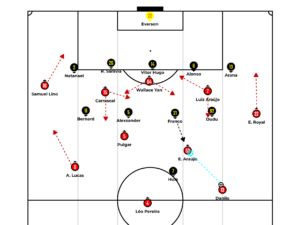
Flamengo’s positional attack in a 3-2-5 shape against Atlético Mineiro’s zonal high-pressure 5-4-1 formation.
The duel involved two teams that like to control the game through positional play, while preferring and feeling more comfortable defending with high pressure. Flamengo, however, stood out with attacks from the final third, positioned in the opponent’s half.
To do that, Filipe Luís’s team, even without some of its key players, tried to create advantages on the outside through triangulations that generated space for the wide player or the one receiving in the half-space to deliver crosses into the box. This has been the tactical tone of several recent Flamengo matches: if there is no space inside, they create dynamics on the outside.
To deal with this tendency of central players being decoys and connectors to free Emerson Royal, Ayrton Lucas, Danilo, or Samuel Lino to cross, Sampaoli slightly adjusted his defensive approach to have more volume in the last line, using three natural center backs and two wingbacks, instead of a right winger. He removed Rony, who was a starter in the Copa Sudamericana final, to play Natanael as a fullback.
Atlético Mineiro’s defense moved in a coordinated way, closing spaces and applying pressure only on the ball carrier or immediate receiver. The team’s vertical compactness allowed the winger on the second line (Bernard or Dudu) to double up on whoever received outside. Despite all attempts, Flamengo found difficulties, and the same compactness that helped Atlético Mineiro defensively made it harder for them to counterattack with speed when winning the ball.
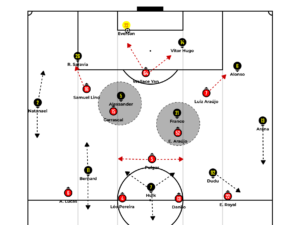
Flamengo’s high-block man-orientation pressing Atlético Mineiro’s buildup in a 3-4-3 outline.
Flamengo was superior in the first half, imposed themselves, and even when forced to go long due to Atlético Mineiro’s high pressure, they managed to push the opponent back, but not only by attacking. Atlético rarely managed to execute its traditional full positional attack in the opponent’s half because of Flamengo’s consistent high press.
Usually, Flamengo presses in a high block with the same trend seen worldwide: a 4-1-3-2 shape. This time, they had to adapt, using a 4-1-2-3 formation, with Wallace Yan pressing the ball carrier, whether Everson or the central defender. The wingers pressed the outside center backs, while Carrascal and Evertton Araújo chased Franco and Alexsander inside.
The buildup system within the positional play structure was a 3-4-3 formation, with Everson active to create superiority against the first line. This neutralized positional triangles, but one area remained open: the fullbacks. When long diagonals or line-breaking passes reached the fullbacks in advanced positions, the inside midfielder, winger, and Pulgar, who protected the back of the first press line, closed that side, while the last line protected depth.
This way, Flamengo made vertical progression difficult, often maintaining numerical superiority of four against three Atlético attackers, who still acted as support for Arana and Natanael’s advances. If that was Sampaoli’s plan, it worked to an extent, because Bernard’s goal, after an individual play by Dudu, came from a positional attack already sustained in the opponent’s half.
Flamengo’s reaction in the title chase
While Flamengo’s match progressed, Palmeiras took the lead against Grêmio but then conceded a 2-1 comeback. To chase the early title with a comeback of their own, Filipe Luís needed his team to adopt an even more offensive posture. With that, Ayrton Lucas, previously part of the back line, moved higher on the outside. The holding midfielder dropped between the center backs to create a 3-1-6 shape, sometimes shifting to a 2-2-6 formation during attacks.
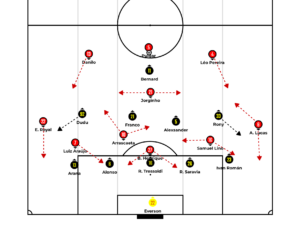
General tactical scenario of the second half, with Flamengo attacking with six players on the last line, against Atlético Mineiro, who adjusted personnel but not its defensive system.
The first substitutions were Tressoldi for Vitor Hugo, who left injured, and Bruno Henrique replacing Wallace Yan to improve aerial threat and offer deeper runs when Atlético Mineiro pressed in a medium or high block. The main tactical adjustment, however, was pushing Ayrton Lucas higher, reducing central volume but increasing overload on Natanael.
In response, Atlético Mineiro made changes, as Natanael was suffering and had received a yellow card. Ronny came in for Hulk to help defend the right side, leaving Bernard freer, and Iván Román entered at right back with better one-v-one defensive ability. This happened simultaneously with Flamengo’s renewals, improving the team with Arrascaeta and Jorginho, then Everton Cebolinha and Gonzalo Plata.
Always attacking in a 3-1-6 or 2-2-6 outline and after sustained dominance, Everton Cebolinha initiated the circulation that allowed Danilo to advance and receive in space. He crossed for Bruno Henrique to head in the equalizer in stoppage time. Everson did everything he could, preventing several goals, especially from Samuel Lino, but could not stop Bruno Henrique’s jump.
Takeaways
With the late equalizer, Atlético Mineiro missed the chance to climb the table and might even fail to secure a Copa Sudamericana spot. After losing the final to Lanús, they still face Fortaleza on Sunday and Palmeiras next Wednesday to close the 2025 season.
Flamengo, who will be rooting for an Atlético win in the final round, is more focused on Saturday. In Lima, Peru, they face Palmeiras in the Libertadores final. In the Brasileirão, the race could and should end before that, with matches against Ceará and Mirassol. One win is enough to become champions.


Comments