

Independiente Rivadavia – Rosario Central: Rivadavia Make It Back-To-Back Wins After Victory Over Rosario (2 – 0)
Rosario will feel hard done by after a performance that deserved more. Yet, this was ultimately decided by ruthlessness in front of goal. Rivadavia’s press didn’t shut down Rosario’s ability to play through the mid-block, but it delivered when it mattered—forcing the error that led to the decisive second goal. For all their control, Rosario lacked the cutting edge in the final third to turn dominance into reward.
Tactical analysis and match report by Ebuka Ogoegbunam.
Rivadavia came into this game following a win over Gimnasia L.P. and looked to build momentum in front of their home fans. Rosario were unbeaten in their last four games with three wins and a draw. With their two wins without their key player, Ángel Di María, Rosario were in a good place to continue their streak in the league. He made his way back to the bench in this game.
Rivadavia’s starting XI had Nicolás Bolcato in goal for the eleventh time this season. Ezequiel Bonifacio, Sheyko Studer, Iván Villalba and Luciano Gómez made up the back four. Tomás Bottari partnered up with Rodrigo Atencio and José Florentín in midfield. Sebastián Villa, Fabrizio Sartori and Álex Arce made up the front three in a 4-3-3 setup.
Rosario’s Conan Ledesma started in goal alongside a back four of Ignacio Ovando, Facundo Mallo, Gastón Ávila, and Agustín Sández. Franco Ibarra paired up with Vicente Pizarro in midfield, while Pol Fernández played slightly ahead of them in the attacking midfield. Jáminton Campaz, Enzo Giménez, and Alejo Véliz made the attacking unit in a 4-2-3-1 shape.
Rosario’s rotations in build up
Rosario gained control early on with their build-up shape. They built up with four center backs with a pivot and two midfielders high up. As the game developed, Ovando joined the back line while Sández pushed up. Rivadavia stayed in a 4-3-1-2 high block. The right winger, Sartori, tracked Rosario’s defensive midfielder, Ibarra, to make sure he wasn’t involved in the build-up, while the wide midfielders pressed the fullbacks.
Fernández, who occupied the attacking midfield area, dropped deep to overload the first line of build-up. Rosario used this well to progress up the pitch, using the 4v2 zone in the first line, and at times found spaces outside Rivadavia’s block to advance the play. Rosario had seamless sequences, playing through the lines and finding spaces inside and outside their opponent’s block.
Rosario’s rotations with Ovando pushing up, Fernández dropping deep, and midfielders interchanging positions with constant movement made it harder for Rivadavia to track their movements. Rivadavia sat back in their shape and pressed to restrict their progression zonally.
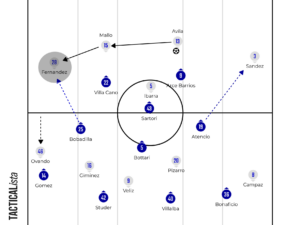
Bobadilla and Atencio pressed the wide players while Sartori covered Ibarra
When Rivadavia applied full pressure with their three attackers pressing Rosario’s back line, Rosario’s Fernández dropped deep to dictate play and use his quality on the ball to help his teammates progress up the pitch. This forced Rivadavia to retreat and cede control to Rosario.
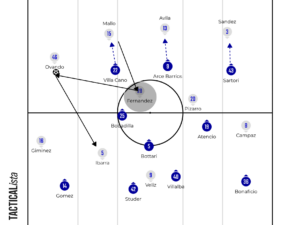
Fernández drops deep and dictates play to give his team the chance to progress.
The press pays off
Rosario’s control got them into advanced areas. Fullbacks pushing high used overlapping runs to attack and support their wingers in a double-width setup. Rivadavia got an early goal against the momentum of play. Bonifacio put the ball into the box from a long throw-in, and Gómez connected with the ball sweetly to strike it into the back of the net from range.
A moment of magic put Rivadavia ahead in front of their home fans. Rosario kept with their game plan, attacking through the wings and getting crosses into the box. With the lack of bodies in the box, these crosses didn’t really pose much threat. Studer and Villalba defended these situations really well.
After going one-nil down, Rosario had more urgency to control the game and attack more. Rivadavia sat into their mid-block and allowed Rosario to dictate the game, but when Rosario tried to progress higher up the pitch, they were aggressive. Véliz dropped deep in between the lines to generate space for his teammates to attack. Rivadavia’s center backs were tight to him and restricted him from playing any progressive passes through aggression.
Rivadavia doubled their lead through their 4-3-1-2 pressing structure. As a form of their rotation, Rosario were building up with a back three with Sández high up while Ovando dropped to the back line.
A 3v2 overload in the first line seemed like a situation of control until Sartori triggered the press covering Ibarra while pressing Mallo. Mallo gifted the ball straight to Arce, who ran through on goal to score.
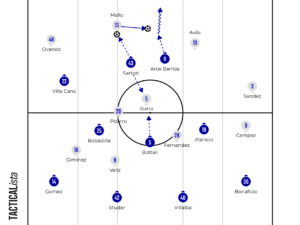
Rivadavia’s second goal happened because Sartori put pressure on Mallo and forced the turnover.
Two goals conceded in the first half made the game harder for Rosario to win the game. Rivadavia stayed compact till the end of the first half to keep the lead at two goals.
Attacking changes
In the second half, Rosario had to be much more direct. They mainly used the left-hand side to attack Rivadavia’s back-line. Campaz was aggressive to go at Bonifacio every time they had a one on one match up. The wings were the outlets Rosario used to advance up the pitch into the final third, but the final pass was lacking.
Rosario’s head coach, Jorge Almirón, made an attacking change by bringing Gaspar Duarte and Enzo Copetti to replace Mallo and Fernández. Ovando shifted to center back to pair up with Ávila in defence, while Giménez offered to drop to right back occasionally. This ultra-attacking substitution generated more momentum towards the end of the game for Rosario but they lacked the finishing touch.
This attacking substitution also allowed Rosario to be susceptible to counterattacks. Rivadavia missed the chance to make these moments count and couldn’t score a third goal. The ending of the game had continuous fouls and breaks of play, which suited Rivadavia.
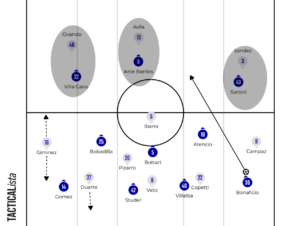
Rosario’s attacking structure leaves them susceptible to counterattacks
Takeaways
From a tactical perspective, the game was defined by control vs efficiency, with Rosario dominating structure and progression, while Rivadavia maximized key moments through pressing and compactness.
Rosario established early control through a flexible build-up structure, often forming a back four (and at times a back three) with rotations that created numerical superiority in the first phase. The dropping movements of Pol Fernández were crucial, helping them create overloads and progress through Rivadavia’s first line. This allowed Rosario to consistently play through the mid-block and access wide areas, where their fullbacks and wingers operated in a double-width attacking shape.
However, Rivadavia’s defensive approach was disciplined and situational. They alternated between a 4-3-1-2 high press and a compact mid-block, prioritizing central compactness and aggressive marking on key receivers like Alejo Véliz. Their centre-backs stayed tight and physical, limiting Rosario’s ability to connect through central zones or create high-quality chances despite territorial dominance.
The key tactical turning point was Rivadavia’s pressing efficiency. While they didn’t consistently disrupt Rosario’s build-up, they were effective in targeted pressing triggers. The second goal came from such a moment, where coordinated pressure forced an error in Rosario’s first phase, highlighting Rivadavia’s ability to capitalize on isolated mistakes rather than sustain pressure.
In possession, Rivadavia were more direct and opportunistic. Their first goal came from a set-piece situation, reinforcing their reliance on low-volume but high-impact attacking moments rather than sustained build-up play.
In the second half, Rosario increased attacking intent, becoming more direct and wing-oriented, particularly targeting 1v1 situations on the flanks. Tactical substitutions further emphasized this, shifting to a more aggressive structure. However, this came at the cost of defensive stability, leaving them vulnerable in transition, although Rivadavia failed to exploit these spaces further.
Ultimately, Rosario’s structured build-up and territorial dominance lacked final-third efficiency and box presence, while Rivadavia’s compact defensive shape and clinical pressing moments proved decisive.
Match plots will be added as soon as possible


Comments