
Manchester United – Newcastle United: Amorim’s New System Earns Scrappy Win (1-0)
A back four both with and without the ball was seen for the first time for Manchester United under Ruben Amorim here. A first-half goal from Patrick Dorgu put United ahead. They then proceeded to become more passive throughout the game, spending the second half defending their lead from a low-block which Newcastle were unable to break.
Tactical analysis and match report by Josh Manley.
We decided to make this article free to read. If you want to support our work, consider taking a subscription.
Ruben Amorim’s side came into this game on the back of a crazy 4-4 draw at Bournemouth, followed by a defeat at Aston Villa last weekend. The Manchester United manager was without some key talent for this game, as Noussair Mazraoui, Amad Diallo, and Bryan Mbuemo were on AFCON duty, while Bruno Fernandes picked up a hamstring injury last weekend.
Newcastle meanwhile dropped points after gaining a 2-0 lead against Chelsea last time out. They also recently had a disappointing Tyne-Wear derby defeat against Sunderland. They had the chance to go level on points with United here if they were to win though.
The home side lined up in a 4-2-3-1 shape as Ruben Amorim experiments with deviations from his 3-4-3 system. Diogo Dalot, Ayden Heaven, Lisandro Martínez, and Luke Shaw made up the back four, while Casemiro and Manuel Ugarte were central midfielders. Patrick Dorgu then started from the right, with Mason Mount and Matheus Cunha also supporting Benjamin Šeško up front.
Eddie Howe meanwhile set his team up in a 4-3-3 system, with a back four of Lewis Miley, Malick Thiaw, Fabian Schär, and Lewis Hall. Bruno Guimarães, Sandro Tonali, and Jacob Ramsey made up the midfield trio, while Jacob Murphy and Anthony Gordon flanked Nick Woltemade up front.
United’s new shape
Amorim seems to have been gradually making the shift towards a back four in recent weeks. Until this game, United had used 4-4-2 variations out of possession, but still mostly built up with a back three. Against Newcastle though, United were finally using a back four on both sides of the ball.
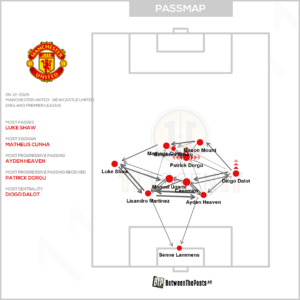
United’s passmap shows their switch to a back four in possession.
This seemed to catch Newcastle by surprise as much as anyone else. Their pressing scheme in the early minutes and the player reference points assigned suggested they expected a back three. Tonali would jump from right central midfield onto Martínez in high pressing, while the rest of the midfield and attacking units went man for man with their opposite numbers.
This didn’t quite work though, as in one early scene it left Mount free between the lines, too far out for a Newcastle defender to jump (they had presumably expected him as a right-sided number ten, not playing centrally).
Howe adjusted his pressing scheme very quickly, swapping Bruno Guimarães and Tonali’s roles so that Tonali was now the deepest midfielder in a 4-3-3 shape and would stay closer to Mount. Newcastle’s pressing was now much more balanced.
As for United’s attacking setup, Shaw would often overlap down the left to allow Cunha to indent, while Dalot was more reserved on the right, as Dorgu provided depth and (less consistently) width on that side. When Newcastle were defending deeper, Murphy would track these runs from Shaw, meaning they often ended up in a 5-4-1 shape without the ball.
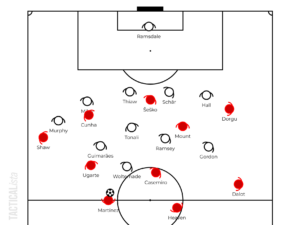
United in possession.
The two central midfielders Casemiro and Ugarte were also quite reserved in their positioning. They would usually stay as a flat double pivot. On the occasions where Dalot did move forward, they also occasionally had one of the central midfielders drop to the side of the center-backs to form a diamond structure in the rest defense.
United’s possession game was not particularly impressive. The main positive was the moments of individual press-resistance shown by their center-backs, especially the recently returning Martínez. His ability to calmly play out of pressure and his accurate passing to start attacks adds huge value to United’s possession game.
The midfield battle
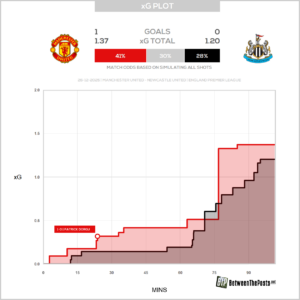
United were able to take the lead around midway through the first half thanks to Dorgu’s volley from the second phase of a long throw. After this, United’s possession share gradually reduced as the game progressed.
Without the ball, United were set up in a 4-2-3-1 shape. In the first half, they would try to press high against Newcastle’s buildup, defending relatively man-oriented against Newcastle’s 4-3-3 formation.
In order to break these man-orientations, Bruno Guimarães would often drop into the number six zone for Newcastle alongside Tonali. This gave Ugarte a decision to make as to whether to follow him. If he didn’t follow, United’s pressure was broken. If he did, Woltemade would drop into the space he vacated to help create an overload.
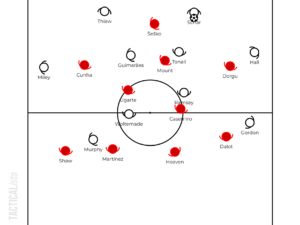
Newcastle with Bruno Guimarães and Woltemade both dropping.
The trend of Woltemade dropping into midfield to help create overloads was a consistent one, although Newcastle did not always use it to full effect. Elsewhere in the attack, Murphy would often invert from the right with Miley moving up, while Gordon generally stayed wider on the left, allowing Hall to make underlapping runs from left back.
Against a lone striker in Šeško, Newcastle’s center-backs were usually able to work the ball so that one of them could step out of defense with it. At this point, it was a duel of Newcastle’s midfielders who would rotate to try and create separation against United’s man-orientations. United were generally able to handle the complications though, and Newcastle created very little in the first hour of the game.
Shutting up shop
As the game continued through the second half, United began to become more passive, increasingly surrendering possession and territory. Newcastle then had the task of trying to break down a low block, which is not their biggest strength overall.
Jack Fletcher had replaced Mount at half-time, and Amorim followed this with two more substitutions on the hour mark as Leny Yoro and Joshua Zirkzee replaced Casemiro and Šeško. This change saw a reshuffle. Yoro would play at right back, meaning Dalot moved forward to right midfield and Dorgu to the left. This allowed Cunha to move to the number ten role, with Fletcher dropping back into central midfield.
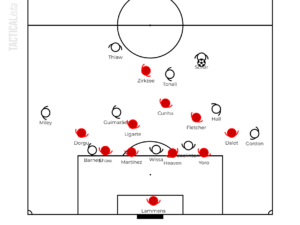
United’s second-half low-block.
United were defending in a 4-4-1-1 low block that would sometimes turn into a 6-3-1 shape due to Dalot and Dorgu dropping back in wide areas. Far from going for a second goal, United were shutting up shop at home, trying to hold onto their one-goal lead.
Newcastle made changes of their own as Joelinton, Yoane Wissa, and Harvey Barnes all came on with just over twenty minutes remaining with Ramsey, Woltemade, and Murphy making way. Howe’s side had plenty of shots in the final thirty minutes but didn’t create anything gilt-edged against United’s deep defense, and the home side ultimately took a scrappy three points.
Takeaways
Amorim’s newfound willingness to adapt tactically will be a breath of fresh air for many United fans. In terms of the actual effectiveness of his new systems – that remains to be tested. They picked up a win here without playing particularly well, albeit they had to go without key creative talents. The center-backs Heaven and Martínez formed an excellent partnership, which is promising for the future.
Newcastle may be disappointed not to have done more here. They went behind without really doing much wrong once they had adapted their pressing shape. But they lacked the ability to create big chances in the second half when faced with a low United block that was not expertly executed.
Use the arrows to scroll through all available match plots. Click to enlarge.
Check the match plots page for plots of other matches.


Comments