
Paris Saint-Germain – Olympique de Marseille: PSG are champions on penalties with Chevalier shining and goals from counter-attacks (2-2)
Paris Saint-Germain won another final, this time their fourteenth Trophée des Champions title. The clash against Olympique de Marseille took place in Kuwait, which sparked protests from both fan bases, but those who watched were treated to an exciting match in which Chevalier was the main protagonist and all the goals came from counter-attacks.
Tactical analysis and match report by Marcus Arboés.
Luis Enrique had his main team almost fully available, with the exception of Hakimi, who is playing the Africa Cup of Nations for Morocco. For that reason, he lined up his usual 4-3-3 outline with Chevalier in goal; Zaïre-Emery at right back and Nuno Mendes on the left; Marquinhos and Pacho as centre backs; Vitinha, João Neves and Fabián Ruiz in midfield; Kvaratskhelia on the left wing, Doué on the right and Dembélé as a false nine. Despite that, the Parisian club also had three injury absences: Kang-in Lee, Safonov and Quentín Ndjantou, in addition to Mbaye, who is also with Senegal in Africa.
On the other side, Roberto De Zerbi had few doubts ahead of the match, as Gouiri was returning from a shoulder injury but still started. His team was set up to face the favourites in a 3-4-3 formation: Gerónimo Rulli in goal; Pavard on the right, Balerdi centrally and Facundo Medina on the left as the back three; Weah on the right and Emerson Palmieri on the left as wing backs, while Hojbjerg and Kondogbia formed the double pivot; in attack, Igor Paixão played on the left wing, Greenwood was the standout on the right and Gouiri acted as the number nine.]
Possession teams defined by transitions
Luis Enrique and De Zerbi are two exponents of positional play culture, each in their own way: PSG characterised by positional play with many rotations and control dynamics, and Marseille by positional play in shorter distances. Two coaches who are tactical references in controlling matches through possession found themselves in a game where offensive transitions were decisive, turning Le Classique into an exciting contest.
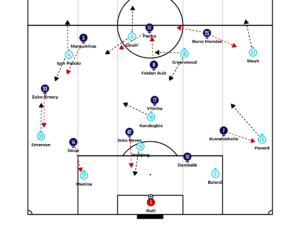
OM building short and overloading the ball side with the midfielders in a 4-2-4 shape, against PSG’s individual-oriented pressing.
Paris Saint-Germain took the lead after an interception against the usually safe and high-quality low build-up of De Zerbi’s team, combined with Vitinha’s brilliance to play a first-time pass that allowed Dembélé to score a beautiful chip over the goalkeeper. To understand this goal, it is important to look at how PSG dealt with Marseille’s build-up.
De Zerbi’s side built from deep with Emerson Palmieri dropping on the left and Pavard opening as a right back, allowing Weah the freedom to push high on the right wing as a wide outlet, with Igor Paixão wide on the opposite side, while Greenwood and Gouiri played freely, dropping with their backs to goal to create advantages inside. The key to the build-up was the fluid and balanced movement of the midfielders, who always shifted together towards the side they wanted to build from, generating positional advantages to progress through short passes, manipulating the opposition through attraction and third-man dynamics.
To disrupt that, PSG operated an aggressive man-oriented pressing scheme, with long individual pursuits. Kvaratskhelia marked Pavard; Dembélé and Doué pressed the centre backs; the midfielders were chased by João Neves and Vitinha at different heights; Zaïre-Emery stepped out wide to mark Emerson; Nuno Mendes and Fabián alternated between covering the last line and marking their references, Weah and Greenwood respectively; Pacho followed Gouiri, while Marquinhos hunted the other Brazilian, Igor Paixão.
While this inhibited progression through Marseille’s short positional logic, it also left PSG very exposed. Even so, Luis Enrique’s team, despite moments of opposition dominance, managed to sustain their advantage in a balanced first half.
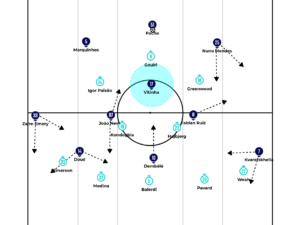
Paris Saint-Germain building in a 3-2-5 formation against Olympique de Marseille defending in a medium block in a 5-2-3 or 5-4-1 shape.
Despite controlling the scoreline and possession, PSG were unable to extend their lead, even though they created chances, through their traditional 3-2-5 positional attacking structure. They were well contained by the opponent’s defensive organisation, whether in a high block or a medium block. The initial high press caused enough discomfort that PSG began to use direct goal kicks, with Chevalier opting for long distributions.
Nuno Mendes was the key attacking outlet, constantly advancing into open spaces, while Fabián and Vitinha alternated in dropping wide or inside to offer passing lanes for the centre backs. Zaïre-Emery doubled up on the right with Doué, while Kvaratskhelia stayed wide on the left and Dembélé, as a false nine, frequently dropped, using his ambidexterity to act as a number ten and facilitate build-up.
By defending with a pressing zonal system, Marseille consistently jumped on the ball carrier or on receptions in more critical zones, and the 5-2-3 or 5-4-1 shape made this easier in medium or low blocks. Even so, through defensive drags, Kvaratskhelia gained a clear qualitative edge against Weah or Pavard, while Dembélé operated efficiently in the shadow of the midfielders. Chances were created at both ends: OM through more vertical attacks and transitions, and PSG through positional attacks with Kvaratskhelia and Nuno Mendes posing a constant threat.
An emotional finale
In the second half, the scenario remained similar: Luis Enrique kept his team focused on controlling possession, unsettling the opponent and defending by denying them the ball, while Olympique de Marseille tried to capitalise on the few opportunities they had through offensive transitions or by exploiting gaps in PSG’s man-oriented pressing. Gradually, spaces appeared, and throughout the second half Chevalier was required to make several important saves in these quick attacks and counter-attacks.
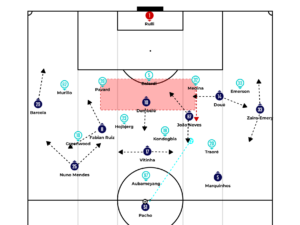
Second-half scenario with Paris Saint-Germain attacking in the final third against Marseille defending in a 5-4-1 shape.
Despite making several saves, Chevalier nearly became the villain of the match when he committed a foul on Greenwood that resulted in the equalising penalty. That situation, however, came from an excellent defensive action and transition by Marseille. It was common for Balerdi not to follow Dembélé inside, creating space between the last two defensive lines that PSG tried to exploit. In that critical zone, the centre backs, especially Medina, attempted to step in aggressively and win the ball. From there, Aubameyang received possession and assisted the team’s number ten.
De Zerbi initially struck gold with his substitutions. Aubameyang replaced Gouiri, who had played well and created chances. The Gabonese forward, coming off a poor Africa Cup of Nations that had sparked controversy with the Gabon national team, injected intensity into the game, adding depth to the counter-attacks and exploiting spaces in PSG’s defence with his experience. Traoré also came on for Igor Paixão, who struggled in the match. On the other side, Barcola replaced Kvaratskhelia and, after the equaliser, Murillo came on for Weah.
Interestingly, the second goal originated from Traoré. From a PSG throw-in, Marseille won the ball back and Traoré produced an individual run down the left before crossing into the box, where PSG centre back Pacho scored an own goal late in the match, seemingly igniting hopes of a long-awaited title for OM after more than ten years. Pacho could have become the villain, but in the emotional closing stages Aubameyang had a clear chance to score a third, only to be dispossessed by number 51.
After Pacho’s decisive intervention, Vitinha launched a final counter-attack in stoppage time, delivering a long ball over Murillo for Barcola, who attacks space better than Kvaratskhelia, to run onto it and calmly nod the ball down for Gonçalo Ramos, brought on late to add attacking presence, to score the goal that sent the match to penalties.
Takeaways
In the penalty shootout, Chevalier redeemed himself and became the hero of PSG’s fourteenth Trophée des Champions title, saving two spot kicks. With another trophy under Luis Enrique, PSG saw Marquinhos become the most decorated player in the club’s history. After the break, they will now face Paris FC in the Coupe de France, boosted by the Super Cup triumph.
On the other hand, Marseille missed the chance to lift a trophy after many years without celebrating with their fans, having victory snatched away at the very end. Their next fixture will be away from home against Bayeux, also in the Coupe de France. In Ligue 1, both teams are chasing Lens, the surprise leaders of the league.


Comments