

Denmark – Czech Republic: Czech Republic seal a World Cup Spot on Penalties after Set-Piece Thriller (2-2, 3-1 after penalties)
Both teams had the chance to make their nations proud, with the winner securing a spot in the World Cup. Denmark’s control and Czech Republic’s threat on the break gave the fans room for excitement and anticipation. The combination of tactical approaches led to a stalemate before a shootout. The game had to be decided with a penalty shoot-out after both teams scored two goals each from set pieces.
Tactical analysis and match report by Ebuka Ogoegbunam.
This felt like a final for both teams. With the importance of the game, both teams had to execute their respective game-plans to almost perfection. Czech Republic’s 3-4-2-1 shape in possession and 5-2-3 shape without the ball showed the intention to concede some momentum to Denmark’s 4-2-3-1 depending on the game state. It was control versus the aim to attack quickly in the transitions.
Matej Kovář started in goal for Czech Republic. The defensive line included a back three of Štěpán Chaloupek, Robin Hranáč and Ladislav Krejčí. The wingbacks holding the width on the right and left were Vladimír Coufal and Jaroslav Zelený respectively. Vladimír Darida and Tomáš Souček paired up in midfield. Pavel Šulc, Lukáš Provod and Patrik Schick made up the front three.
Denmark’s Brian Riemer started Mads Hermansen in goal with Alexander Bah, Victor Nelsson, Joachim Andersen and Joakim Mæhle the back defensive line in front of him. Morten Hjulmand and Pierre-Emile Højbjerg started in the middle. Victor Froholdt started in the attacking midfield position with the aim to feed the front line of Gustav Isaksen, Mikkel Damsgaard and Rasmus Højlund.
Denmark exploit Czech Republic’s defensive setup
Miroslav Koubek’s Czech Republic setup in a 3-4-2-1 shape with the ball and without the ball shaped in a 5-2-3/5-4-1 shape. They were very aggressive in their press with Coufal pushing up to press Mæhle. Šulc pressed the right back, Bah. Provod and Schick pressed the center backs alongside the goalkeeper from buildup. The wide center backs were also aggressive to their markers.
Czech Republic went man to man against Denmark. Denmark used this to their advantage to create space for Højlund to hold up the play and create transitional opportunities.
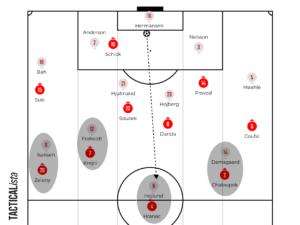
Czech Republic going man to man. Denmark used this to create space for Højlund to hold up play and help beat the press.
When Denmark had the ball, they exploited the space Coufal conceded on Czech Republic’s right side. When Denmark went long, Damsgaard often drifted narrow and this allowed Højlund to use his hold up play and channel running in wide areas against Chaloupek. Højlund was a consistent outlet from wide areas; holding up and link up play in central areas as well as making channel runs.
This created attacking plays for Højlund to get his shots off from the left side while holding off his man. The Czech defenders had a hard time trying to limit him.
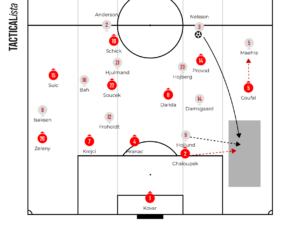
Denmark exploited the space Coufal left while going forward generating channels for Højlund to run onto.
This was a common theme during the game to how Denmark beat Czech Republic’s press. Denmark were patient after they beat the press and continuously calmed the play and started to build up again.
Czech Republic’s mid-block was very aggressive. The center back pushed very high to be aggressive and apply pressure. However, when these defenders didn’t push up, Froholdt dropped deep and added an extra man to the midfield. Souček and Darida were overloaded in the midfield. Denmark progressed using their movements to destabilize their opponent’s block and create space to exploit.
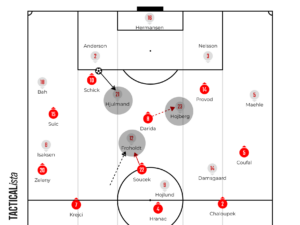
Froholdt’s movements created space for Andersen to find Hjulmand. The midfield overload enabled Denmark to progress.
The early goal effect
Denmark’s dominance in the early stages was undone with an early goal by Šulc. A corner was swung in by Coufal which went over the head of everyone crowded in the box. The ball kindly falls for Šulc, who catches a clean strike to wrap the ball in the back of the net. Czech’s early lead gave the home fans optimism and much vibrancy early on.
Denmark approached the game slightly more attacking with their fullbacks pushing up and overloading the back-line. Bah and Mæhle pushed up to the last line and this reduced the numbers for Czech Republic’s first line of pressure. Šulc was tasked to track Bah’s movements and with Bah pushing higher up, Šulc at times was non-existent in the first line of pressure.
Denmark sustained control with their center backs not under much pressure from the Czech forwards. Andersen and Nelsson had time and space to play balls over the top and, when they didn’t, Højbjerg and Hjulmand dropped deep to dictate the play.
Denmark changed to a 3-1-6 setup with one of their midfielders dropping in to join the back-line. The fullbacks pushed up and swapped roles with their wingers occasionally. The rotations were very fluid and that was very crucial to Denmark’s control. Czech Republic conceded momentum but were a threat in transition. Schick, Provod and Šulc caused Denmark problems on the counter.
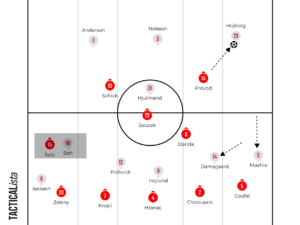
Denmark’s rotations pushed back Czech Republic’s high pressure forced them to sit deeper.
The late surge
In the second half, Denmark continued to control the game. Czech Republic sat deeper in their own half to defend the lead but were also aggressive while doing so. Their wide center backs still maintained their man marking duties and made sure the team made it harder for Denmark when they tried to play through their mid-block.
Denmark later found an equalizer from a set piece. An indirect free kick taken from Damsgaard found the head of Andersen in the box. Denmark found an answer in the box after an awaited period in the second half and had enough momentum to carry on and win the game.
The introduction of Christian Eriksen allowed Denmark to exert more control towards the ending of the game and the extra time period. He was the focal point on the ball and brought a creative spark to his team. Czech Republic used long throws and corners to generate some momentum late in the game and they got rewarded from it.
After a top defensive display from Krejčí, he put his country ahead resulting from a long throw. Coufal’s long throw doesn’t beat the first man and is headed away back to Coufal. His cross comes off Souček and finds its way to Krejčí, whose left footed strike finds the net at the back-post.
Denmark found an equalizer later in the second half extra time from their super subs combining, Kasper Høgh and Anders Dreyer. Dreyer delivers a corner that finds the head of Høgh, who heads the ball past the goalkeeper. Four goals resulting from set pieces and these two teams couldn’t find the breakthrough afterwards.
Penalties decided the winner with Denmark missing three out of their four spot kicks. Czech Republic booked a spot in the World Cup after a resilient and hard fought battle with Denmark.
Takeaways
Denmark controlled large phases of the game through structured possession, often building in a 4-2-3-1 that shifted into a 3-1-6, with full-backs like Joakim Mæhle and Alexander Bah pushing high to pin the Czech block. Midfield rotations allowed them to progress the ball, and Rasmus Højlund provided a direct outlet with his hold-up play. However, their dominance lacked cutting edge, as loose touches and poor final passes limited their effectiveness in the final third and led to turnovers.
Czech Republic were compact and disciplined in a 5-2-3 mid-block, balancing selective pressing with strong central protection. They posed their main threat in transitions, where Lukáš Provod, Pavel Šulc, and Patrik Schick attacked space quickly and directly. Set pieces proved decisive, with all goals coming from dead-ball situations, and despite Denmark’s late control boosted by Christian Eriksen, their lack of clinical finishing ensured the game remained level before Czech Republic secured victory on penalties.
match plots would be added as soon as possible.
Comments