

Why Does Serie A Look Like That?
Another World Cup missed. Another year without participants in the quarter-finals of the Champions League. Italian football is in dire straits, but what are the tactical themes that are causing this rot?
Written by Joel Parker.
We decided to make this article free to read. If you want to support our work, consider taking a subscription.
Over the past decade, Serie A has produced teams that have pushed the boundaries of the league’s tactical blueprint. Luciano Spalletti’s Napoli and Simone Inzaghi’s Inter went on to win the Scudetto with brands of offensive football that entertained, whilst the hybrid pressing of Stefano Pioli’s AC Milan also saw them reach the summits.
Various editions of Gian Piero Gasperini’s Atalanta saw them flourish throughout this period. Thiago Motta and Roberto de Zerbi are no longer active in the league, but their game plans of drawing the opposition into their own defensive third and building play in very different ways clearly made an impact. This led to many teams becoming quite inventive in how they navigated the various man-marking systems that Serie A opponents have always used, especially the movements of the center-backs, who were at the forefront of these creative build-ups. But like most aspects of life, the threat of traditionalism can hinder the progress of innovative minds at work.
This is not to imply that Italian elites have not benefited. Antonio Conte brought the Scudetto back to Napoli with Spalletti’s right-sided rotations still in place and the defensive structure prioritised. Cristian Chivu may be a newer face, but his Inter team is currently at the top, having reduced the wide rotations and evolved the midfield into more traditional roles (most notably, Nicolò Barella back in the mezzala role he previously enjoyed early in his career), while being pursued by Max Allegri, who is back at Milan with his very rigid approach.
The return of traditionalism has had an effect. Napoli were knocked out of the Champions League early, whilst teams outside Europe’s Big Five would knock out Inter and Juve, before Bayern Munich destroyed Atalanta. Meanwhile, the league has reached twenty-nine goalless draws, which is more than the Premier League (twenty-seven), Ligue 1 (sixteen), LaLiga (eleven) and Bundesliga (ten). What explains Serie A’s tendency to stay in a deadlock, and what is leading to the overall quality of the league being reduced?
Intensity, but with issues
The biggest change in high-level modern football has been the improvement of out-of-possession strategy. Lines become blurred between zonal and man-marking approaches, as coaches incorporate multiple layers into their plans, placing triggers for various situations that strike a balance between the two. As these lines blur, the distance between players shortens. Italian football has always been at the forefront of strict man-to-man tactics, even if its pedigree is no longer on par with the peaks of the 90s/early 00s.
In the high block, these operations are in use in various ways. Raffaele Palladino’s Atalanta, Vincenzo Italiano’s Bologna, Gasperini’s Roma and Conte’s Napoli have used rigid forms of man-marking, which see little switchability in the first lines of pressure. When zonal and passive high blocks jump into action, they will move into man-to-man situations against a defensive line that tries to play out from the back. Barella is a good example of this trigger at Internazionale, whilst Alexis Saelemaekers has a similar task from right wing-back at Milan, albeit Inter presses a lot more consistently than their city rival.
Using data provided by MyGamePlan, we can see that Serie A teams have a specific issue. Measuring the passes completed, from the opposition, in their first third is a good indicator of a team’s intensity off the ball. Newcastle United and Liverpool are two clubs whose identity has bloomed from high pressing and are the outliers in the top five European leagues. Serie A teams rank well in this regard: Napoli and Roma, with the lowest percentages (71%), while Como, Inter (both 72%), Genoa and Bologna (both 73%) are below the European average (75%). However, when we compare this with the possession regains, in the final third, a different picture emerges.
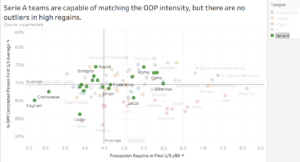
A scatterplot that highlights the passing accuracy of the opposition in their own defensive third versus the number of possession regains made in the final third, per 90 minutes.
The average European team makes 5.08 possession regains in the final third per 90 minutes. Serie A is significantly below this figure at 4.45 per 90; no other league approaches this. The notably passive and zonal set-ups of Cagliari, Cremonese, and Lazio distort this average, but even clubs like Napoli, Bologna, and Atalanta are all below the league average. Only six teams exceed the European average: Genoa (5.2), Lecce (5.24), Roma (5.5), Inter (5.75), Como (5.83), and Juventus (5.99), while there are no outliers that break away from the rest of the group, such as Paris Saint-Germain or Bayern München.
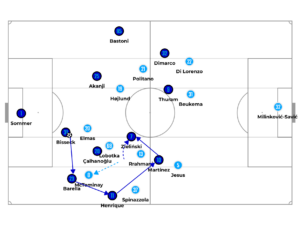
Inter 2-2 Napoli: With both Napoli midfielders committed high in their man-to-man arrangement, spaces occurred when access was made towards Martínez, and Zieliński came more towards the ball side to connect with the move. Even if Napoli were to win back possession in this phase, it would require a quick connection between the two center-midfielders without the striker involved in the transition.
The man-to-man high block can set an intensity on the opposition. However, this does not mean that there is a reliable mechanism for winning the ball back or installing any traps that the opposition can be led into. In deep circulation, utilizing the goalkeeper as a plus one can be enough to stifle the high press from pushing the opponent into a dangerous situation, or it can see a plus one open up in a different position in the buildup. The recent victory for Como over Roma served as a good example: Cesc Fàbregas adapted his team into a 3-4-2-1 formation, which saw right-sided center-back Jacobo Ramón move forward as high as the striker position, Jean Butez be utilized as a spare player in the first line of buildup phase, and one of the center-backs be freed as Donyell Malen pressed onto them.
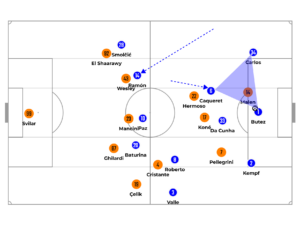
Como 2-1 Roma, 26th minute: Positional rotation from Como forced the Roma high block backwards. The center-backs formed a wide split on the goalkeeper and Maxence Caqueret dropped into the position next to Lucas Da Cunha (situationally the single pivot). As a result, Butez could pass to Caqueret and Diego Carlos was free as Malen had left him to jump onto. In this phase, the long pass from Butez to Ramón and the center-back won the aerial duel, before Ramón continued his run to receive inside the box from Ivan Smolčić.
Buildup, that does not bait
Italian high blocks may lack the traps that force high turnovers, but that does not mean that the buildup is reliable in playing through the lines. Like the out-of-possession operations, the first phase of buildup can still have a common look. To build a line of four on the goalkeeper, the back three is tilted in one of three ways: either one of the wider center-backs pushing into a fullback spot, the central center-back stepping up to play next to the pivot player or the midfielder dropping into the defensive line.
Of course, there are other variations. Bologna is one of the more distinctive, as Italiano has retained some of the structure introduced by Thiago Motta. When building play, the fullbacks tend to stay more passive (and can sometimes take more narrow positions to become a more viable passing option), while the two center-backs perform more advantageous off-ball runs. Once the duo of Riccardo Calafiori and Sam Beukema, who Bologna sold for a combined £63.2 million, Bologna could perform short combinations in a unique manner.
The structure remains intact, but Bologna has faced more issues. Even when the ball is at the goalkeeper’s feet, Bologna does not successfully initiate the press on them during these rotations to break through the middle. The buildup also depends on the fullbacks being in suitable positions to provide secure circulation, but this is not always the case when they are exchanging short passes, which can force the goalkeeper to go long without preparation. The idea of this rotation is for the center-back to bounce off the single pivot, or at least free up space for Lewis Ferguson, Nikola Moro or Remo Freuler, but because the man-marking system remains intact, it does not pull the opposition apart. As a result, Federico Ravaglia or Łukasz Skorupski are heavily involved, but the overall action is not very progressive.
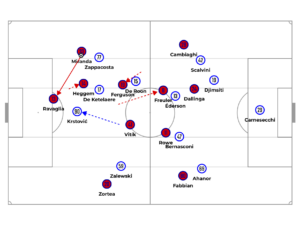
Bologna 0-2 Atalanta, 55th minute: Bologna’s buildup failed to connect through the lines. As Ravaglia held possession, the center of the structure exchanged positions without pulling the man-marking scheme apart. Although the distances were increased, Atalanta could still effectively jump as their opponent had not baited them to trigger a high press with exits available.
At Napoli, Conte has returned to his deep automatisms in the face of adversity. This has seen some trademark positions being taken up in the process: in midfield, Stanislav Lobotka and Scott McTominay operate in close proximity. As passes are channelled through the right side from deep, Lobotka would be nearest to the center-backs, whilst McTominay would be positioned on the same side but slightly higher to offer support or make a third-man run. Until the recent return of Kevin de Bruyne, Alisson Santos and Antonio Vergara executed off-ball runs to open passing lanes towards Rasmus Højlund or to make runs against the last line.
The success rate of Conte’s predetermined patterns has improved since they returned to a variation of the 3-4-2-1 formation. However, as one would expect, these moves are quite readable, and Napoli have been scorned when they are man-marked in an aggressive fashion. Højlund’s wide wrestling of the opposition center-back can be a benefit, but Højlund does represent a common theme when it comes to Serie A and its strikers. The league has players who are good at attacking the depth: Malen is in great form for Roma, Anastasios Douvikas has provided good runs for Como, strikers like Højlund, Jonathan David, Moise Kean and Gift Orban are attackers that run in the space or move like they are second strikers between the lines. However, for a league that is quite reliant on forwards who could anchor play from these longer passes, the roster is quite short in this department outside of Marcus Thuram and Udinese’s Keinan Davis, who can still provide goals.
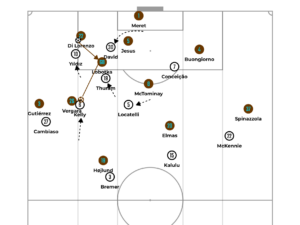
Juventus 3-0 Napoli, 3rd minute: High press from Juve created a high turnover as Juve read Conte’s automatism. After pressing Meret, David dropped onto Lobotka, who received the ball from Giovanni Di Lorenzo, whilst Kenan Yıldız blocked the lane towards the right. With Thuram and David jumping, Lobotka scanned and passed towards Vergara, but Lloyd Kelly read the pattern, and Juve turned the ball over in the final third.
The data is quite reflective of who can build through the lines, starting from the first third of the field. Serie A matches the average of the rest of the European leagues in terms of short goal-kicks being taken, but getting the ball from the first third into the final third is a difficult task for teams not named Como.
Lecce is the outlier in the opposite direction. Since his time at Roma, Eusebio Di Francesco has made a habit of keeping relegation-threatened teams organized but falling on the wrong side of the coin. Lecce are well-drilled in defending transitions and are effective in winning second balls, but their progression from deep is very limited. Genoa, Cagliari, Cremonese, Fiorentina, Torino and Pisa all join Lecce in taking more short goal-kicks, but their final third activity is quiet. Some of these goal-kicks are used to bait the high block, to go directly over the lines. However, the lack of an effective hold-up striker struggles to stabilize attacks.
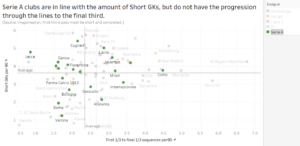
A scatterplot that highlights the number of short goal kicks per 90 by the number of sequences made where the first pass is made in the first third, and completed in the final third per 90 (first third pass must contain a short pass that is completed).
In the deeper buildup phase, teams like Milan, Juve, Inter and Napoli all contain players who can break lines through their passing. Como clearly displays the most solutions, which also see Marc-Oliver Kempf and Ramón be very reliable in progressive carries up the pitch. Left-footed center-backs like Lloyd Kelly, Sead Kolašinac and Alessandro Bastoni all offer this solution too, but when it comes to clean methods going through the lines, Serie A clearly needs a few more coaches to steer the league into a more vibrant environment.
U-shape, with no progression
With high blocks not pinning buildups deep, or plenty of Italian football’s core deciding to drop off into the medium/deep block, then play can be situated around the halfway line without much progression being shown. In possession, the 3-4-2-1/3-5-2 formation begins to filter out, and this is where the game can be most stale.
Deep midfielders are where Serie A still has a rich roster. Manuel Locatelli, Luka Modrić and Hakan Çalhanoğlu all have the license to drop into the first line of buildup and allow their passing range to take centerstage, and in fairness to those players, their ability to break lines remains at a high level. However, the filtering out of the midfield is where the issues take place. In the process, too many players can become situated outside of the block, with no tensions to pry space open between the lines of the opposition. At Inter, Chivu’s team can enter this stalemate consistently as the wide center-backs are not always able to attack the channels and support the wing-backs, which, in turn, makes the wide rotations ineffective as the opposition has time to shift. Barella bounces between lines in the right halfspace, but this can see him become another piece in the lateral circulation and not a diagonal option to open a defense up.
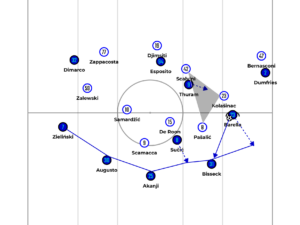
Inter 1-1 Atalanta, 14th minute: In circulation, the arrangement had switched so that Zieliński was wide-left and Sučić was the pivot player. As Barella passed back to Yann Bisseck, he dropped into the wide-right spot and Inter had six players outside of the block in their own half. Marten de Roon could jump, knowing there was no pocket player to cause problems, as Thuram (who acted more as the Lautaro replacement in this game) moved into a position where Kolašinac could collapse onto him, whilst Scalvini closely followed. The ball circulated towards the left before a chipped pass from Zieliński was intercepted.
At Napoli, the issue is more severe as Lobotka has the press resistance, but not the passing range to quickly force problems in another position. This had seen them rely on the right-sided dynamics between Giovanni Di Lorenzo, Frank Anguissa and Matteo Politano for an extended period. Beukema, when he is allowed to move into more adventurous positions, does alleviate some issues in the middle third, but on the left side, a common theme keeps appearing when a winger-profile plays on the left side of the attack. The left wing-back is instructed to invert, and this has left Alisson Santos isolated without many diverse movements around him, an issue which previous left-sided wingers have suffered.
Milan has also suffered similar problems, even if the French duo of Adrien Rabiot and Youssouf Fofana have produced a decent offensive output from the center-midfield. There is no designated direct option as Christian Pulisic must provide extra work between the lines, or Rafael Leão must bank on individual brilliance from wide-left positions to get touches around the final third. Strong seasons from Saelemaekers and the deep runs from Strahinja Pavlović have lightened issues from an attack that is not always that active.
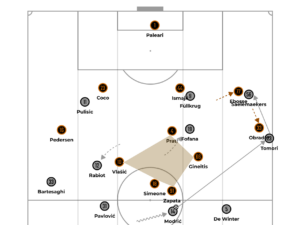
AC Milan 3-2 Torino, 19th minute: The 3-5-2 buildup of Milan versus the 5-3-2 block of Torino, Torino with braver man-to-man marking on the wing-backs. Modrić dictated from the center, but as he moved from the right, Rabiot dropped to fill in his position, despite the spaces in the halfspace. Modrić played the ball out wide to Tomori, and Saelemaekers moved on the underlap, but Torino read the move, and Ebosse’s shoulder on Saelemaekers was enough to stop the move.
Perhaps these issues are most prevalent in the Gasperini teams. Whilst Roma have reshaped their identity into one of his team’s, Atalanta have continued in the same vein under Palladino. Both teams drop both center-midfielders in the 3-4-2-1 formation, but the access into the offensive interiors is limited. Out of possession, the opposition is either in a variation of the back five or the zonal 4-5-1/4-4-1-1 formation that clubs like Lazio, Sassuolo and Parma deploy. In the process, play is funnelled towards the flanks at a low tempo: with the double pivot in the defensive line, it is comfortable for one of the center-midfielders to jump on the ball side, with the attackers being isolated as six/seven players sit outside of the defensive block.
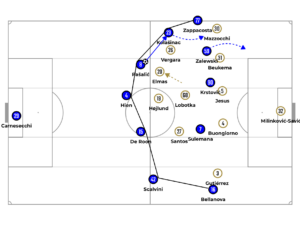
Atalanta 2-1 Napoli, 35th minute: Atalanta buildup against the Napoli defense. Double pivot dropping between the positions of the center-backs meant that Atalanta had way too many players positioned outside of the block or behind the ball to cause a threat.
This issue does not just affect those who play in the 3-5-2 formation. Lazio and Bologna also partake in filtering out their midfield, which sees a similar problem as all the play gets funnelled onto the outer channels, with very few connections being struck amongst the midfielders. Playing against a defensive five, space is most accessible for your fullbacks or wide center-backs to move into and create problems, but Serie A teams have regressed in this field, considering the rotations being performed a few seasons ago.
The data paints a clear image. Serie A joins the Bundesliga and Ligue 1 in having most of its buildup situated in the middle third (52%), but only the Premier League (12.08) has fewer progressive passes being produced, from this location of the field, than Serie A. Napoli ranks below the average European club in this field, despite ranking 9th for total number of average passes in the middle third per game and Como being the only team that ranked higher out of the Italian clubs. Milan is also relatively inactive from deep, with fewer progressive passes than Torino and Bologna. Juventus are the major outlier, thanks to the uptick in form since Spalletti’s appointment in October.
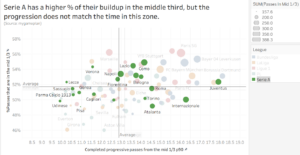
A scatter plot with the percentage of passes that are in the middle third by the completed progressive passes, which are from the middle third per 90. The larger the bubble, the more passes are made in the middle third.
Upon the turnover, these games can become more transitional with the center hollowed out for a limited counterpress to take place. Nevertheless, the issues of Serie A teams have bled into the Italian national side: an institution that has usually leaned towards a 3-5-2 formation, reflecting the most common system in the domestic division. For the games against Northern Ireland and Bosnia & Herzegovina, Gennaro Gattuso had his strongest midfield in place, as well as Bastoni and Calafiori behind Dimarco (over 20 goal contributions from left wing-back).
However, the issues were laid bare when the midfield filtered out, especially against Northern Ireland in Bergamo. Locatelli fixated between Bastoni and Gianluca Mancini, whilst Barella’s activity went as far as dropping into the same line on the right, whilst Sandro Tonali was disconnected from the rest of the midfield. This led to Italy resembling a 4-0-6 in possession, with the midfield being hollowed out and no vertical solutions, despite the general aim of the 3-5-2 system encouraging this. Dimarco and Politano were the only wide presence and neither player, despite their offensive tendencies, was going to offer dynamic dribbles out wide to try and pull the defensive block towards them. In the striker positions, Mateo Retegui and Moise Kean, could not complement one another to create central angles.
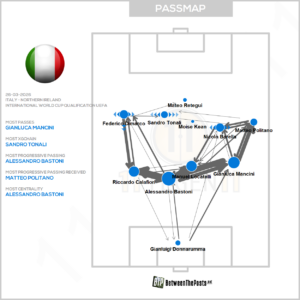
Italy’s passmap versus Northern Ireland.
The result? Italy had 71% possession in the first half (more balanced in the second), and Northern Ireland managed the same number of passes from Zone 14 and completed seven fewer passes in the halfspace than their counterparts. The script in Bosnia was more tragic after Bastoni’s red card, but there is a correlation between a league that has struggled to evolve and a national team which is short of ideas.
Takeaways
Issues for a league or a national team have way more variables and complexities than what goes on the pitch, but it’s what we see on the field that gives us the most tangible evidence. The return of older faces, whilst the next core of Italian coaches is active outside of Italy, speaks volumes to the entire league system and why Serie A has regressed in some of its ideas, even from two or three years ago.
The rotations produced by Spalletti’s Napoli, Inzaghi’s Inter or Motta’s Bologna are so much cleaner than what is currently being made. There is still hope in the current work of Como and Juve to keep an entertaining edge to the league, but there needs to be a lot more if Italian football is to reclaim its status.


Comments