

Bosnia & Herzegovina – Italy: Italian World Cup Nightmare Continues (1-1, 4-2 After Penalties)
Despite struggling to break down Bosnia & Herzegovina’s mid-block pressing, Italy were able to take the lead early in this game. Things turned after Alessandro Bastoni’s red card though, and Italy were left holding on for dear life against a barrage of crosses into the box. They eventually conceded the equalizer and went on to lose on penalties.
Tactical analysis and match report by Josh Manley.
We decided to make this article free to read. If you want to support our work, consider taking a subscription.
Italy were able to secure a comfortable 2-0 win against Northern Ireland in their World Cup qualification playoff semi-final last week despite not putting in an overly impressive performance. Bosnia & Herzegovina meanwhile overcame Wales on penalties after Edin Džeko’s late equalizer cancelled out Dan James’ strike.
Bosnia lined up in a 4-4-1-1 shape for this game with Amar Dedić, Nikola Katić, Tarik Muharemović, and Sead Kolašinac in the backline. Ivan Bašić and Ivan Šunjić partnered in central midfield with Esmir Bajraktarević and Amar Memić wide. Ermedin Demirović then supported the veteran Džeko up front.
Gennaro Gattuso meanwhile fielded an unchanged lineup from the Northern Ireland game. This meant a 3-5-2 formation with a back three of Gianluca Mancini, Alessandro Bastoni, and Riccardo Calafiori, plus Matteo Politano and Federico Dimarco as wing-backs. Manuel Locatelli was the deepest midfielder with Nicolò Barella and Sandro Tonali ahead of him, while Mateo Retegui and Moise Kean were the front pairing.
Energetic Bosnia
In their previous game against Northern Ireland, Italy were able to have a majority of ball possession with relatively little pressure. In this game though, Bosnia were more aggressive adversaries, starting from a mid-block and jumping into a high press where possible.
Bosnia used a 4-2-3-1 shape in pressing, with Demirović looking to mark Locatelli to reduce his influence from the number six space. When they jumped into a higher press, the wide midfielders could engage Italy’s wide center-backs, meaning Bosnia were man-to-man against Italy’s shape.
Against the mid-block, Barella sometimes dropped out to the right of the Italy second line in order to try and pick up the ball in space. Tonali could occasionally do similar on the left. Both wide center-backs for Italy would make forward runs past the wing-backs situationally when they moved the ball into advanced areas.
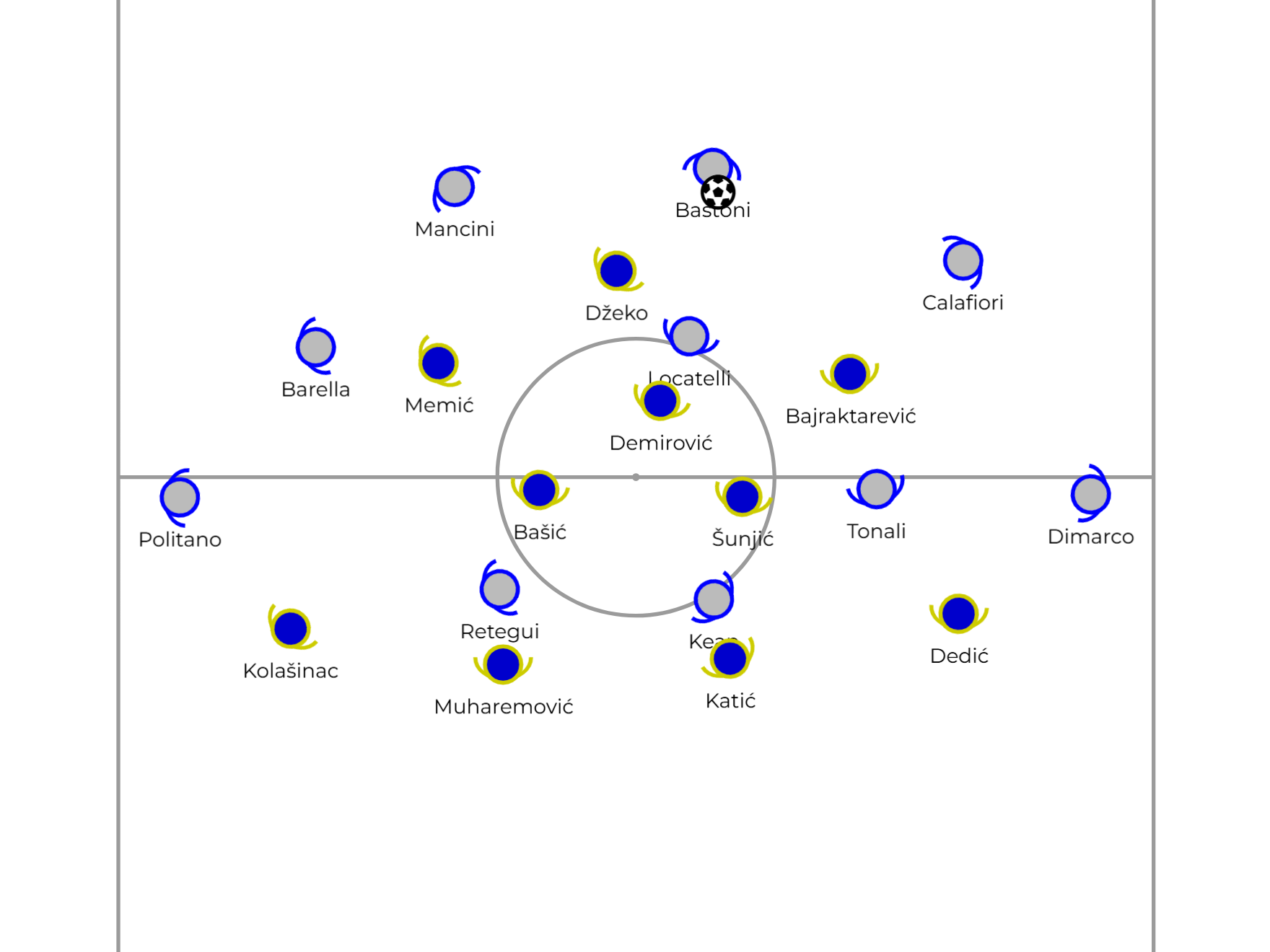
Bosnia’s 4-2-3-1 mid-block shape.
Italy’s wide areas were therefore quite fluid in terms of their rotations between wide center-back, wing-back, and central midfielder. In terms of their final third penetration though, Italy were quite reliant on longer diagonal passes from the wide areas into the strikers, or switches of play.
This was a quite limited approach and Italy struggled to create from their possession phases. However, they were able to take the lead after fifteen minutes thanks to a loose pass from Bosnia goalkeeper Nikola Vasilj which allowed Barella to roll the ball into the path of Kean whose first-time finish was emphatic.
With the ball, Bosnia essentially attacked in a 4-2-4 shape. They were able to prevent the lines from becoming too flat through the fluid movement of the likes of Džeko and Demirović, plus the staggering of the central midfielders.
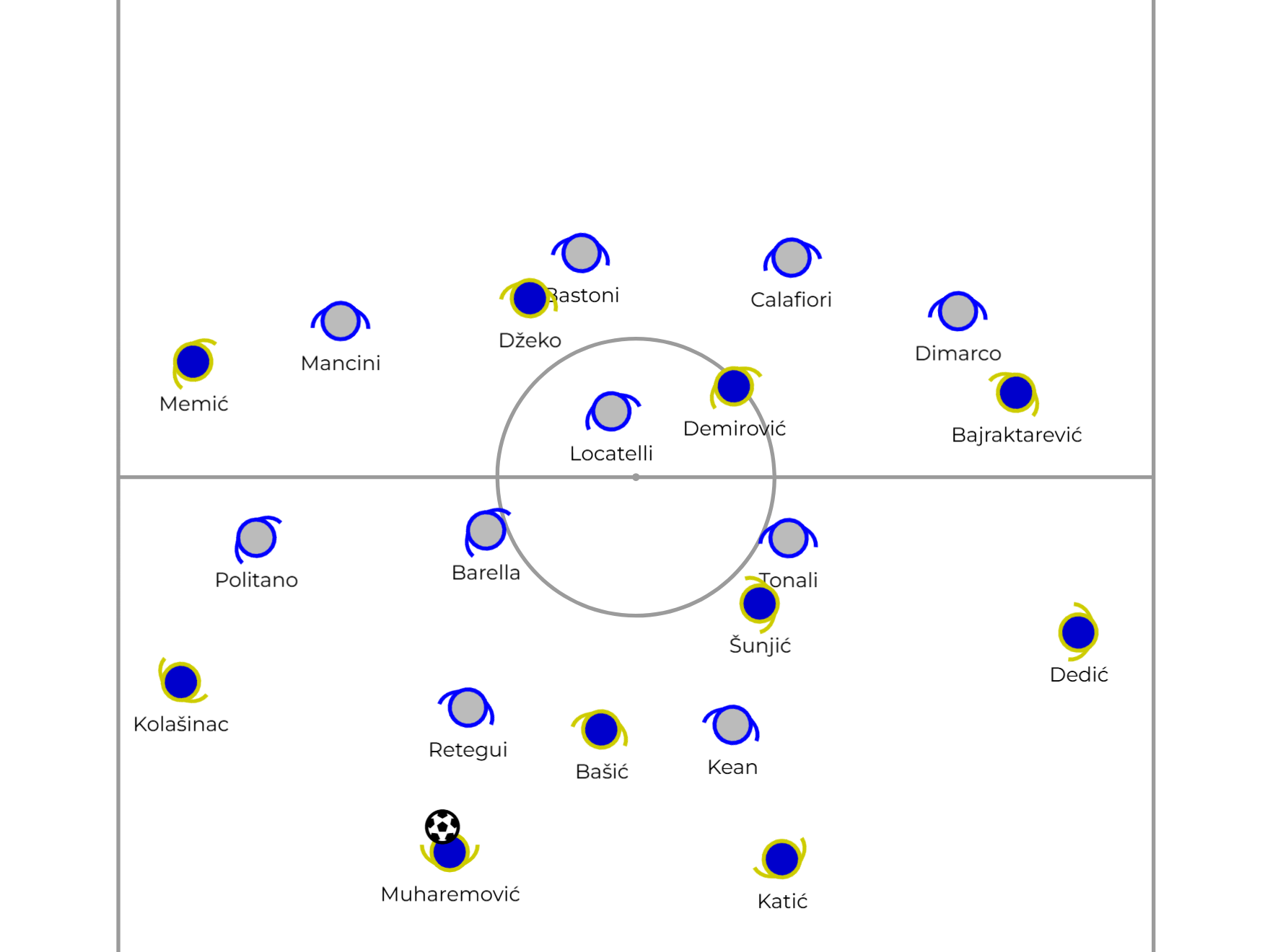
Bosnia against Italy’s 5-3-2 mid block.
It was surprisingly easy for the Bosnia central midfielders to find space between or just behind Italy’s front two. Bašić and Šunjić were generally able to avoid staying in a flat line of two, with Bašić in particular able to drop and pick the ball up from the defense.
They were unafraid to be direct, with Muharemović keen to spray long passes from the backline, plus the wingers providing plenty of width and depth. The crosses they swung into the box in the first half were dangerous, and they made life uncomfortable for Italy.
Pivotal red card
Despite their difficulties, it seemed that Italy were going to end the first half in the lead. Five minutes before the break though, Bastoni was sent off for bringing down Memić as he raced in behind the Italian defensive line.
Gattuso responded by restoring his back five, sacrificing Retegui to bring on Federico Gatti to play as a center-back in a 5-3-1 shape. He also brought on Marco Palestra in place of Politano at the break. Bosnia manager Sergej Barbarez had his own response at half time, making a double change in which Kolašinac and Šunjić were replaced by Kerim Alajbegović and Benjamin Tahirović.
The latter was a like-for-like replacement in central midfield, while the introduction of Alajbegović prompted a reshuffle. Memić switched from left midfield to right back, while Dedić went from right to left back, allowing the youngster Alajbegović to play from the left of midfield.
Italy spent the second half defending a low block, while Bosnia attacked in a 2-4-4 shape. The central midfielders were once again staggered though, with one staying deep and the other arriving at the edge of the box for crosses.
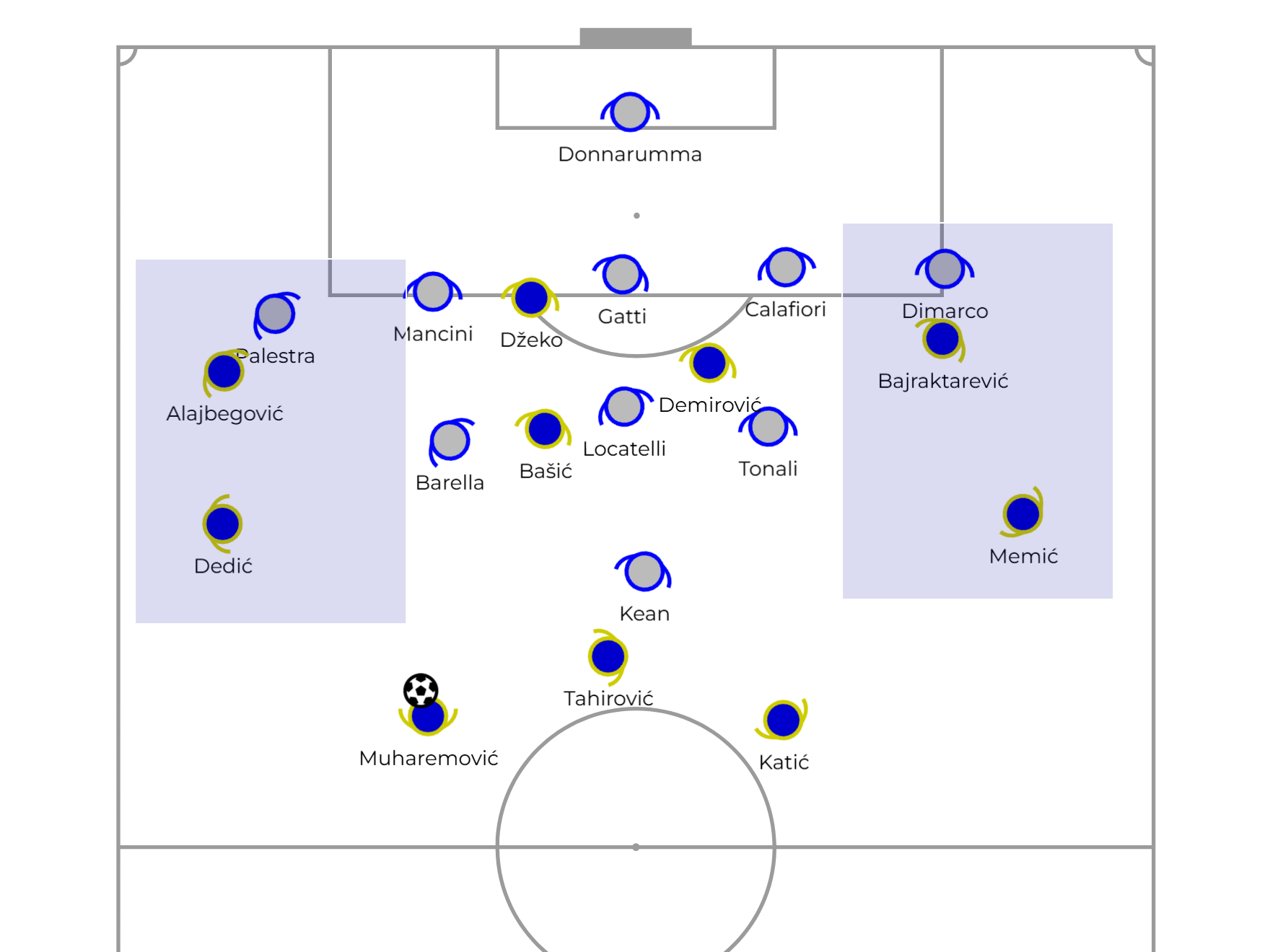
Bosnia were able to exploit the wide areas against Italy’s low block.
With Italy’s midfield and forward units being quite narrow, there was plenty of space in the wide areas to use the fullbacks as starting points for their attacks. Bosnia continued to look dangerous swinging crosses into the box.
With twenty minutes left, both coaches made another double change. For Bosnia, Dženis Burnić and Haris Tabaković replaced Memić and Bašić. This saw the number ten Demirović move back into central midfield to allow Tabaković to play up front, while Burnić played as left back, causing Dedić to move back to the right.
Less than ten minutes later, Bosnia’s siege of the Italian box finally paid off. Dedić’s cross from the right was met by Džeko who was one of three players arriving into the six-yard box. His effort was blocked, but the substitute Tabaković pounced on the rebound to make it 1-1.
The game therefore went into extra time. Due to Italy’s numerical disadvantage though, the Bosnia equalizer did not actually change the pattern of the game that much. The Italians were mostly forced to continue sitting in a low block while the Bosnians probed with wide attacks.
Gattuso’s side were able to weather the storm of extra-time though, taking the game to penalties. Substitutes Pio Esposito and Bryan Cristante both missed their spot kicks though, meaning that it was Bosnia who secured a place in this summer’s World Cup.
Takeaways
Bosnia approached this game with intensity and bravery, not content to play passively with home advantage. The red card surely helped them, but credit should still be given to their performance. They bombarded the Italian box and found the right spaces in the opponents’ shape, and were eventually rewarded for it.
For a country of Italy’s football pedigree missing out on a third consecutive World Cup, especially a 48-team edition of the tournament, is unthinkable. Yet, that is exactly what has happened. While their first half performance was not great, the red card was very much the decisive moment for them in this game – one that will be remembered for all the wrong reasons.
Match plots to be added shortly.


Comments