Mexico – South Africa: Quiñones and Jiménez strike in chaotic, three-red-card World Cup opener (2-0)
Co-hosts Mexico kicked off their 2026 FIFA World Cup campaign with a historic and electric 2-0 victory over South Africa at the legendary Estadio Azteca. Javier Aguirre’s side made a dream start through a 9th-minute strike from Julián Quiñones, before weathering an increasingly physical second half that dissolved into absolute disciplinary chaos. An emotional, late insurance goal from veteran striker Raúl Jiménez sealed the win, completely breaking El Tri’s historical opening-day curse. However, the tactical narrative was completely overshadowed by a modern World Cup record: three red cards brandished by the referee Wilton Simpaio in a ferocious second-half battle.
Tactical analysis and match report by Aderemi Qoyum.
We decided to make this article free to read. If you want to support our work, consider taking a subscription.
The opening matchday of the global showpiece brought a localized, high-stakes tactical battle to Mexico City, with both sides carrying heavy defensive mandates. For South Africa, the tactical assignment under the global spotlight was clear: maintain a highly disciplined, compact 5-3-2 block and ruthlessly exploit the space behind Mexico’s advancing fullbacks on the break.
The hosts, meanwhile, carried the immense weight of home expectations, tasking Aguirre with engineering a system that could break down a low defensive shell without leaving his center-backs completely exposed to vertical counters. The tactical chess match would ultimately be decided by Mexico’s box midfield and central overloads, a coordinated high press, and a complete second-half breakdown in physical discipline.
The tactical layout for this monumental opener saw both managers lean into distinct structural blueprints. Mexico took the pitch in a balanced 4-3-3 formation, starting Raúl Rangel in goal behind a back four of Israel Reyes, César Montes, Johan Vásquez, and Jesús Gallardo, while an industrious midfield trio of Érick Gutiérrez, Érik Lira, and Álvaro Fidalgo worked to feed an explosive frontline led by Roberto Alvarado, Raúl Jiménez, and Julián Quiñones.
On the other hand, South Africa countered with a highly defensive, low-block 5-3-2 system engineered to absorb immense pressure and strike on the counter-attack. Captain Ronwen Williams anchored the side behind a compact five-man defensive wall featuring wingbacks Khuliso Mudau and Aubrey Modiba flanking center-backs Thabiso Sibisi, Ime Okon, and Fawaaz Mbokazi, while a central midfield engine room of Sphephelo Sithole, Teboho Mokoena, and Jayden Adams was tasked with suppressing Mexico’s interior lanes and immediately releasing the dual-striker partnership of Lyle Foster and Iqraam Rayners into vertical transition spaces.
Mexico’s high press leads to early goal
Throughout his managerial career, Javier Aguirre has balanced traditional defensive steel with functional attacking overloads. While Mexico’s first-phase build-up structure comfortably bypassed South Africa’s initial pressing lines, it was El Tri’s out-of-possession aggression that truly dictated the early tempo. When South Africa attempted to build from the back, goalkeeper Ronwen Williams was central to their progression, tasked with finding his split center-backs, playing through to Sphephelo Sithole operating as a single pivot or launching play higher up the pitch.
During this phase, South Africa’s shape morphed as Fawaaz Mbokazi drifted into a traditional left-back role, allowing both wingbacks, Khuliso Mudau and Aubrey Modiba, to push incredibly high up the flanks. Initially, Mexico struggled to consistently win the ball back in the final third. The sheer expansive width of South Africa’s setup forced Aguirre’s men to cover massive amounts of territory, which inadvertently opened up clean, vertical passing lanes for Williams and his defenders to exploit.
To counter this, Mexico adjusted into a narrow, diamond-esque 4-4-2 pressing structure. Raúl Jiménez and Érick Gutiérrez led the first line of the charge by squeezing the center-backs, while the wide forwards tucked inside to choke the halfspaces. Crucially, either Érik Lira or Álvaro Fidalgo would aggressively jump out of the midfield line to lock onto Sithole. The South African pivot quickly became Mexico’s primary pressing trigger, with El Tri hunting for turnovers the moment he received the ball with his back to the play.
This precise tactical trap directly engineered the historic 9th-minute opener. As Williams attempted to play vertically into the center, Lira snuck up undetected from behind a receiving Sithole, ruthlessly dispossessing the midfielder in his own third. The loose ball broke perfectly into the path of the oncoming Julián Quiñones, who clinically burst into the penalty area and slotted a precise finish through the legs of the oncoming Williams. The early strike sent Mexico City Stadium into absolute delirium and forced a shell-shocked South Africa to abandon their expansive short build-up ambitions entirely, retreating into a compact, mid defensive shell to stem the bleeding.
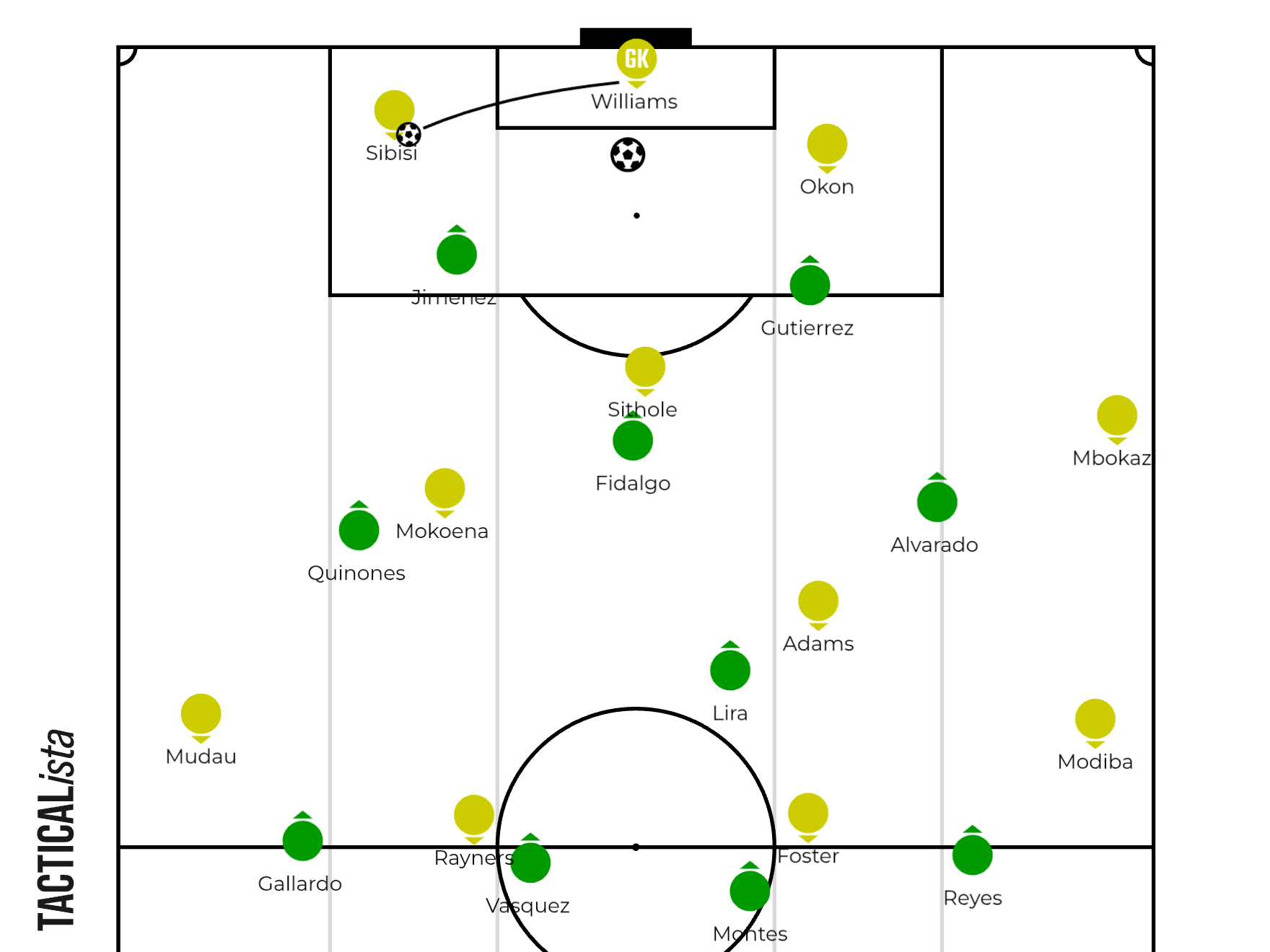
Minute 8′: Mexico press high in a diamond 4-4-2 shape with both wingers tucking in and shifting towards the ball side.
Mexico dominate with their box midfield
Once Mexico established possession, their structural shape mutated dynamically to ruthlessly exploit the seams in South Africa’s defensive structure. Before the opening goal, Érik Lira was seen dropping directly between center-backs Montes and Vásquez to dictate play against South Africa’s front two, establishing a clean 3v2 numerical advantage in the first phase. This deep drop acted as a tactical green light for Israel Reyes to push incredibly high on the right wing to support Roberto Alvarado on the overlap—an early asymmetric mechanism that nearly bore fruit when a pinpoint Reyes cross handed Raúl Jiménez an excellent early chance in the 5th minute.
With Jesús Gallardo holding the width on the opposite flank, Mexico’s initial attacking blueprint resembled an ultra-aggressive 3-1-6 shape designed to stretch Bafana Bafana to their absolute limits. Once the early lead was secured, Aguirre adjusted the system into a highly sophisticated control mechanism that completely overwhelmed South Africa’s engine room. Lira returned to a traditional midfield base just behind the front two of Foster and Rayners, while Reyes tucked back inside to form a conservative back three alongside the center-backs. Ahead of them, Álvaro Fidalgo and Julián Quiñones completed a fluid box midfield alongside Lira and Érick Gutiérrez, handing Mexico a commanding 4v3 overload in the center of the pitch.
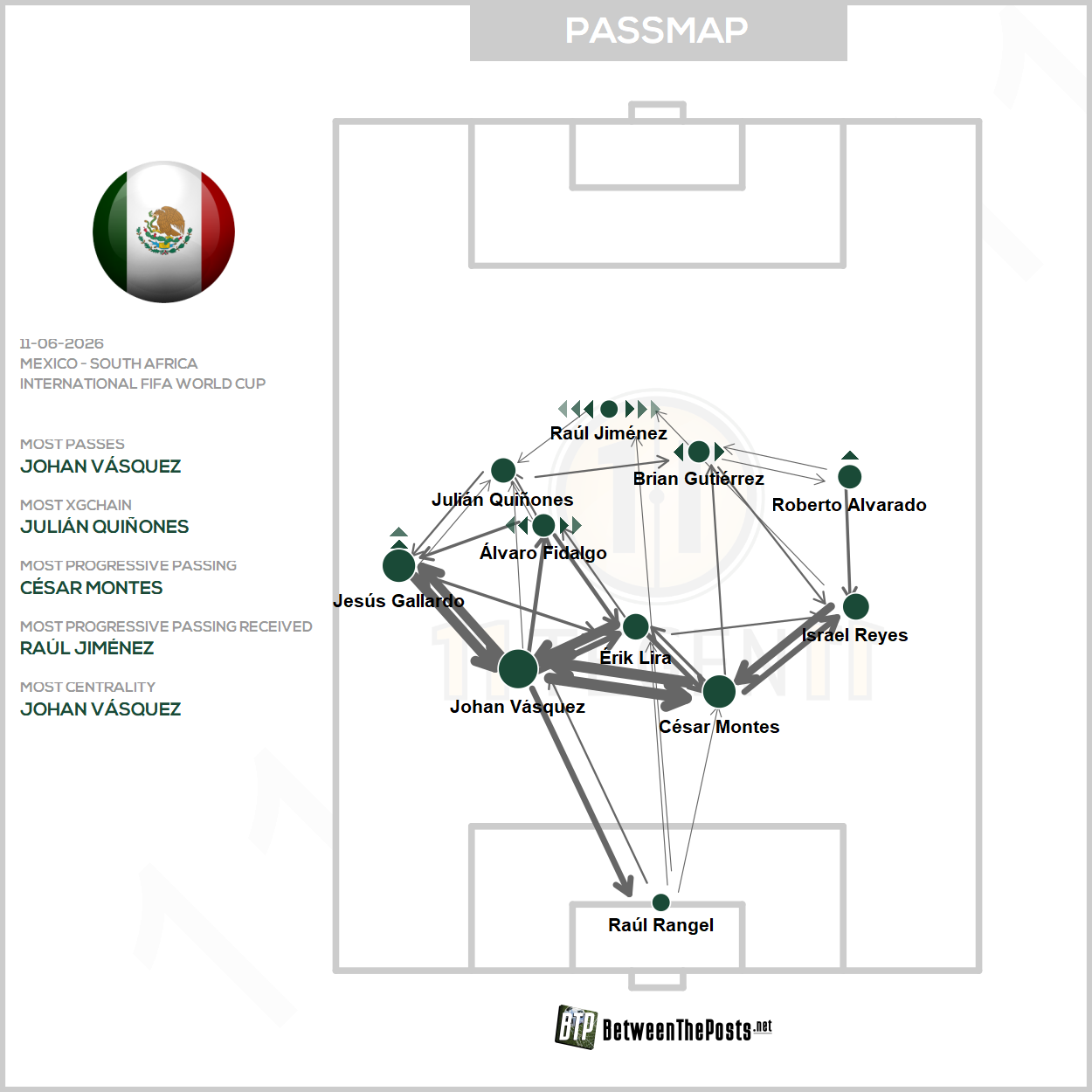
Mexico Passmap
The primary mechanism for progression on the left involved Fidalgo intelligently dropping outside of South Africa’s 5-3-2 block into deep wide areas. This deep, press-resistant positioning served as a tactical trigger; with Fidalgo shielding the wide space and orchestrating from deep, Gallardo was unlocked to confidently hold the width near the halfway line, knowing he had secure structural cover behind him.
This structural flexibility and the constant left-sided rotations caused absolute chaos for Khuliso Mudau, Teboho Mokoena, and Thabiso Sibisi, who perpetually struggled to pass off marking assignments. As Fidalgo controlled the deep halfspace, Quiñones masterfully drifted centrally from the left touchline to occupy dangerous pockets between the lines, or aggressively run beyond Jiménez whenever the veteran striker dropped deep to receive or drag defenders out of position.
Because of the box midfield’s numerical superiority, South Africa’s wide center-backs were completely paralyzed; jumping into midfield to track Mexico’s halfspace threats would instantly leave catastrophic gaps behind them. Consequently, Mexico progressed through the middle with absolute ease, consistently finding Quiñones and Jiménez in central zones as they toyed with the visitors’ hesitant defensive line.
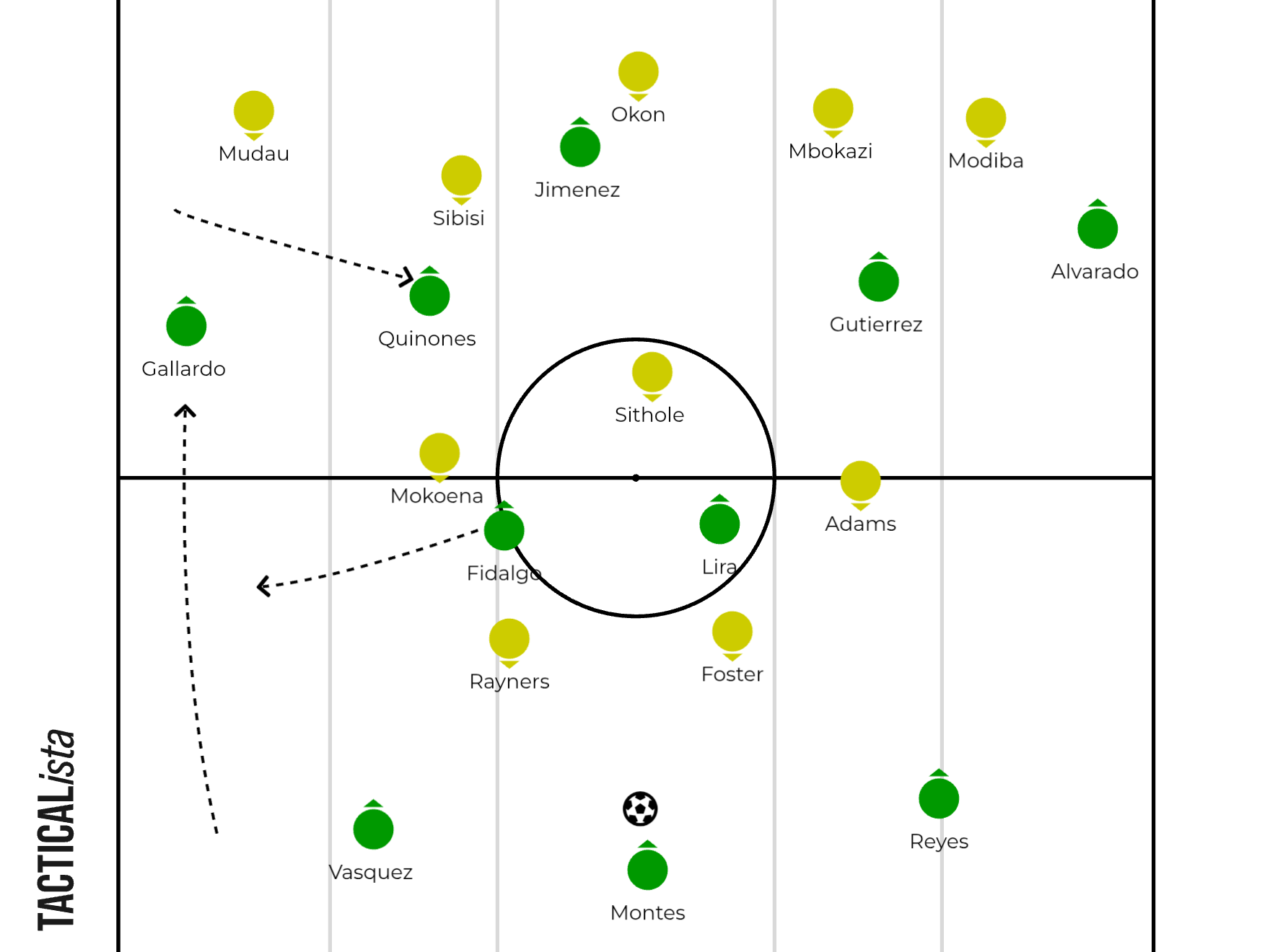
Minute 14′: Mexico box midfield helped to create overloads in the middle. Mbokazi and Sibisi reluctant to jump on the Gutierrez and Quinones in the half-spaces.
South Africa’s possession struggles
When South Africa did manage to secure rare spells of settled possession in the first half, Hugo Broos’s side attempted to establish a 3-2-3-2 or a more expansive 3-2-1-4 structural baseline. In this phase, both wingbacks—Khuliso Mudau and Aubrey Modiba—pushed high up the touchlines to maximize horizontal width, while Jayden Adams operated just behind the dual-striker partnership of Lyle Foster and Iqraam Rayners to pull strings in the central hole.
Despite the aggressive positioning, Bafana Bafana lacked the confidence and clinical cohesion required to unlock Mexico’s defensive layers. Their progression lacked bite, and when they did cross the halfway line, South Africa routinely rushed their decision-making in the final third, turning over the ball cheaply and failing to register a single shot on target until a 37th-minute header from Lyle Foster.
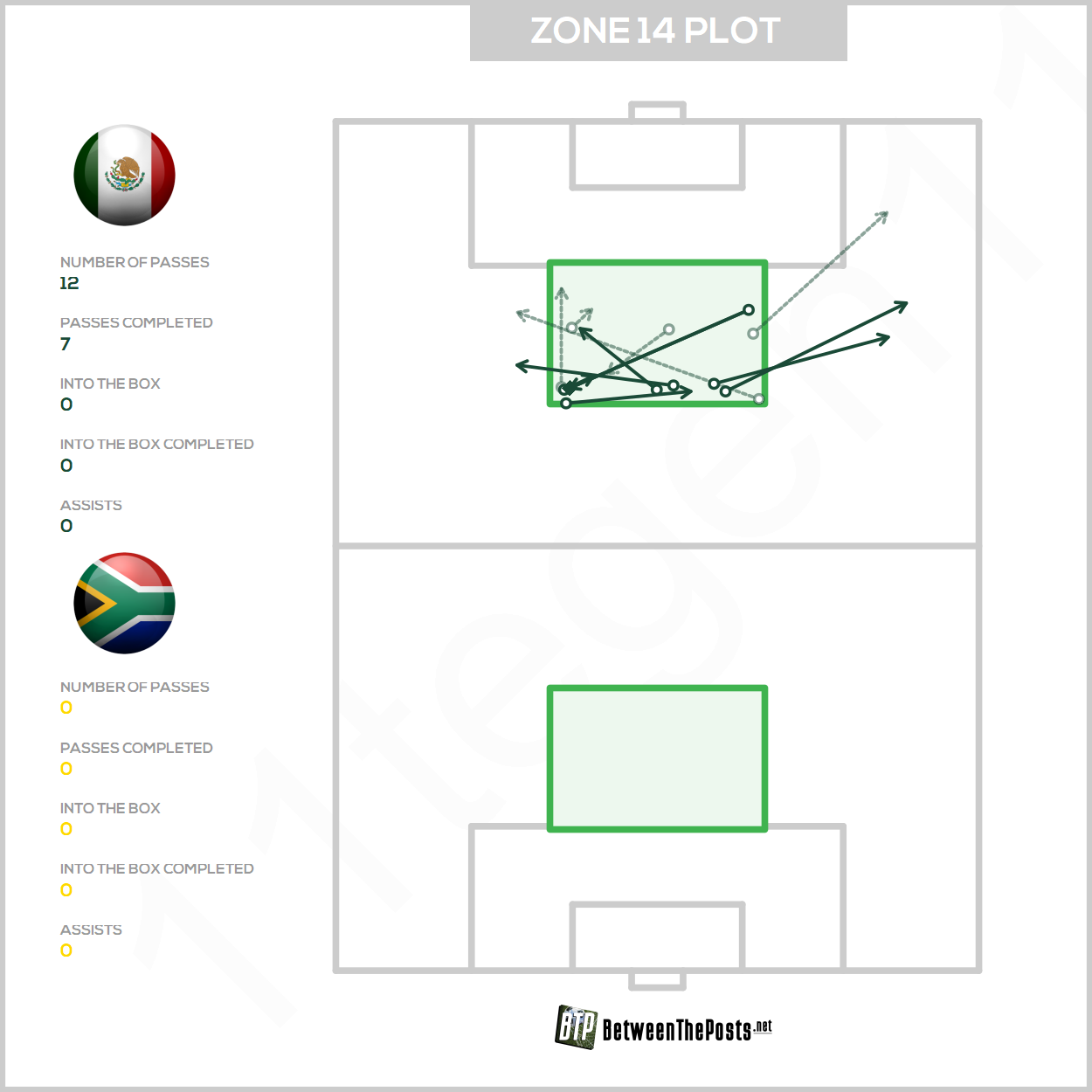
The Zone 14 plot shows how less threatening South Africa were throughout the game with no passes into zone 14 or inside Mexico’s box.
To nullify the threat of being overloaded on the flanks by South Africa’s charging wingbacks, Javier Aguirre engineered an incredibly disciplined, reactive out-of-possession defensive mechanism. Roberto Alvarado was handed a heavy defensive mandate, tracking Modiba’s vertical runs all the way back into the defensive third, which allowed Israel Reyes to tuck inside and seamlessly form a temporary five-man backline alongside the center-backs. Ahead of them, Érik Lira anchored the space by strictly monitoring Adams, while Érick Gutiérrez, Álvaro Fidalgo, and Julián Quiñones compressed into a secondary defensive screen behind a lone Raúl Jiménez. This fluid adjustment morphed Mexico into an impenetrable 5-1-3-1 defensive block, easily suffocating South Africa’s 3-2-1-4 shape and leaving the visitors entirely devoid of ideas.
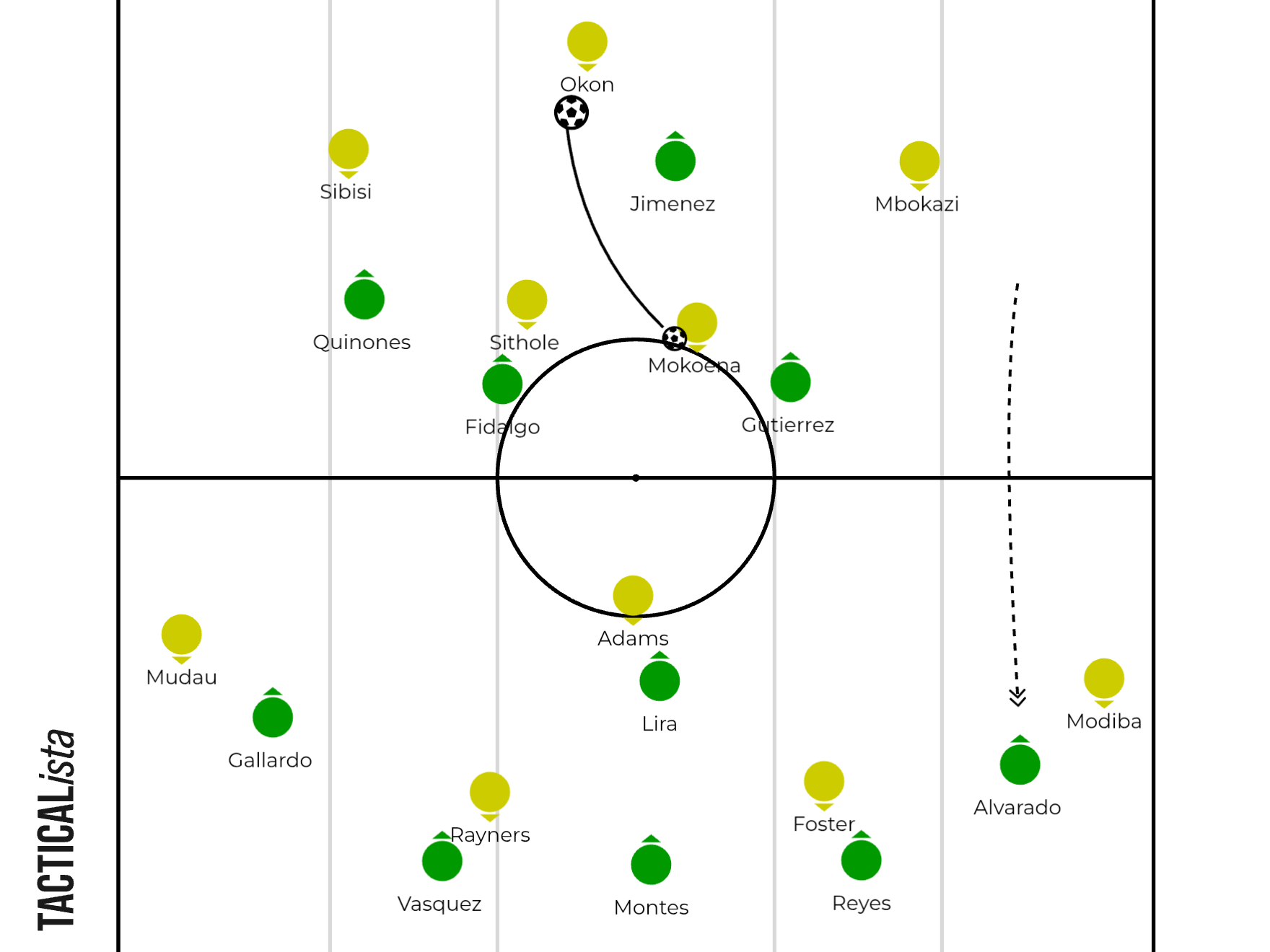
Minute 28′: South Africa set up in a 3-2-3-2 shape IP, but failed to create dangerous chances
Red card, Jimenez strikes, and two more sending-offs
Just 35 seconds after the restart, a rare and uncharacteristic passing error from goalkeeper Ronwen Williams nearly gifted Érick Gutiérrez a second goal, setting a frantic tone for the remainder of the match. The visitor’s structural integrity vanished completely three minutes later, in the 49th minute, when Sphephelo Sithole was shown a straight red card for denying a clear goalscoring opportunity after bringing down Gutierrez from behind on the edge of the box.
Down to ten men, South Africa courageously and perhaps naively refused to drop into a low block, instead opting to press high in an aggressive zonal-man hybrid press to search for an equalizer. This tactical gamble left massive, vacated spaces in central areas that Mexico’s technical midfielders ruthlessly exploited.
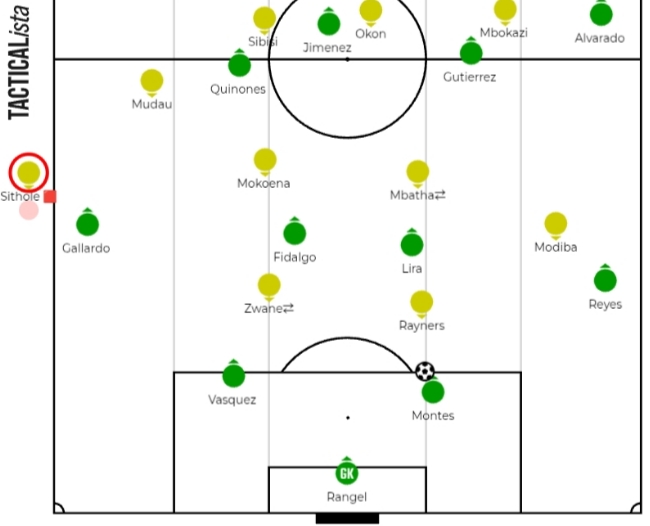
Minute 63′: Ten-man Bafana Bafana pressing high to win possession back, although this plays straight to Mexico’s hands.
South Africa’s inability to settle into a cohesive defensive block after the dismissal directly invited Mexico’s second. In a brilliant exhibition of territorial dominance, El Tri orchestrated an intricate, 34-second passing sequence that involved nine of Mexico’s ten outfield players, entirely pulling the fatigued South African press apart. The breathtaking move between Jimenez and Quinones helped shift the ball to the right wing, where Alvarado whipped a delicious delivery to the back post for Raúl Jiménez to power home a fine poacher’s header in the 66th minute. The emotional strike marked Jiménez’s 46th international goal, tying him with Jared Borgetti for second place on Mexico’s all-time scoring charts.
With the tactical plans entirely dissolved, the match descended into absolute disciplinary fragmentation. The chaos peaked in the 84th minute when South African substitute Themba Zwane was brandished a straight red card for lashing out with his arm, leaving the visitors with nine men. Mexico were not immune to the rising tempers either; skipper César Montes picked up a late red card of his own in stoppage time, reducing the hosts to ten men before the final whistle. This fierce battle secured a historic opening-day victory for El Tri, but it also etched both teams into the record books for the first time in FIFA World Cup history with three red cards in an opening match.
Takeaways
Mexico’s World Cup opener was a mix of tactical brilliance and drama. El Tri impressed with a high-press 4-4-2 that led to Julián Quiñones’ early goal and a 34-second, 9-player passing move that set up Raúl Jiménez’s header, giving Mexico their first-ever victory in a tournament opener.
However, the second-half collapse, including three red cards, raised concerns about discipline. Looking ahead, Mexico must adjust for the loss of César Montes, while South Africa, missing key players Sphephelo Sithole and Themba Zwane, must recover tactically and mentally to remain in contention.