
Brazil – Morocco: Brazil recover from a frightening start in a draw that sounds good for both teams (1-1)
The World Cup got underway for Group C, and anyone who follows international football knew that Brazil and Morocco would be a balanced matchup, pitting a cohesive, consistent and renewed football project against a traditional side whose World Cup qualifying cycle was turbulent until the arrival of Ancelotti and which still needs to find its tactical identity during the tournament itself. Based on what both teams produced, the draw was fair and beneficial for both, though for different reasons.
Tactical analysis and match report by Marcus Arboés.
After arriving at the 2022 World Cup as favorites and being painfully eliminated by Croatia, the Brazil National Team ended the cycle under Tite and went through three different coaches, none of whom managed to restore the team’s confidence and quality of play. The legendary Ancelotti took charge, but with Militão, Wesley, Rodrygo and Estêvão sidelined through injury, he is still searching for his ideal team. Therefore, he lined up: Alisson in goal; Ibañez (Al-Ahli), Marquinhos, Gabriel Magalhães and Douglas Santos (Zenit) in defense; Casemiro, Bruno Guimarães and Lucas Paquetá (Flamengo) in midfield; Vinícius Jr, Raphinha and Igor Thiago (Brentford) as the attacking trio.
Morocco were the biggest surprise of the last World Cup, reaching the semifinals despite Walid Regragui having had little time in charge. This time, however, Regragui left his position shortly before the tournament and was replaced by Ouahbi, who had already enjoyed success with Morocco’s youth national teams. That was not the only change. Experienced players from the last World Cup, such as Ziyech and En-Nesyri, were left out so a new group could be built. In the starting lineup, with Aguerd and Ez Abde unavailable through injury, Morocco fielded: Bono (Al-Hilal) in goal; Hakimi and Mazraoui as the fullbacks, Riad (Crystal Palace) and Issa Diop (Fulham) as the center back pairing; El Aynaoui (Roma) and Bouaddi (Lille) as the holding midfielders, with Ounahi (Girona) as the attacking midfielder; Brahim Diaz on the right wing, Bilal El Khannouss (Stuttgart) on the left and Saibari (PSV) deployed as a false nine.
Morocco’s dominant first half
Regardless of the result, Morocco made history by pressing and overwhelming a five-time world champion for large stretches of the first half, leaving Brazil exposed and pinned back. This happened for a number of reasons that do not diminish what Morocco accomplished tactically, physically, technically and mentally. With young Bouaddi orchestrating the build-up and Brazil looking extremely nervous, the game began in an almost one-sided fashion.
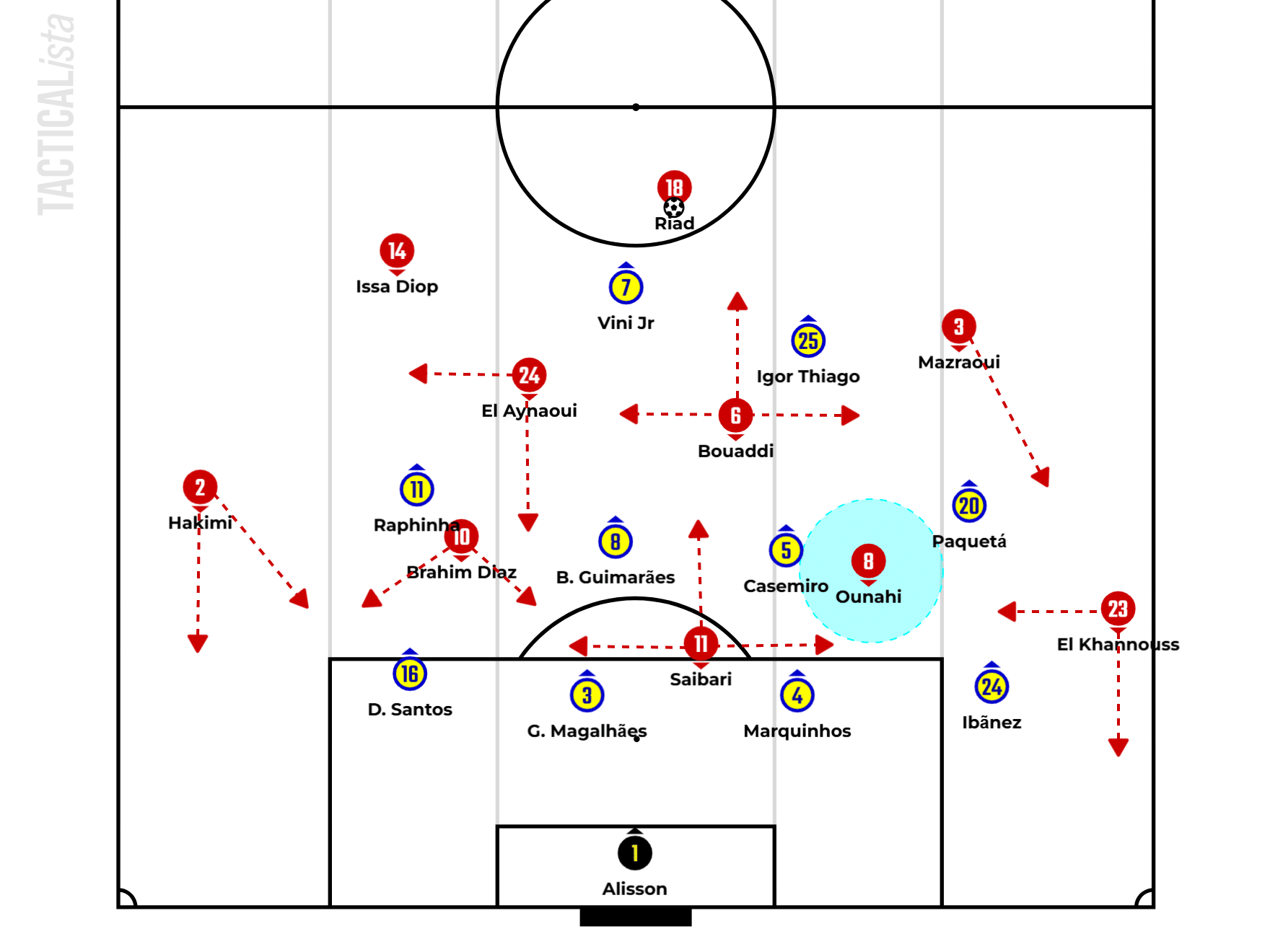
Morocco’s positional attack in a 3-2-5 shape against Brazil’s defense in a 4-4-2 formation.
By design, Morocco operate from a 4-2-3-1 outline that transforms into a positional 3-2-5. The center backs begin the build-up with Mazraoui acting as an inverted fullback at the base of the play, though he is free to support attacks and create overloads alongside El Khannouss on the left side. On the right, Hakimi provides the width, attacking spaces or carrying the ball inside or outside to cross or shoot, while Brahim Diaz influences the build-up more directly and operates between the lines alongside Ounahi, who enjoys greater positional freedom from the left side, and Saibari, who nominally plays as a striker but was free to provide support wherever he wanted in the attacking half.
The key to the team lay in the midfield pairing. El Aynaoui interpreted available spaces and frequently arrived near the edge of the box, creating constant uncertainty for opponents, while Bouaddi influenced the build-up across the entire pitch from deep positions. His ability to escape pressure and progress play was outstanding, making him the central figure of the night. Nobody could keep up with him defensively or disrupt the fluidity of Morocco’s positional game. In attack, he also contributed through quick circulation to exploit players in advantageous positions on the opposite side, taking advantage of the slow defensive shifting in Brazil’s 4-4-2 structure.
Every Moroccan attack created nervous silence in Brazilian households. Brazil defended poorly while retreating and their defensive lines looked fragile and easy to manipulate. What prevented a worse outcome were several important shot blocks, particularly from Marquinhos and Bruno Guimarães. Brazil’s start to the match was terrifying, not only because of Morocco’s technical superiority during that phase, but also due to the sheer number of misplaced passes and ineffective attacking constructions.
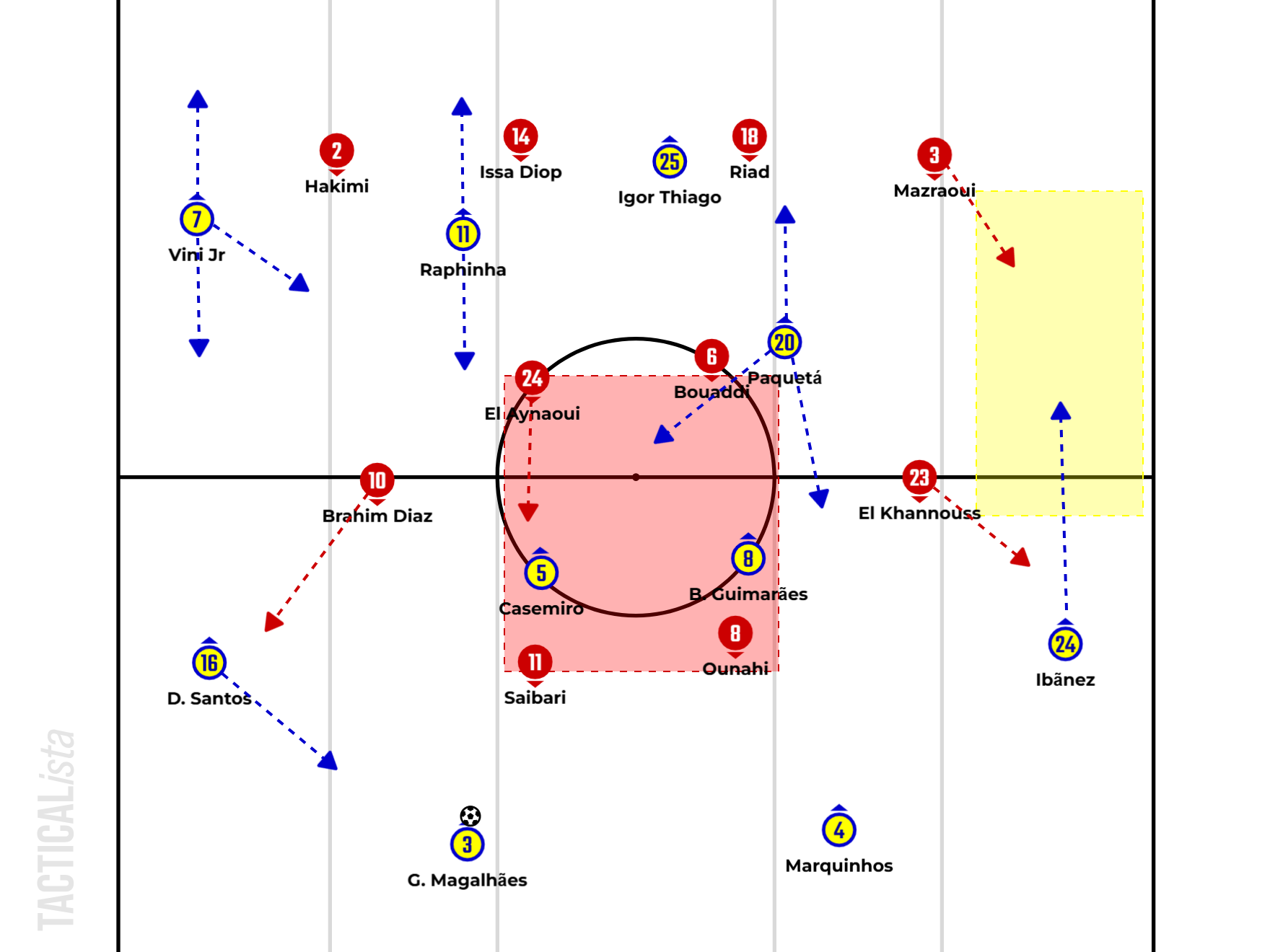
Brazil’s build-up from an asymmetric structure, with Morocco defending the central block in a zonal 4-4-2 formation.
Brazil created virtually nothing through central areas, but there was a clear explanation. The initial setup featuring three midfielders, with Bruno Guimarães and Casemiro as the deeper players, Paquetá dropping as a number ten to create superiority and even Raphinha operating more centrally as an additional support player within an asymmetric 4-2-3-1/4-3-3, had been instrumental in several recent victories under Ancelotti. Morocco’s strategy to neutralize it, however, was excellent.
Given that Gabriel and Marquinhos are center backs with excellent passing ability, Saibari and Ounahi, forming the first defensive line, did not jump forward to press. Instead, they passively protected passing lanes toward Casemiro and Bruno Guimarães. The compactness between Morocco’s first two defensive lines and this specific behavior meant Bouaddi and El Aynaoui did not need to step out aggressively onto Brazil’s midfielders, avoiding exposure between the lines or being attracted out of shape, as previous opponents of Brazil had been.
With the center of the pitch closed, Douglas Santos dropped to form a 3+2 structure, Paquetá moved deeper, Bruno or Casemiro advanced, and Brazil attempted to create numerical superiority at the base of the play. However, nothing proved effective in stretching Morocco’s medium block either horizontally or vertically. With Raphinha tucked inside from the left and Paquetá functioning as a central playmaker, Brazil became asymmetric and effectively gave up having an advanced player on the right. On two occasions, Ibañez received long balls into that space, but this is not his natural profile, unlike Wesley, who missed the tournament through injury, since Ibañez is fundamentally a center back.
Lacking confidence to progress and visibly nervous, Brazil misplaced numerous passes. One of them led to a counterattack where Brahim Diaz brilliantly positioned himself in the blind spot of Brazil’s defensive transition, dropping into open space without pressure despite being surrounded by three Brazilian players. From there, he produced a perfect pass into Saibari’s run. With Marquinhos slow to provide cover and Alisson rushing off his line too early, the PSV attacker produced a beautiful chipped finish.
Ancelotti’s answers in the second half
Brazil’s equalizer only arrived following a quick attack in which Paquetá dropped to the left side to create superiority and release Vinícius Jr. At a moment when Brazil were playing poorly and looking nervous, Paquetá delivered the pass, dragged defenders with his movement and allowed Bruno Guimarães to receive from Vinícius before returning the ball for the Brazilian star to score a superb goal that brought Brazil back into the game. There was still a long way to go if they wanted to win. With Casemiro and Ibañez struggling and both booked, Brazil’s coach decided to alter both the structure and the confidence of his team.
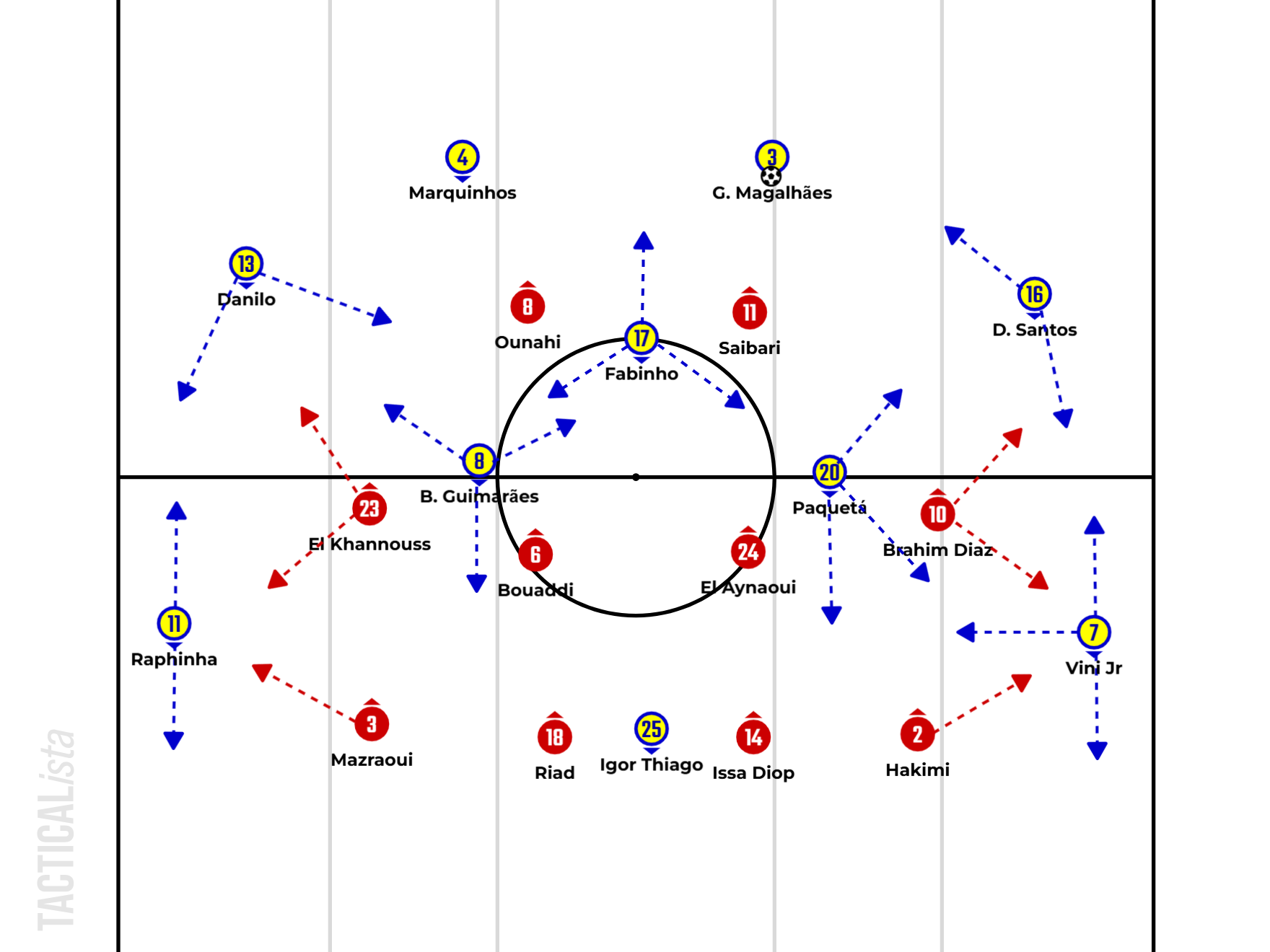
Brazil’s attack in a 4-3-3 shape during the second half, with Fabinho at the base of the build-up and Raphinha wide on the right wing.
Casemiro had a poor first half defensively. After Fabinho entered, Bruno Guimarães became less burdened with initiating attacks, and both the midfield structure and player profiles changed. Bruno operated more on the right, advancing through central spaces or helping build from deeper areas, while Paquetá remained more to the left, supporting Vinícius Jr both inside and outside and even helping initiate attacks from wide positions, as he did in the move leading to the goal.
The other change came on the right side. Already on a yellow card, Ibañez, who also appeared nervous and struggled badly in individual duels, made way for veteran Danilo, whose call-up had been questioned because he is currently a Flamengo substitute. One of the squad leaders, he showed great composure while helping initiate attacks from a back four. Whenever Brazil built down the left, Danilo moved inside as an auxiliary midfielder, allowing Bruno to advance centrally alongside Paquetá, while Raphinha now held width on the right, providing another outlet and combination option.
With both fullbacks starting deeper, the workload on Morocco’s wingers increased. Brahim Diaz and El Khannouss, who defended outside the block in the second line, occupied ideal positions either to jump onto the fullbacks or drop and create double coverage against Brazil’s wingers. After the adjustments, that defensive burden changed because Morocco’s greatest advantage, locking down the central block, no longer had the same value as Brazil increasingly built through the flanks.
Although Brazil enjoyed more possession and Paquetá, who had misplaced the pass leading to Morocco’s goal, improved significantly in attack while the fullbacks looked more secure, something was still missing. Ancelotti therefore made another adjustment.
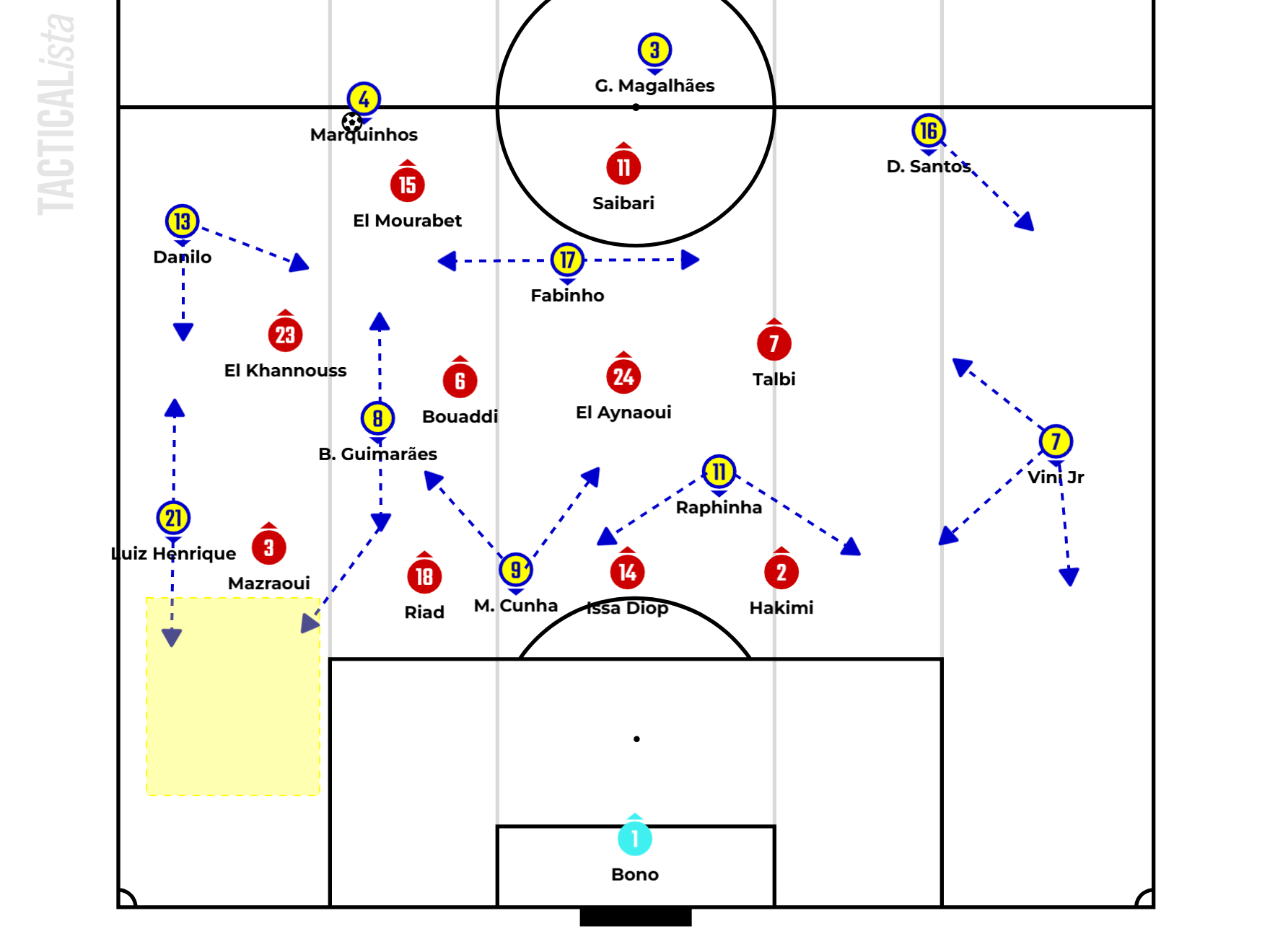
Brazil in an asymmetric 4-4-2 formation, with Matheus Cunha and Raphinha operating centrally to create overloads through the flanks.
Raphinha was holding the width on the right but struggled both to receive with his back to goal during build-up and to beat Mazraoui in one-on-one situations. Therefore, Luiz Henrique entered, offering greater support play, better hold-up qualities and more unpredictability on the wing. The change came at the expense of striker Igor Thiago, who had been anonymous throughout the match. As a result, Raphinha moved inside alongside Matheus Cunha, who replaced Lucas Paquetá, altering Brazil’s attacking structure.
Ancelotti’s team now operated in a 4-4-2 formation that became asymmetric whenever one midfielder remained deeper at the base of the play on the attacking side while the other advanced to exploit spaces or provide support in more advanced central areas. This frequently occurred on the right, with Bruno Guimarães pushing forward inside and attacking the space behind Mazraoui, a gap created by Luiz Henrique’s movements.
On the left, Fabinho generally started attacks alongside Douglas Santos, looking to find Vinícius Jr in wide positions. Whereas Vinícius had previously sought combinations inside with Paquetá, he could now combine with Raphinha or act as the wide playmaker himself while Raphinha attacked space. However, this combination only worked once, leading Matheus Cunha to drift more toward the left, dropping deeper as a playmaker to free Vinícius to advance.
In response, with Brazil no longer focusing on central superiority, El Mourabet replaced Ounahi to provide greater disruption during Brazil’s build-up, while Talbi came on for the tiring Brahim Diaz to strengthen the right side defensively and bring fresh energy. Brazil remained the better and more dominant side, although Morocco became more dangerous and enjoyed more possession in the closing stages, only to be denied by two excellent saves from Alisson in the final minutes.
Takeaways
As I said, this draw was good for both teams. Morocco’s young generation managed to hold a star-studded Brazilian side and even competed at an excellent technical and tactical level against the most successful World Cup nation in history. The outstanding performances of Brahim Diaz and Ayyoub Bouaddi perfectly embodied Morocco’s generational renewal, as the federation continues investing heavily in strengthening the national team through closer ties with the Moroccan diaspora in Europe, attracting elite young talents who could have represented Spain, France or other major footballing nations.
Brazil, meanwhile, will always carry enormous expectations because of their status, but the Brazilian public currently appears more skeptical than confident. That feeling was reflected within the squad itself and in figures such as Vinícius Jr, from whom the entire football world expects greater performances in the yellow shirt. His goal during a difficult moment, reviving both the team and the crowd, provides an important boost in confidence, because he represents the identity of Brazilian football, where individual talent, combined with a strong collective structure, can define World Cup nights.
It was a good match from both sides, featuring excellent individual stories. Both teams now have one point, ahead of Haiti, who played better but lost to Scotland, the leaders of Group C. In the next round, Brazil face Haiti while Morocco take on Scotland.
Use the arrows to scroll through all available match plots. Click to enlarge. Check the match plots page for plots of other matches.


Comments