
Côte d’Ivoire – Ecuador: Diomande’s Brilliance Prevails over Ecuador’s Positional Play (1-0)
For an hour, Ecuador looked like the side with clearer positional ideas, using rotations and overloads to destabilize Côte d’Ivoire’s defensive block. Yet as the game evolved, the athleticism, transitions, and tactical adjustments of the African side gradually tilted the contest before a late winner sealed a deserved victory.
Tactical analysis and match report by Sebastián Parreño.
We decided to make this article free to read. If you want to support our work, consider taking a subscription.
From the opening stages, the clash presented a classic stylistic contrast. Ecuador sought control through possession and positional structures, while Côte d’Ivoire preferred to defend compactly before unleashing their athletic attackers in transition. The Ivorians defended in a 4-4-2, with the back four of Guéla Doué, Wilfried Singo, Emmanuel Agbadou, and Ghislain Konan behind the midfield pairing of Franck Kessié and Seko Fofana. Evann Guessand Diomande and Touré occupied the wings, while Nicolas Pépé partnered Elye Wahi up front.
Ecuador’s possession structure was notably more elaborate. Sebastián Beccacece’s team built in a 3-2-5, but one with several asymmetries. Joel Ordóñez and William Pacho formed the central defensive base alongside Alan Franco, who inverted from right back into midfield and then into the back line. This inversion was particularly significant because Franco is naturally a midfielder rather than a fullback, making the structure ideal for his skill set. Moisés Caicedo partnered Pedro Vite in midfield, although Vite frequently dropped deeper and constantly moved across zones to facilitate progression. Ahead of them, Ecuador’s front line stretched Côte d’Ivoire’s defense with a combination of width, interior movements, and rotations.
The Ivorian response to Ecuador’s shape was intelligent. Rather than pressing recklessly, Wahi and Pépé matched Ecuador’s center-backs directly, while Touré stepped out aggressively whenever Franco received possession. Franco’s reception became an explicit pressing trigger. The effect was immediate: Ecuador were repeatedly forced backward and often resorted to long passes. Only Vite’s mobility prevented the hosts from becoming completely trapped in their own buildup. His ability to drift into free spaces repeatedly manipulated Côte d’Ivoire’s 4-4-2 and gave Ecuador valuable progression routes.
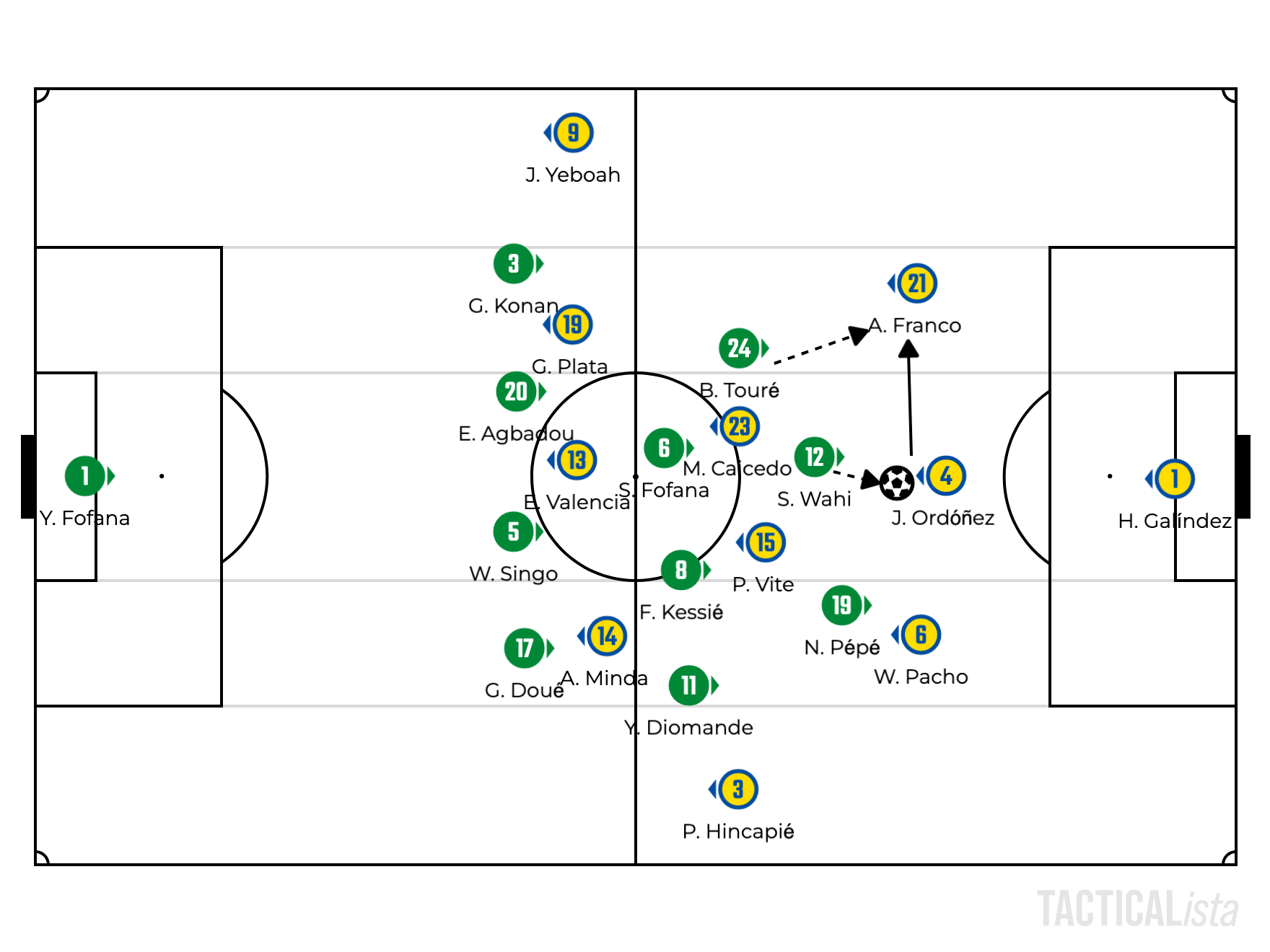
Cote d’Ivoire’s 4-4-2 against Ecuador’s 3-2-5
Positional rotations create overloads, but at a cost
Ecuador’s attacking intentions were ambitious. Their five-player last line often overloaded Côte d’Ivoire’s back four, generating numerical superiority in advanced areas. A particularly important mechanism involved Vite dropping into Hincapié’s vacated zones whenever the left-sided defender advanced. This rotation preserved rest defense while maintaining attacking numbers.
However, the trade-offs were substantial. Hincapié’s advanced positioning frequently left Ecuador exposed against Diomande, who was operating on that flank for much of the first half. In practice, Ecuador often ended up with Vite joining the last line while Minda held width and Hincapié occupied interior spaces. Despite the attractive geometry, these rotations failed to consistently destabilize the Ivorian defense.
The player who most benefited from Ecuador’s fluidity was Vite. His constant movement disrupted the defensive references within Côte d’Ivoire’s 4-4-2 block, opening passing lanes between defenders and midfielders. Several through balls emerged from these manipulations, allowing Ecuador to bypass the defensive line and generate promising opportunities.
Still, Côte d’Ivoire never appeared overly concerned. Their defensive scheme was relatively passive, yet there was an underlying confidence rooted in their physical profile. With only four defenders and two midfielders behind the ball, they trusted their athletic superiority to survive positional attacks while waiting for transition opportunities. Against a technically precise opponent, this setup could be vulnerable, but Ecuador were unable to consistently punish it.
One clever Ecuadorian solution involved Gonzalo Plata. By drifting wide to the right, Plata occupied spaces that the Ivorian center-backs were unwilling to follow into. This, in turn, forced Touré to remain in position rather than jump onto Franco, giving Ecuador cleaner buildup sequences and temporarily easing the pressure on the first phase.
Ecuador’s press: effective when committed, vulnerable when not
Without the ball, Ecuador defended in a 4-4-2, with Plata joining Enner Valencia on the first line. Their pressing scheme aimed to attack Côte d’Ivoire’s 4-2-4 attacking structure aggressively in midfield zones. The back line would shift across and convert into man-oriented marking, attempting to suffocate progression.
Yet the transformation from zonal to man-oriented pressing was not always fast enough. There was often a brief moment during these transitions when Côte d’Ivoire’s defenders and midfielders had time to lift their heads and find forward passes. When those passes reached the front line, Ecuador suddenly faced dangerous four-versus-four scenarios—particularly problematic given the dribbling qualities of Diomande.
A recurring issue centered around Pépé’s positioning. His hybrid role between midfield and attack created uncertainty for Pacho. If Pacho hesitated to press, Pépé received freely. If he jumped aggressively, large gaps appeared in Ecuador’s last line that Côte d’Ivoire immediately looked to exploit. The same problem appeared during Ivorian buildup from a 4-2-1-3 shape, where Pépé either found space or positioned himself advantageously to attack second balls.
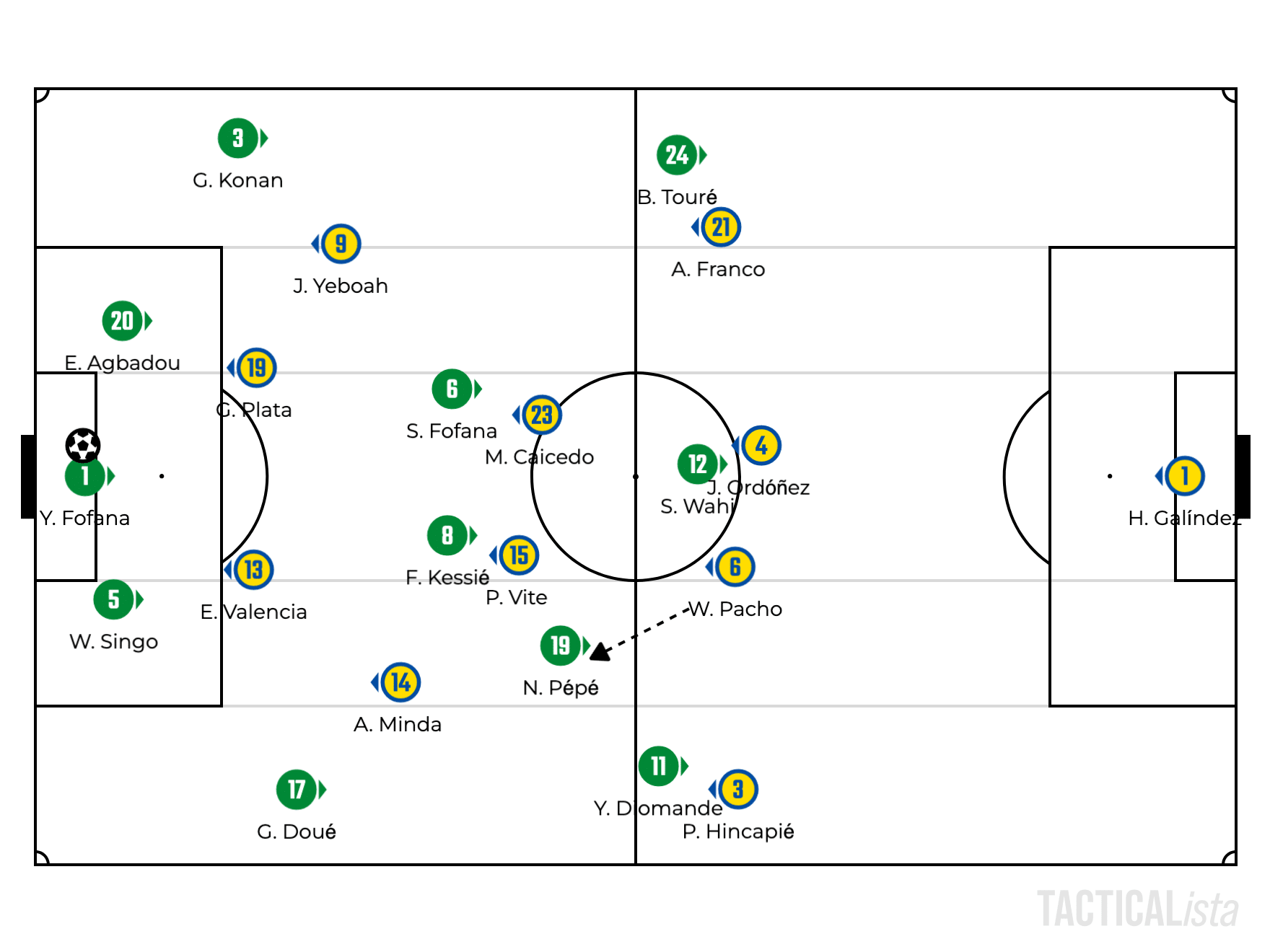
The Cote d’Ivoire build-up that exposed a problem in Ecuador’s press, as Pacho was playing an intermediate position and wouldn’t fully commit to his man.
Ecuador’s high press itself worked effectively whenever fully executed. They forced turnovers high up the pitch and generated quality chances from those recoveries. Their failure was not structural but clinical: two efforts struck the post, and several promising moments went unfinished. As a result, a first half in which Ecuador looked slightly superior ended without reward. Meanwhile, Côte d’Ivoire’s primary threat remained clear: Diomande repeatedly isolated Hincapié and generated danger, as the Leipzig player flew by the defender on multiple occasions.
The second-half imbalance: Ecuador lose the midfield
The game’s tactical landscape changed significantly after halftime. Ecuador shifted toward a 4-1-5 structure, with Vite moving into a left-back role. While the adjustment increased numbers on the last line, it came with a severe cost: the midfield became almost entirely vacant. Caicedo was left alone inside the 4-4-2 cage with Kessié and Fofana patrolling him.
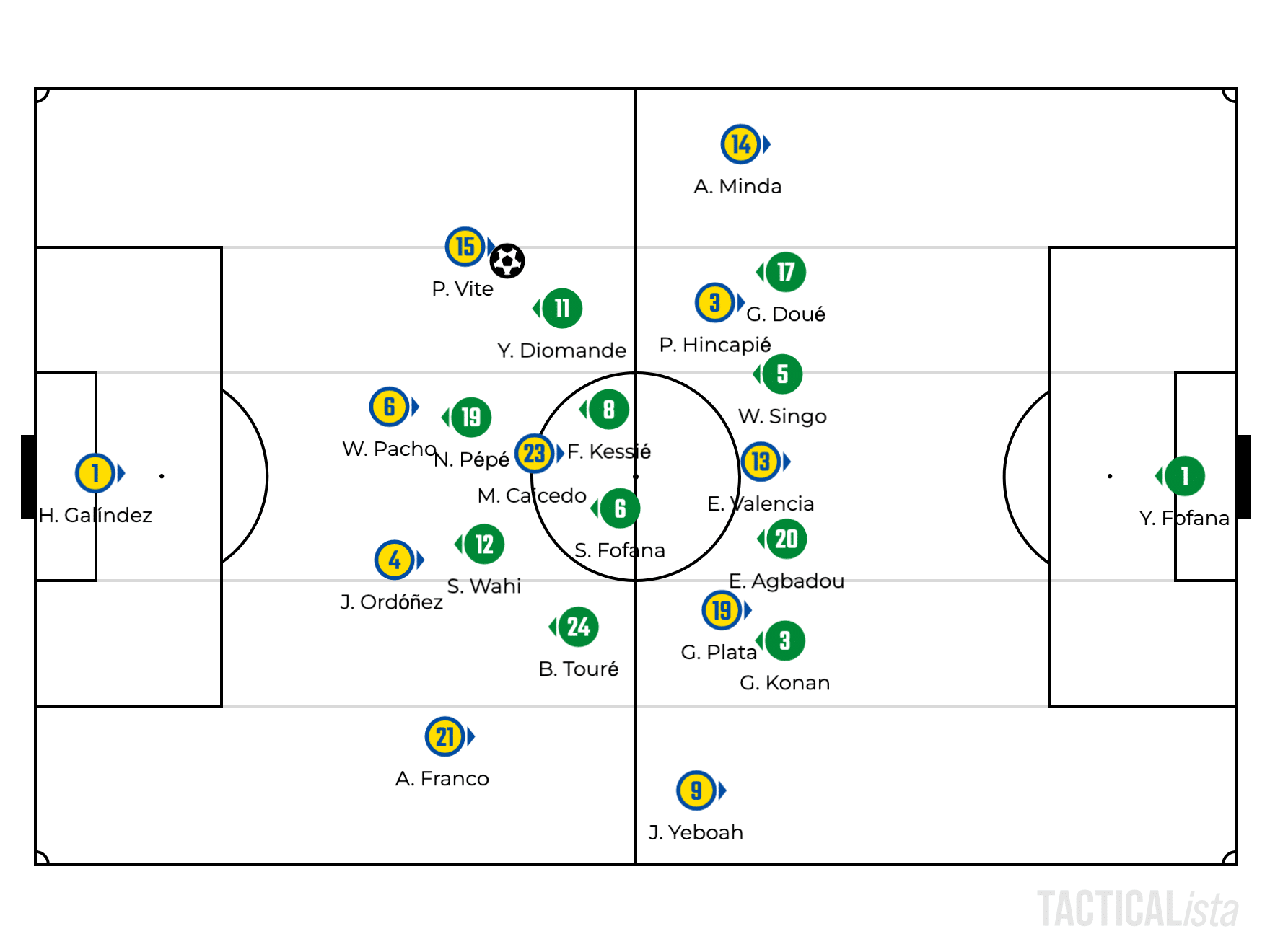
The second half set-up from Ecuador that didn’t work, as they ended up resorting on long balls that the defenders always won.
As a consequence, Ecuador increasingly resorted to direct play. In theory, their five attackers against Côte d’Ivoire’s four defenders offered an advantage. In practice, the Ivorian back line possessed a clear physical superiority. Ecuador repeatedly lost aerial duels and second balls, turning possession into immediate transition opportunities for their opponents.
The absence of midfield control also expanded the spaces available for Côte d’Ivoire to counterattack. Ecuador suffered increasingly in transition during the second half, with their rest defense becoming progressively unstable.
Diallo and Diomande turn the match
The decisive tactical shift arrived in the 55th minute. Diallo entered for Touré, while Diomande switched from the right flank to the left. What followed was effectively a chess match in which Ecuador constantly reacted rather than dictated. Beccacece introduced Preciado, a right back, as a right winger to help defensively with the unstoppable Diomande, while Franco was replaced by Porozo and Ordóñez moved into a new role on the right side also in an effort to contein the youngster.
The core of Côte d’Ivoire’s attacking success lay in the support provided by their fullbacks. Doué and Konan consistently overlapped and created numerical superiority around the ball. Ecuador frequently tried to double-mark Diomande and Diallo, but doing so simply freed the fullbacks to attack the half-spaces. The Ivorians continually generated favorable situations regardless of Ecuador’s defensive choice.
From that point onward, Côte d’Ivoire largely controlled proceedings. Ecuador became increasingly erratic in possession, losing the ball quickly and appearing intimidated by the growing attacking threat. The substitutions failed to improve the team’s balance, whereas Diallo immediately impacted the game, stretching Hincapié just as Diomande had done earlier.
A late winner born from structural collapse
The winning goal in the 90th minute encapsulated the themes of the second half. The move began when Angulo failed to track Singo’s run from deep. As Ecuador’s defense scrambled to manage multiple runners, Singo advanced all the way into the attacking third before delivering a pass behind the defensive line. Ecuador’s defenders had retreated too deep, while the midfield failed to recover into the vacated space. Diallo arrived in the gap and finished beyond Hernán Galíndez to seal victory.
It was not merely an isolated defensive mistake, but the culmination of Ecuador’s deteriorating structure: stretched lines, insufficient midfield coverage, and constant pressure from Côte d’Ivoire’s transitions.
Takeaways
This match was ultimately a contest between two opposing footballing philosophies. Ecuador attempted to create through positional play, overloads, and rotations. Côte d’Ivoire sought to create through transitions, athletic superiority, and wide isolation. For much of the first half, Ecuador’s positional mechanisms produced the cleaner football and the better chances. Yet football rewards control of key moments as much as control of possession.
Côte d’Ivoire’s second-half dominance, driven by the introduction of Diallo, the positional flexibility of Diomande, and the constant support from the fullbacks, gradually transformed the match. Ecuador’s structural changes after halftime removed midfield stability, increasing the game’s openness in precisely the way the Ivorians desired. By full time, the result felt deserved: one side never stopped refining its advantages, while the other slowly lost control of its own. Diomande was the outstanding figure throughout, regardless of flank or defensive attention, and Côte d’Ivoire’s superior adaptations ultimately made the difference.
Use the arrows to scroll through all available match plots. Click to enlarge. Check the match plots page for plots of other matches.


Comments