
Egypt – Australia: The Pharaohs Outlast The Socceroos To Script World Cup History (1-1, 4-2 On Penalties)
Egypt produced one of the most memorable results in the nation’s football history, defeating Australia 4-2 on penalties after a fiercely contested 1-1 draw to secure their first-ever qualification for the FIFA World Cup Round of 16. Emam Ashour gave the Pharaohs an early advantage with a well-taken header, before Australia drew level through a Mohamed Hany own goal after the interval. Both sides created opportunities during extra time, but neither could find the decisive breakthrough. Egypt remained flawless from the penalty spot, converting all four of their attempts, while Australia’s misses proved costly, sealing a historic victory that sent the Pharaohs into the round of 16 for the first time.
Tactical analysis and match report by Mustafa Hassan
Egypt entered the Round of 32 looking to make history by reaching the FIFA World Cup Round of 16 for the first time. After progressing from Group G through a series of disciplined performances, Hossam Hassan was forced into two changes to his preferred starting line-up.
Ahmed Fattouh’s injury saw Karim Hafez come into the side at left-back, while Mohannad Lasheen was suspended through accumulated bookings. As a result, Hamdy Fathy returned to his natural position in central midfield alongside Marwan Attia, allowing Rami Rabia to come into the side and form a new centre-back partnership with Yasser Ibrahim, the first time the pair had started together during the tournament.
Hassan retained his familiar 4-2-3-1 structure. Mostafa Shobeir started in goal behind a back four of Mohamed Hany, Rami Rabia, Yasser Ibrahim and Karim Hafez. Hamdy Fathy partnered Marwan Attia in the double pivot, while Emam Ashour and Mostafa Ziko operated as relatively conservative wide midfielders to provide defensive support as well as attacking width. Mohamed Salah was given a free role behind Omar Marmoush, who once again led the Egyptian attack.
Australia also remained faithful to their established 3-4-2-1 system under Tony Popovic. Patrick Beach started between the posts behind Alessandro Circati, Harry Souttar and Lucas Herrington. Jordan Bos and Aziz Behich occupied the wing-back roles, while Jackson Irvine partnered Aiden O’Neill in central midfield. Cristian Volpato and Connor Metcalfe operated in the half-spaces behind Nestory Irankunda, who spearheaded the Australian attack.
Egypt’s 2-2 Build-Up
Egypt consistently built possession through a clear 2-2 structure, with Rami Rabia and Yasser Ibrahim forming the first line of construction behind the double pivot of Hamdy Fathy and Marwan Attia. Although Australia defended in a compact mid-block, Tony Popovic’s side showed little intention of applying direct pressure to Egypt’s two holding midfielders. Instead, Cristian Volpato and Connor Metcalfe remained relatively narrow, protecting central passing lanes rather than stepping forward to engage the pivots.
Egypt exploited this behaviour intelligently. Rather than asking only one midfielder to drop alongside the centre-backs, both Hamdy Fathy and Marwan Attia consistently positioned themselves underneath the ball during the build-up. While this occasionally created numerical equality rather than superiority, it occupied Australia’s two attacking midfielders and prevented them from jumping onto the Egyptian full-backs. As a result, Mohamed Hany and Karim Hafez frequently received possession in advanced positions with time to progress play.
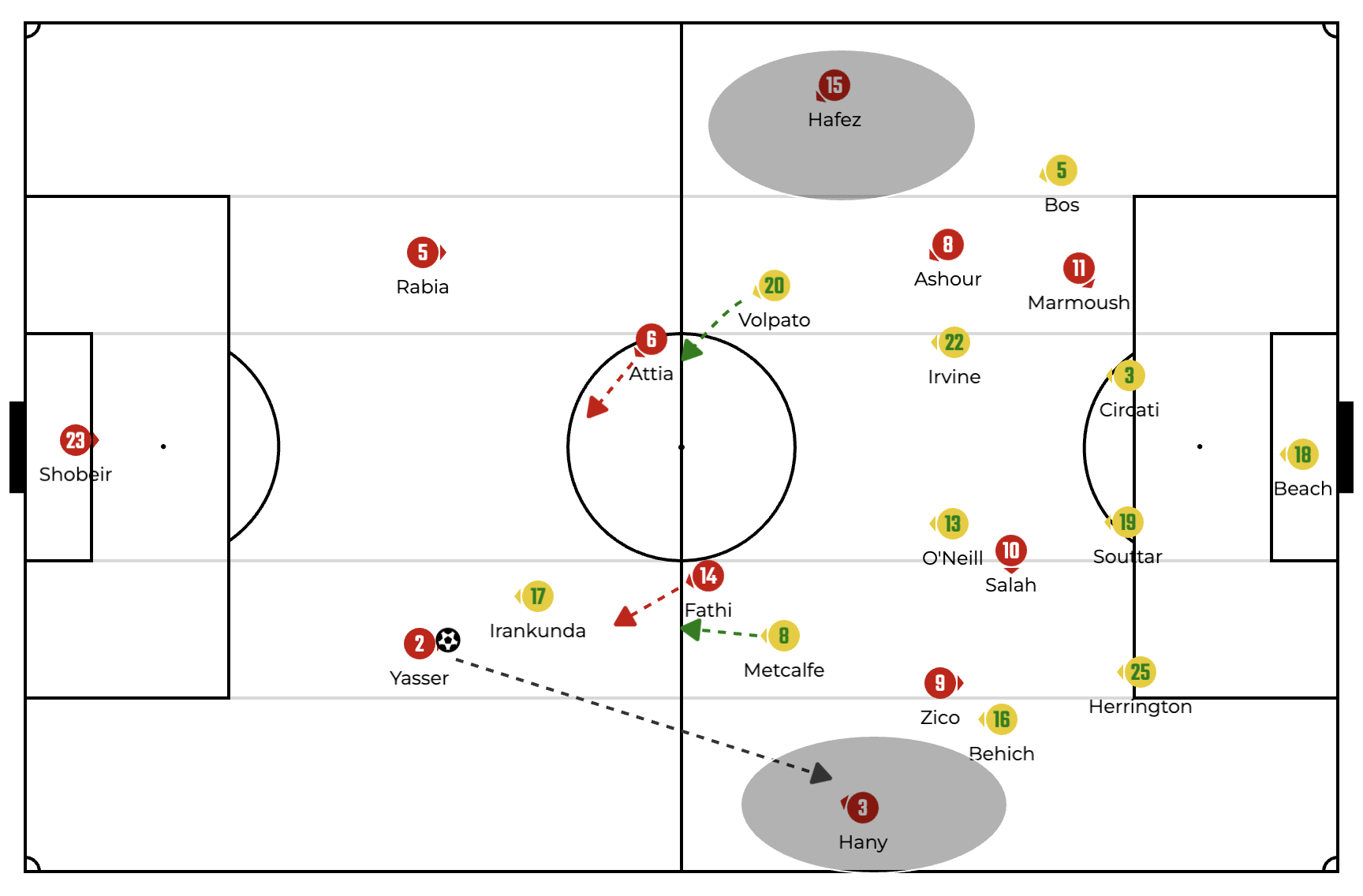
Egypt’s 2-2 build-up pinned Australia’s attacking midfielders centrally, creating space for Mohamed Hany and Karim Hafez to receive high and progress possession down both flanks.
The movements of Emam Ashour and Mostafa Ziko further enhanced this mechanism. Instead of remaining fixed on the touchline, both wide midfielders regularly drifted into the inside channels, dragging Australia’s wing-backs with them and vacating the wide corridors. This created clear passing lanes towards Hany and Hafez, allowing Egypt to advance possession through the flanks rather than forcing play through central areas. By combining their disciplined 2-2 build-up with intelligent off-ball movements, Egypt repeatedly bypassed Australia’s first defensive line and established controlled attacks from wide areas.
Australia Targeted Egypt’s Right Flank Through Rotational Overloads
Australia’s most effective attacking pattern came down their right side, where Tony Popovic’s team repeatedly created local overloads to disrupt Egypt’s defensive structure. Rather than progressing through direct passes, the Socceroos relied on compact positional rotations designed to manipulate Egypt’s pressing and create space behind the left-back.
The sequence regularly began with Jordan Bos holding an extremely wide position on the right touchline. Around him, Aiden O’Neill, Jackson Irvine and Alessandro Circati positioned themselves in close proximity, forming a compact diamond that offered multiple short passing options. Australia circulated possession patiently between the four players, forcing Egypt’s midfield to shift across while maintaining numerical support around the ball.
This circulation eventually achieved its intended objective. As Karim Hafez stepped out aggressively to press the diamond, supported by Marwan Attia moving across to help contain the overload, the space behind Egypt’s left-back became increasingly exposed. Cristian Volpato timed his movement perfectly into this vacant channel, receiving between the lines after Australia’s patient combinations had drawn Egypt out of shape.
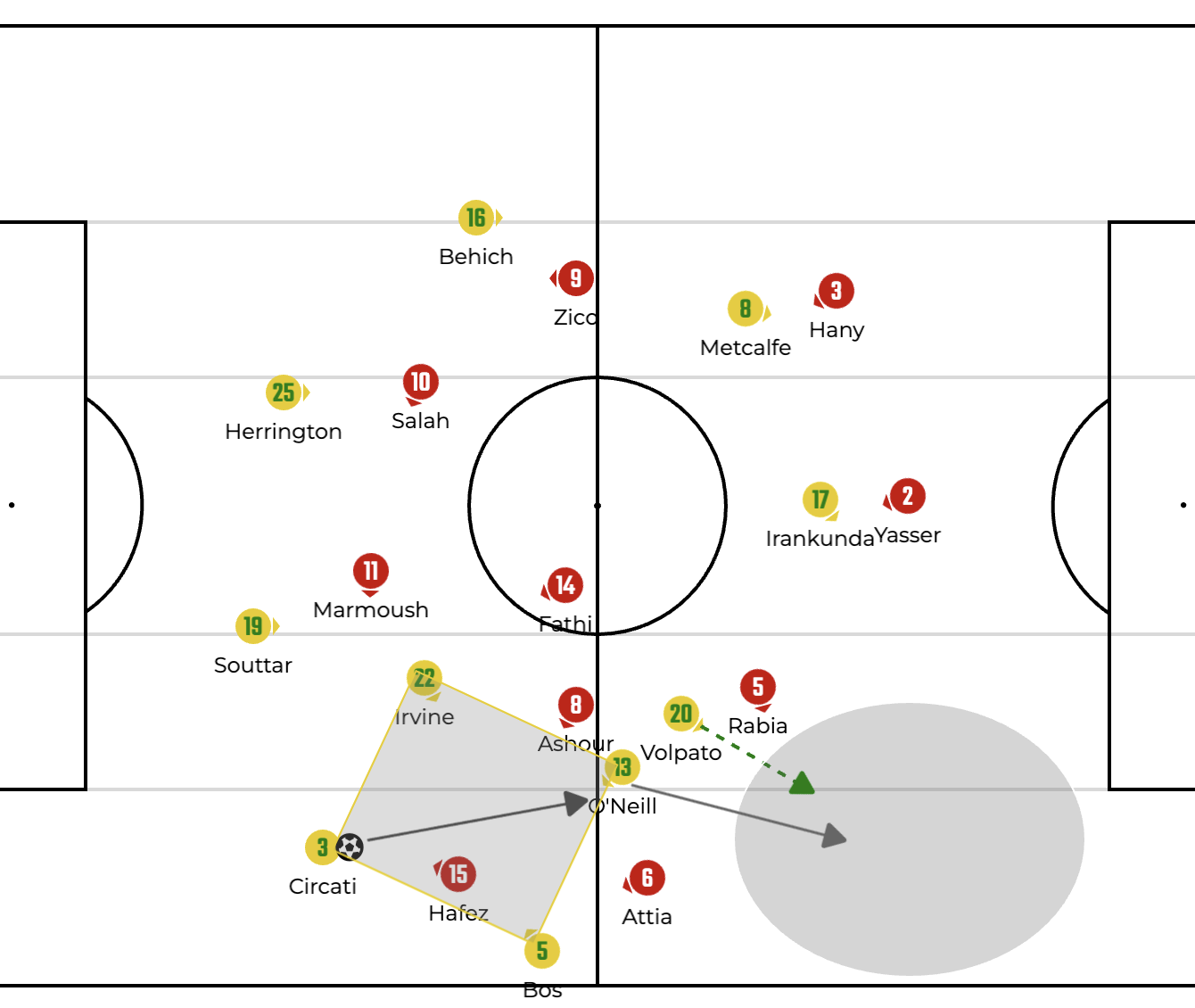
Australia repeatedly created right-sided overloads to release Cristian Volpato behind Karim Hafez after drawing Egypt’s defensive block towards the ball.
The danger did not end there. With Volpato receiving in behind, Rami Rabia was repeatedly forced to leave the defensive line in order to confront him before he could turn towards goal. Although this prevented immediate progression on several occasions, it also disrupted Egypt’s central defensive organisation and opened further spaces around the penalty area for Australia’s supporting runners.
The pattern generated several promising attacks throughout the first half, including Australia’s clearest opportunity before the interval, when Volpato found himself in an excellent shooting position but failed to convert, allowing Egypt to preserve their narrow advantage.
Egypt’s Switch to a 5-2-3 Gave Them Complete Control
Hossam Hassan’s tactical adjustments after the interval proved decisive in shifting the balance of the contest. Egypt gradually abandoned their original 4-2-3-1 shape following a series of substitutions, with Haissem Hassan replacing Mostafa Ziko, Hossam Abdelmaguid coming on for Hamdy Fathy and, after Karim Hafez was forced off through injury, Trezeguet entering the game. These changes transformed Egypt into a well-organised 5-2-3 that offered greater defensive security while simultaneously improving their attacking structure in possession.
Hossam Abdelmaguid slotted into the back line alongside Rami Rabia and Yasser Ibrahim, creating a back three that allowed Mohamed Hany and Trezeguet to operate as wing-backs. Ahead of them, Marwan Attia and Emam Ashour formed the central midfield pairing, while Haissem Hassan occupied a hybrid role between a right winger and a number ten. Omar Marmoush continued to drift into the channel between Australia’s outside centre-back and wing-back, stretching the defensive line horizontally and creating uncertainty over defensive responsibilities.
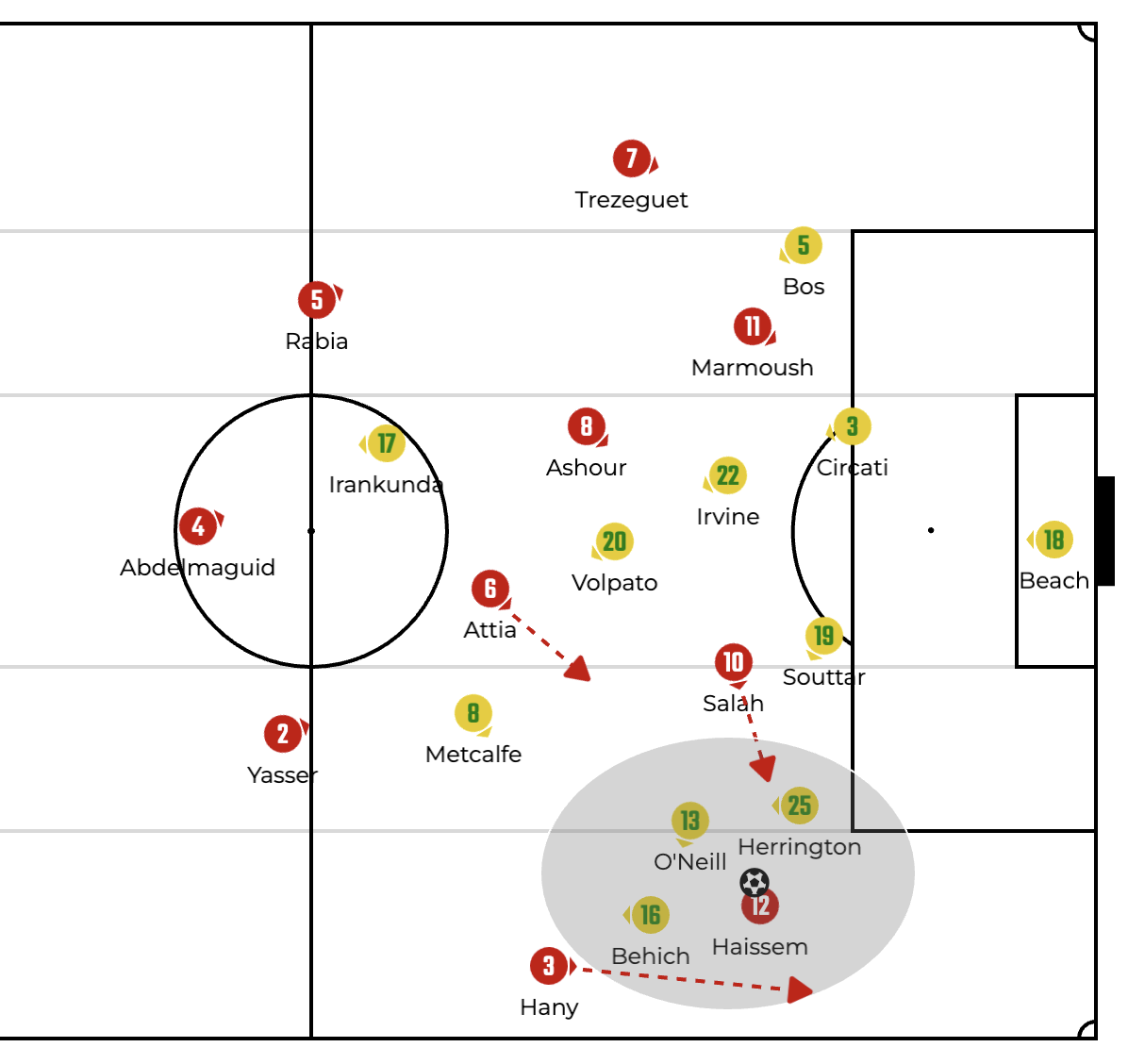
Egypt’s switch to a 5-2-3 after the interval overloaded Australia’s right side, with Haissem Hassan attracting double coverage and creating space for Mohamed Salah to exploit in the right half-space.
Australia’s response to Haissem Hassan’s introduction ultimately worked in Egypt’s favour. Recognising his ability to receive and drive forward in one-versus-one situations, the Socceroos consistently committed two defenders whenever possession reached him. Although this reduced Haissem’s individual influence on the ball, it repeatedly created space elsewhere. Mohamed Salah, operating as the nominal centre-forward but frequently drifting towards the right half-space, became the primary beneficiary. With Australia’s defensive attention focused on Haissem, Salah regularly found pockets of space to receive, combine and progress attacks.
The structural balance of Egypt’s new shape enabled them to dominate possession throughout the second half and extra time. The back three provided secure circulation, the wing-backs maintained width, while Marmoush’s intelligent movements continuously disrupted Australia’s defensive line. In contrast, Australia’s attacking threat diminished significantly. Unable to sustain possession against Egypt’s compact structure, Popovic’s side became increasingly reliant on direct balls, transitional attacks and set-pieces, rarely managing to construct prolonged periods of controlled possession.
Takeaways
Egypt’s intelligent 2-2 build-up consistently bypassed Australia’s mid-block, with Hamdy Fathy and Marwan Attia pinning the Socceroos’ attacking midfielders centrally to free Mohamed Hany and Karim Hafez in advanced wide areas.
Australia’s greatest attacking threat came from right-sided rotational overloads, repeatedly drawing Karim Hafez and Marwan Attia towards the ball before releasing Cristian Volpato into the space behind Egypt’s left-back.
Hossam Hassan’s switch to a 5-2-3 changed the game after the interval, giving Egypt complete control of possession while Haissem Hassan’s introduction attracted double coverage and created space for Mohamed Salah to influence the game from the right half-space.


Comments