

Arsenal – Bayern Munich: Arsenal Overpower Bayern To Maintain Perfect Champions League Form (3–1)
Arsenal maintained their perfect record in the UEFA Champions League with a statement 3–1 victory over Bayern Munich at the Emirates Stadium. The clash, which pitted two European heavyweights and previously unbeaten sides against one another, was decided by a ruthless second-half display from the Gunners. After a tactically balanced first half ended 1-1, Mikel Arteta’s side adjusted their high press and leveraged their devastating set-piece threat and superior squad depth to overcome a Bayern team that was ultimately undone by defensive errors and a lack of second-half adaptation.
Tactical analysis and match report by Aderemi Qoyum
We decided to make this article free to read. If you want to support our work, consider taking a subscription.
This highly anticipated Champions League league phase encounter saw Arsenal, buoyed by a sensational domestic run, face a formidable Bayern Munich side under the leadership of Vincent Kompany. The tactical battle was defined by Arsenal’s relentless high-press and set-piece threat against Bayern’s attempts to control possession through their positional structure, with the intensity and technical quality making for a genuinely elite contest.
Mikel Arteta opted for a fluid 4-2-1-3 formation. David Raya was in goal, shielded by a back four of Jurrien Timber, William Saliba, Cristhian Mosquera, and Myles Lewis-Skelly. Martin Zubimendi and Declan Rice anchored the midfield, with Eberechi Eze ahead of them. Bukayo Saka and Leandro Trossard provided the width, supporting central forward Mikel Merino.
Vincent Kompany set up his Bayern side in their usual 4-2-3-1 shape. Manuel Neuer started in goal, behind a back four of Konrad Laimer, Dayot Upamecano, Jonathan Tah, and Josip Stanišić. A double pivot of Joshua Kimmich and Aleksandar Pavlović provided central stability, with Michael Olise, Lennart Karl, and Serge Gnabry supporting the focal point, striker Harry Kane.
Across Europe in 2025, more teams are leaning toward aggressive man-to-man pressing, and it boils down to three simple ideas. First, it removes confusion, every defender knows exactly who they’re marking, unlike older systems where players had to constantly decide when to pass their man on. Second, it stops positional-play teams from getting comfortable, because no one ever receives the ball without immediate pressure. Third, it lets teams drag the game into individual duels all over the pitch, even if it means their shape looks messy for a moment.
That’s exactly what Arsenal and Bayern did in this match. Arsenal pushed Mosquera and even Saliba right up the pitch just to keep the match-ups tight, while Bayern’s Tah and Upamecano stayed glued to their opponents and trusted the midfield and fullbacks to cover behind them. Both sides were happy to leave big gaps at the back if it meant staying man-to-man and taking away the time and space Bayern and Arsenal normally use to build play.
Arsenal’s Build-Up vs. Bayern’s Aggressive Man-Marking
The opening phase of the game was a tactical war of attrition centered on Arsenal’s build-up play against Bayern’s uncompromising, man-oriented high press. Arsenal established a consistent 4-2-2-2 shape in possession with Merino and Eze dropping into the halfspaces or wherever they see fit to drag a Bayern defender. Martin Zubimendi, the deepest midfielder, was key to Arsenal deep play, often dropping right between the two centre-backs, Saliba and Mosquera, effectively creating a temporary back three against Kane and Karl while making it difficult for Bayern to mark him deep. This was a calculated structural move designed to pull Bayern’s forwards apart and create spaces.
Bayern’s response was a full man-to-man press across the pitch. Harry Kane tracked Saliba, while wingers Serge Gnabry and Michael Olise marked the wide defenders, Timber and Lewis-Skelly, respectively. In midfield, the scheme was dynamic: Lennart Karl often tracked Arsenal’s deepest midfielder (Zubimendi or Rice), while Aleksandar Pavlović pushed high to mark the other. Crucially, Joshua Kimmich often played a covering role on Eberechi Eze. An alternative press saw Karl press Mosquera while also using his cover shadow to screen Rice, Kimmich step up to Rice, and one centre-back stick with Merino while the other covered Eze.
Arsenal’s primary ‘trap’ to exploit this aggressive marking was the movement of their attacking players. Centre-forward Mikel Merino often dropped super deep into midfield, dragging either Dayot Upamecano or Jonathan Tah out of the backline. Simultaneously, Eberechi Eze would pull the other centre-back into no man’s land, leaving huge central channels open behind the Bayern defence. However, the plan to exploit these spaces with quick passes to the wide players, Saka and Trossard, was largely ineffective in the first half. Both players preferred to receive the ball to feet rather than make penetrative, off-the-ball runs into the vacated space, and even if they made the runs, they lacked the pace to beat their markers, allowing the covering Bayern players to recover.
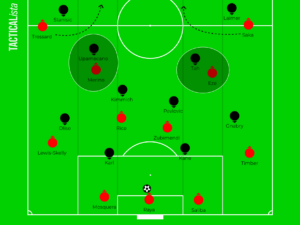
Arsenal’s 4-2-2-2 build-up, Zubimendi dropping, Merino dragging Upamecano, and the central space created behind the Bayern backline.
Arsenal’s Unstoppable Weapon
Arsenal’s opening goal in the 22nd minute was a devastating demonstration of a tactical weapon that has become their hallmark: the meticulously designed set-piece. In an otherwise cagey opening where both teams were respecting each other’s structural solidity, the deadlock was broken from a corner kick, the 10th set-piece goal the Gunners have scored this season.
Bukayo Saka’s delivery was whipped with pace to the near post. The choreography saw a sea of Arsenal bodies swarm the six-yard box, creating a deliberate distraction and traffic. Jurrien Timber, who had started in a deeper position, timed his run perfectly to ghost across the face of Manuel Neuer who was unable to push through the bodies for the ball and glance a header into the net. This move highlighted two critical factors: Arsenal’s world-class, pre-planned routines by set-piece coach Nicolas Jover, and a vulnerability in Bayern’s zonal/man-marking hybrid system that Kane, specifically tasked to cover the near-post area, failed to fully execute. The goal forced Bayern to reconsider their approach and gave Arsenal early psychological momentum.
Kimmich Exploits The Space.
Bayern’s 32nd-minute equaliser was a perfect example of exploiting the distances created by Arsenal’s high defensive line and failed man-oriented pressing triggers. The goal’s genesis was a deep positional move by Joshua Kimmich, who cleverly dropped into the space between his own centre-backs, Tah and Upamecano, to receive the ball with time and space, a distance too great for Declan Rice to press effectively.
This deep position allowed Kimmich to launch his trademark, precise long diagonal pass. The key counter-movement involved Harry Kane dropping slightly deeper, which attracted and dragged William Saliba with him. As Saliba stepped up, Serge Gnabry exploited this movement by making a searing run from the flank into the space behind Myles Lewis-Skelly at left-back, who seemed to be lacking match fitness and reacted too slowly to Gnabry’s off-the-ball threat. Kimmich’s pass found Gnabry perfectly in the channel, and Gnabry’s pass was precise for Lennart Karl, who finished from the gap created by Saliba tracking Kane. The goal was a consequence of Kimmich’s vision and Bayern’s off-the-ball runners (Gnabry and Karl) exploiting the temporary lack of co-ordination in Arsenal’s backline and the space given to Kimmich.
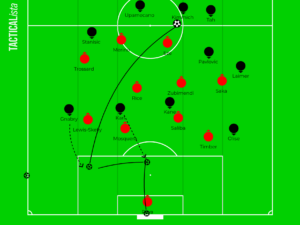
Min 32′ Bayern’s only goal. Kimmich dropping deep between CBs, Kane’s central movement dragging Saliba, Gnabry’s run into the channel behind Lewis-Skelly, and Karl’s finishing position.
Relentless Pressure
The second half began with a ferocious change in tempo and tactical intent from Arsenal, determined to re-establish their lead. Mikel Arteta having introduced pace and pressing aggression by replacing the injured Trossard with Noni Madueke in the 38th minute. The impact was immediate, with Arsenal earning five corner kicks within the first 11 minutes of the half due to a relentless high press that forced Bayern into hurried, misplaced clearances.
Arsenal’s man-marking structure on Bayern’s goal kicks became far more aggressive and synchronised after the break. Eze stepped out to track centre-back Tah, while Madueke moved inside from the left wing to follow Upamecano. Lewis-Skelly pushed high onto Stanišić, and Saka locked onto Laimer on the opposite flank. Merino dropped to shadow Kimmich, with Zubimendi sticking closely to Pavlović. Rice took responsibility for Karl, Mosquera followed Olise, and Saliba and Timber stayed tight to Kane and Gnabry respectively.
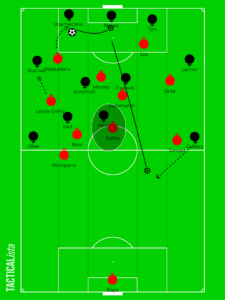
Min 52′ Arsenal’s aggressive man-marking press against Bayern’s goal kick: Madueke inverting, Merino dropping, and the full man-for-man coverage with Mosquera on Karl.
This full man-to-man coverage forced Bayern into desperate long balls or losing possession in their own third, creating dangerous turnovers and yielding the barrage of corners. Four of these corners were precise deliveries from Saka and Rice, primarily targeting the aerial threat of Mikel Merino at the near post. While Merino was the intended target, a reflection of Gabriel Magalhães’ absence, he could not convert the chances, but the constant pressure eventually broke Bayern’s resolve in open play.
Calafiori’s Instant Impact
Arsenal’s second goal came from a critical turnover in the 69th minute, a direct result of the high-risk style Bayern employs and Arsenal’s sustained pressure. Dayot Upamecano, under pressure from the rejuvenated Arsenal attack, played a loose ball in the defensive third. Declan Rice, who had an outstanding all-around performance, intercepted, setting off a rapid transition. Arteta’s inspired substitution of Martinelli and Calafiori seconds earlier saw Riccardo Calafiori make an underlapping run to receive from Eze who was wide. Calafiori, playing left-back, delivered a perfect, curling cross to the back post where Madueke, making his Champions League debut for the club, arrived unmarked to tap in for 2–1 to score his first goal for Arsenal. This single sequence, a turnover from a high press, instant substitution impact, and clinical finishing, smashed the momentum Bayern had built.
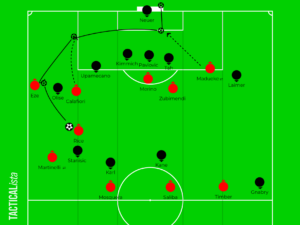
Min 65′ Image of the turnover by Rice, Eze pass, Calafiori’s cross, and Madueke’s run and finishing position.
Martinelli’s Final Blow
Bayern’s desperation to find a second equaliser led them to push their defensive line extremely high, a calculated risk that Arsenal’s pace and verticality were poised to exploit. The insurance goal came in the 77th minute, highlighting both Arsenal’s counter-attacking speed and a shocking misjudgement from Manuel Neuer.
With both Tah and Upamecano still looking to follow Eze and Merino everywhere, from deep inside their own half, Eberechi Eze found space and delivered a magnificent, long pass over the top of the aggressively high Bayern defensive line, perfectly weighted for substitute Gabriel Martinelli. The Brazilian forward, with his blistering pace, chased the ball in a foot race, drawing Manuel Neuer, who had rushed 40 yards off his line into a ‘no-man’s land’. Martinelli’s superb touch took him past the stranded goalkeeper, leaving him with an empty net to calmly slot home the 3–1. The goal sealed the contest and served as the perfect example of how Arsenal, despite their positional dominance, retain a devastating direct threat in transition. The introduction of Martinelli and Madueke proved decisive, showcasing the difference in firepower coming off the bench.
Arsenal’s Versatile Threat and Bayern’s Fatal Flaw
The key difference between the two halves lay in the personnel providing the vertical threat. While Bayern effectively demonstrated that pace and the ability to run in behind were crucial for their success, as seen with Serge Gnabry for their equaliser, Arsenal’s first-half starting wingers Saka and Trossard largely preferred to receive the ball to feet. The introduction of the pacey Madueke and Martinelli in the second half instantly replicated Gnabry’s threat, allowing Arsenal to ruthlessly exploit the space behind the retreating Bayern defence, particularly in the lead-up to Martinelli’s late goal. This substitution proved that Arsenal possesses multiple ways to dismantle elite opposition.
This match ultimately served as a comprehensive demonstration of Arsenal’s multifaceted threat. They proved they can hurt opponents in diverse ways: they broke down a tight structure and scored from a set-piece; they punished a pressing phase with an open-play transition goal; and finally, they exploited Bayern’s high line and aggression with a classic counter-attack. As former Spurs striker Harry Kane toiled, unable to even register a shot at the ground where he has scored more times than any other visiting player, Arsenal rammed home their advantage.
Man of the Match: Declan Rice
Declan Rice delivered a commanding performance that deservedly earned him Man of the Match, he anchored Arsenal’s midfield alongside Martín Zubimendi, controlling the central zones with elite positioning, anticipation and defensive calm. His most decisive moment came in the 69th minute, when he reacted fastest to a loose pass from Upamecano, intercepted it and immediately launched the vertical move that led to Noni Madueke’s winning goal. On the ball, Rice was brilliant too, steady under pressure, composed in possession, and efficient in progressing play from deep into dangerous areas, especially with his powerful ball carrying.
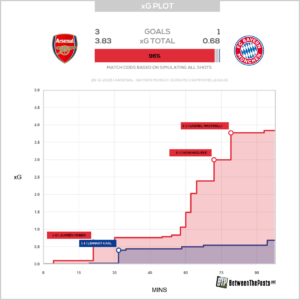
Takeaways
This 3–1 victory was a serious statement from Arsenal, confirming their status as a genuine contender for the Champions League crown. They exhibited the hallmark of a mature, top-tier team: the ability to adjust mid-game, a ruthlessness from set-pieces, and the immense quality of their substitutes. The second-half performance, where they stifled Bayern and dominated key tactical zones through Rice’s control and Arteta’s switch, was masterclass material.
For Bayern Munich, the result marks their first defeat of the season and raises uncomfortable questions about their defensive discipline under pressure. While they showed quality in their equaliser, their reliance on a high defensive line and individual defensive lapses proved fatal against a superior and highly adaptable Arsenal side. Kompany’s side remains a potent threat, but their inability to adapt and the individual blunders from key defenders and the goalkeeper proved too costly.
Use the arrows to scroll through all available match plots. Click to enlarge.
Check the match plots page for plots of other matches.


Comments