
Brazil – Haiti: Ancelotti makes changes and Brazil cruise to a comfortable win with Vinícius Jr shining (3-0)
The doubts and uncertainties surrounding the Brazil National Team were partially eased with a comfortable victory over Haiti. The changes made the difference, with standout performances from Matheus Cunha, Paquetá and especially Vinícius Júnior, as the match was effectively decided in the first half. On the other hand, Haiti, who had played well despite losing to Scotland, switched to a 5-4-1 outline that didn’t work and were eliminated from the competition ahead of schedule.
Tactical analysis and match report by Marcus Arboés.
We decided to make this article free to read. If you want to support our work, consider taking a subscription.
Many Brazilians were unhappy with the draw against Morocco and, indeed, the team had shown some issues that needed to be corrected. Carlo Ancelotti carried out several experiments during the week before settling on what appeared to be his ideal lineup: Alisson as goalkeeper; Danilo replacing Ibañez, who had struggled in the opener, at right fullback, with Douglas Santos on the left; Marquinhos and Gabriel Magalhães as the center backs; Casemiro, Bruno Guimarães and Lucas Paquetá in midfield; Vinícius Júnior on the left wing, Raphinha on the right wing and Matheus Cunha as a false nine, replacing Igor Thiago, who operates as a target man before. This created a 4-3-1-2 outline, different from the 4-3-3 formation used in the first match.
Sébastien Migné had lined Haiti up in a classic 4-4-2 outline in their opening game and the team delivered an excellent performance against Scotland in a defeat that could even be considered unfair. However, against Brazil, they changed both their playing style and defensive structure, switching to a back five, something that had barely been tested during their World Cup qualifying cycle. Placide (Bastia) started in goal; Arcus (Angers) and Experience as the fullbacks; Duverne, Ricardo Adé and Delcroix completing the back five; Bellegarde (Wolves) and Jean Jacques as the holding midfielders; Casimir (Auxerre) and Providence on the wings, with Pierrot as the target man.
Brazilian dominance through verticality and close combinations
Brazil scored three goals, settled the match before halftime and comfortably won by exploiting Haiti’s vulnerability in open spaces, taking advantage of counterattacks and confusion within Haiti’s defensive line when defending depth after switching to a five-man defense, a system they had barely used before. Vinícius Júnior, Matheus Cunha, Lucas Paquetá and Bruno Guimarães all benefited greatly from the tactical context.
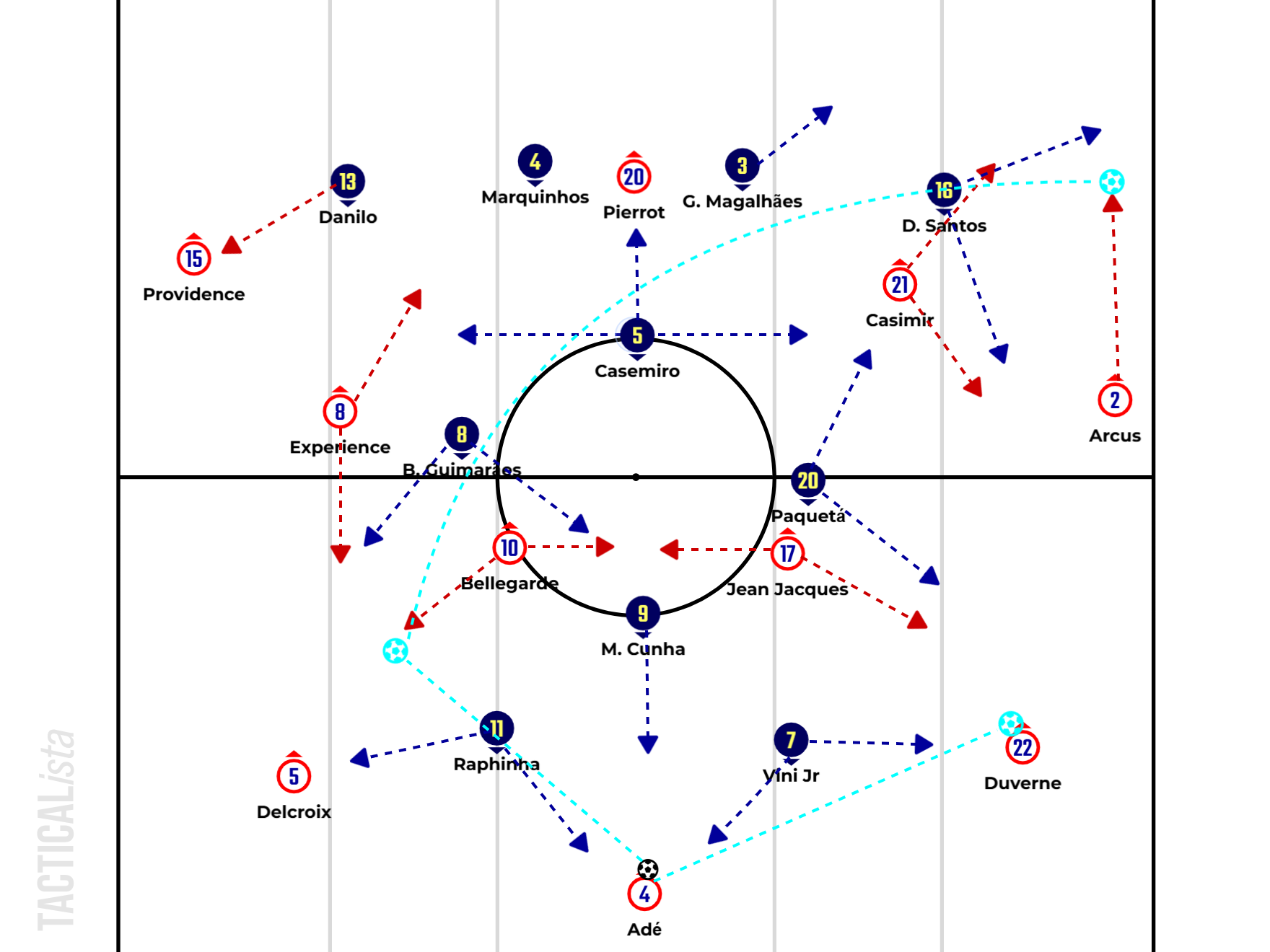
Haiti’s build-up in a 3-2-5 shape against Brazil’s defense in a 4-1-2-3/5-3-2 formation.
Two of Brazil’s goals came from very quick counterattacks launched from long passes after Brazil defended in a medium-low block. Although Brazil’s defensive structure focused on protecting central areas, the main objective was to deny Haiti access to the center, where they usually begin their build-up to create advantages. To understand that, it’s important to look at how Haiti attempted to attack.
The three center backs initiated the build-up in a positional 3-2-5 shape. In the second line, Bellegarde and Jean Jacques looked to receive behind Brazil’s first pressing line either to provide support or to create angles for long diagonal switches. On the left, fullback Experience operated freely inside, in the blind spot of Bruno Guimarães, while left winger Providence stayed wide.
On the opposite side, Arcus advanced high and wide on the right. He was the main target of Haiti’s long passes. Bellegarde, Jean Jacques and Delcroix tried to escape Brazil’s defensive references to find him on the right, seeking superiority alongside Casimir and even Pierrot dropping to support and create volume on the flank. While Casemiro protected the space behind Brazil’s midfielders or dropped deeper to create superiority against long balls toward Pierrot, something that had been highly effective against Scotland, Bruno Guimarães and Paquetá tracked players moving inside, while Matheus Cunha protected the space behind the first pressing line formed by Vinícius and Raphinha.
Thanks to Casemiro’s positioning and Douglas Santos’ excellent defensive performance, supported by Gabriel Magalhães’ cover, Haiti’s attempts to find Arcus and Casimir on the right never truly worked. Their alternative was to build through the center, using one of the midfielders and Casimir drifting toward the right side alongside Duverne and Arcus. In these situations, Brazil’s defensive block shifted accordingly. Paquetá, for example, could either track a midfielder or drop to support Douglas Santos, who in turn either protected the depth against long parallel passes or followed Casimir’s movement, with Gabriel or Casemiro covering behind him.
The ball recoveries that led to Brazil’s first two goals came from the tightness of these defensive references and the physical ability of Brazil’s midfielders to win ground duels. In the first instance, Vinícius was released and his shot allowed Matheus Cunha to score from the rebound. In the second, Vinícius himself created the move and released Matheus Cunha behind the last line to double the lead. Although the defensive performance deserves recognition, the overall picture was that of a highly vertical Brazil.
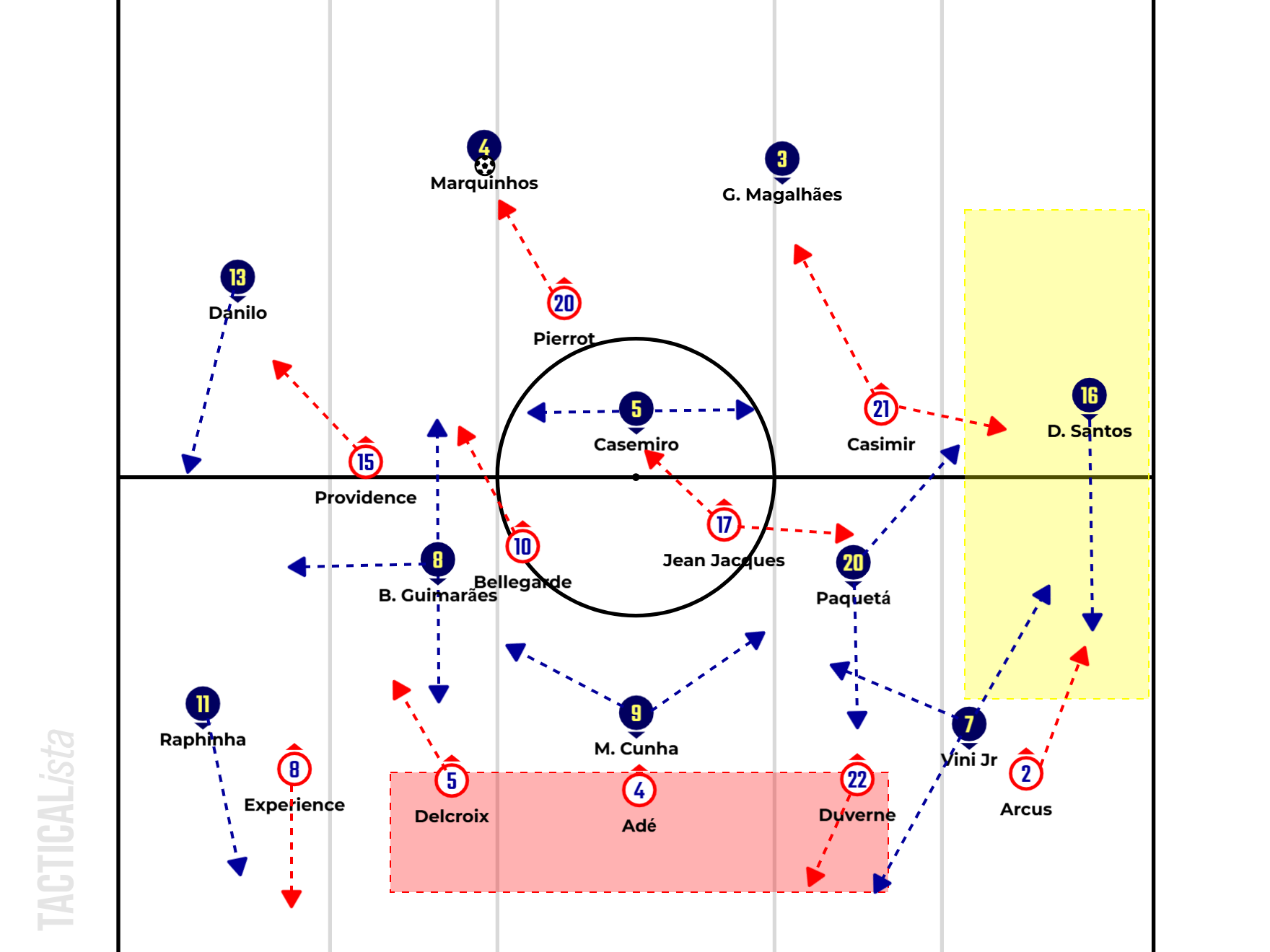
Brazil’s attacking structure in a 4-3-1-2 shape, using Matheus Cunha as a false nine/number ten against Haiti’s medium-block 5-4-1 formation.
This was the most common picture of the first half. Brazil used asymmetric fullbacks: Danilo remained deeper, helping organize the build-up, while Douglas Santos advanced whenever opportunities arose. This was connected to the new behavior of the wingers. Raphinha, who had played more centrally in the opener, started wide on the right, while Vinícius Júnior operated as an inside winger on the left with greater freedom.
In midfield, Casemiro stayed at the base of the build-up, while Matheus Cunha dropped either side or through the center. Bruno Guimarães, operating more to the right, varied his height and drifted wide to create triangles. Paquetá, on the left, either pinned the last line or dropped alongside Casemiro, sometimes filling the left lane to allow Douglas Santos to advance and drag Casimir out of position.
With the center backs initiating attacks, the idea was to attract Haiti’s defensive references and then play vertically behind the last line. On the right side, however, Brazil progressed through quick, short and vertical passing combinations, attacking the space behind Delcroix and Experience. They tried it twice, and on one occasion Raphinha scored only to be ruled offside. Later, the use of close support movements from midfielders created further opportunities to progress vertically, not only through long balls but also through line-breaking passes along the ground. Raphinha had two more chances through these patterns, which highlighted his strengths very effectively.
Haiti’s main problem, naturally, was protecting the space behind the last line. This didn’t happen because the defenders failed to position themselves correctly in situations where the ball carrier had time and vision, but because there was a lack of coordination and communication among the three defenders. They didn’t cover for each other as expected. This likely happened because Haiti’s coach, concerned about Vinícius Jr, wanted to have two players marking him, sacrificing one of the attackers. However, although the team may have trained this structure, they had never started a match in the cycle with a five-man defensive line.
Paquetá used his technical quality, vision and ability to escape pressure with a turn before quickly releasing Vinícius Júnior in a situation where the passer had time to execute.
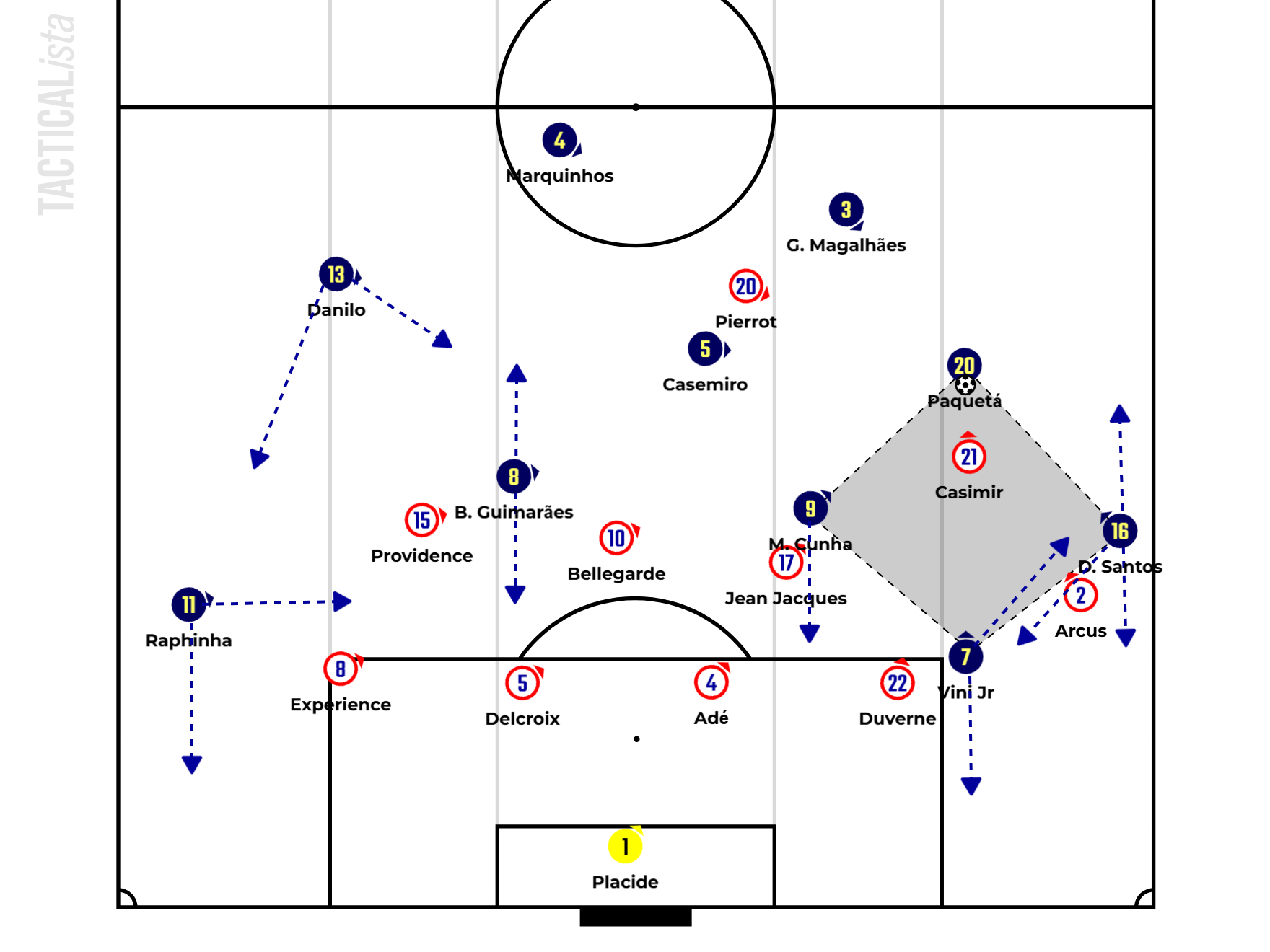
Brazil positioned in the opposition half, attacking through close combinations and creating numerical superiority on one side of the pitch.
Although Brazil attacked vertically on many occasions, another pattern previously seen under Ancelotti was also evident. Without a fixed number nine, Matheus Cunha frequently dropped toward the side where Brazil were attacking. On the left, the team’s strongest side, there was more combination play. Cunha appeared inside, while Paquetá operated facing the game from deeper areas, a role that better suits his characteristics. Douglas Santos either stayed wide or exchanged positions with the more advanced Vinícius Júnior. Danilo, the center backs and Casemiro provided defensive balance, while Bruno Guimarães frequently arrived in the box and Raphinha stretched the defense from the right wing.
Several attacks emerged from these dynamics, although they weren’t Brazil’s main strength on the day. What they did demonstrate was that Ancelotti’s team can also find solutions against low blocks without depending entirely on positional circulation. In the second half, Brazil used this approach even more as a tactical tool.
Never ignore the opponent on the other side
With the result secured before halftime, Brazil reduced both their offensive and defensive intensity. This generated criticism, particularly because Haiti were widely viewed as a “weaker opponent.” It’s obvious that Haiti are not among the world’s elite teams, but many tactical analyses and technical opinions overlook the fact that there’s an opponent on the other side, one with ideas, patterns, strengths, weaknesses and its own story.
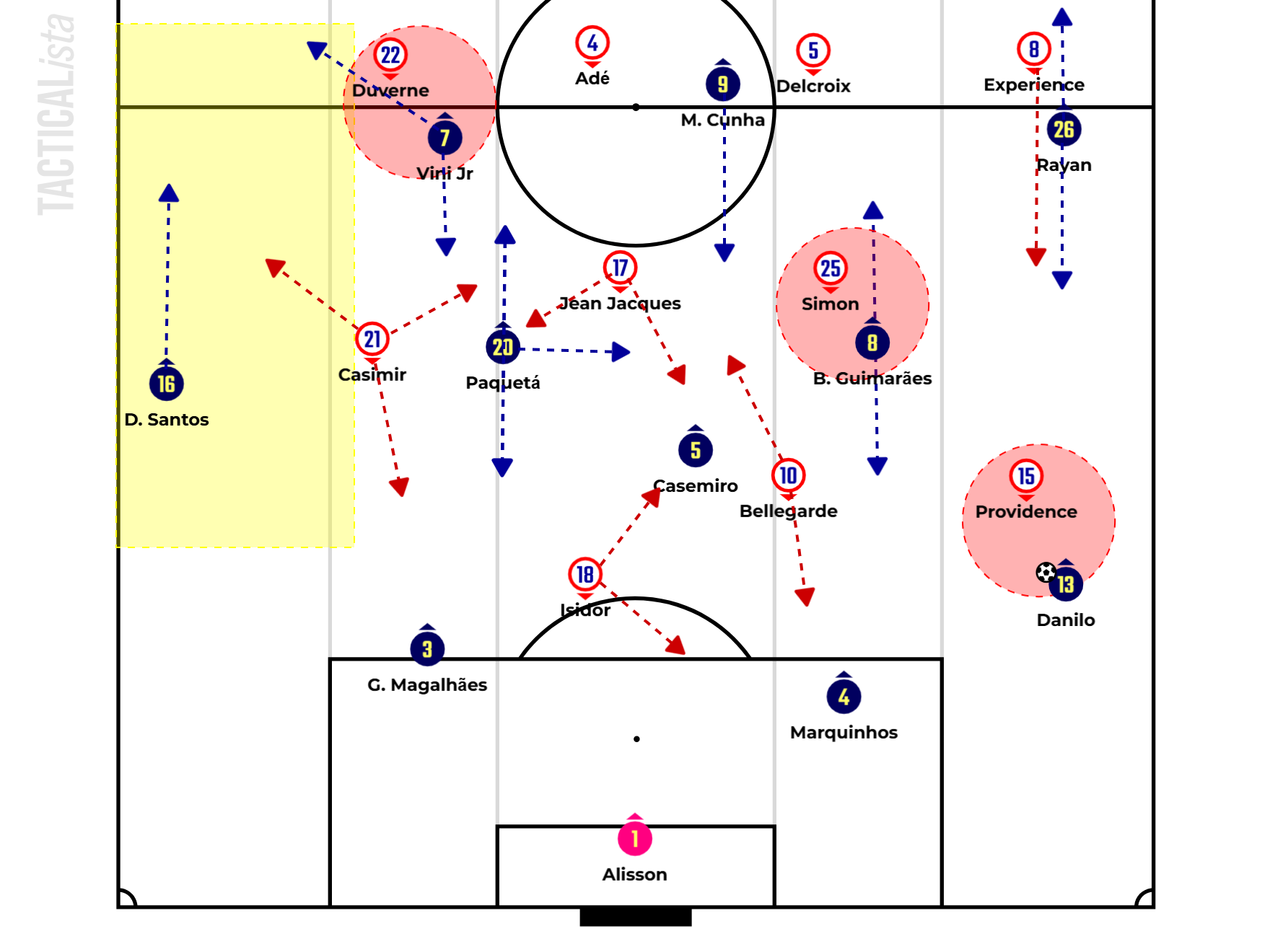
Man-oriented pressing references in a 4-4-2 shape against Brazil’s build-up.
In the second half, Migné corrected the issue caused by his earlier adjustment. He removed Arcus, kept Duverne at right fullback and introduced an additional midfielder, Simon, to strengthen central areas both in attack and defense. As a result, Haiti returned to the defensive structure they know best: a medium block in a 4-4-2 formation built around aggressive man-oriented references.
Brazil maintained the same build-up structure: a 4-3-1-2 formation with asymmetric fullbacks and wingers, now featuring Rayan on the right wing after Raphinha suffered an injury during the first half. This made Haiti’s references much clearer. The build-up usually started on Brazil’s right side, with Providence marking Danilo; Isidor, who had replaced Pierrot, splitting responsibilities between the center backs and Bellegarde alternating between covering a center back or Casemiro; the midfielders tracking Brazil’s midfielders; and Casimir either stepping forward to press, filling central spaces or shifting defensively whenever play was switched toward Douglas Santos.
Within this context, Brazil became somewhat boxed in and often found that switching play from deep positions was their best escape route. Lucas Paquetá, Vinícius Júnior and Matheus Cunha began moving even more to create advantages. Paquetá, in particular, frequently crossed the pitch with complete positional freedom to create superiority on the right side. Through these movements, Brazil generated several dangerous attacks in open spaces and could easily have scored one or two more goals.
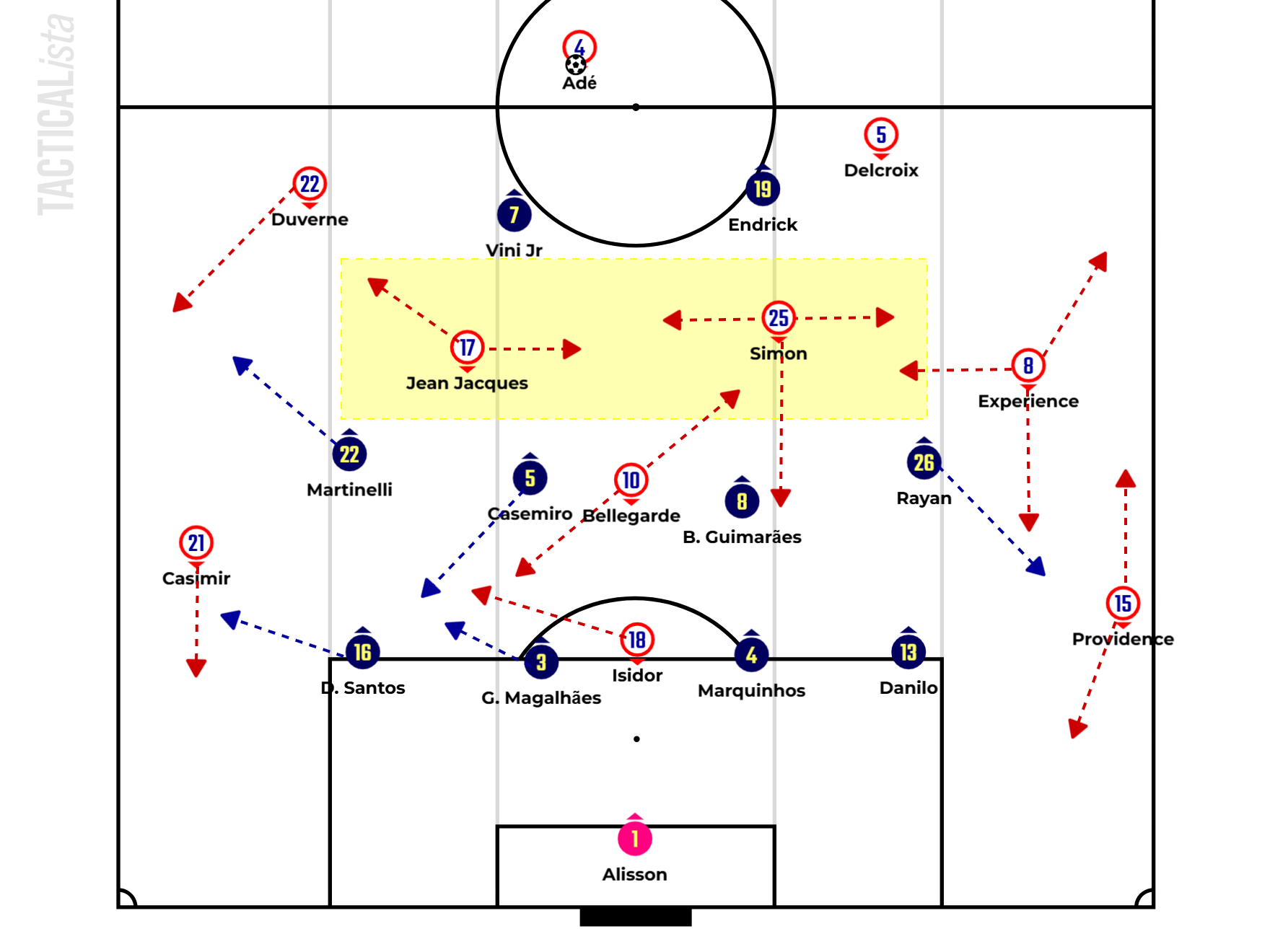
Haiti’s positional attack in an asymmetric 3-2-5/3-3-4 formation against Brazil’s defensive 4-4-2 outline.
Matheus Cunha’s responsibility for influencing every phase of play, Paquetá’s constant movement and Brazil’s defensive approach, which depended heavily on defensive shifting and retreating runs, eventually exhausted the team’s two main creative players. Ancelotti chose not to alter the midfield structure and instead introduced Martinelli, known primarily as a touchline winger at Arsenal, as a left-sided central midfielder. Endrick replaced Matheus Cunha as a more direct, space-attacking striker. In attack, Brazil created several opportunities down the left through close combinations and long passes that freed Vinícius Júnior and Martinelli.
Defensively, with Brazil choosing to defend in a low block and counterattack in open spaces, Endrick formed the first defensive line alongside Vinícius Júnior. Rayan and Martinelli provided support on the flanks, while Casemiro and Bruno Guimarães protected central areas in a relatively simple and sometimes passive defensive setup focused mainly on closing spaces. Some observers may dislike this approach, but they probably didn’t watch Haiti’s match against Scotland, where the Haitians imposed themselves technically and showed a clear desire to dominate possession.
Now operating from a 4-3-3 outline, Haiti built attacks through the center backs, supported by Duverne, who played wider on the right, while Experience occupied his more natural role. Casimir held the width on the right side. The key to Haiti’s attack became positional rotations. Bellegarde was given almost complete freedom, with the team adapting to his movements. If he dropped as a midfielder, Simon advanced through the left half-space and Isidor drifted to the right. These rotations were used several times to create advantages on that side and Brazil’s midfielders were essential in breaking them up.
These positional exchanges also appeared in quick attacks and direct transitions from Haiti’s build-up, when Experience and Providence dropped deeper to attract Brazil’s defensive references before being released in behind by one of the midfielders or by Delcroix. However, Brazil dealt with these situations very well. Despite featuring less famous players, Haiti are a well-organized side with clear technical principles. Alisson, Marquinhos, Gabriel Magalhães, Danilo and Douglas Santos, indeed Brazil’s entire defensive system, were thoroughly tested by the opposition.
The main warning sign for Brazil is that when defending in a 4-4-2 shape, the space behind the first defensive line becomes too open, consistently allowing opposing midfielders freedom to create. This happened against Morocco and again during the final thirty minutes of this match.
Takeaways
It’s unfortunate that Haiti have been eliminated so early due to the tiebreaking criteria. The Haitian side showed more technical quality and attacking organization than Scotland, for example, despite having a less star-studded squad, albeit one that remains experienced and competitive. Even if they defeat Morocco, they can no longer reach third place and compete for qualification to the next stage of the World Cup.
Although they’re not particularly well known internationally, they demonstrated considerable quality. It is very easy to produce a shallow analysis that ignores how they play, their strengths and weaknesses, as though the other side of the tactical board didn’t contain ideas, plans, patterns and people. The truth is that easy matches are rare in modern international football. This one became easy for Brazil because Haiti’s defensive tactical context matched up poorly against the characteristics of Brazil’s attackers.
Brazil, meanwhile, have taken a major step toward qualification. Even if they lose to Scotland in the third round, they could still advance as one of the best third-placed teams, which also applies to Morocco. The result is encouraging, reinforces Carlo Ancelotti’s planned patterns, eases some of the pressure and, although it does not mean Brazil are favorites or that everything is perfect, especially considering they almost conceded during a period of relaxation, it certainly creates an atmosphere of optimism.
Now it remains to be seen which side of the bracket each team will enter and whether anyone will be eliminated by the smallest of margins.
We decided to make this article free to read. If you want to support our work, consider taking a subscription.
Use the arrows to scroll through all available match plots. Click to enlarge.
Check the match plots page for plots of other matches.


Comments