

CA Rosario Central – Racing Club: Rosario Book Semi-Final Place In The Apertura Playoffs After Late Drama (2-1)
Rosario Central’s win over Racing Club proved to be one with fight and resilience. Although the late drama put Racing at a disadvantage, Rosario’s second-half momentum helped them get over the line later. Racing, however, would wonder how they let the game slip after their early lead.
Tactical analysis and match report by Ebuka Ogoegbunam.
Racing’s win over Estudiantes in the previous round raised a lot of eyebrows for most. After being underdogs in the previous round, they came into this round with similar expectations. The win over Estudiantes gave the team hope after previous struggles in the Apertura. They had a chance to turn a new page in the playoffs.
Rosario’s win over Independiente was rather more convincing than their opponents. Being favorites in front of their home fans gave the team a massive boost ahead of the game. Jorge Almirón’s Rosario had to avoid any shocking result, with Racing winning as underdogs in the last round.
Conan Ledesma stayed behind the goal for Rosario Central. The back four had Emanuel Coronel, Ignacio Ovando, Gastón Ávila and Agustín Sández in defence. In midfield, Vicente Pizarro and Franco Ibarra played in the two-man midfield. Ángel Di María, who captains his side, and Enzo Giménez filled up the wide areas on the wings to feed the strikers up top. Alejo Veliz and Enzo Copetti led the line in attack.
For Racing Club, Facundo Cambeses started in goal with a back three of Santiago Sosa, who operated in defence while being in a defensive midfielder. He was also partnered with Marcos Rojo and Marco Di Césare in the back three. Gastón Martirena and Gabriel Rojas played as the right and left wingbacks, respectively. Bruno Zuculini, Baltasar Rodríguez and Matías Zaracho made up the midfield. Adrián Martínez and Tomás Conechny were the front two in attack.
Racing gain control through the midfield overload
Racing club set up differently from the previous game. Gustavo Costas changed from a back four to a back three in this game, although the dynamics of the team didn’t change a lot but the changes were significant. Sosa dropped into the backline to make the back three, while the fullbacks were higher up to attack.
In possession, Sosa often positioned himself as a defensive midfielder while making dropping movements into the first line of build up. Rosario had Di María and Veliz lead the press and put pressure on the center backs while Copetti marked Sosa. Giminez did the defensive work of tracking Racing’s wingback on his flank, Rojas.
Copetti’s role in marking Sosa tightly, allowed Sosa’s movements to draw him out of the midfield. This gave Zuculini room to move freely among the midfielders, while the other two midfielders positioned themselves to pin Rosario’s midfielders. Racing, with the advantage they had in the first phase of build up, played long to their strikers to use second balls to catch Rosario out.
Racing’s wingbacks, Martirena and Rojas, pushed up, giving Racing options in wide areas when the center backs played long. As the game progressed, Racing became more patient with the ball and used the overload they had in build up. Their patience baited Rosario’s press with the aim to play through the first line and dismantle the shape. They did so to find the spare man and effectively forced the Rosario forwards to concede gaps in which they could play through.
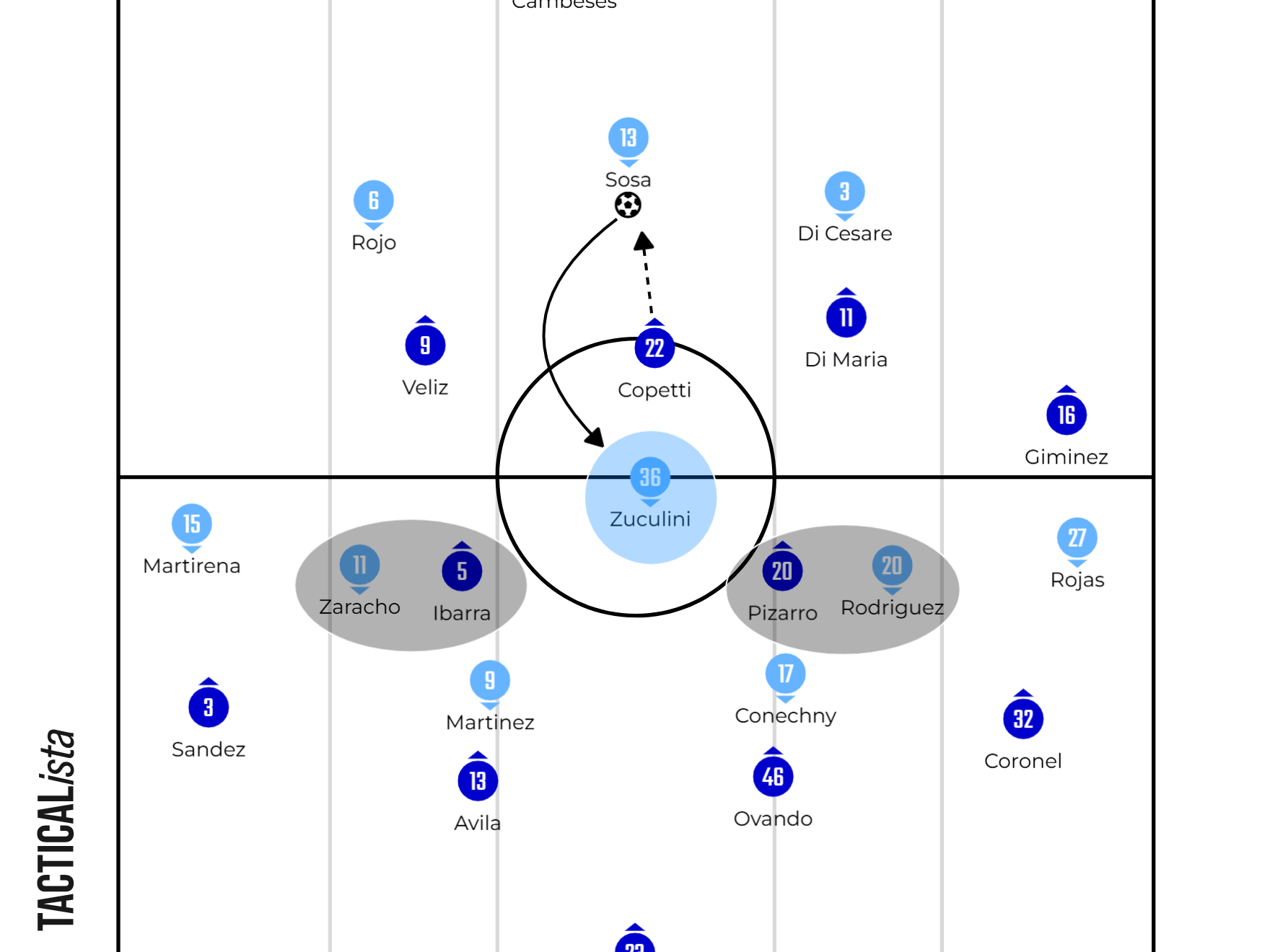
Sosa’s positioning drawing out Copetti, leaving Zuculini as the free man in midfield as Pizarro and Ibarra were pinned.
Racing use their advantage, but it wasn’t enough
The opening goal of the game came from an earlier pattern of Sosa’s movement and always looking for space to create an advantage for his side. Zaracho makes a pass to Sosa, who makes a run behind his marker, Copetti. Sosa finds Conechny who heads the ball into the path of Zaracho to score from the backpost. Racing’s opener was evidently a result of the momentum they had built up in the first half. Although it was still early in the game, Rosario didn’t look like they were going to completely change the game immediately.
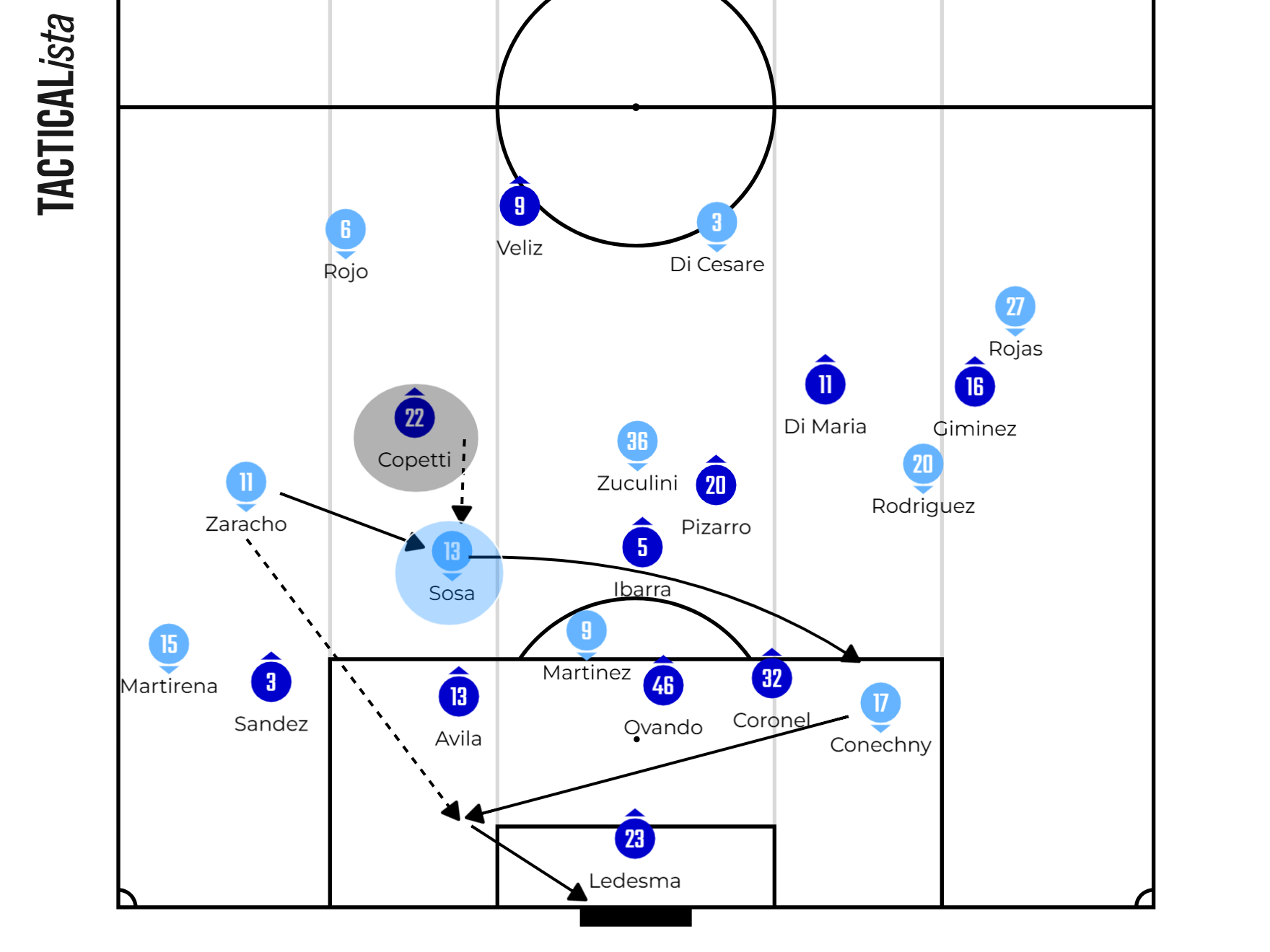
Sosa makes a run behind Copetti, driving the attack for Racing’s first goal.
Rosario on the ball were the more direct of both teams. Their 3-2-5 shape looked to exploit Racing’s line of five through runs in behind the defence. Their direct play led to several turnovers. These turnovers allowed Racing to transition easily into the final third. They had good moments with equal numbers in the last line. They found openings resulting from playing through the backline and combining well to get in behind.
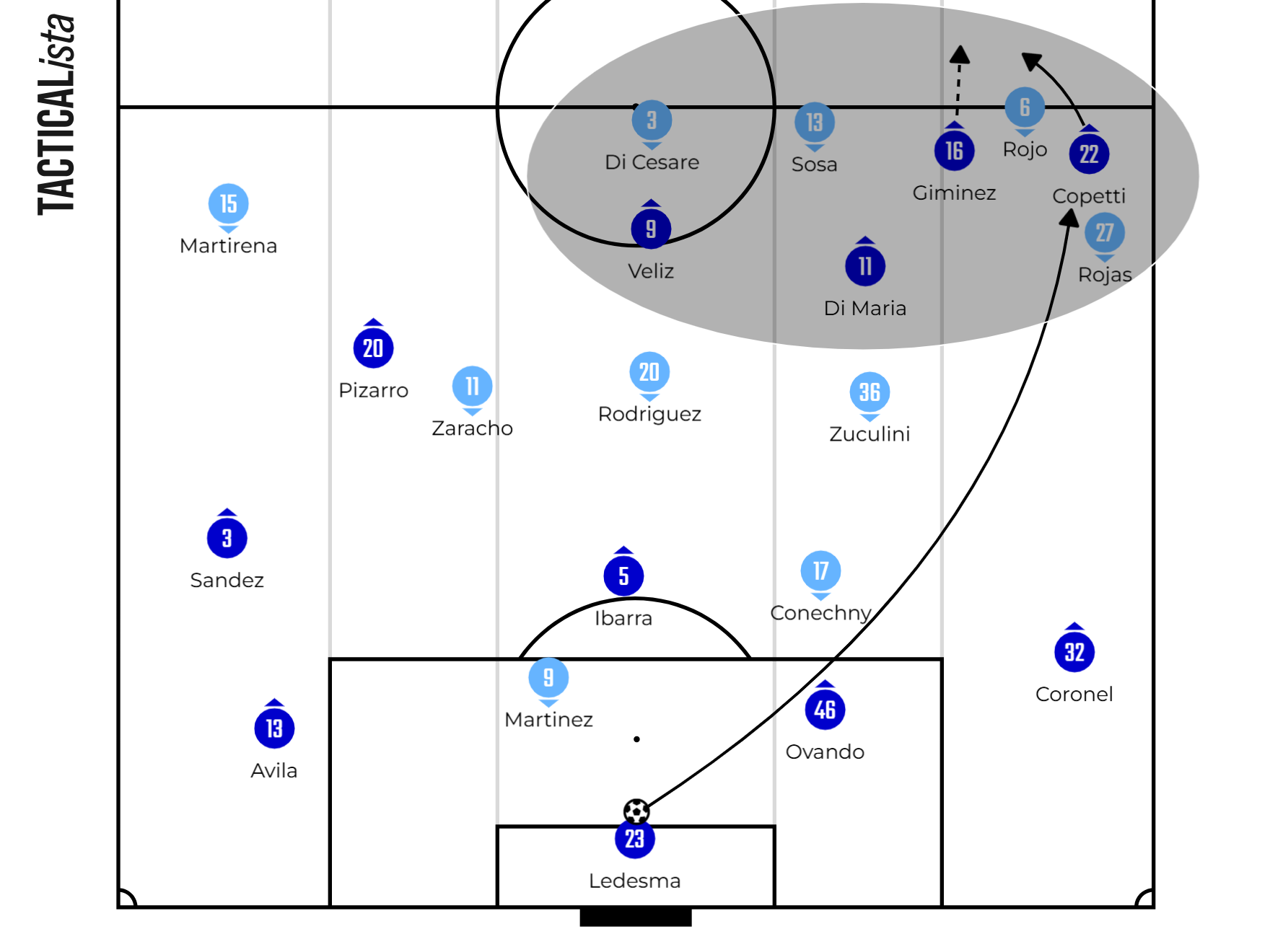
Rosario is attacking using the right side overload and progressing further up the pitch.
Di María was the center of the team’s attacking creativity and often drifted towards the right hand side to help the team in the final third. Sandez was left isolated on the left-hand side and with the lack of numbers on that flank, the right hand side was a more preferable option.
The second half was much better for Rosario. Unlike the first half, Di María’s influence in the final third wasn’t seen as much. In the second half, Di María got more involved in the game, being the focal point of numerous attacks for Rosario from the right half space.
Rosario got the equalizer from a corner. Di María’s cross found the head of Ávilaaround the near post to equalize for the home team. Where things got worse for Racing was the sending off given to Martinez towards the end of the game. This completely made it harder for them to come back into the game.
Late in the game, Rosario pushed for a winner and put Racing under immense pressure. Cambeses made top saves to keep his team alive until full time. Rosario’s pressure didn’t cease as they used their momentum with the extra man to attack with urgency.
Extra time proved to be a crucial moment for both teams. However, another Racing red card gave the home team belief. Di Césare got a second yellow card after a late tackle to get sent off in the 96th minute of the game. It was only one way this game was going and in the end, Rosario find a magical moment from outside the box. Copetti’s long range shot in the 106th minute proved to be the winner.
Nine men Racing were left handicapped and pushed forward with what they could but the numerical disadvantage was always going to make things much more difficult. Rosario held on to win the game and advance to the next round of the Apertura.
Takeaways
Rosario Central’s dramatic victory over Racing Club was ultimately shaped by tactical persistence, momentum shifts, and Racing’s inability to sustain control when the game became increasingly chaotic. Racing’s first-half structure gave them the upper hand early on, with Santiago Sosa’s flexible positioning creating overloads in midfield and disrupting Rosario’s pressing shape.
By drawing Enzo Copetti out of central areas, Racing opened spaces for Bruno Zuculini and Matías Zaracho to progress play, while the wingbacks stretched Rosario’s defensive line. Their opening goal reflected the effectiveness of those movements and the confidence with which they manipulated Rosario’s press.
However, Rosario gradually adapted as the match progressed. Their second-half improvement came through greater attacking urgency and Ángel Di María’s increased involvement in the right half-space, where his creativity became the focal point of Rosario’s attacks. Racing struggled to maintain defensive stability under sustained pressure, and the red cards completely shifted the momentum in Rosario’s favor.
With numerical superiority, Rosario pinned Racing deeper and forced them into survival mode. Although Facundo Cambeses produced several important saves, Racing could no longer resist the pressure. Copetti’s extra-time strike sealed a comeback that reflected Rosario’s resilience and tactical persistence, while Racing were left to regret their loss of control late in the contest.
Match plots will be added as soon as possible.


Comments