

Chelsea – Barcelona: Dominant Blues Bang Three (3-0)
In a blockbuster Champions League week with multiple highlight fixtures, Barcelona’s trip to west London to face Chelsea was one of them. The highly anticipated match delivered from the outset, with both sides attacking directly and creating chances, including Ferran Torres coming close early. However, from that moment, the game was one-sided, as the rampant Chelsea scored three in a dominant performance.
Tactical analysis and match report by Fahd Ahmed.
Historically, the Chelsea versus Barcelona match-up has proven to be an entertaining battle. Many iconic Champions League memories have been created for both teams. However, their last meeting was back in the 2017/18 season when Barcelona beat Chelsea 4-1 on aggregate in the round of sixteen. After more than seven years, they met again, which understandably filled the supporters with excitement.
Enzo Maresca made five changes to the team that defeated Burnley 3-0 on Saturday. At the back, Tosin Adarabioyo was replaced by Wesley Fofana, and Malo Gusto was preferred to Andrey Santos. The latter was not a like-for-like change since Reece James was pushed up into midfield whilst Gusto featured at right-back. The Chelsea captain was paired with Moisés Caicedo. Up front, there were a few interesting choices.
Firstly, Pedro Neto started as the striker – an evident indication from Maresca to have pace up top to exploit Barcelona’s offside trap. Secondly, Estêvão Willian was given the nod to start his third consecutive game in the Champions League, having scored in the previous two ties against Ajax and Qarabağ.
On the other hand, Hansi Flick only made two alterations to the lineup that he fielded in Barcelona’s 4-0 win over Athletic Bilbao. Gerard Martín was benched for Ronald Araújo at center-back, whilst Frenkie de Jong returned to the team instead of Dani Olmo.
The contest commenced with a lot of energy from the hosts and the visitors. From a tactical standpoint, out-of-possession strategies from both managers were the most eye-catching in the early period.
Barcelona’s aggressive high press
In the first five minutes of the tie, Barcelona’s intent to press Chelsea aggressively and intensely was evident – a tactical trait that has been consistent under Flick’s tenure. The home side often used a 4-2-4 build-up shape with Robert Sánchez involved to create a man surplus at the back. This advantage can be used against man-oriented pressing units to generate an overload.
However, Barcelona prevented Sánchez from enjoying time on the ball, especially considering that there was a four-versus-four at the back, which could be capitalized on with accurate long balls. Thus, Robert Lewandowski would leave his man, Reece James, and press the goalkeeper.
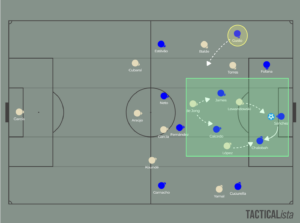
Barcelona’s intense man-oriented pressure included Lewandowski pressing the goalkeeper. Although it left them light in midfield, there were other factors to consider like Chalobah’s passing angles.
This left an underload in midfield since Frenkie de Jong would have to choose between pressing James and Caicedo. That being said, there were other conditions in Barcelona’s favor that somewhat balanced out the risks.
Firstly, Trevoh Chalobah is a right-footed player deployed by Maresca at left center-back. This makes it uncomfortable for him to receive a pass from the goalkeeper as Chalobah has to take an extra touch before opening his body rather than doing it first time. Moreover, it would also be difficult for Chalobah to pass into the free Chelsea midfielder since he wouldn’t have enough time on the ball to set himself.
Secondly, building on the above point, de Jong was in a suitable position to press the midfield that Chalobah would play to. Since the pass would lack the zip that a left-footed center-back like the injured Levi Colwill could play, it made it a tad bit easier for de Jong to press.
Thus, Lewandowski curving his run to block Fofana when pressing forced Sánchez to play to the left to Chalobah. But as mentioned, although Chelsea had a surplus in midfield, this was difficult to access.
Torres misses a golden opportunity
Barcelona made it tough for Chelsea to play short passes out from the back, and one of their early attempts to do so almost proved costly. In the fifth minute, Flick’s high press tactics played out exactly as intended with Lewandowski forcing Sánchez to pass to Chalobah, who played it toward James.
Although de Jong was moving toward Caicedo, Fermín López managed to intercept James’ pass, which was under-hit. This soon led to Torres being one-versus-one against the goalkeeper in point-blank range but he directed his shot wide after not balancing himself before the attempt.
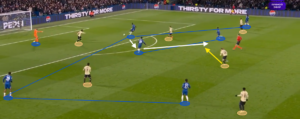
Barcelona’s press nearly paid off after James’ pass to Caicedo was intercepted by López.
Chelsea’s press and the right-side triggers
The Blues matched Barcelona’s intensity without the ball by similarly pressing man-to-man during opposition goal kicks. In the middle third, this was not the case as Chelsea set up in a 4-5-1 shape from which they had right-side triggers that transitioned into a man-oriented approach.
Specifically, when Araújo passed it to his left toward Cubarsí, Estêvão left Balde, the fullback, and jumped to the left center-back. This triggered the movement down Chelsea’s right as Gusto and Fofana shifted across. Here, the Chelsea right-back especially had a lot of distance to cover.
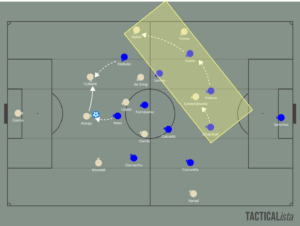
Chelsea transitioned from a 4-5-1 shape into a man-to-man press with all triggers down the right flank.
This posed an opportunity for Barcelona as they could, in theory, use these right-sided triggers against Chelsea by playing early passes to Torres, the left winger, who would be one-versus-one against Fofana. Maresca would likely be aware of this, but he may have considered it to be a risk worth taking compared to defending passively or even leaving the player deficit down the flank rather than the center. Additionally, it is also worth noting that Maresca decided to have this weakness down Barcelona’s left wing where Torres played, who is less of a one-versus-one threat than Lamine Yamal. When taking all of those factors into account, there is a clear rationale behind Maresca’s tactical decision.
Chelsea's OOP set-up in the middle third is as follows (not what I predicted):
— Fahd (@fahdahmed987) November 25, 2025
- Set up in a 4-5-1 shape from which Neto looks to force Barcelona down Chelsea's right side.
- This triggers Estevao to leave the Barcelona LB (Balde) and press the LCB (Cubarsi).
- That movement… https://t.co/z9POqDwK88 pic.twitter.com/z74Yt5zc2U
Using double width to create an overload
An evident weakness for Barcelona during defensive phases is the lack of support provided by the wingers when the opposition fullback advances. This has its risks and rewards. The primary benefit is that it can leave the winger with acres of space to attack on the transition. However, from an out-of-possession perspective, it leaves the fullback vulnerable to an easy overload.
Further, Maresca deployed James as the defensive midfielder on that side with Fofana at the back – a pacey defender capable of covering large spaces. Thus, as was the case with the earlier tactic of the right-side triggers in the press, Maresca had solutions to the defensive weaknesses that could be exploited.
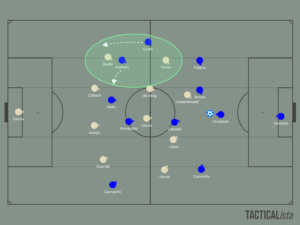
Gusto’s higher positioning generated a wide overload against Balde.
This overload could leave Gusto or Estêvão free. If the latter drifted infield, for example, Balde could not track him due to the Chelsea right-back’s position. This indirectly played its hand in the lead-up to the first goal with the situation below occurring moments before the corner from which Chelsea scored.
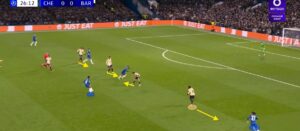
Estêvão could receive the ball unmarked in midfield since Gusto pinned Balde down Chelsea’s right flank.
From the corner that resulted from the above sequence, Barcelona failed to deal with a commonly used short corner routine by Chelsea. Yet again, the home side generated an overload, this time a three-versus-two, before launching the ball into the box, which ended up at the back of the net.
Chelsea's 3v2 wide overload from a short corner, something that has been used for a while now, paying off in the lead up to the opening goal against Barcelona tonight. https://t.co/lPkmoBCZQd pic.twitter.com/E8YG177ZMQ
— Fahd (@fahdahmed987) November 25, 2025
Araújo’s red card, Estêvão’s magic, and cruising to three points
After the early dangerous chance for Torres, Chelsea looked like the better team heading into half-time. However, Barcelona did not get the ideal situation to recoup at the break with Araújo carelessly fouling Marc Cucurella to receive his second yellow card of the game. This put Chelsea in the driving seat ahead of the second half.
The Blues did not falter in their lead against the ten-man Barcelona and instead extended it by two. The first of those was a magical moment from the young Brazilian starlet Estêvão. The dribble, composure, and finish were quite simply a moment of magic that cannot be described well enough by words.
Estê ̶v̶ã̶o̶WOW 💥
— Amazon Prime Video Sport (@primevideosport) November 25, 2025
A super goal from Chelsea's young Brazilian to make it 2-0! 🔵🇧🇷 pic.twitter.com/B8NJlt4Xby
The substitute, Liam Delap, made it three later on as Chelsea capitalized on Barcelona’s high defensive line. However, the offside trap was a little too deep by just a couple inches, which played Enzo Fernández onside, who set up Delap to seal the tie.
Takeaways
Barcelona’s tactics under Flick worked impressively and successfully last season. There is no denying that. However, they are evidently overdue an evolution, specifically with their defensive tactics, as multiple teams have figured them out. Chelsea were simply yet another team that managed to exploit that.
It was not the only or primary tactical flaw of the game as the minor details like the wingers not tracking back, lack of discipline, and poor defensive set-pieces played their parts. The last point is especially crucial when facing English teams who have improved their set-piece proficiency over recent seasons.
Chelsea’s dominant display is yet another reminder of the high ceiling of this squad and Maresca’s abilities as a manager. In such high-stakes games, the Blues have the potential to give any opposition a tough test. It is now a matter of bringing out this quality consistently, as Chelsea have had the habit of having sporadic peaks and troughs. Ahead of a top-of-the-table clash against Arsenal in the coming weekend, the momentum will be crucial to defeat Mikel Arteta’s title contenders.
Use the arrows to scroll through all available match plots. Click to enlarge.
Check the match plots page for plots of other matches.


Comments