
Como – Napoli: Fabregas Controls, Conte Contained… Without Real Chances (0–0)
This had all the makings of a defining late-season clash, particularly with Napoli still clinging to faint title hopes and Como pushing for European qualification. What unfolded at the Stadio Giuseppe Sinigaglia felt less like a contest of ambition and more like a tactical compression of space. In a match dominated by structure over spontaneity, Cesc Fàbregas appeared to prioritise territorial control, while Antonio Conte leaned into compactness and defensive security. The result was a game defined by extremely short distances between lines, suffocating central access and reducing attacking sequences to low-probability moments.
Tactical analysis and match report by Mustafa Hassan.
We decided to make this article free to read. If you want to support our work, consider taking a subscription.
Como, under Fàbregas, set up in a 4-2-3-1 that emphasised positional occupation between the lines and controlled territorial pressure rather than direct verticality. Jean Butez operated behind a back four of Smolčić, Ramón, Diego Carlos and Álex Valle, a unit tasked with maintaining compact spacing while stepping forward aggressively to sustain pressure.
The double pivot of Perrone and Da Cunha provided both circulation and counter-pressing stability, allowing Como to sustain long attacking phases. Ahead of them, Nico Paz functioned as the central connector, constantly receiving between Napoli’s midfield and defensive lines, while Diao and Baturina offered width and diagonal penetration. Douvikas acted as a mobile reference point, stretching depth but also linking play when required. The structure clearly aimed to compress Napoli territorially while maintaining control of second balls and transitions.
Napoli, meanwhile, adopted a more conservative 3-4-2-1 under Conte, built around compactness and defensive layering rather than proactive control. Milinković-Savić anchored the side behind a back three of Beukema, Rrahmani and Buongiorno, who remained narrow and disciplined, prioritising central protection over aggressive stepping.
In midfield, Lobotka and McTominay formed a functional but relatively deep double pivot, often pinned by Como’s advanced positioning. The wing-backs, Politano and Gutiérrez, were crucial outlets but were frequently forced into deeper starting positions, limiting their attacking impact. Ahead of them, De Bruyne and Alisson Santos operated as narrow attacking midfielders, but with limited space between Como’s compact lines, their influence was heavily restricted. Højlund, isolated for large periods, functioned more as a transitional outlet than a consistent penalty-box presence.
Como’s Left-Sided Fluidity
Como’s most consistent progression pattern emerged down the left, where their structure created the platform for controlled fluidity rather than chaotic movement. The initial positioning was highly deliberate: Martin Baturina held a very wide role on the left touchline, stretching Napoli’s defensive width, while Álex Valle positioned himself slightly higher on the same flank. Behind them, Diego Carlos carried the ball into the left half-space, with Máximo Perrone occupying a central lane but subtly leaning towards that same side. On the far side, Assane Diao stayed extremely high and wide on the right, pinning Napoli’s back line and maximising horizontal stretch, while Anastasios Douvikas remained as the central reference point.
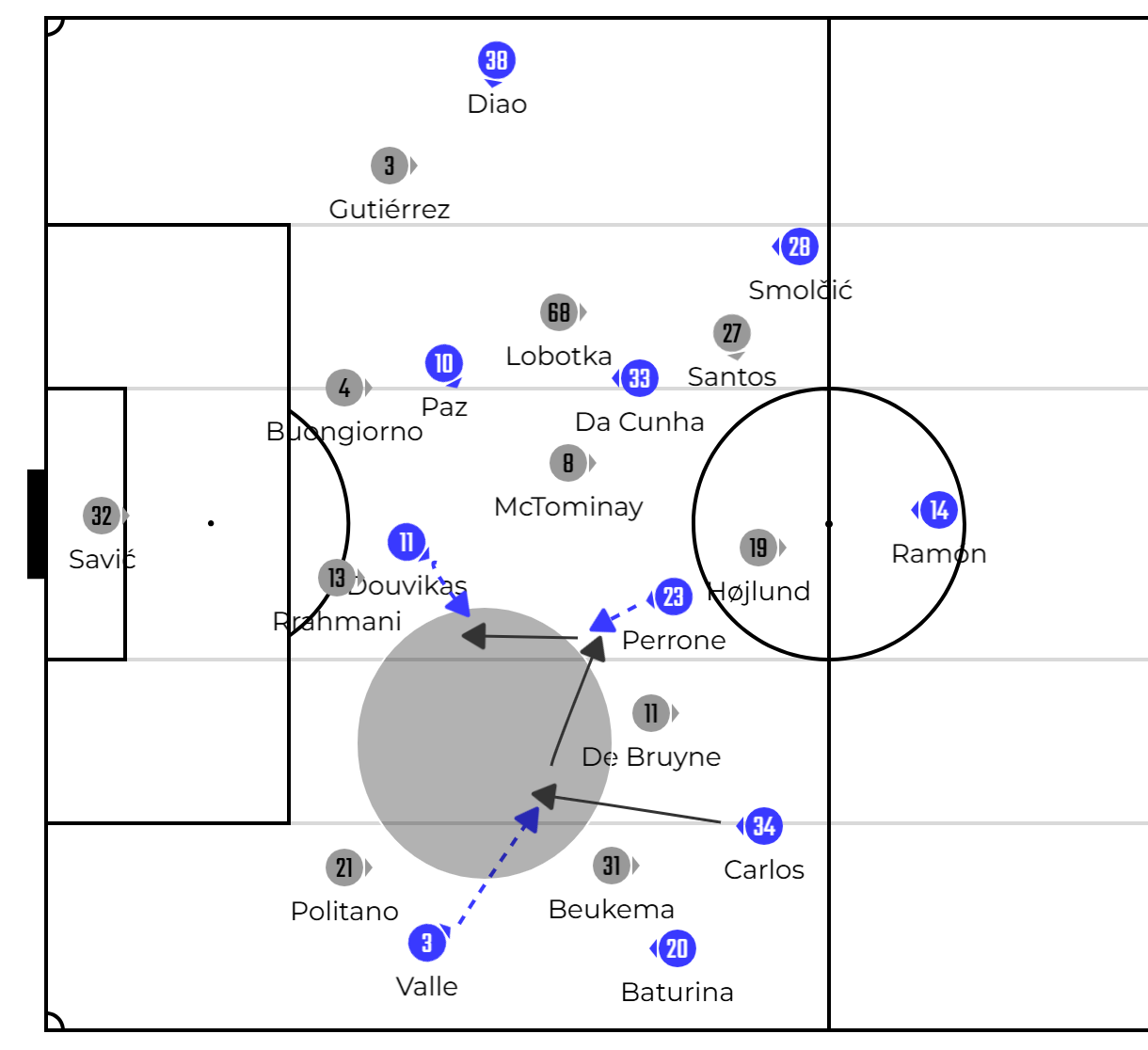
Como’s left-sided rotations create controlled central access through positional fluidity.
From this base, the fluidity unfolded through coordinated rotations. Valle would drift inside into the left half-space, effectively vacating the flank for Baturina to remain wide and isolated. As the ball progressed inward, Perrone adjusted his positioning to offer a close central passing option, creating a compact triangle around the ball. Simultaneously, Douvikas dropped slightly from the front line, occupying a pocket just ahead of Napoli’s midfield. This movement sequence generated a temporary overload between the lines, opening short passing lanes and destabilising Napoli’s compact block without requiring vertical risk. It was controlled, positional fluidity, designed not to break lines instantly, but to gradually manipulate them.
This mechanism was evident early in the match, when Como successfully progressed through the left and generated a promising shooting lane just outside the penalty area. The rotations pulled Napoli’s midfield slightly out of shape, briefly opening central space in front of the box.
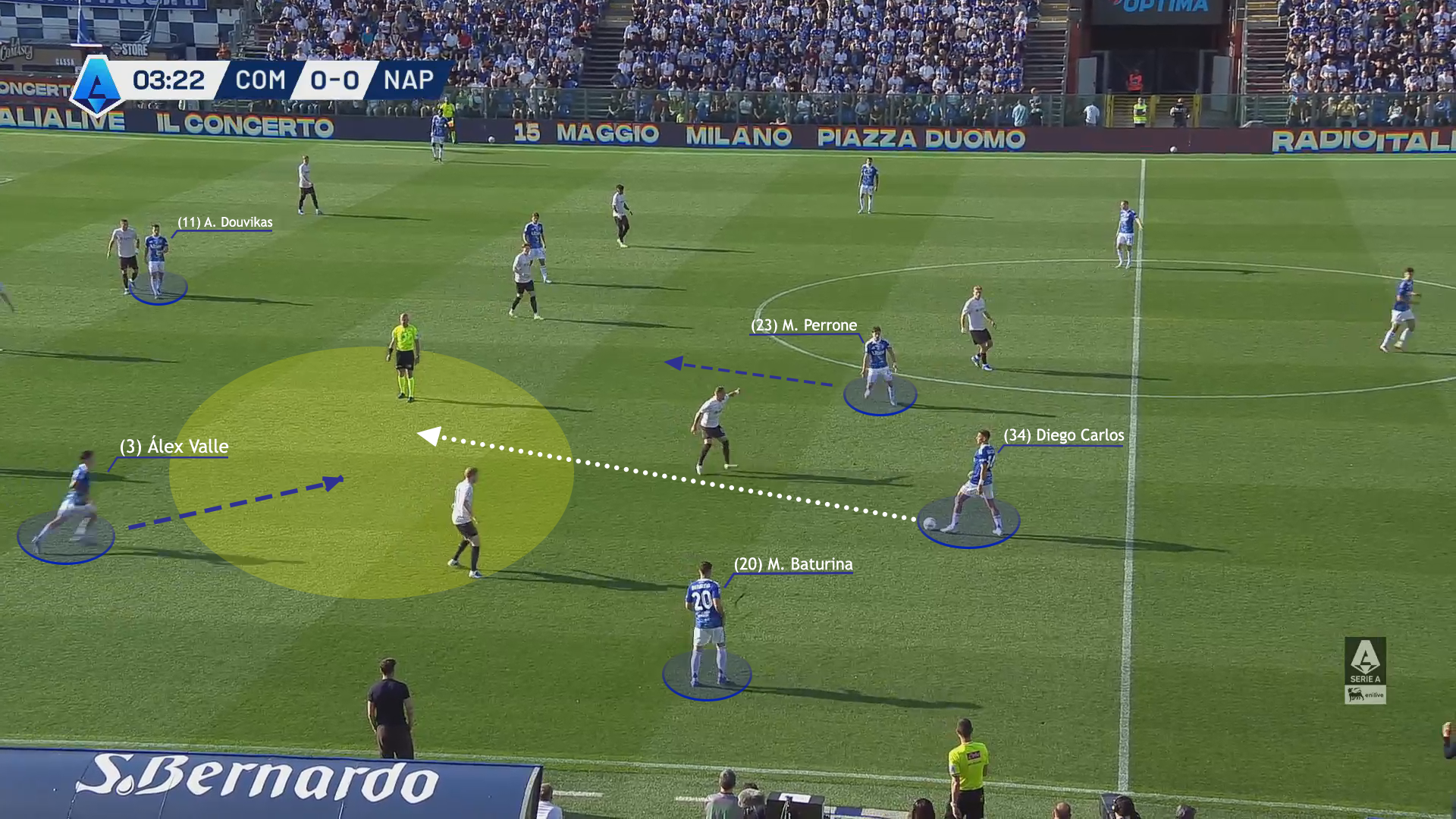
A well-constructed attack ends without a shot despite space opening at the edge of the box.
Despite the favourable conditions, the final decision lacked conviction, with the player opting against taking the shot. The move ultimately broke down, encapsulating the broader issue of the match, structure creating opportunities, but hesitation preventing execution.
Napoli Wide Overloads
Napoli’s clearest attacking intention came through their attempts to manufacture wide overloads, particularly as a way of disrupting Como’s compact, centrally focused block. The structure was designed to stretch attention before exploiting the far side. Rasmus Højlund remained high in the central channel, pinning Como’s centre-backs and preventing them from stepping out, while Matteo Politano held an advanced and very wide position on the right, acting as a constant outlet and horizontal reference point.
This positioning was key in fixing Como’s defensive line and subtly shifting their focus, especially when circulation initially moved away from the target side.
With Scott McTominay and Stanislav Lobotka controlling possession centrally, the trigger for the overload came through lateral circulation. As the ball was secured in midfield, the far-side dynamic activated, Miguel Gutiérrez would push forward aggressively to join Alisson Santos on the left flank. This created repeated 2v1 situations against Como’s right-sided defender, with Gutiérrez often overlapping on the outside while Santos occupied the inside lane.
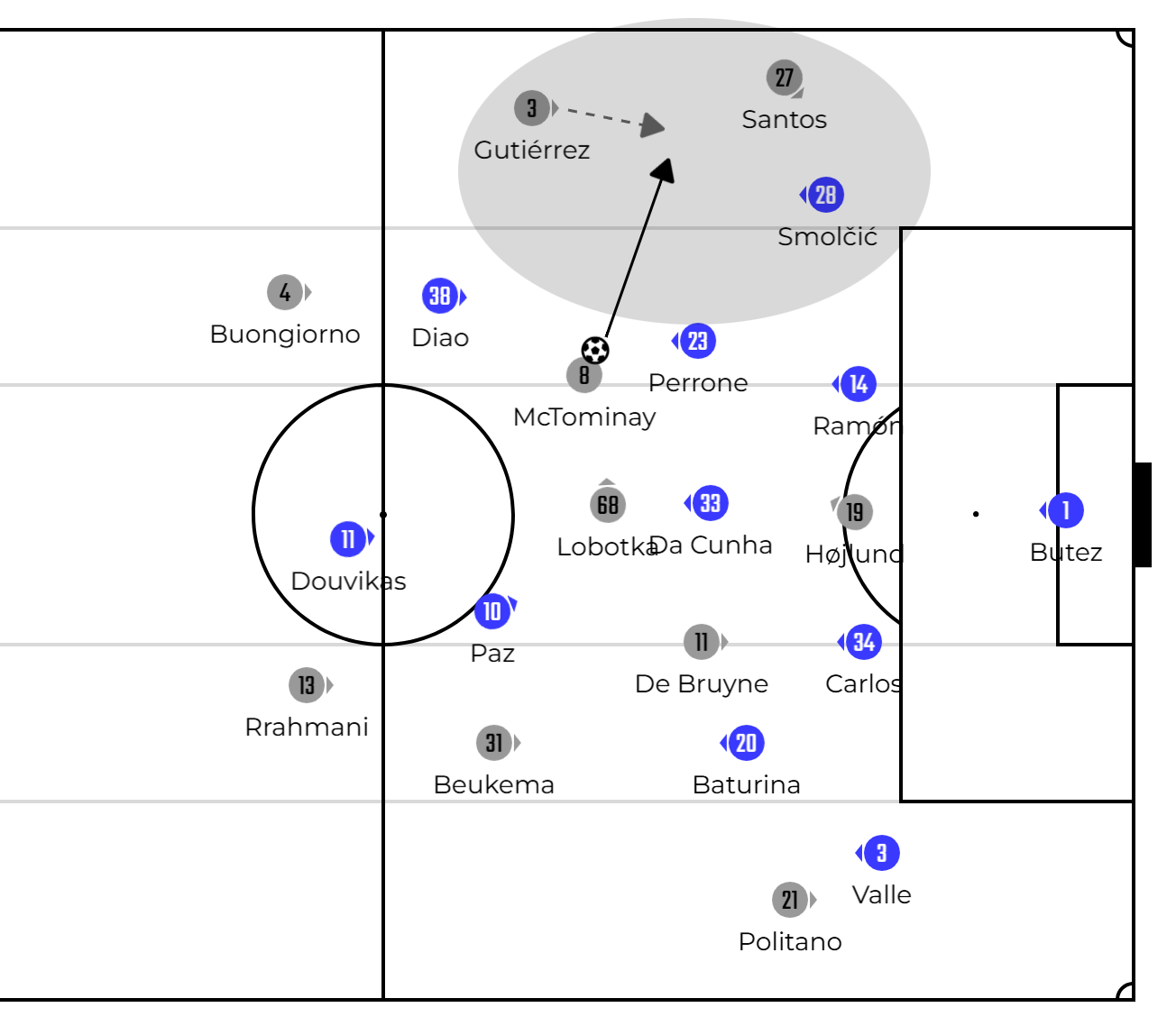
Napoli create wide 2v1 overloads to stretch Como’s compact central block.
The objective was clear, draw Como’s compact block inward, then stretch it late through width and timing. While the pattern succeeded in accessing crossing zones, the lack of presence and precision inside the box limited its overall effectiveness.
Como’s Inverted Full-Backs
A key feature of Como’s positional play was the use of inverted full-backs to reinforce central control and improve progression through the half-spaces. During the second phase of build-up, both Álex Valle and Ivan Smolčić consistently moved inside, occupying the left and right half-spaces rather than holding traditional wide positions. This adjustment increased the number of players positioned between Napoli’s lines, effectively creating central overloads and stabilising possession in midfield zones.
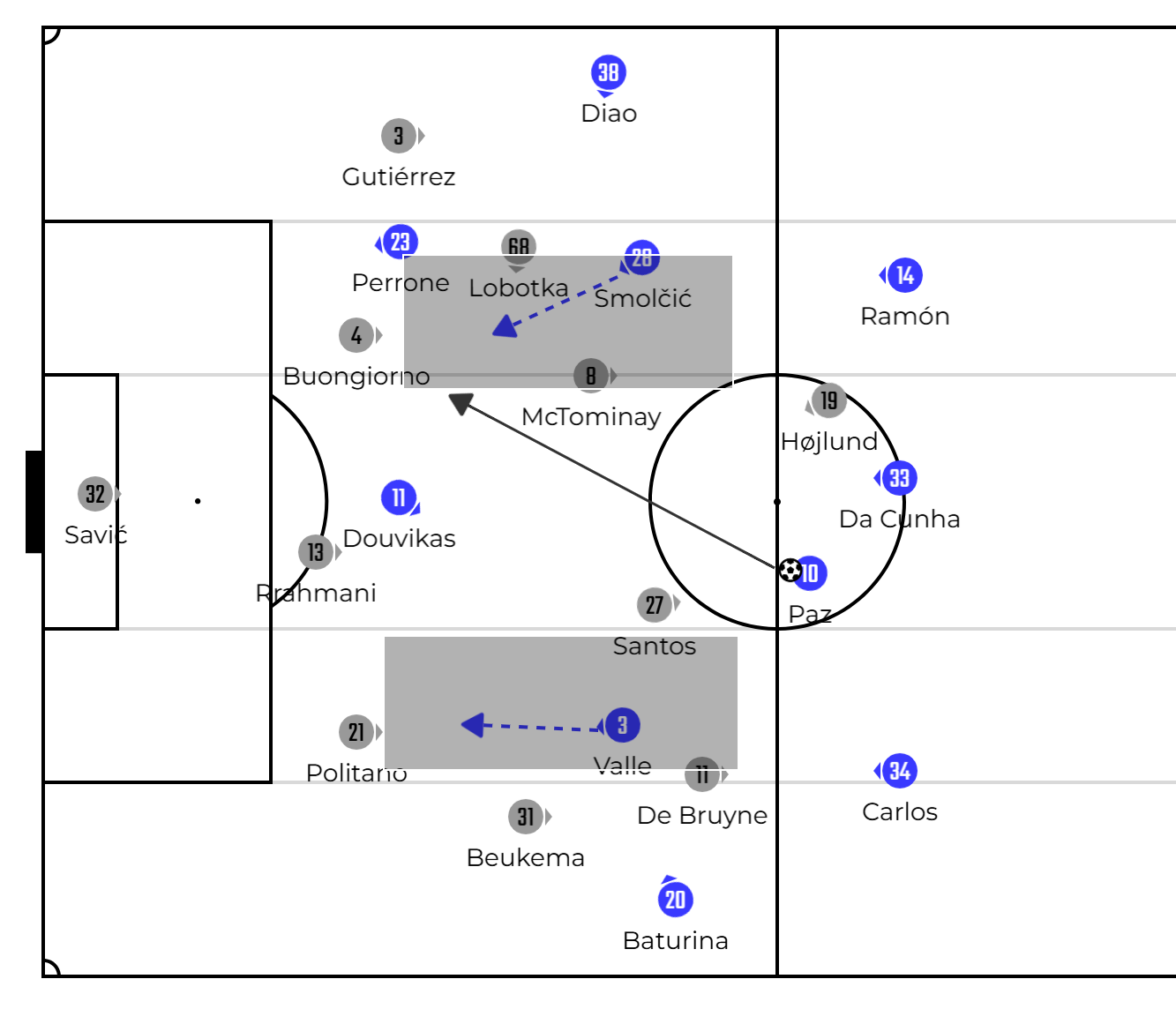
Inverted full-backs create central overloads and enable controlled progression through the half-spaces.
With both full-backs narrowing, Como were able to dictate circulation with shorter, safer connections, while also subtly shifting Napoli’s compact block from side to side. The structure encouraged ball progression towards one half-space before redirecting play into the opposite interior channel, where the next phase could be activated. From there, one of the inverted full-backs would step forward aggressively, carrying the ball or combining into the final third to advance the attack.
This mechanism allowed Como to progress without relying on risky vertical passes, instead using positional superiority and timing to move through the thirds. It was less about immediate penetration and more about controlled advancement, drawing Napoli inward before breaking lines through interior access and late forward movements.
One clear example came when Nico Paz received the ball in the middle third, with Baturina and Diao positioned high and wide to stretch Napoli’s back line. Meanwhile, both Smolčić and Valle occupied the half-spaces, timing forward runs to receive from Paz. Their interior positioning created forward passing lanes, allowing Como to progress through central channels rather than relying on the wings.
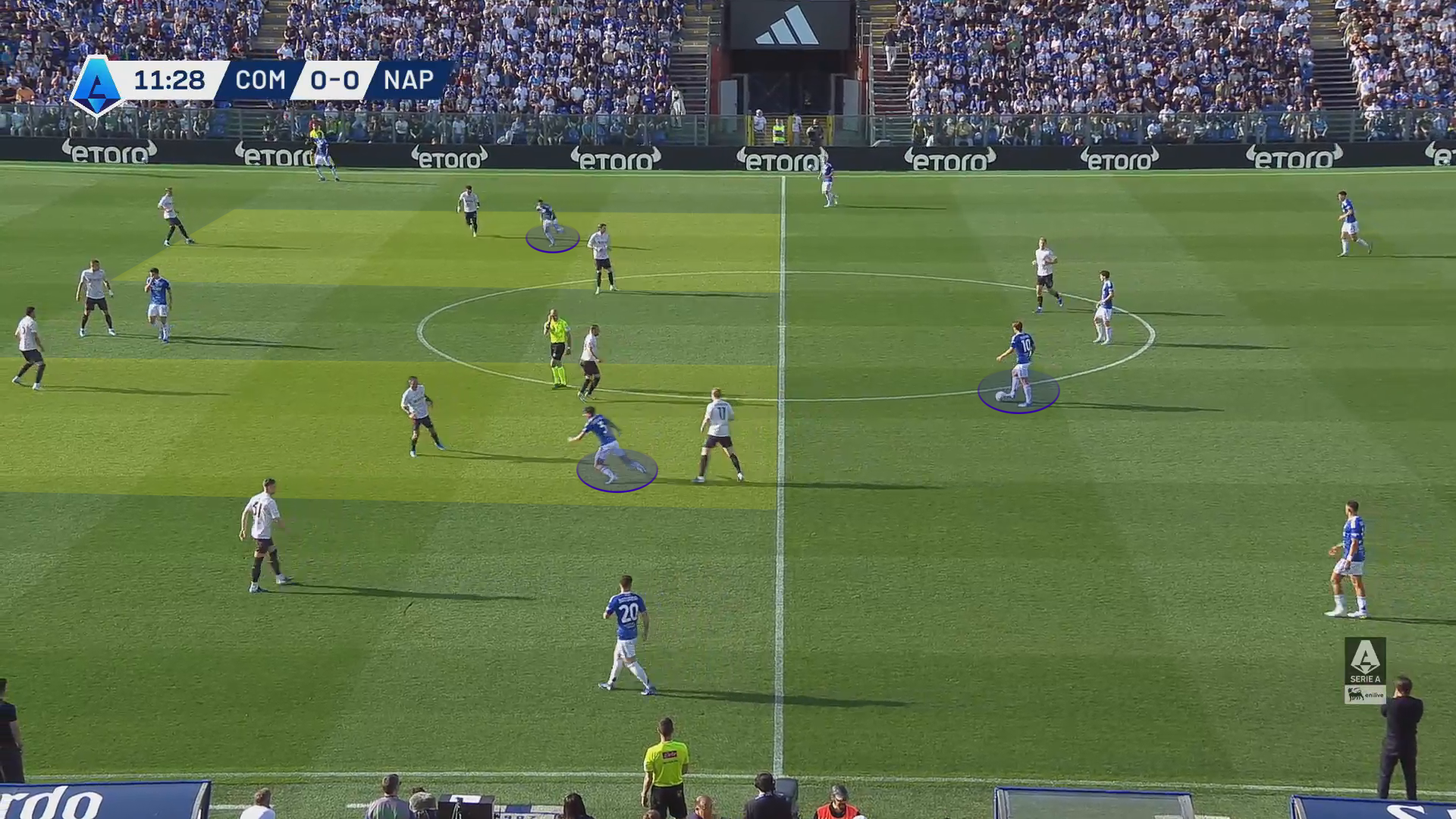
Full-backs invert into half-spaces and make forward runs to support central progression.
Nico Paz as the Rhythm Controller
Nico Paz played a central role in dictating Como’s tempo, operating intelligently between the lines and acting as the team’s primary reference in the central channel. His constant movement allowed him to receive in pockets just ahead of Napoli’s midfield, from where he could either circulate possession or redirect play towards the flanks and half-spaces. In the third phase, Como looked to build around his positioning, with Douvikas occupying the centre-backs and Baturina stepping into deeper central zones near the edge of the box.
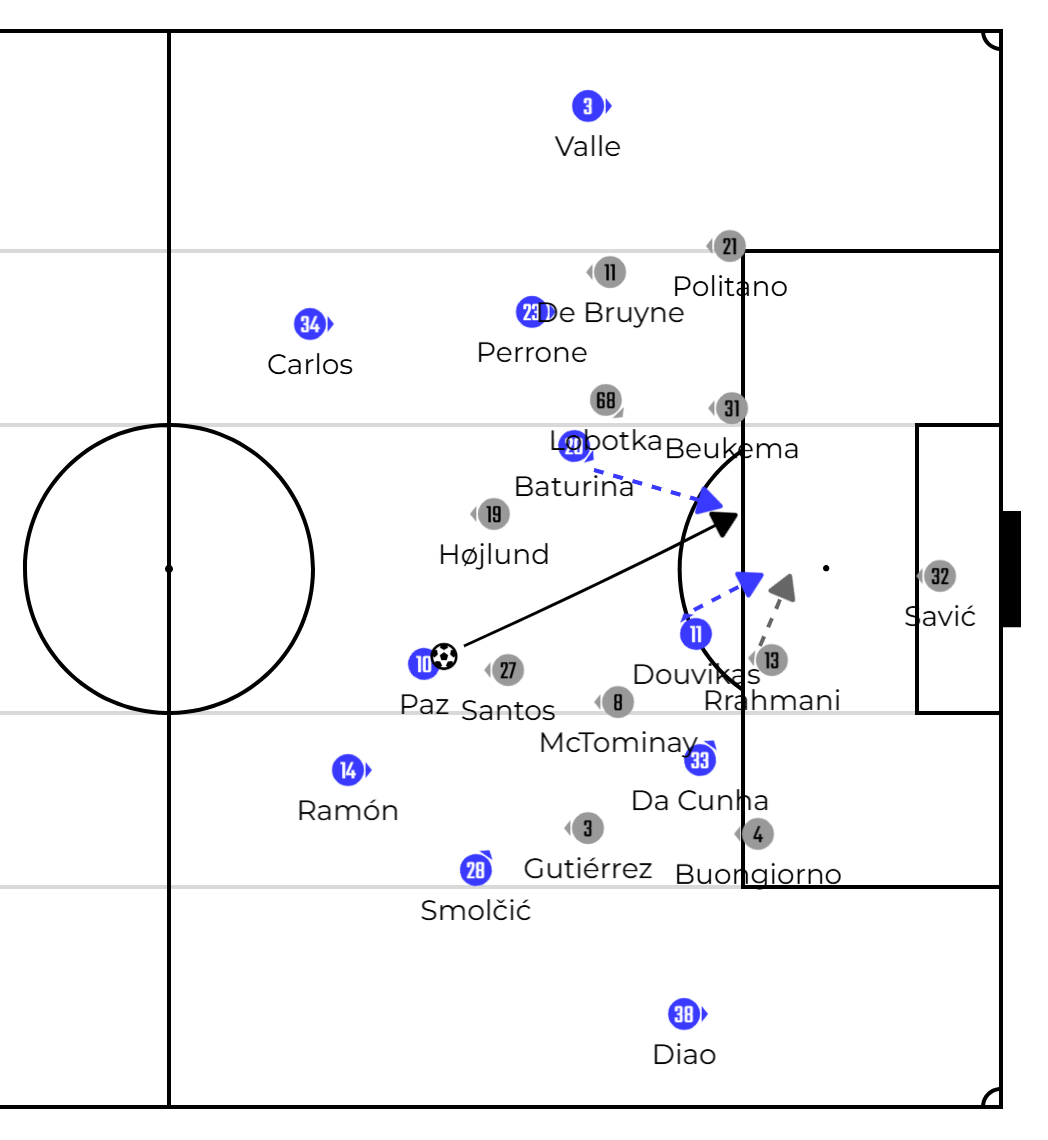
Nico Paz orchestrates play between the lines but is contained by Napoli’s compact defensive block.
This created a layered central presence designed to generate shooting opportunities through combination play. However, despite the structural clarity, Napoli’s defensive compactness and discipline consistently limited space and time on the ball, preventing Paz from translating control into decisive final actions.
Takeaways
Ultimately, this was a game defined more by structure than outcome. Como demonstrated clear positional superiority, using fluid rotations, inverted full-backs, and central occupation to control territory and dictate rhythm. Their ability to progress through the thirds was consistent, but the lack of decisiveness in the final phase limited their attacking return.
Napoli, on the other hand, executed a disciplined defensive plan, maintaining compact distances and successfully protecting central zones. While their wide overloads offered a potential route forward, they lacked both presence and precision in key moments.
The match underlined a broader tactical truth: control does not always translate into chance creation. With both sides prioritising structure and compactness, the game became a strategic stalemate, organised, controlled, but ultimately lacking the chaos required to produce goals.
Use the arrows to scroll through all available match plots. Click to enlarge.
Check the match plots page for plots of other matches.

Comments