

England – Argentina: England Frozen By Fear (1-2)
The first half of this game was combative although without many chances. England tried to use wing attacks in their 4-3-3 system while pressing with a focus on the center. England went ahead but then sank incredibly deep into their own box. Eventually, the spaces around England’s box became too large, and Argentina punished them with two late goals.
Tactical analysis and match report by Josh Manley.
We decided to make this article free to read. If you want to support our work, consider taking a subscription.
It had been twenty years since England and Argentina had met in a World Cup prior to this game, but the intensity of the rivalry has not grown weaker. Both sides came into this game with serious fire in their bellies. Interestingly, this was the first time Lionel Messi had ever played against England in his long and storied career.
England lined up in a 4-3-3 formation with Reece James returning to the back four alongside John Stones, Marc Guéhi, and Djed Spence. Elliot Anderson, Declan Rice, and Jude Bellingham formed the midfield trio, while Morgan Rogers was selected for the right-wing role ahead of more orthodox options. Harry Kane and Anthony Gordon completed the frontline.
For Lionel Scaloni’s Argentina it was a 4-4-2 shape. Nahuel Molina, Cristian Romero, Lisandro Martínez, and Nicolás Tagliafico made up the back four, while Leandro Paredes and Enzo Fernández played in central midfield. Giuliano Simeone and Alexis Mac Allister started wide, while Julián Alvarez joined Lionel Messi up front.
Combative start
If there was any doubt about whether the players felt the same animosity towards their opponents as their fans felt coming into this game, that doubt was assuaged from the first whistle as the teams engaged in a physical battle with plenty of fouls breaking up the game.
Despite this, England did try to play positively and impose themselves on the game through more tactical means, albeit without producing shots on goal, with neither team mustering an effort at goal within the first half an hour.
England were attacking in their 4-3-3 formation which was wing-focused as usual. They tried to penetrate Argentina with runs from Rice and Bellingham into the channels between Argentina’s fullbacks and center-backs when the Argentina fullbacks tried to get tight to England’s wingers.
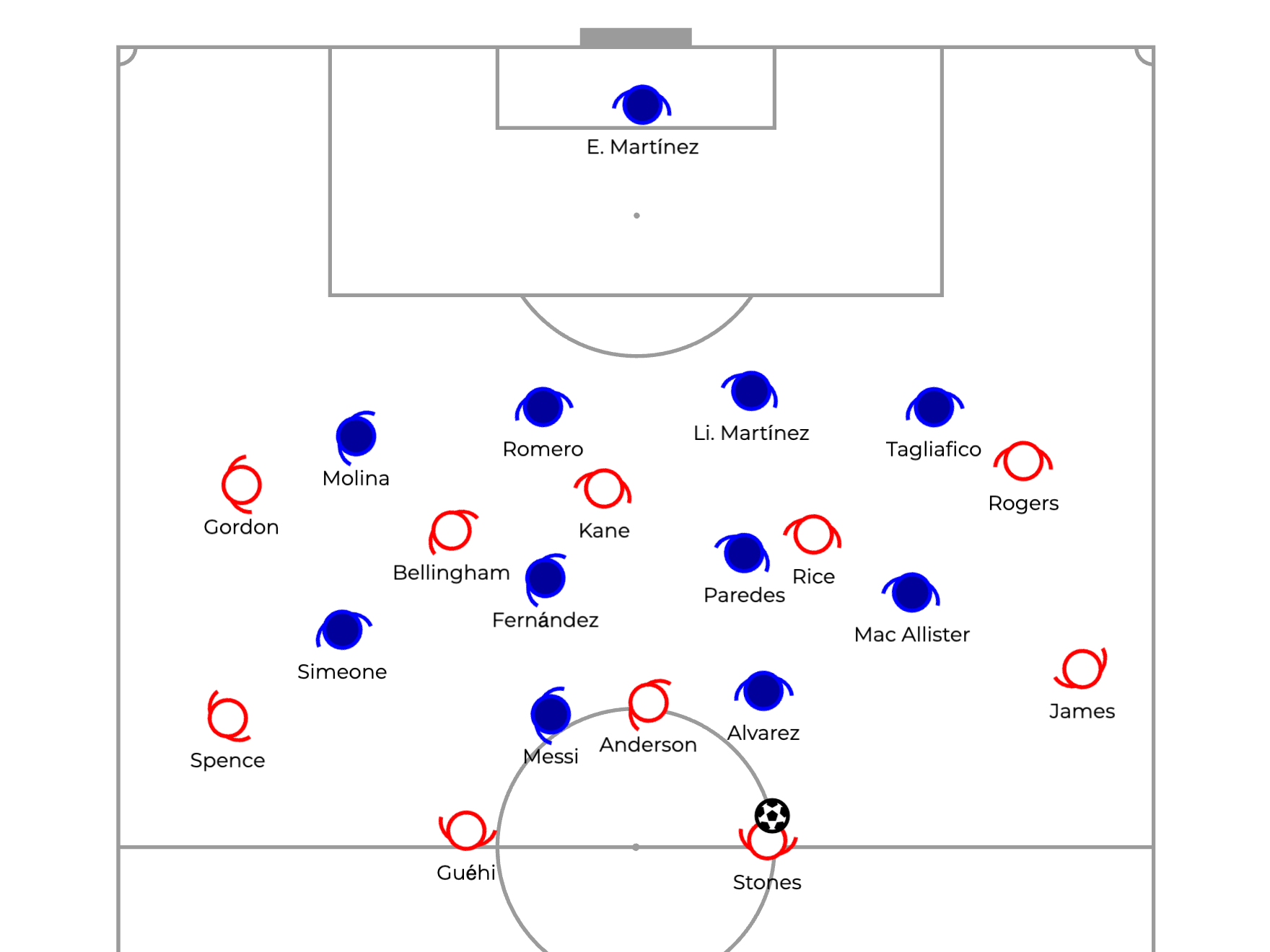
England’s initial attacking shape.
Rogers and Gordon could also indent onto the last line in many cases, allowing James or Spence to advance outside them. England were keen to use switches of play wherever possible to try and get around the outside of the Argentina block and manufacture crossing situations from which they would try to load the box aggressively.
When James advanced forward, Rice would sometimes drop deeper in the right halfspace, while Anderson sometimes dropped between the center-backs. A key theme in this game was that Kane would come extremely deep in many of England’s buildup situations – more than he has done in most games this tournament.
England’s pressing gamble
An interesting strategic aspect for England in this game was their pressing approach. Tuchel has had England pressing in a man-oriented fashion in this tournament, often with a focus on Bellingham jumping from midfield to join Kane in the first line while the wingers track the opposition fullbacks if they go forward.
In this game, it was England’s wingers who were often responsible for getting pressure on Argentina’s center-backs Romero and Martínez. Rogers and Gordon would start diagonal pressing movements to try and cut direct access to the fullbacks and force Argentina’s center-backs inside.
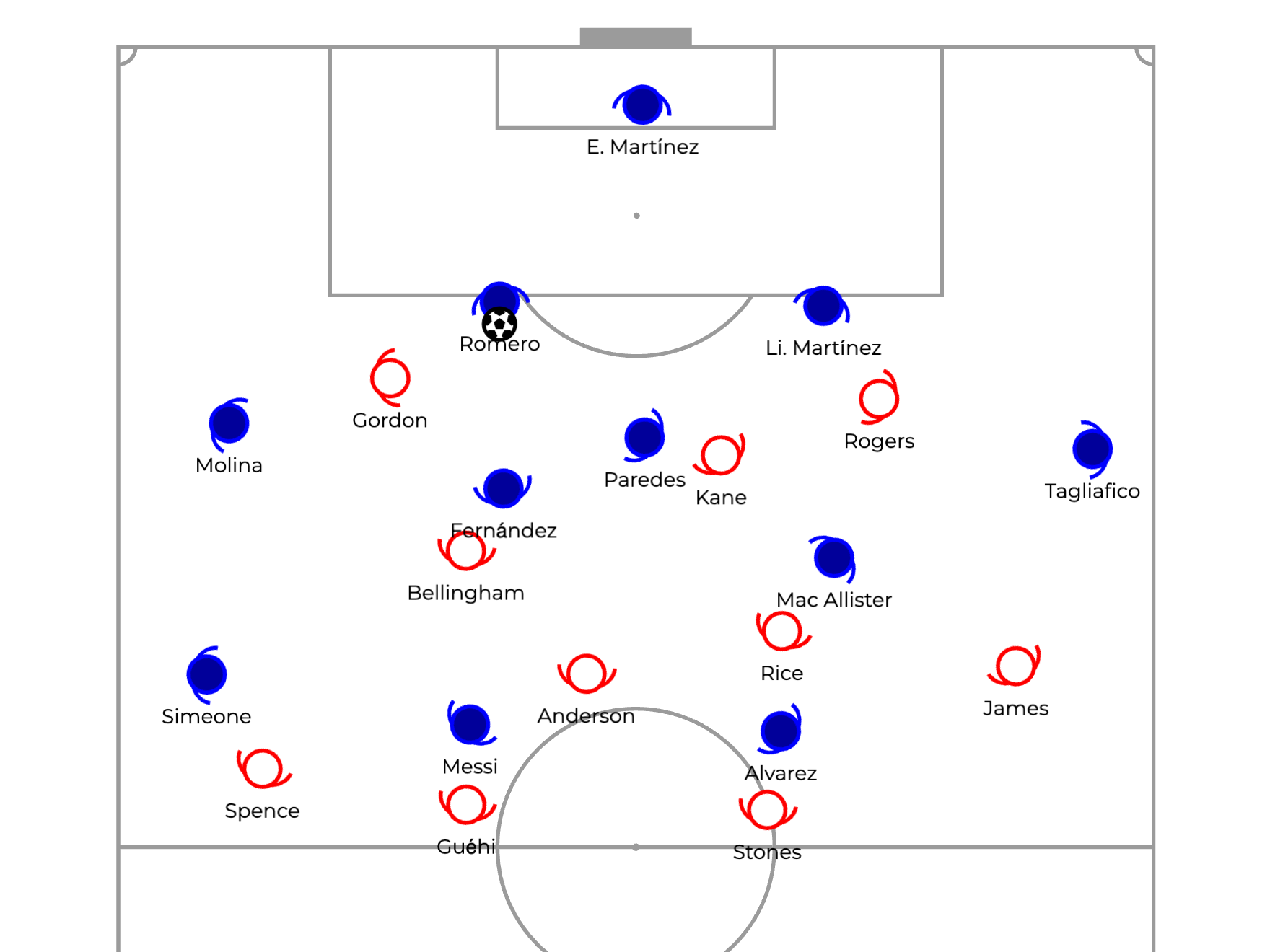
Tuchel’s pressing scheme – mistake or strategic gamble?
Kane and Bellingham would then be more focused on Argentina’s number six space, trying to get close to the likes of Paredes and Fernández in order to limit the short passing options.
The issue was that Argentina could still access their fullbacks indirectly though third-man passes or similar means. On England’s left side, Bellingham found himself pushing out to press Molina, while James would sometimes jump on the right side to try and pressure Tagliafico.
This seems to have been a calculated gamble by Tuchel to leave Argentina’s fullbacks free and focus on defending the center, since Argentina’s game is often focused around central combinations.
Initially, this gamble seemed to work as Argentina still did not find productive routes to England’s final third after finding the fullbacks. However, as the game went on, the ability for Argentina to dissolve pressure in this manner gradually drove England back and allowed Scaloni’s side to control more of the ball and territory.
Frozen by fear
The first half had lacked goalmouth action, but England were able to take the lead just ten minutes into the second half thanks to Gordon’s well-timed arrival at the far post to meet Rogers’ cross. It came from a move where Kane’s dropping into midfield had finally paid off for England, as he was able to get free and hit a searching pass in behind which the Argentina defense failed to deal with properly.
After the goal though, England quickly sank into a low block from which they would rarely venture for the next forty minutes. While getting bodies behind the ball seemed logical, the depth to which England retreated along with their lack of counter-attacking prospects became a problem for the rest of the game.
Argentina brought Nicolás González on for Paredes after the hour mark. Mac Allister moved into a more central role, while González provided more width on the left side. Messi was mostly playing around the right halfspace at this point, while Simeone played wider on the right.
As the game moved past the seventy minute mark, England were coming under pressure from Argentina with dangerous crosses starting to come into the box. It was at this point that Tuchel made a change which he thought would help add security to England’s defense, but actually ended up making things much worse.
Gordon was removed in favor of Ezri Konsa, with England switching to a back five. The removal of Gordon harmed England’s counter-attacking prospects. More fatally though, the switch to a 5-3-2 shape further reduced England’s already-weak control of the spaces around their own penalty box.
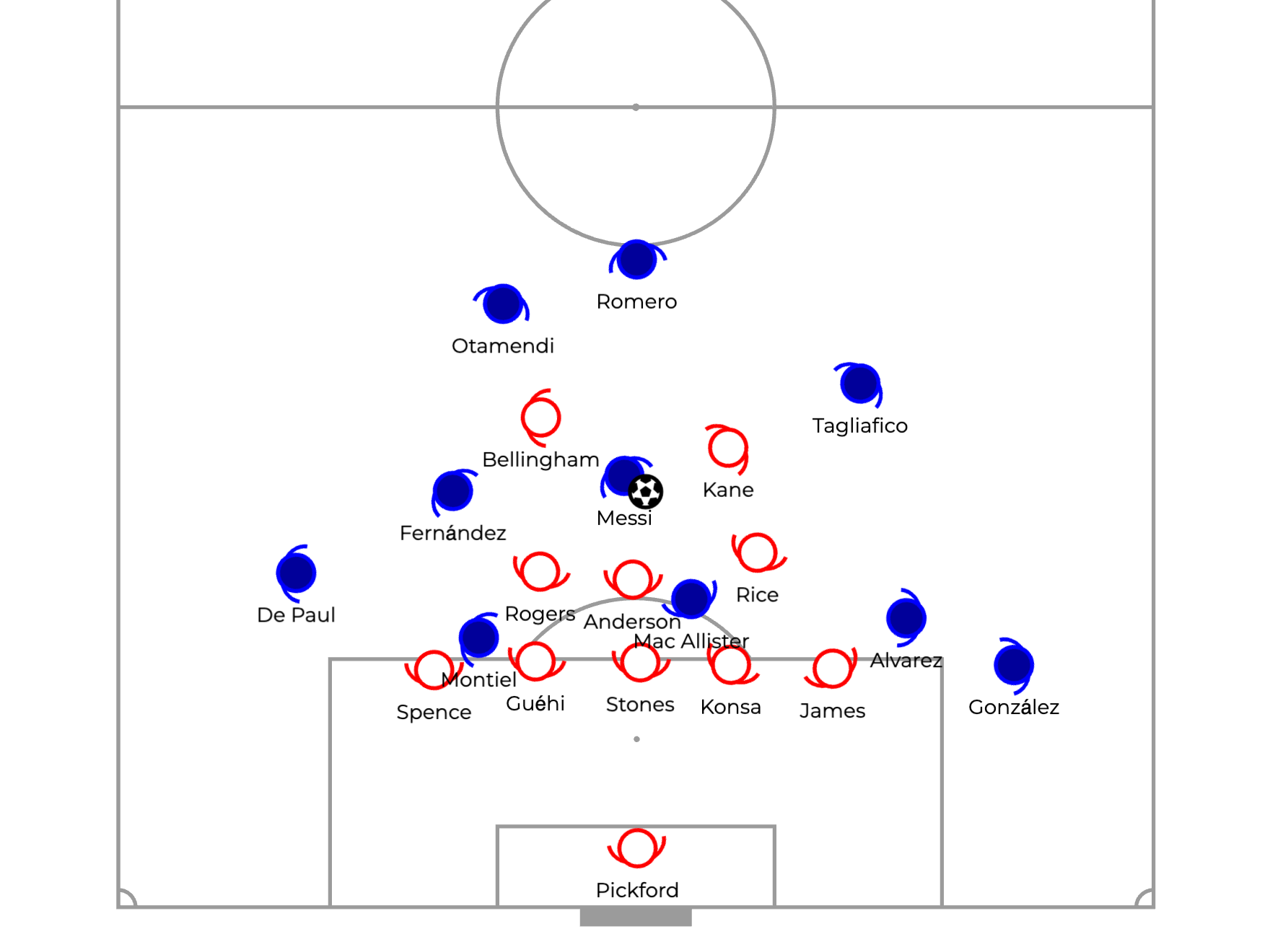
England’s switch to a back five saw them concede large spaces around their own box.
Tuchel said after the game that the change to five at the back was intended to make the gaps in the defensive line smaller. However, the gaps in the defensive line were not the problem that England were experiencing at that time. The problem was that Argentina found pockets of space too easily at the edge of the box, from which their technically gifted players could whip crosses and long shots into the England goalmouth.
Messi and substitute Rodrigo De Paul were able to find space in the right halfspace down the side of England’s three-man midfield line in the 5-3-2 formation, while Mac Allister and Alvarez did similar on the left. It was simply far too easy for Argentina to reach the corners of England’s penalty box with minimal pressure on the ball.
Tuchel at least recognized this and tried to widen the stance of the midfield line by switching to a 5-4-1 shape with the introduction of O’Reilly for Rice. However, just a few minutes later, Argentina scored after a short corner led to Messi passing to Fernández on the edge of the box. England were so deep in their own area that Fernández had time to pick his spot in Jordan Pickford’s net.
Even after the equalizer, England seemed completely rooted to their own penalty box. With England’s four-man midfield line, there was now less space in the right halfspace for Messi, who moved to the right wing to find space.
In added time, Argentina’s captain picked up the ball on the right wing and went on the outside, onto his weaker right foot. He produced a cross which flashed across Pickford, meeting the head of substitute Lautaro Martínez who made it 2-1.
Takeaways
England had a decent start this game, trying to play the game in Argentina’s half and exploit their characteristic wide attacks. Their strategic gamble in pressing eventually helped push them back though, and Argentina gained more control. Plenty of ink will be spilled regarding the events of the second half. England seemed frozen with fear after going ahead, and the switch to a back five only dug them deeper into the rut they were stuck in.
Argentina showed huge character here, as they have done throughout the tournament, and indeed the past five years or so. Their approach to chasing the game was patient, and they worked good positions for crosses and shots from around the edge of the box for which they were eventually rewarded.
Match plots to be added shortly.



Comments