
Estudiantes – CA Talleres: Estudiantes Fail To Pull Clear Off Top After Falling Short to Talleres (0-0)
Estudiantes dictated the tempo and tilted the pitch in their favor, but control alone wasn’t enough to crack the final third. Their well-constructed overloads built momentum and forced Talleres deep, yet the decisive breakthrough never came, with central spaces in the final third expertly shut down. That lack of sustained cutting edge ultimately played into Talleres’ hands, making their defensive task far more manageable. Resolute and disciplined, Talleres did just enough to secure a point, but offered too little going forward to turn resistance into victory.
Tactical analysis and match report by Ebuka Ogoegbunam.
Estudiantes had a chance to extend their lead at the top in the Apertura. With three points being the difference between the two sides on the table, there was all to play for. Carlos Tevez’s Talleres had won three out of their last five games, with Alexander Medina’s Estudiantes having the same record in their last five.
Fernando Muslera started in goal for Estudiantes and led the team as the captain in this game. Eros Mancuso, Leandro González Pírez, Tomás Palacios and Gastón Benedetti made up the back four. Gabriel Neves and Ezequiel Piovi both played together in the midfield. Facundo Farías played slightly high up in midfield with Mikel Amondarain to his right and Edwuin Cetré to his left. Adolfo Gaich led the line in front of the goal.
Guido Herrera captained his side in goal with a defensive line of Alex Vigo, Santiago Fernández, Matías Catalán, and Alexandro Maidana. Mateo Cáceres and Matías Galarza played in midfield to protect the backline. Franco Cristaldo played in the attacking midfield, connecting an attacking front three of Rick, Diego Valoyes, and Ronaldo Martínez.
Estudiantes Don’t Take advantage
Medina’s Estudiantes controlled the game early. Their 4-2-3-1 shape had their fullbacks push up, with the right back, Mancuso, having more freedom to do this on his wing. Amondarain occupied a narrow position on the right side while Mancuso held the width. On the left side, Cetré held the width with Benedetti often staying deeper in his defensive line while occasionally making overlapping runs in attack.
Talleres pressed in a 4-4-2 high press and often sat in a 4-4-2 mid-block. Cristaldo led the press with Martinez, but they were often overloaded in this phase. Farias’ movements between the lines were an outlet for Estudiantes to progress up the pitch during the build-up. Talleres planned to control this by dropping one midfielder in case Farias was the extra passing option when they pressed.
Estudiantes used this opportunity to make use of their overloads in those areas and play through the Talleres midfielder who pushed up during the press. When the two in front put pressure during the press for Talleres, Piovi and Neves had a 2v1 overload in the middle, and they found lanes to play through beyond the Talleres’ press.
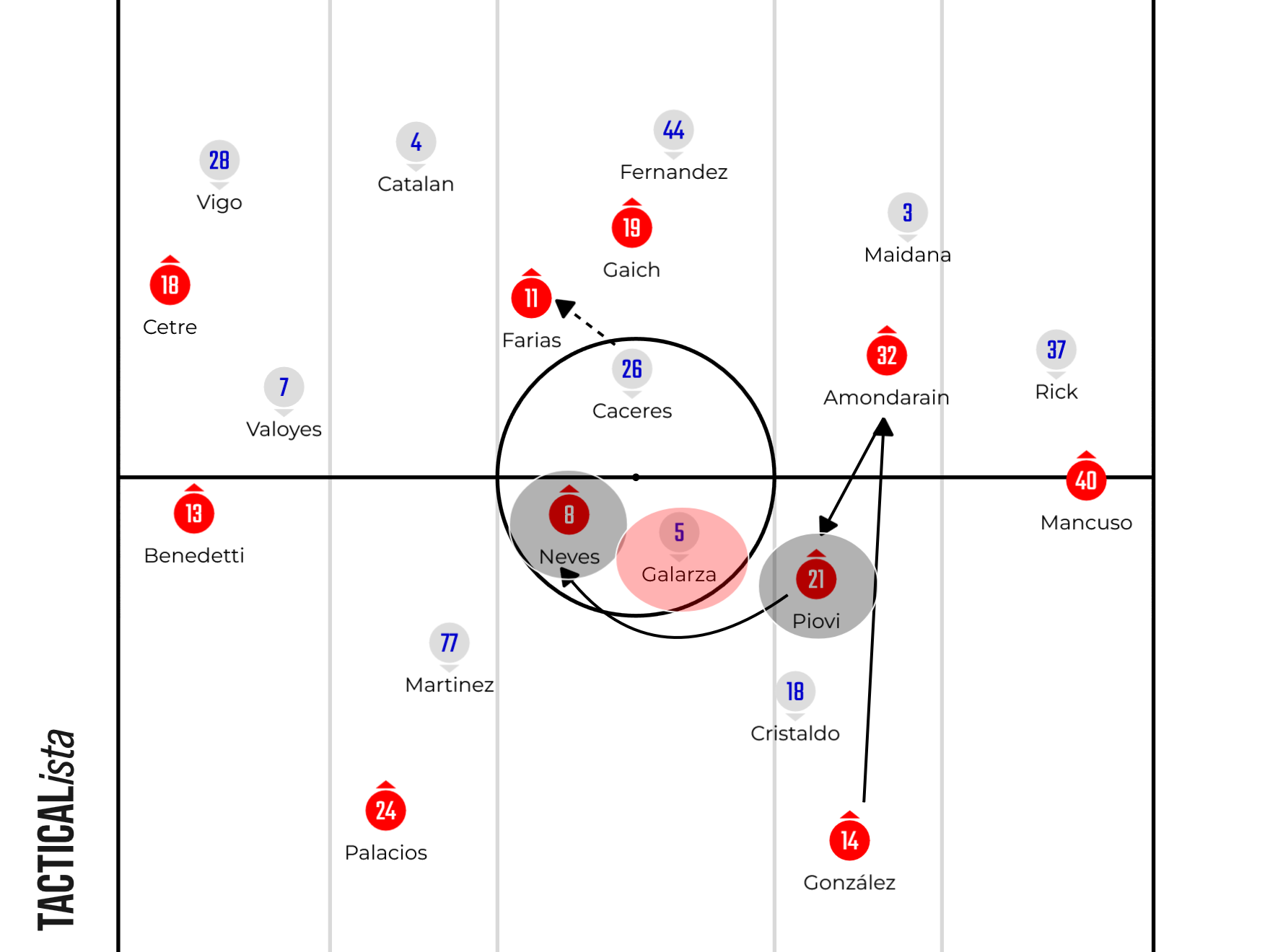
Piovi and Neves overloaded the opposition midfielder high up, and Estudiantes escaped the Talleres press by playing through the overloads.
Farias’ positioning caused problems for Talleres’ press with the center back ofte picking him up in positions when Galarza or Caceres weren’t in proximity to the middle of the pitch. Estudiantes’ build-up phase gave them momentum to play and access the middle third. They played long balls to take advantage of the numbers they had in the last line of the pitch.
As the game progressed, Talleres switched up their press to have more numbers in the middle of the pitch. The players leading the press had to put pressure on the center backs while covering the opposition pivot. This sequence forced Estudiantes to play long, and they won second balls in attacking areas to attack the backline from high up. The right fullback, high up made constant forward runs to aid this.
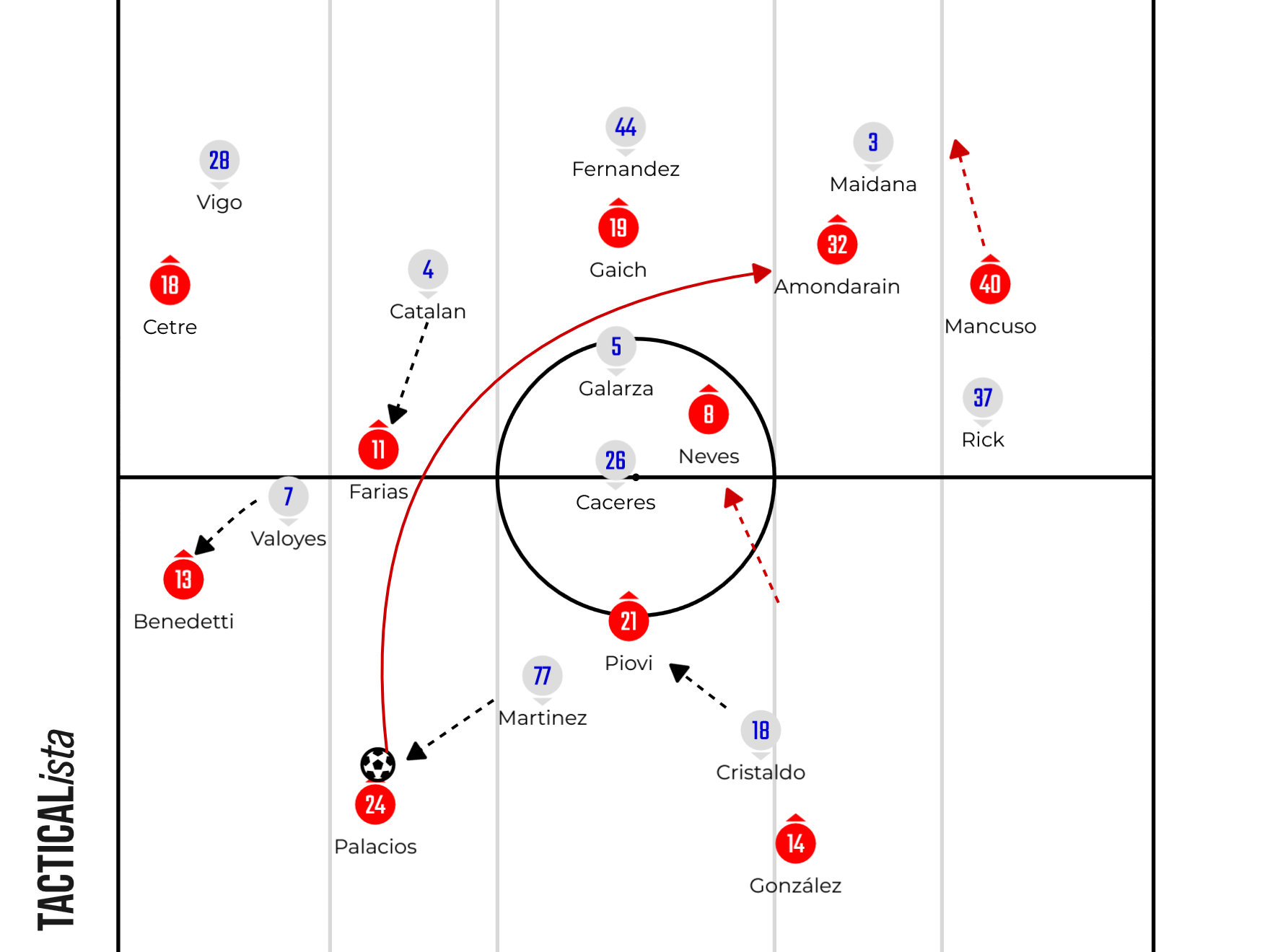
The Talleres pressing two managed the overload in the build-up phase and forced the Estudiantes to play over the press.
Estudiantes later adjusted their build up phase by overloading the first line of the press. Piovi and Neves dropped into the defensive line to give Estudiantes an extra passing lane during build up. Estudiantes building up with a back three made it harder for Talleres front two to press.
Piovi dropping into the first line of build up meant Neves had to drop to occupy the sole pivot role and Benedetti pushed up higher than on previous occasions. Estudiantes made use of these overloads and progressed but often gave away possession too cheaply after they progressed. Talleres were very aggressive in central areas.
When Estudiantes tried to find Farias and Amondarain between the lines, the Talleres back-line were very aggressive to force turnovers. Estudiantes’ lack of patience and consistent intent to play quick generated turnovers in the final third to ruin their flow in the attacking third. They didn’t make use of the overloads they had in the final third.
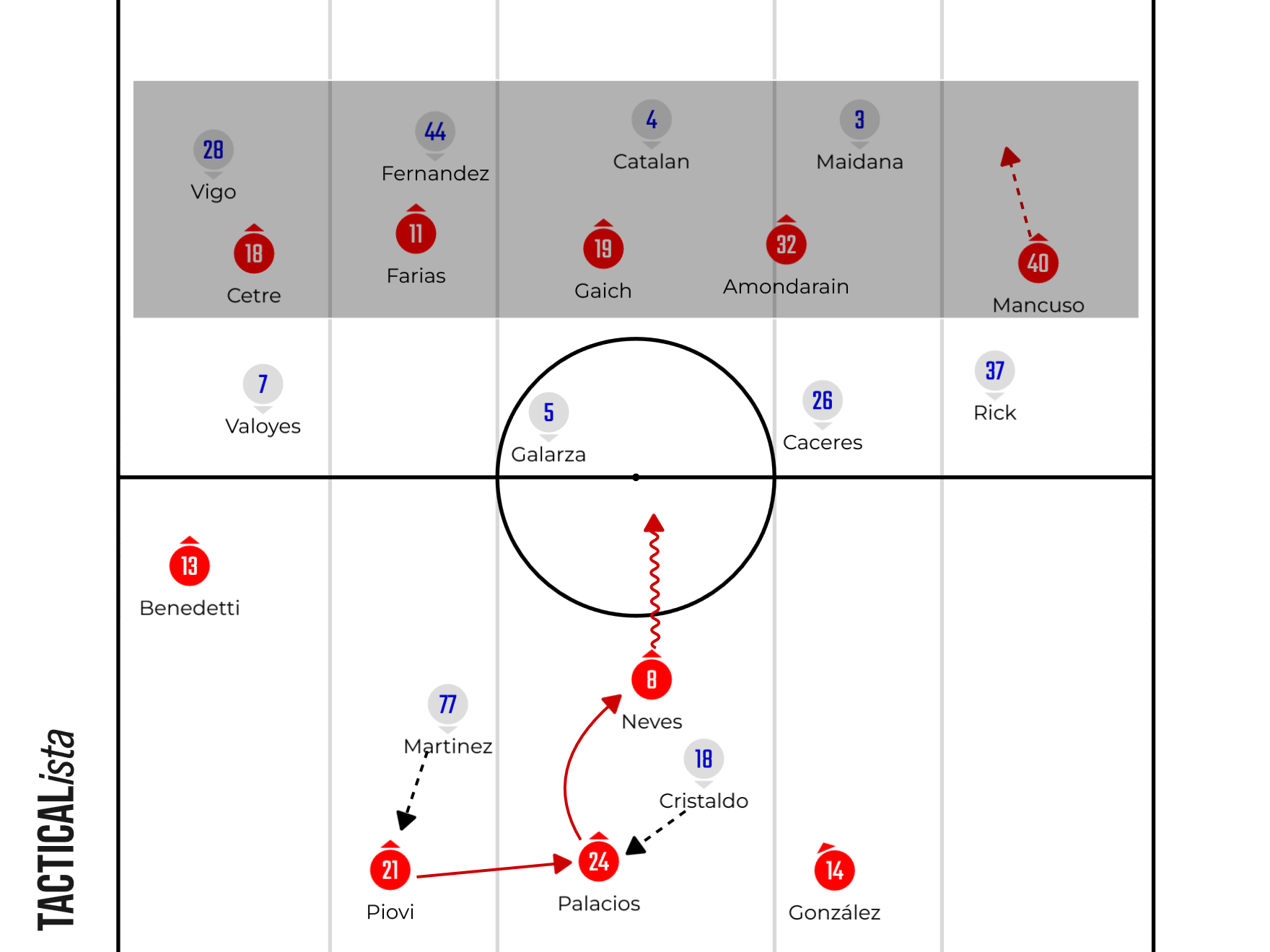
Piovi dropped into the first line of build-up to create an overload. Mancuso pushed up to give the team an extra man in the last line.
Estudiantes lacked the attacking dynamics to create clear cut chances in the final third. When Mancuso was found in attacking wide, Talleres defended the crosses into the box well to nullify any threat in the final third.
Talleres’ lack of threat offensively
Talleres didn’t pose much of a threat on the ball. From build up, they were forced long and couldn’t sustain possession for long periods in the game. Estudiantes’ zonal press forced the Talleres’ defender to one side of the pitch. Estudiantes often times made it hard for Talleres to have the ball for too long but when Estudiantes sat deep in their 4-4-2 mid-block, they were compact and didn’t allow spaces in between the lines.
Gaich and Farias led the press, with one pressing the ball side center back while the other covered the passing lane to the pivot. Estudiantes having a plus one in the backline gave them defensive protection and limited spaces in behind when they forced Talleres to go long from build-up.
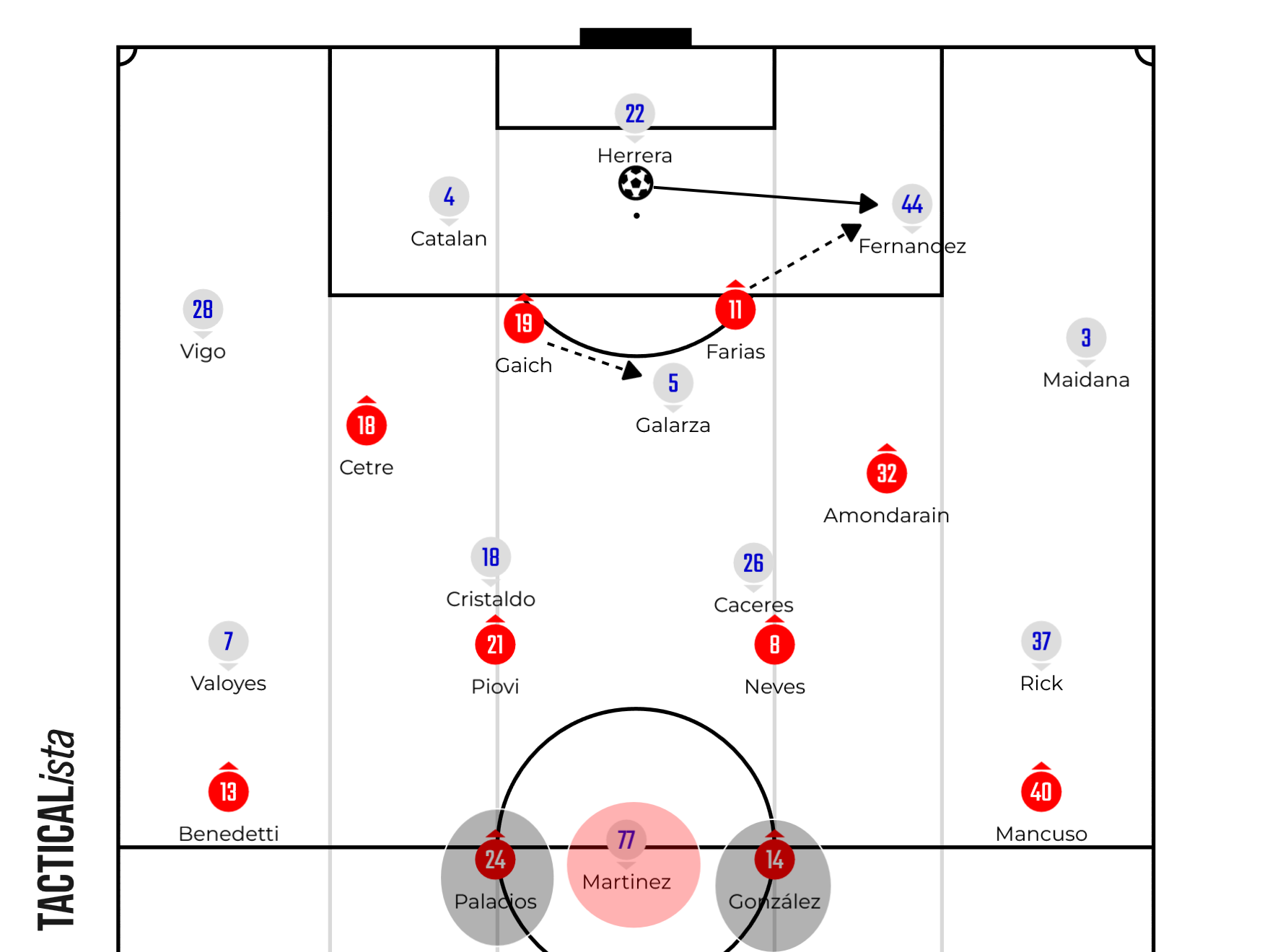
Estudiantes zonal press, forcing the opponent to one side and making them go long. Having a plus one in the defensive line secured the defensive line.
Galarza helped Talleres in build up at times even with consistent struggles in this phase. He dropped into the back-line and forced Estudiantes’ front three to put pressure. One of the Estudiantes wingers had to push pressure on one of the Talleres center backs while the pressing two put pressure on the Galarza and the other center back, making a 3v3 in that zone.
Talleres exploited this by taking full advantage of the free man who was their right fullback. Cetre jumping to the center back and Benedetti pinned allowed Vigo to be free. Talleres escaped the press in this scenario but they hardly looked to execute this to beat the press.
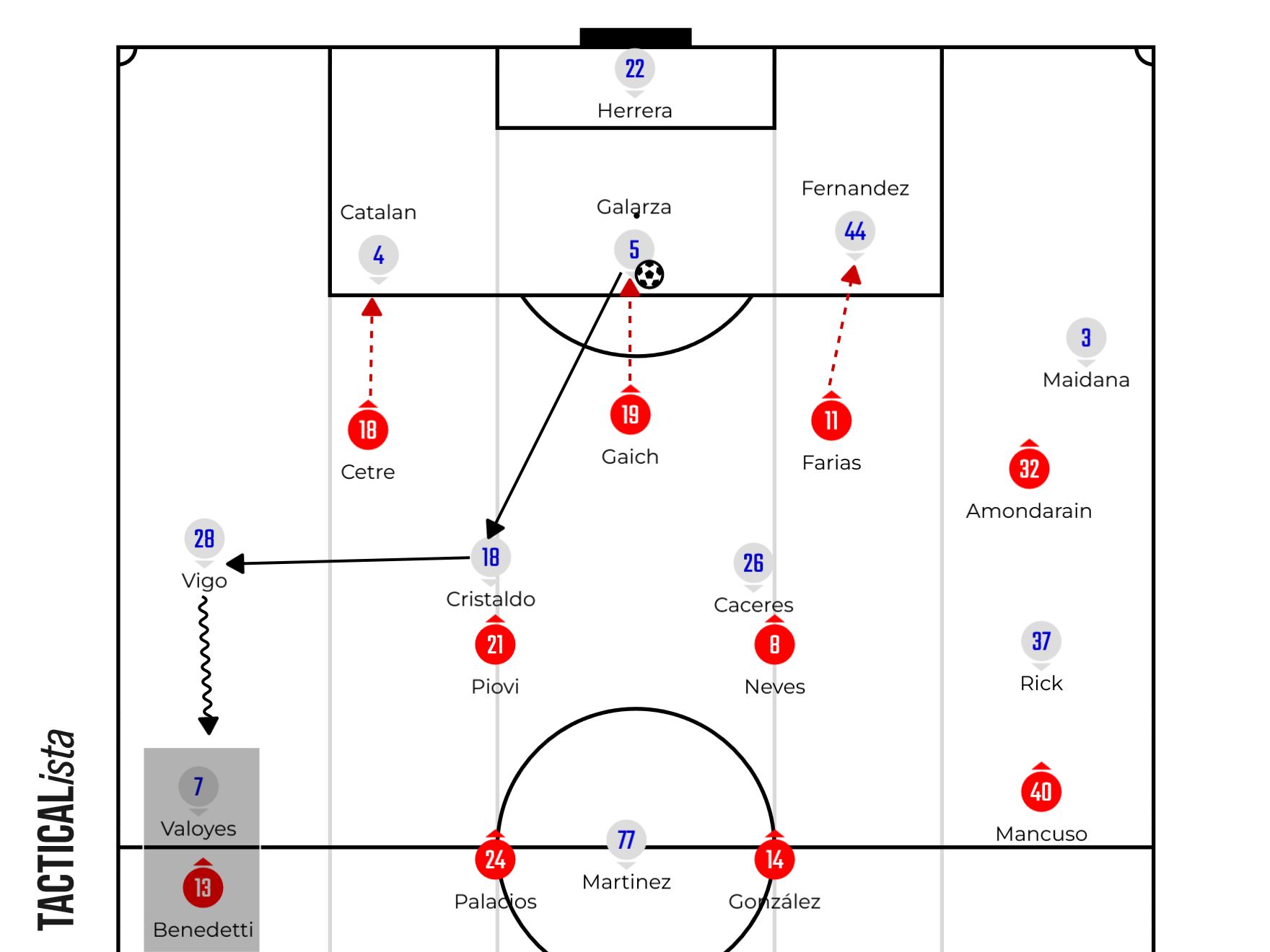
Talleres playing through Estudiantes press by baiting the press and playing through to find the free man.
Talleres’ actions in the middle and final third weren’t decisive. Their poor attacking movements with and without the ball didn’t help much either as they gave the ball away when they had multiple moments to attack with intent and cause panic in the opposition backline. Maidana and Rick were key on the left hand side as both they helped the team progress into the final third from wide areas. The team lacked numbers or a target in the box, and their attacks didn’t trouble the goalie.
In transitions, they failed to take advantage of Estudiantes defensive shape with their fullbacks high up. Estudiantes did well to control these transitions well, with Talleres lacking the incisiveness to execute the final pass in these situations.
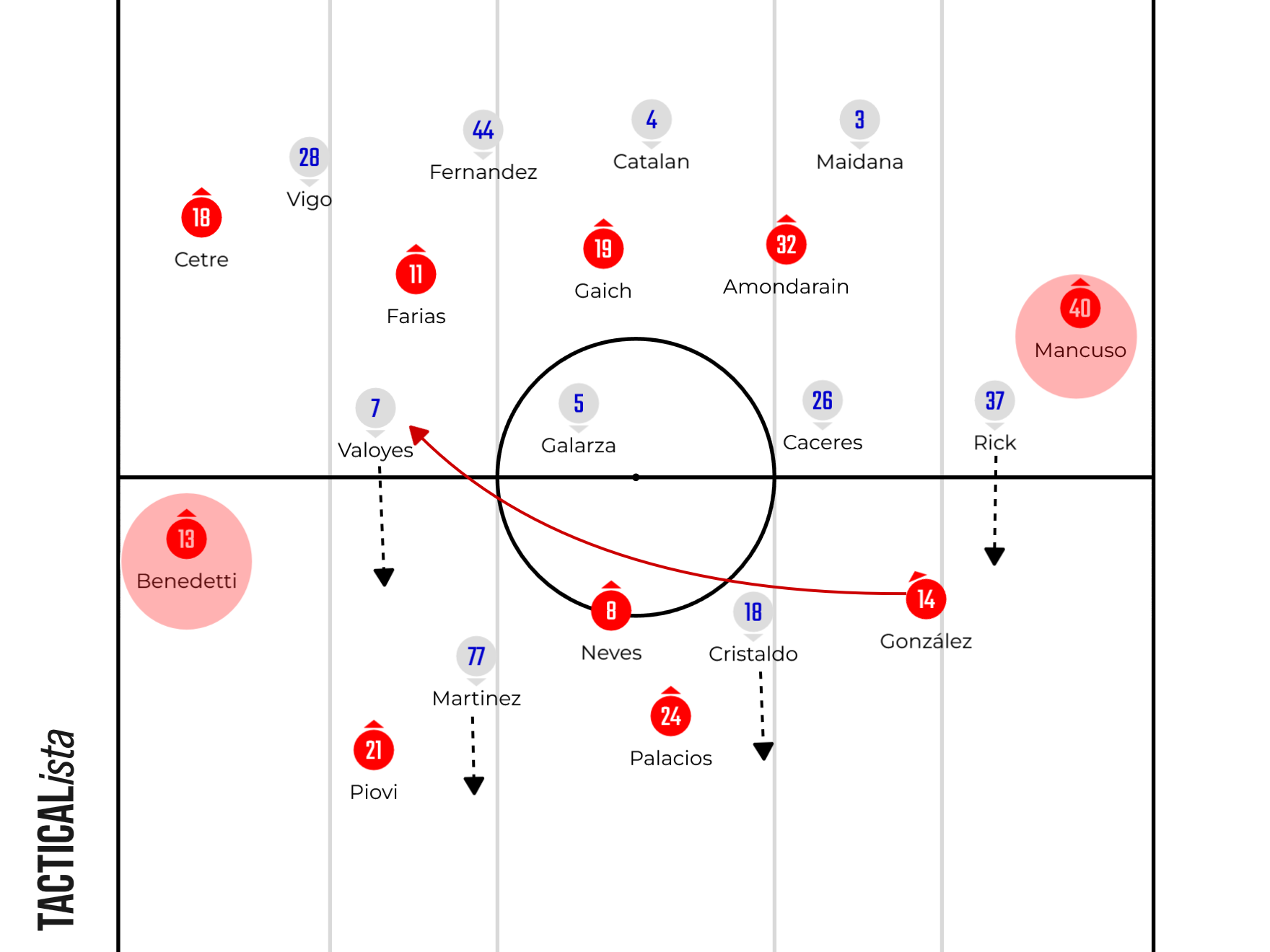
Estudiantes in defensive transitions. Fullbacks high up and Talleres having runners in transition.
Takeaways:
Estudiantes controlled large phases of the game through their midfield overloads and fluid positioning especially from Piovi, Neves, and Farías, to bypass Talleres’ press and progress into advanced areas. Their ability to manipulate the first and second phases of build-up gave them territorial dominance and sustained pressure. However, this control didn’t translate into real attacking threat, as impatience in the final third and Talleres’ aggressive central defending led to frequent turnovers and limited clear-cut chances.
Talleres, on the other handwere disciplined and effective, particularly in dealing with crosses and stepping out to contest players between the lines. In possession, though, they offered very little, struggling to build consistently, lacking numbers in attack, and failing to capitalize on transitions despite moments of space.
Overall, it was a game where Estudiantes had control without cutting edge, while Talleres showed defensive resilience without offensive ambition. This resulted in a stalemate that reflected both teams’ limitations on the day.
Match plots will be added as soon as possible.