

Fluminense – Botafogo: Fluminense win derby with ten men and show consistency (1-0)
Fluminense reached fifteen consecutive home wins under Zubeldía. This time, they secured their second victory in the Brasileirão in the third round. Argentine Lucho Acosta scored the only goal of the match, capitalizing on a mistake by goalkeeper Neto, but Canobbio’s red card changed the context of the derby against Botafogo.
Tactical analysis and match report by Marcus Arboés.
Fluminense are enjoying one of the best spells at the start of the year, while many teams are still adjusting to find their best form. Coach Zubeldía has a clear starting base and has been rotating well, giving opportunities. For this match, he selected the experienced and record holding goalkeeper Fábio; Samuel Xavier, Jemmes, Freytes and Renê in the defensive line; Bernal and Martinelli as the double pivot, with Lucho Acosta as the number ten; and Canobbio (former Uruguay National Team), Kevin Serna (Colombia National Team) and John Kennedy forming the attacking trio.
Botafogo, after seeing the work of Davide, son of Carlo Ancelotti, fail to produce results, now have Martín Anselmi, former Porto, as head coach. He has not yet found his ideal starting eleven and faces a delicate political situation at the club. For the derby, he lined up Neto (former Bournemouth and Arsenal) in goal; Ythallo, Barboza and Newton as a back three; Vitinho (Brazil National Team) at right fullback and Alex Telles (former Manchester United) on the left; Allan (former Napoli) and Danilo (former Nottingham Forest) as holding midfielders; and up front Artur (former Zenit) and Montoro operating inside as wingers, with Arthur Cabral (former Benfica) as the number nine.
First half with ideas but little excitement
It is fair to say that Fluminense were superior in the first half, even though they did not create many chances and the match was balanced in terms of possession and attacking volume. After losing Thiago Silva, the team made several signings and are reorganizing very well, showing many of these ideas in the opening half against Martín Anselmi’s new Botafogo, a side that still has more questions than answers, even if the playing idea is already being implemented.
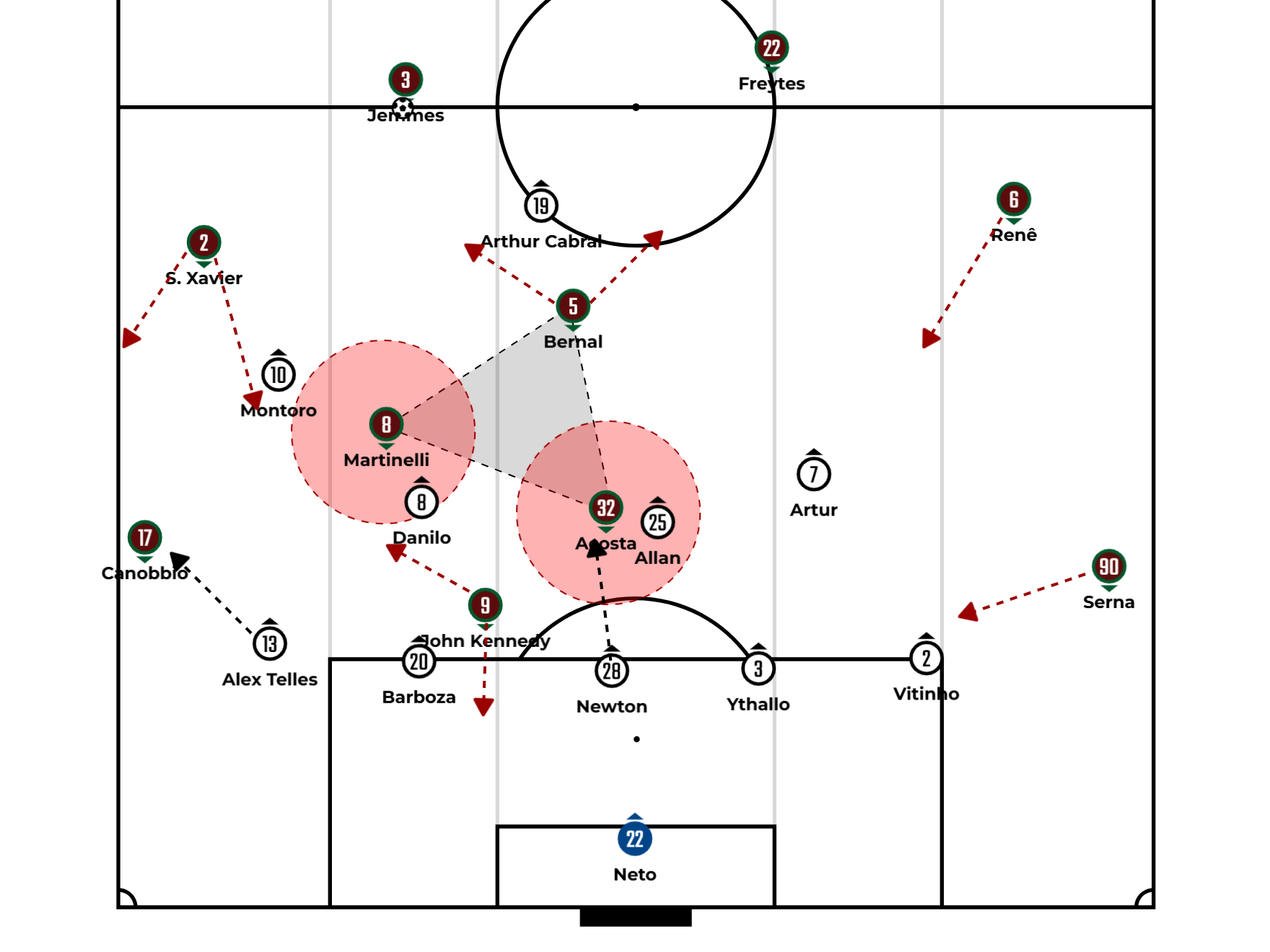
Fluminense offensive organization in a 4-2-3-1 positional outline, with fullbacks inside, wingers wide and a mobile midfield trio.
With the ball, Fluminense displayed much greater tactical and technical clarity in reaching the area defended by their rivals. Zubeldía builds positional teams but adapts each player’s role within the scheme to their characteristics. Renê and Samuel Xavier are build-up fullbacks, while Serna and Canobbio are direct attacking wingers who stay wide.
The magic, however, lies in midfield. Lucho Acosta is the number ten who plays freely in advanced areas to accelerate attacking construction. Martinelli has established himself as one of the best holding midfielders on the continent, influencing creation in every phase. With Hércules and Nonato injured, young Uruguayan Bernal gained space, showing traits of a positional first holding midfielder who constantly seeks the blind side of the player marking the center back line, positioning himself logically at distances that create an advantage to receive and progress play.
In quicker attacks, Fluminense used Bernal, the center backs or Renê in circulation to look for long balls behind the last line. Strategically, Kevin Serna received most of these passes, as he was being marked by Ythallo, a more inexperienced center back. This margin also existed because Freytes and Renê were loosely marked by Arthur Cabral and Artur, leaving space to deliver those passes.
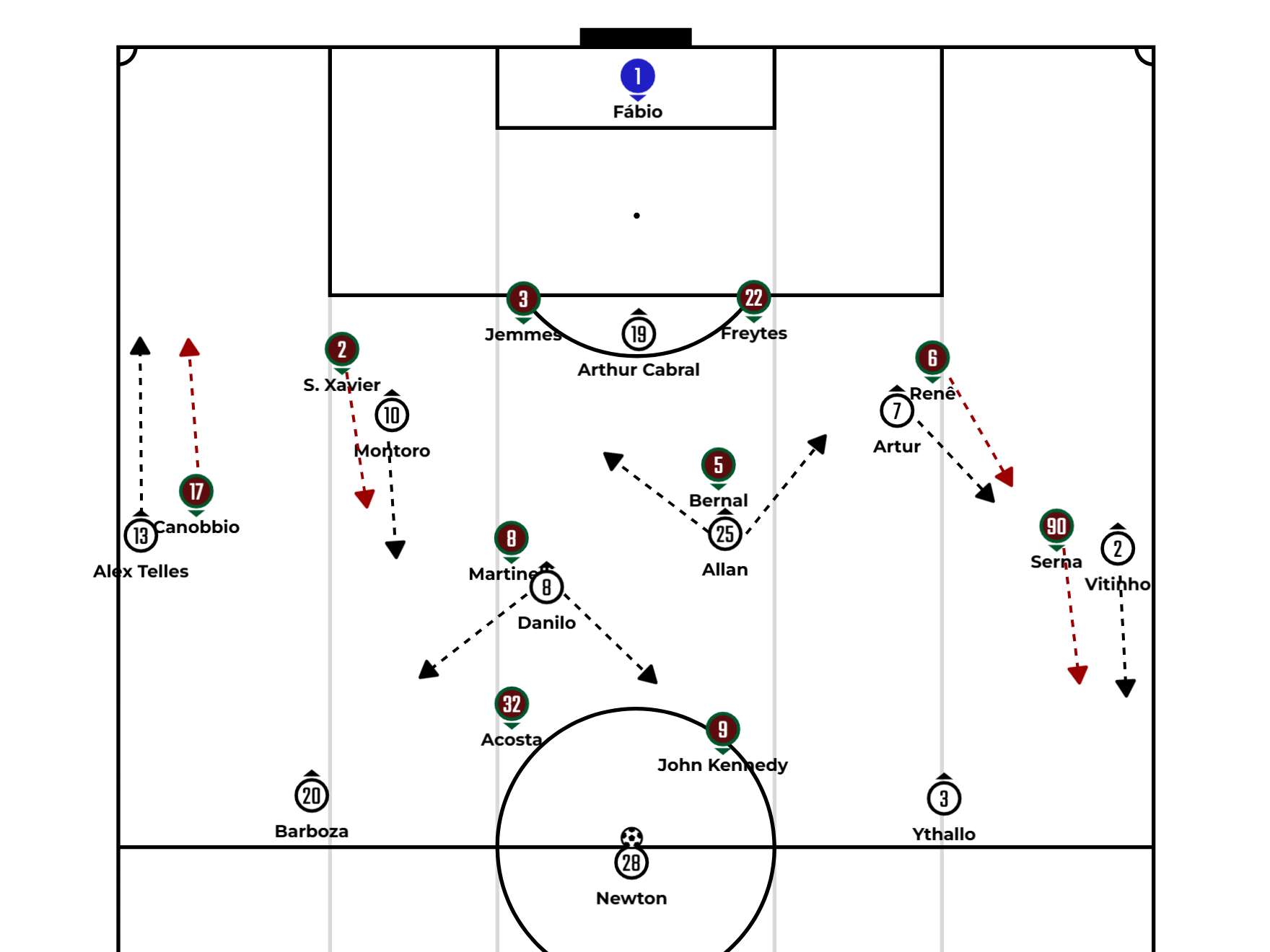
Botafogo attack in a 3-4-2-1 shape, with wide fullbacks and the double pivot varying their height.
Anselmi has been trying to find his ideal starting team amid a political and financial crisis at Botafogo, where staff are being dismissed and players must be shielded from possible sales. Amid the chaos, he managed to implement his playing idea, earned some wins and saw Danilo stand out, but warning signs are already flashing after recent setbacks.
With three center backs, Alex Telles and Vitinho played wide, Montoro wore the number ten from the left and Artur operated as a skillful false winger on the right. The team’s functioning revolves around the dynamics between the holding midfielders. Danilo is the heart of build-up, constantly dropping into available spaces in the blind side of the first pressing line to receive with an advantage and either play one of the inside attackers through or switch play toward advancing wide players. Meanwhile, Allan, as a box to box midfielder, attacked open spaces but suffered an early injury and was replaced by Barrera.
If Botafogo did not create much, it was because Fluminense defended very well at all heights, applying individual matchups. Since Anselmi’s team values sustained possession, Fluminense neutralized them through these matchups. Serna and Canobbio tracked the fullbacks all the way to the byline, while Fluminense’s fullbacks followed Montoro and Artur wherever they tried to operate. The holding midfielders mirrored their counterparts, while still protecting the central zone.
How did Fluminense win with ten men?
If Fluminense were better in the first half, where ideas were evident but not converted into goals, they came out strongly in the second half. Within ten minutes, they created at least two chances, combining well against Botafogo’s defense, which had replaced Ythallo with Nathan Fernandes on the left, shifting Alex Telles into the back three during defensive phases. After a throw in, Neto made a major mistake on a shot by Martinelli and Lucho Acosta scored a goal worthy of Lionel Messi, lifting the ball over the goalkeeper in a split second.
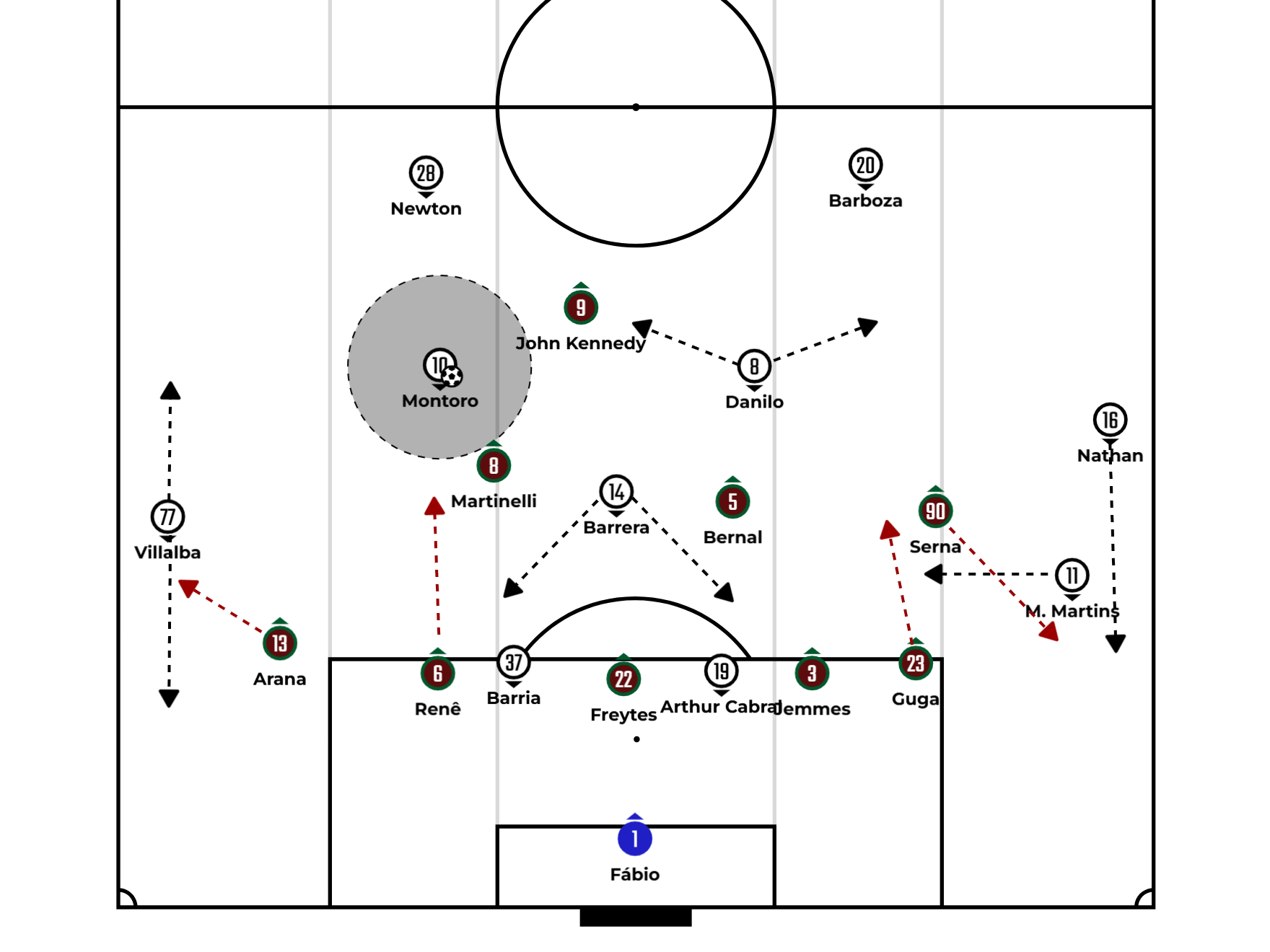
Botafogo attack stacking forwards, dropping Montoro deeper to build facing forward against a ten man Fluminense.
Fluminense seemed in control, but Canobbio was sent off for violent conduct, leaving the team exposed. They initially shifted into a 5-3-1 shape, with Serna tracking Vitinho and Acosta dropping into midfield alongside the holding midfielders. Botafogo then made another change, removing Alex Telles and introducing left winger Matheus Martins, former Watford. In this context, Fluminense still counter-attacked effectively, but Serna was tiring and both Acosta and Samuel Xavier were on yellow cards.
Zubeldía responded by introducing Guilherme Arana for Acosta, moving Serna to the right side of the midfield line, and replacing the right fullback with Guga to refresh the defensive structure. These changes made Fluminense more secure, with two very compact lines. Anselmi then removed Artur for Barria, adding another box striker, and replaced Vitinho with Villalba. With two players attacking down the left and Villalba on the right, Montoro vacated the space where he previously struggled to create facing forward.
Trailing with a numerical advantage, Botafogo resorted to long balls from Montoro and Danilo, targeting aerial play, an early season weakness for Fluminense. However, they were stopped by Fábio and the box protection of Jemmes and Freytes.
Takeaways
With another victory, Fluminense remain one of the unbeaten teams at the start of the Brasileirão, collecting seven points from three matches and sitting level with Bahia in third place. After beating Botafogo again this year, and having already eliminated Bangu in the quarterfinals of the Campeonato Carioca, they will face Palmeiras in the next Brasileirão round.
Botafogo, on the other hand, who began the Brasileirão with a big win and top spot, now sit mid table with only three points after two defeats. This poor run extends further, as they were eliminated by Flamengo in the Campeonato Carioca and have now suffered five consecutive losses. To turn things around, they will face Nacional Potosí in the Libertadores playoffs.



Comments