
Japan–Sweden: When a Draw Is Enough, Why Ask for More? (1–1)
Japan and Sweden played out a draw that suited both sides in Group F. The Samurai Blue secured qualification for the Round of 16 by finishing second, while Sweden’s four points are enough to progress as one of the best third-placed teams. On the pitch, both sides struggled to look beyond what was necessary.
Tactical analysis and match report by André Martins.
We decided to make this article free to read. If you want to support our work, consider taking a subscription.
What happens when two teams know a draw is enough to qualify and neither is willing to risk conceding first? Probably something very close to this Japan–Sweden encounter.
The match had its moments of excitement: Japan displaying its trademark combination play, Sweden taking a more direct approach, Zion Suzuki producing a few important saves, Daizen Maeda scoring a brilliant goal… But the dominant trend was one of carefully managed risk, with both teams setting up to defend first.
The result was an overall closed game in which clear-cut opportunities were few and far between.
Japan could at least be pleased to rotate part of its starting XI and rest some key players. Hajime Moriyasu kept his usual 3-4-3 as the base structure. Zion Suzuki started in goal behind Hiroki Itō, Ko Itakura and Ayumu Seko. Wing-backs Keito Nakamura and Yukinari Sugawara flanked Daichi Kamada and Ao Tanaka in midfield. Daizen Maeda and Ritsu Doan supported Ayase Ueda up front.
Graham Potter’s Sweden lined up in a mirror system, albeit a far less fluid one throughout the game. Jacob Widell Zetterström replaced Kristoffer Nordfeldt in goal after the latter conceded five goals in Sweden’s heavy defeat to the Netherlands. Gabriel Gudmundsson, Isak Hien and Gustaf Lagerbielke formed the back three, with Elliot Stroud and Alexander Bernhardsson as wing-backs. Yasin Ayari and Victor Lindelöf partnered in midfield, while Alexander Isak, Anthony Elanga and Viktor Gyökeres led the attack.
Mirror Systems and Defensive Stalemate
The first half was essentially one long feeling-out process. Japan managed four shots, Sweden two, and neither side created a genuine big chance, except for Nakamura’s curling shot just before half-time.
Out of possession, Japan settled into its familiar 5-2-3 mid-block. Not an entirely passive one, though, as there were clearly rehearsed references for stepping out and forcing Sweden backwards.
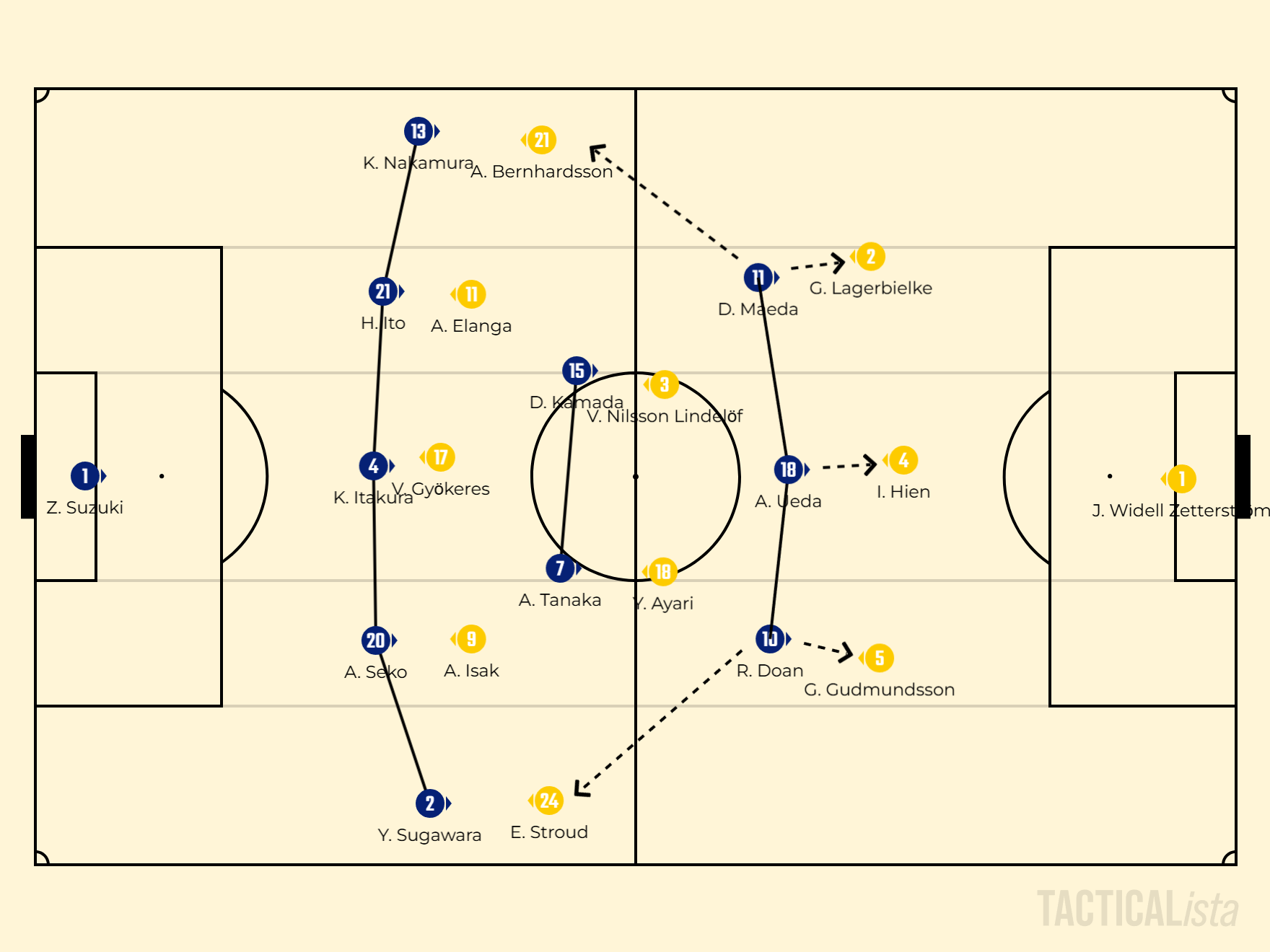
The Japanese more-or-less active out-of-possession structure alongside Sweden’s mirrored 3-2-5. Two similar organisations that largely cancelled each other out during the first half.
Japan’s front three matched Sweden’s first line of build-up numerically while blocking central access. Behind them, Tanaka and Kamada defended zonally but stayed close to their direct opponents, stepping out whenever the team was properly set to do so. Since Sweden used an almost identical structure, the wing-backs naturally became direct opponents on either flank.
The differences mainly appeared in Japan’s 3-2-5 in possession. The three centre-backs stretched as wide as possible in an attempt to stretch Sweden’s front three.
Tanaka then dropped into the backline to create temporary numerical superiority, while Kamada remained as the pivot in front of the defence. It almost resembled a 4-3-3 if Maeda and Doan had not occupied such high positions in the half-spaces.
The Tanaka–Kamada connection was probably one of the smoothest relationships of the match.
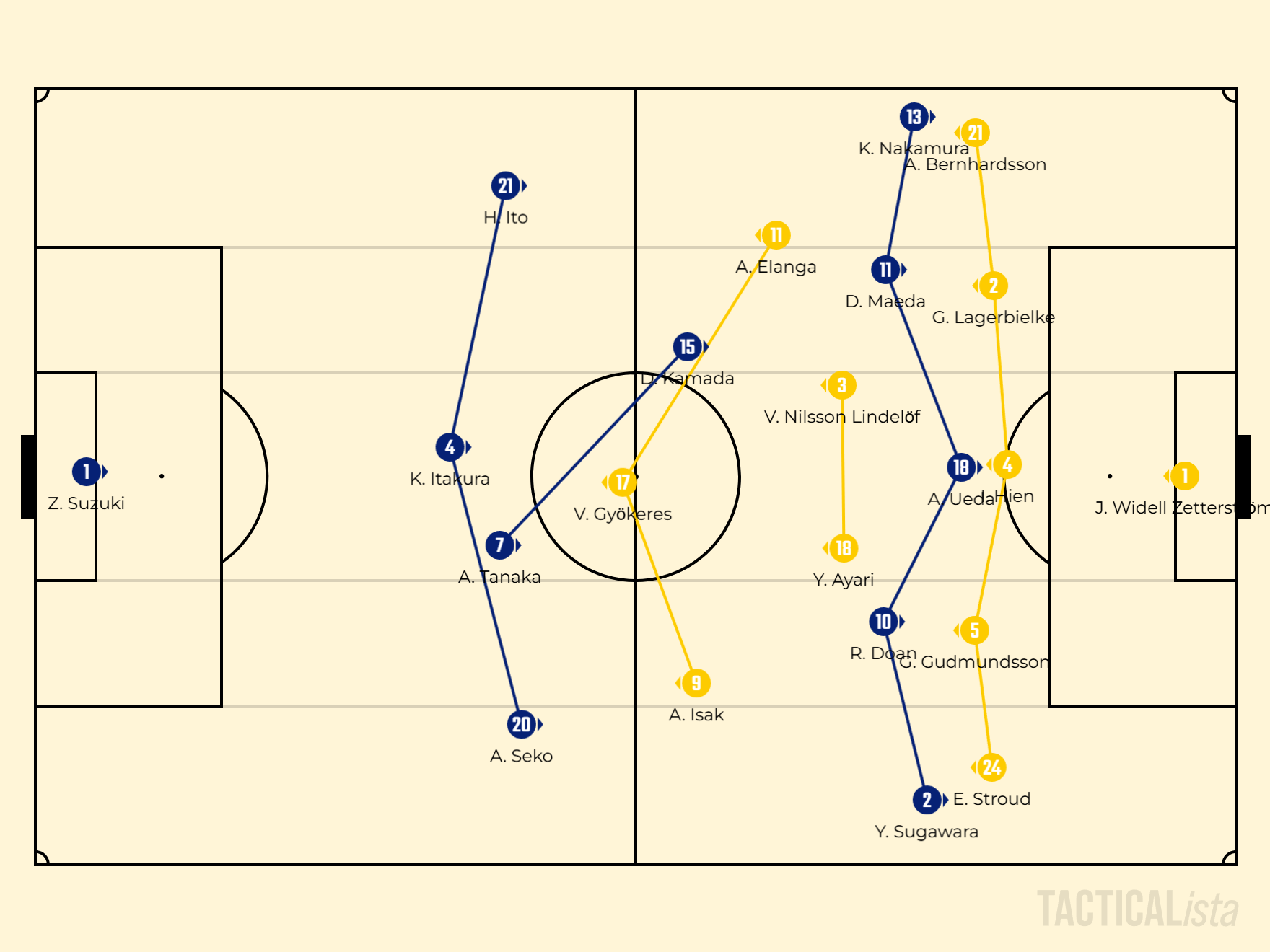
Japan’s in-possession structure, with its 3-2-5 designed to stretch Sweden’s front three and create access to wide combinations.
Structured Risk vs Controlled Ambition
Japan could arguably be labelled masters of controlled risk-taking, the kind of risk that almost redefines what “risk” means. Despite interchangeable and technically compatible profiles, the team avoided attacking through the central corridors.
Against Sweden, Japan prioritised long balls into the runs of the front three, as well as wide combinations to progress. It is difficult to say that either approach was truly effective, given how few clear chances were created in the opening 45 minutes.
The first solution ran into Sweden’s physical and aerial strength at the back, while the second better aligned with Japan’s technical and dynamic identity. The work of the wide defenders in enabling these combinations was crucial. They could carry the ball forward before releasing it to the wing-back, overlap or underlap when the ball was wide, and form triangles with both the wing-back and the wide attacker. This is what makes Japan’s back three somewhat special compared to the positional norm.
At the 7th minute, Kamada found Sugawara on the right flank with a long pass. The wing-back controlled and played into Seko, who advanced into the half-space. Sugawara drove inside while Maeda drifted wide to the touchline to receive. He eventually opted for a cross, but Seko continued his run to underlap and provide a depth option for his teammate.
In these moments, Japan’s 3-2-5 transformed into a 3-1-6. Build-up responsibility was shared between the two pivots and the centre-backs, who stayed deeper to provide balance.
Shortly after, Tanaka found Ueda between the lines with a grounded pass. Japan attempted a few similar combinations throughout the half, but Sweden’s defensive line remained tight and physical. The space required for these passes was often created by stretching Sweden’s first pressing line.
Sweden’s Long Ball Dependence and Japan’s Defensive Control
While Japan worked through structured combinations, Sweden struggled to find space through Japan’s block and relied heavily on direct play. The goalkeeper and back line attempted to draw Japan’s press before targeting Isak, Elanga, or Gyökeres in the air or into space.
Japanese defenders came out on top in aerial duels despite the physical challenge. Even when Sweden managed to control long balls, Japan’s compactness quickly closed down second balls and restored possession. Yet Sweden continued to insist on direct goal kicks and long distribution.
Japan’s response to Sweden’s high press from goal kicks was more nuanced. Instead of immediately going long, they often played an extra pass or two to lure Sweden’s attackers forward before releasing a free man between the lines. This could be a drop from Ueda into midfield, or a timed run in behind, as seen at the 15th and 21st minutes, where Japan repeatedly tried to exploit the space between Sweden’s midfield and defensive lines.
Momentum Swings and Japan’s Breakthrough
The second half was largely defined by momentum shifts. Japan came out of the dressing room with clearer attacking intentions: more forward runs, more carries and dribbles, and a stronger willingness to go wide first before finding central spaces later.
It was therefore no surprise that they opened the scoring ten minutes after the restart, through a very well-constructed attacking sequence.
Japan in settled possession high up the pitch. The move starts on the right side with Tanaka finding Sugawara. He then plays into Doan, who drops deep and drags a midfielder with him. Doan combines with Ueda, who protects the ball with his body, before releasing Maeda in behind. What stands out is the coordination of movements. Maeda starts his run just before Doan plays the pass. At the same time, Seko underlaps to provide an extra passing option and create more space for the wing-back.
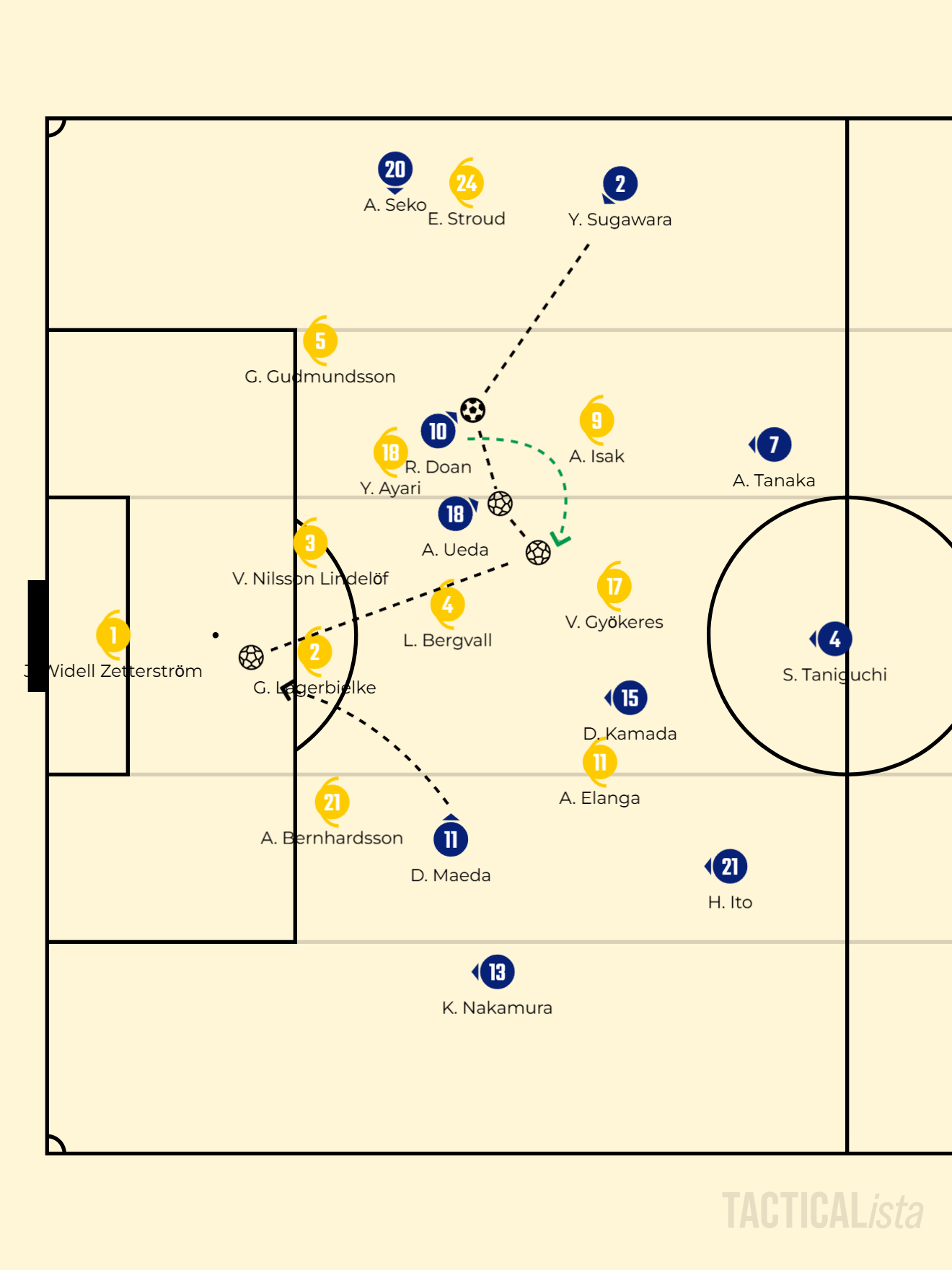
56th minute. Japan’s opening goal built through coordinated movements and timed runs. Sweden react late to both passing and off-ball actions, also due to their passive defensive block.
Japan are consistently capable of producing these sequences thanks to their technical quality and understanding of space and timing, among the best at this World Cup. However, they only choose to take these risks intermittently.
Criticism of this approach is understandable, but it is also interesting to see how their risk-aversion can still produce a recognisably “beautiful” attacking structure when they do commit.
Sweden Fight Back and Individual Quality Decides
Virtually eliminated, Sweden were forced to increase their attacking volume in search of an equaliser.
Japan’s natural defensive drop allowed them to shift from long-ball reliance to more patient possession and carries. Gudmundsson briefly stepped into the centre to create space in the Japanese front three. Lindelöf carried through midfield before releasing Gyökeres, who found Elanga on the right side. Elanga exploited Gyökeres’ underlapping run, cut inside, and curled a left-footed effort into the net. Suzuki was beaten, appearing slightly rooted, perhaps because he did not track the trajectory of the shot early enough.
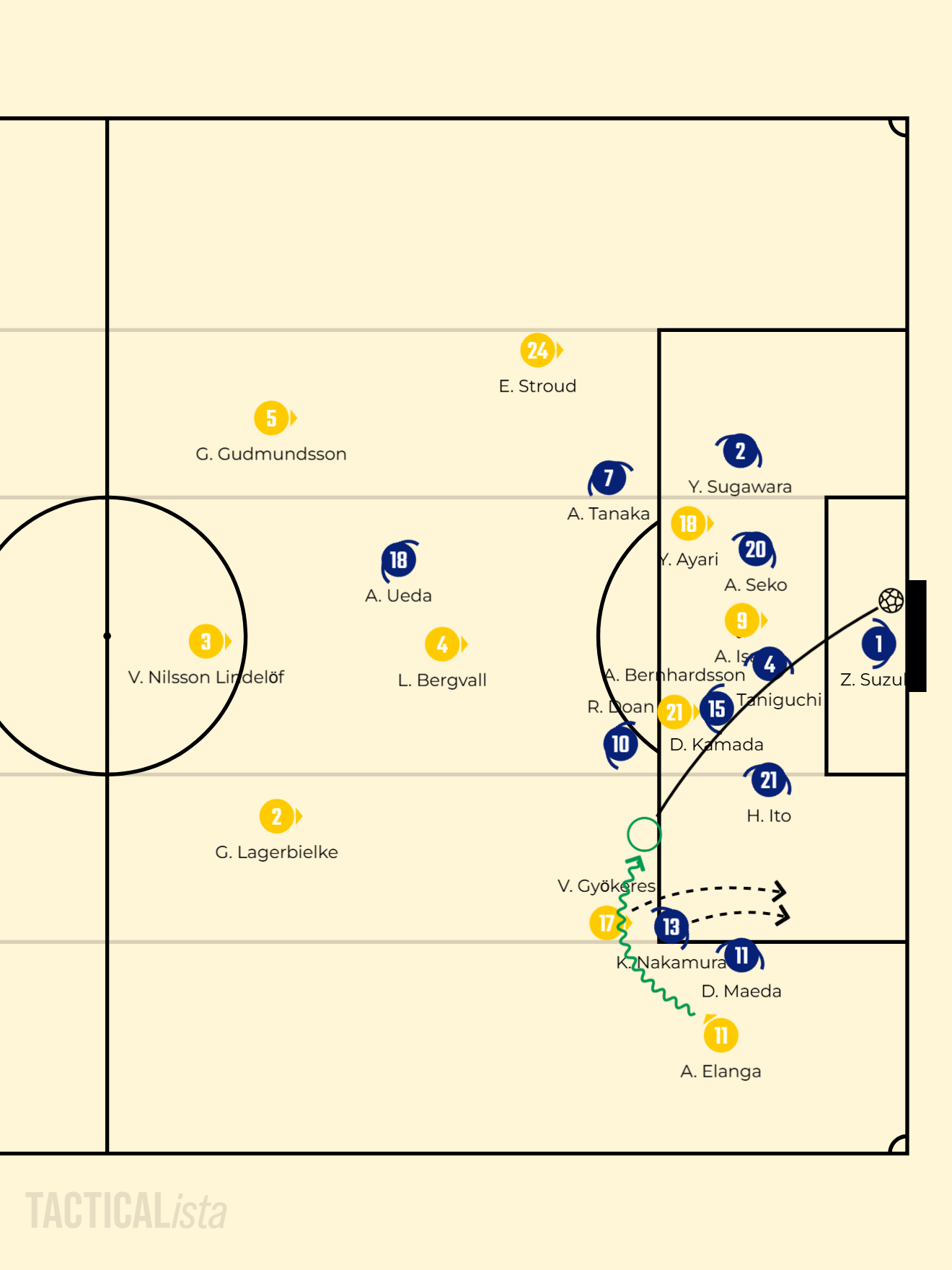
62nd minute. Sweden’s equaliser, with Gyökeres’ intelligent underlapping run creating space for Elanga to dribble inside and finish.
Japan’s defensive block is usually disciplined and comfortable in low structure, but by conceding initiative, they naturally open themselves up to individual moments like this. Actions driven by dribbling quality and off-ball movement become decisive weapons against them.
This goal is reminiscent of Crysencio Summerville’s strike against Japan earlier in the tournament against the Netherlands: same side, similar inward cut, Denzel Dumfries’ overlap on the first, Gyökeres’ underlap on the second.
Dribbling remains one of the few attacking weapons that no defensive system can fully neutralise. This is also why elite teams increasingly prefer to defend in a controlled rather than purely reactive way.
Sweden then gained confidence and began playing a more associative style, while Japan’s block gradually lost compactness.
By the end of the game, Sweden had two big chances to win it, both denied by Suzuki: a powerful shot from Elanga and a header from Isak.
But ultimately, the result was exactly what both teams seemed to have come for from the start.
Takeaways
Japan will face Brazil on June 29. Fans of the Captain Tsubasa anime will remember this long-imagined final and will finally get to see it play out in a World Cup Round of 16 setting. Vinícius’ unpredictability will be one of the main challenges for Japan’s defence, especially because their wing-backs are naturally attack-minded, yet often end up responsible for defending opposing wingers due to the back five structure.
Sweden will be happy to extend their stay in the Americas by another week, after what was ultimately an unexpected and almost miraculous run through the European qualifiers for this World Cup cycle. France are overwhelming favourites against the Blue and Yellow in the Round of 16, though.
Use the arrows to scroll through all available match plots. Click to enlarge.
Check the match plots page for plots of other matches.


Comments