
Mexico – Ecuador: El Tri break 40-year knockout curse (2–0)
Mexico marched into the Round of 16 of the 2026 FIFA World Cup, shattering a historical 40-year knockout stage hoodoo with a commanding 2-0 victory over Ecuador at a supercharged Azteca Stadium. Javier Aguirre’s side weathered a brief pre-match lightning delay to unleash a tactical storm on their South American counterparts. A lovely 22nd-minute strike from Julián Quiñones set the tone, before the forward turned provider for veteran marksman Raúl Jiménez just nine minutes later. El Tri managed the remainder of the encounter with pristine defensive structure, completely validating the roaring home expectations and extending their magnificent run of consecutive clean sheets.
Tactical analysis and match report by Aderemi Qoyum.
We decided to make this article free to read. If you want to support our work, consider taking a subscription.
The encounter offered a fascinating tactical battle: Mexico’s possession dominance and creativity versus Ecuador’s defensive solidity and direct transition blueprint. Ecuador looked to sit in a structured mid-block, seeking to protect the centre and exploit vertical channels through the athleticism of John Yeboah and the experienced presence of Enner Valencia.
However, Mexico seized full ownership of the first-half tempo through synchronized territorial suffocation. Using an asymmetric midfield configuration and fluid overloads, El Tri consistently pinned Ecuador deep, isolating the visitors’ fullbacks and capitalizing ruthlessly on quick attacks in open spaces.
The structural layouts highlighted distinct tactical setups favored by both managers. Mexico lined up in a fluid 4-1-2-3 formation, with Raúl Rangel anchoring between the posts. The defensive foundation consisted of Jorge Sánchez, Jesús Gallardo, César Montes, and Johan Vásquez. Positioned in front of them, Érik Lira operated as the single defensive anchor, allowing the dynamic Luis Romo and 17-year-old prodigy Gilberto Mora to operate as advanced internal connectors. Up front, Raúl Jiménez spearheaded the attack, flanked by Roberto Alvarado and the explosive Julián Quiñones.
Conversely, Ecuador deployed a 4-4-2 shape designed to soak up intense local hostility and spring forward in vertical transitions. Hernán Galíndez stood in goal behind a back four composed of fullbacks Alan Franco and Piero Hincapié flanking center-backs Joel Ordóñez and Willian Pacho. The central engine room relied on a heavy-duty double pivot of Moisés Caicedo and Pedro Vite tasked with closing central channels, while wide players John Yeboah and Nilson Angulo looked to provide vertical support to the strike duo of Gonzalo Plata and Enner Valencia.
Mexico break the press
During short goal-kick routines, Mexico utilized a distinct 4-2-4 build-up shape specifically engineered to bait and bypass Ecuador’s aggressive man-to-man press. The double pivot of Lira and Romo deliberately stayed right on the edge of the penalty box, acting as central magnets to receive under intense pressure before executing quick turnouts or sharp bounce passes to the fullbacks. Out wide, Quiñones held a slightly wider starting position on the left while Alvarado did the same on the right.
Whenever short progression paths were heavily suffocated, Jiménez acted as Mexico’s ultimate tactical escape route, staying high to contest physical long balls—an assignment he executed flawlessly by winning five out of his eight contested duels to secure second-phase possession.
Ecuador’s press saw Valencia and Plata jump directly onto Mexico’s center-backs, while Vite and Caicedo locked tightly onto Lira and Romo. Wingers Angulo and Yeboah initially pinched narrow to block the halfspaces before exploding outward to pressure the Mexican fullbacks if they received short. Simultaneously, Mora dropped between the lines but was tightly tracked by Hincapié, who was explicitly instructed to vacate his left-back zone to follow the teenager centrally, leaving Pacho to drift wide and cover Alvarado.
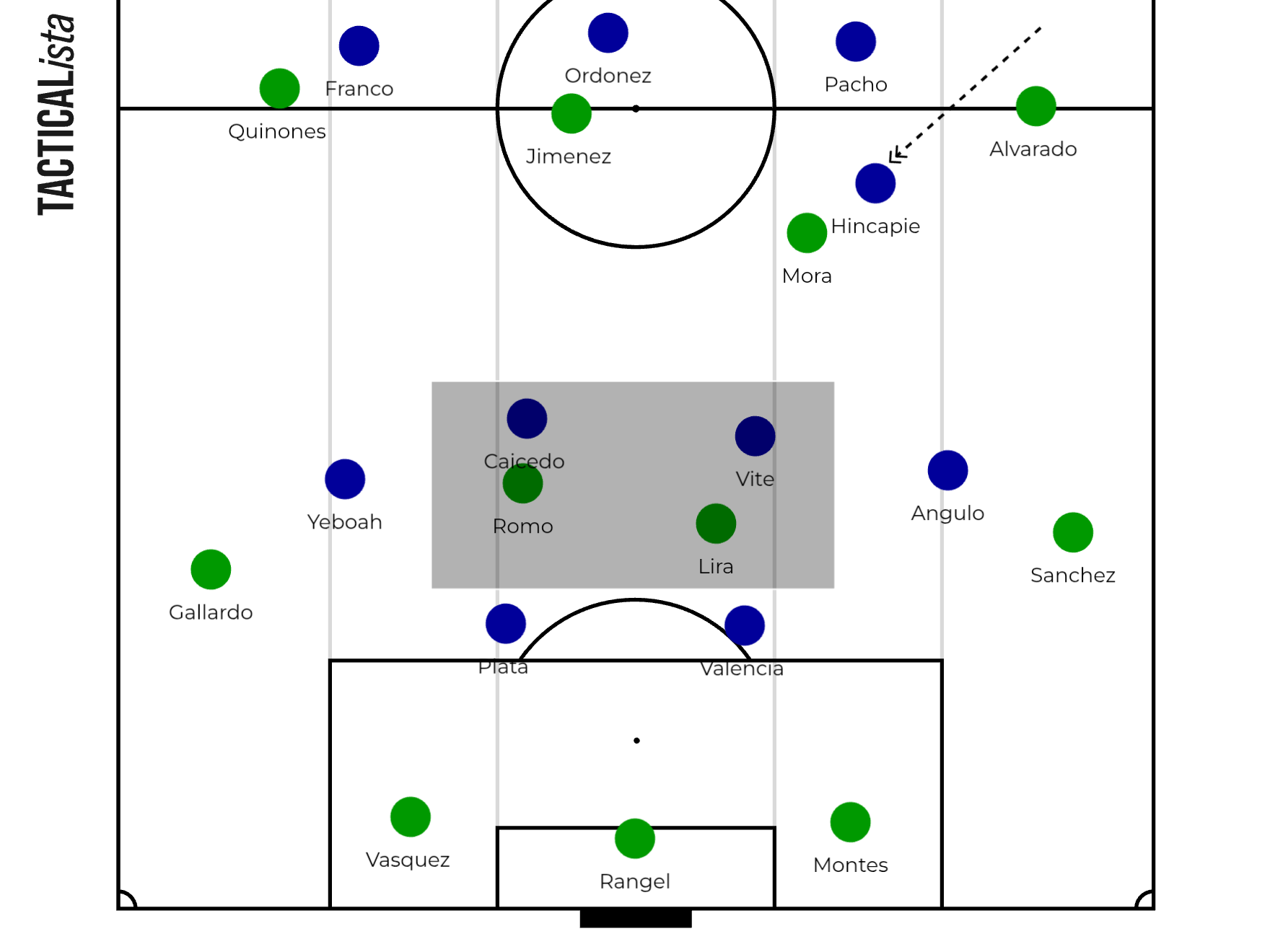
Minute 14′: Mexico’s 4-2-4 build-up structure vs Ecuador’s aggressive man-to-man pressing shape during goal-kicks.
Once Mexico successfully established settled possession in the middle third, their structure morphed to break down Ecuador’s compact 4-4-2 mid-block. Fullbacks Gallardo and Sánchez were given license to bomb forward down the touchlines when necessary, which allowed wide forwards Quiñones and Alvarado to tuck inside into the half-spaces, generating massive central overloads.
While Lira held his discipline as the anchor, Romo operated with box-to-box freedom. This freedom was perfectly illustrated in the 7th minute when Romo made a powerful, advanced run down the right wing and delivered a pinpoint cross to the far post; Jiménez threw himself at the service but uncharacteristically nodded the golden opportunity wide.
Ecuador try, Quiñones shines
When Ecuador established possession, they pushed both fullbacks, Franco and Hincapié, high into the half-spaces, while wingers Yeboah and Angulo maintained maximum width along the touchlines to stretch Mexico’s defensive line. This left the two center-backs and the double pivot to dictate play from deep.
To aid progression, when play circulated on the left, Vite shifted laterally into the left-back slot or the left half-space to orchestrate, while Caicedo anchored centrally. If the ball traveled to the right, Caicedo conversely drifted into the right half-space to find a passage outside Mexico’s block.
El Tri countered this defensively in a rigid 4-4-2 shape; unlike previous matches where right winger Alvarado would drop to form a temporary back five, he maintained his right midfield location throughout the first half to track Hincapié’s interior underlaps, leaving Sánchez to handle Angulo 1v1. Frustrated by this shape, Ecuador frequently opted for direct, early long balls to rapidly locate their central attackers.
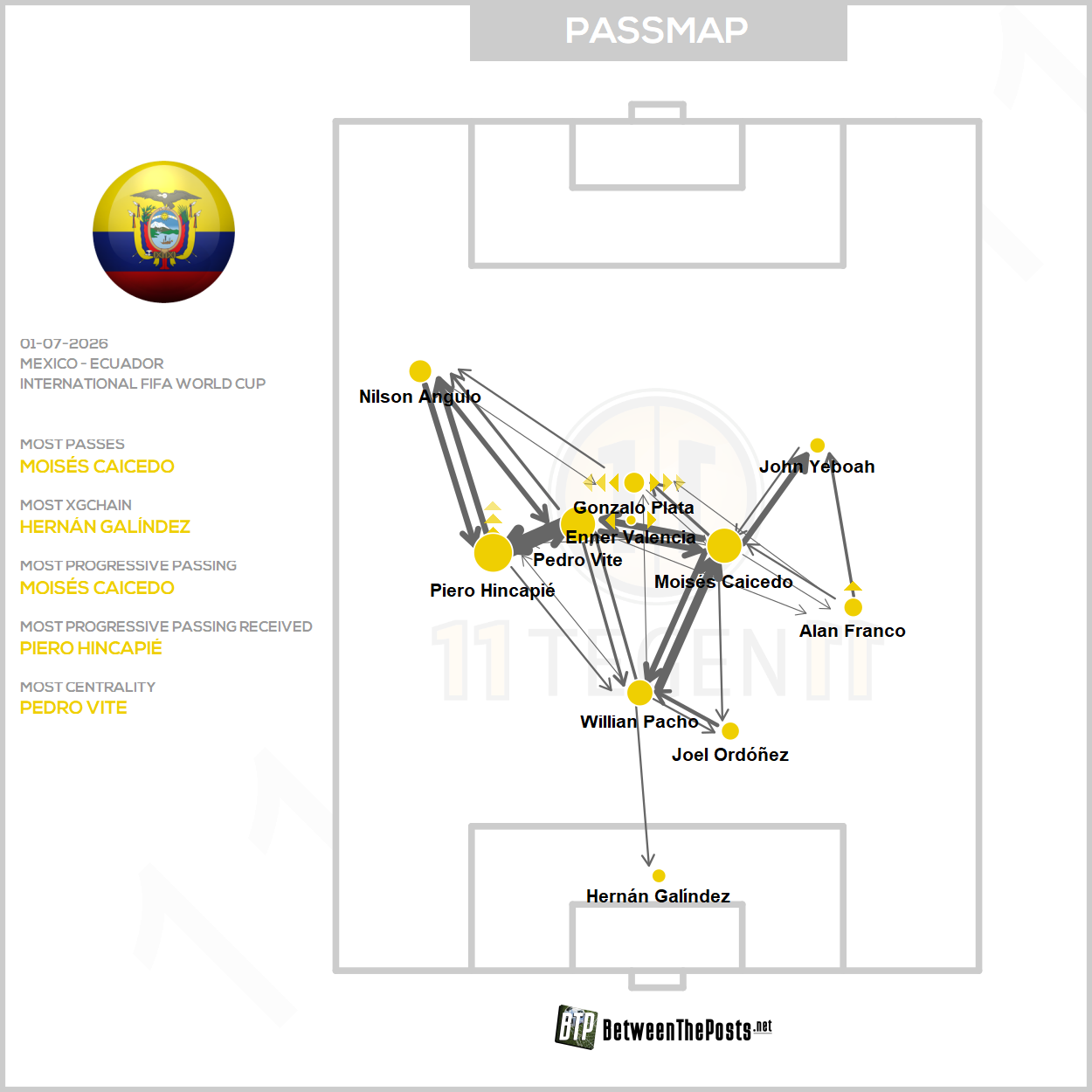
Ecuador Passmap
Mexico’s opening goal in the 22nd minute was a direct consequence of punishing Ecuador’s aggressive man-to-man press. As Ecuador’s defenders followed their markers deep into the middle third, they left vast space unprotected behind them. A rapid, synchronized combination sequence between Quiñones, Romo and Alvarado completely unzipped the pressing lines. Alvarado escaped Ordóñez and threaded a beautiful, progressive through ball back into the path of Quiñones, who exploited the vacated Ecuador half, sliced inward, and unleashed a spectacular strike into the top corner.
The second goal in the 31st minute was another meticulously planned sequence leveraging Jiménez’s targetman qualities. A ball was played up to Jiménez, who initially lost the ball. However, a poor clearance and an unfortunate slip by center-back Ordóñez gifted possession straight back to an advancing Jiménez. He passed to Quiñones who then slid a perfectly weighted pass back to Jiménez, who made no mistake, blasting a brilliant finish past Galíndez to make it 2-0.
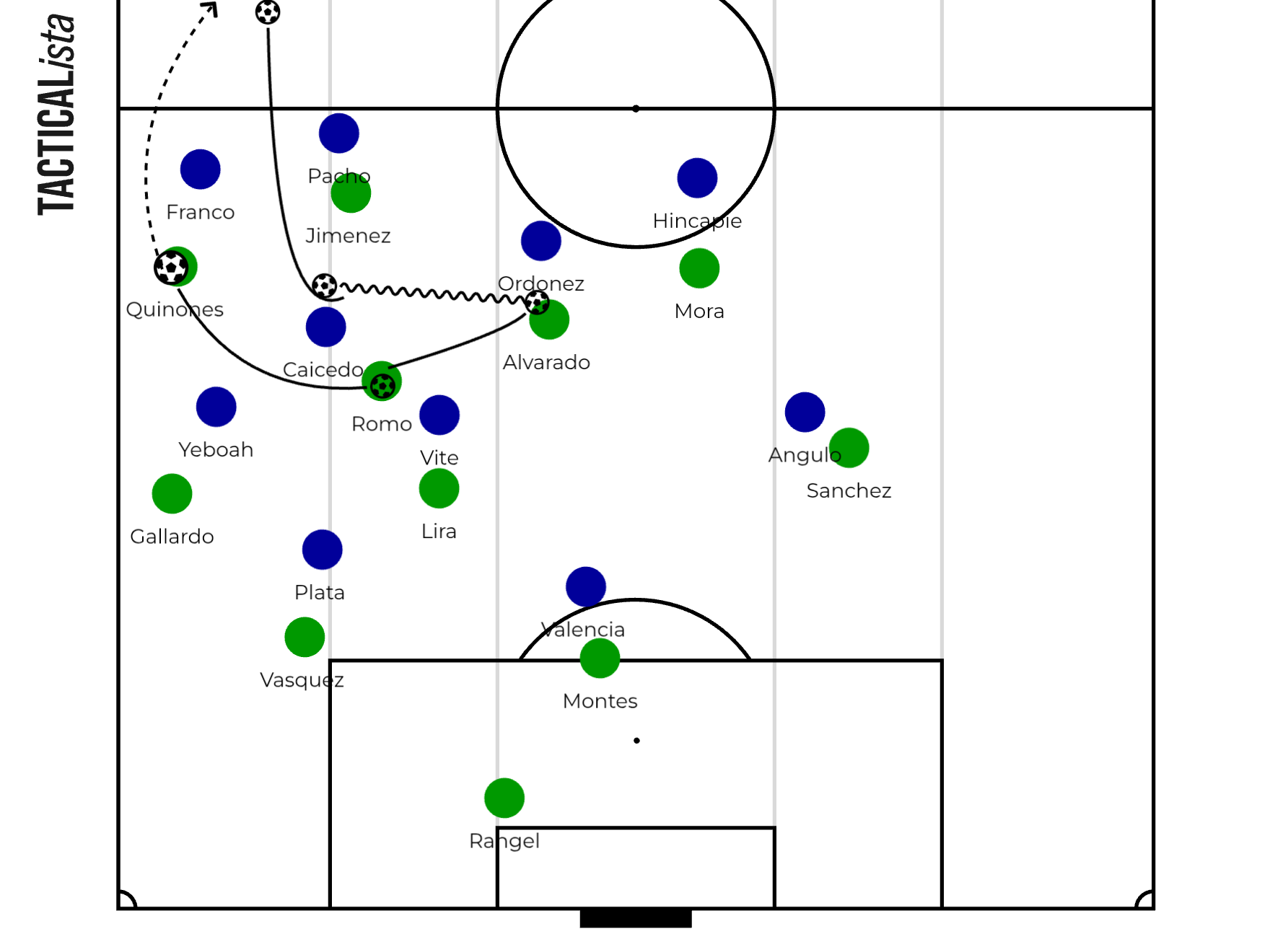
Minute 22′: The quick central combination sequence against Ecuador’s aggressive press to release Quiñones for the opening goal.
Ecuador change things, but in vain
Faced with a two-goal deficit and defensive instability, Beccacece enacted a drastic double substitution at halftime. The error-prone Ordóñez and the yellow-carded Franco—who had endured a torturous half trying to contain Quiñones—were hooked. On came Yaimar Medina and Ángelo Preciado to occupy the left-back and right-back positions, respectively, while Hincapié was shifted centrally to partner Pacho.
This adjustment completely gave Ecuador fresh energy and altered their structural layout into a dominant 3-1-6 progression shape. Caicedo dropped deep alongside Pacho and Hincapié to construct a fluid back three, leaving Vite as the lonely lone pivot in midfield. The freshly introduced fullbacks pushed incredibly high up the flanks, engaging in constant positional rotations with Yeboah and Angulo regarding who occupied the touchline and who inverted into the half-spaces.
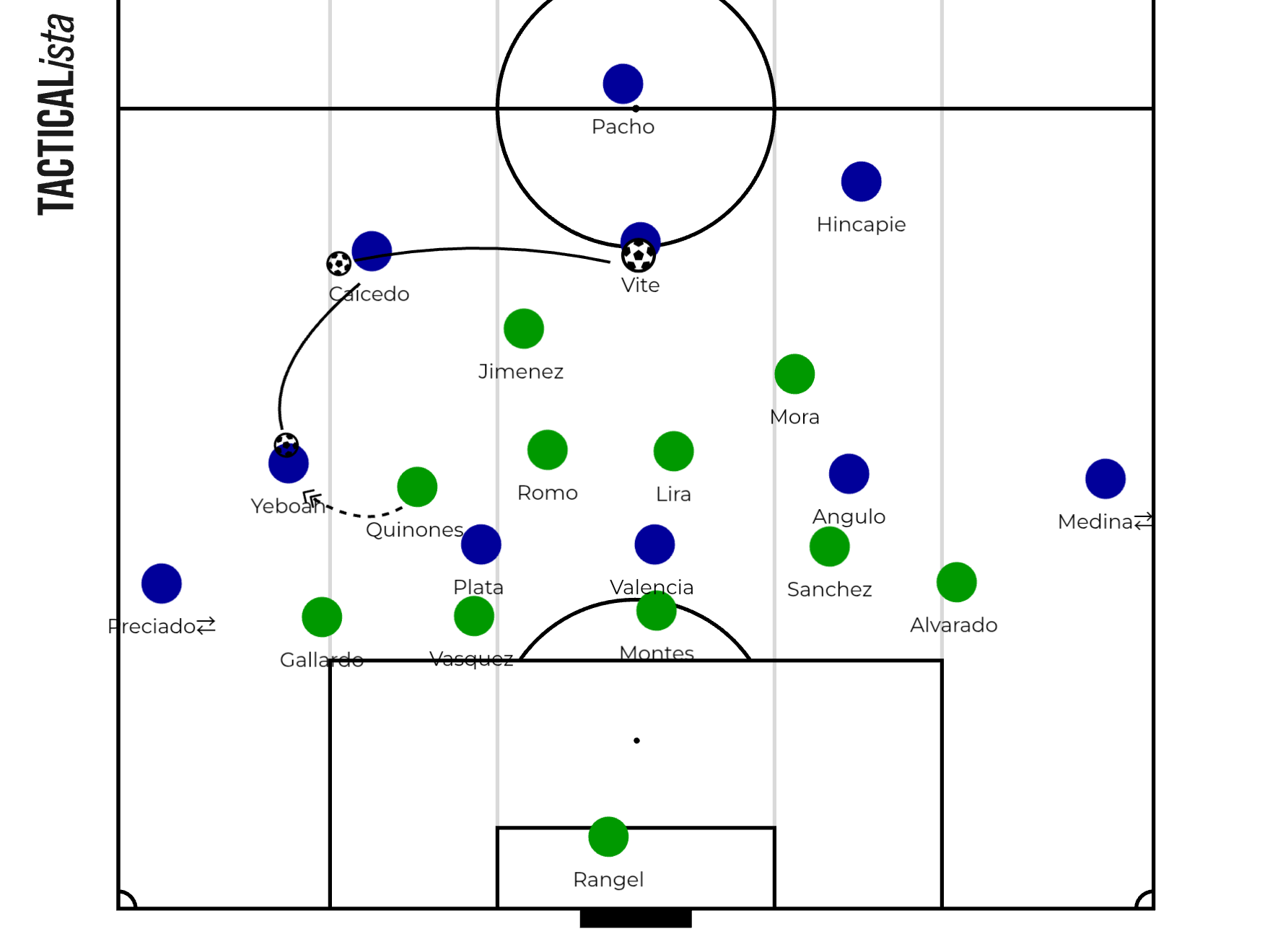
Minute 54′: Ecuador’s 3-1-6 progression shape pins back Mexico’s adjusted 5-4-1 low defensive block.
Mexico’s defensive resilience
Aguirre respected Ecuador’s growing flank dominance and immediately ordered Mexico to retreat into their heavily drilled 5-4-1 defensive low block that has kept them consecutive clean sheets, dropping the energetic Alvarado entirely into the defensive line as a auxiliary right wing-back. Mexico absorbed waves of territorial pressure comfortably. Whenever El Tri attempted to construct short sequences from goal-kicks or low turnovers, Ecuador’s high press forced immediate losses of possession.
Ecuador’s structural tweak allowed them to completely dominate second-half possession, yet their possession remained slow, methodical, and highly predictable. Wingers Yeboah and Angulo stood out as the visitors’ most vibrant threats, causing severe structural headaches for Mexico’s wide defenders. Together, the duo completed 7 dribbles, won 13 duels, and drew 3 fouls through individual brilliance. However, their commendable efforts lacked any tangible end product, as both failed to create a single scoring opportunity due to poor final-third decision-making.
Despite this intense pressure, Ecuador’s slow central execution resulted in just seven total shots all game, with a meager one hitting the target. Ecuador’s frustrating night concluded in disciplinary despair when Hincapié received a straight red card deep in stoppage time for covering his mouth while saying something to Giménez during an altercation. A new law at this World Cup: obstructing your mouth while having heated words with an opponent is a dismissible offence.
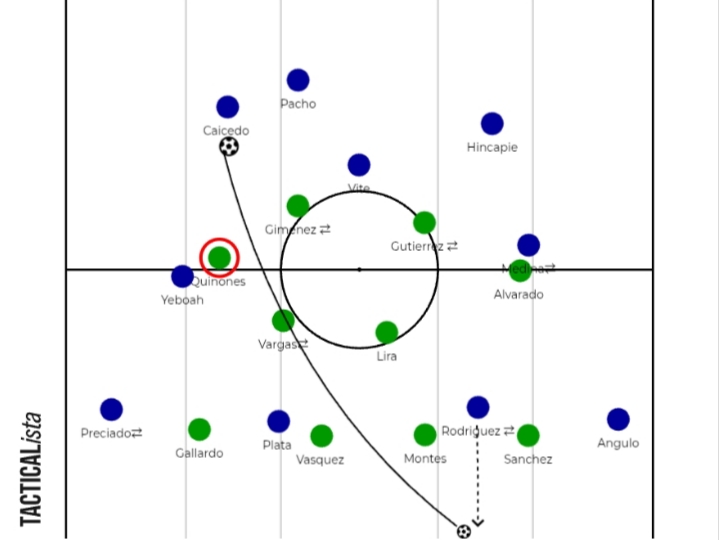
Minute 74′: Caicedo bypasses the midfield with a direct long ball to Rodriguez, whose snap-shot flies off-target.
Takeaways
Mexico delivered a masterclass in tactical control, underpinned by a fluid positional rotations, and stellar defensive execution to register their fourth consecutive clean sheet of the tournament. The combination of Quiñones’ clinical productivity, Jimenez’s maturity, and Aguirre’s rigid structural management completely neutralized Ecuador’s threats.
El Tri now carry immense psychological momentum into the Round of 16, where an iconic, blockbuster showdown against England awaits them at the Azteca. Ecuador, meanwhile, exit the tournament reflecting on a campaign where their tactical limits were thoroughly exposed under pressure.


Comments