
Olympique Lyonnais – RC Lens: Lens Run Riot as Lyon Collapse Under Pressure (0-4)
Olympique Lyonnais missed the opportunity to secure direct qualification for the Champions League after suffering a heavy defeat against a heavily rotated RC Lens side. Quite surprisingly, itx was Lens who took full advantage, putting on a show and building confidence ahead of next week’s Coupe de France final, their final match of the season.
Tactical analysis and match report by André Martins.
After last week’s damaging defeat against Toulouse, Olympique Lyonnais had seen Lille overtake them in third place, the final automatic Champions League spot. To reclaim it, they needed to beat Lens and hope Lille failed to do the same against Auxerre.
Paulo Fonseca therefore showed a degree of caution, fielding a slightly more defensive XI than the one that faced TFC, while also opting for a 4-3-3 that he likely believed could help contain Lens’ transitions. Dominik Greif in goal behind a back four of Rúben Kluivert, Moussa Niakhaté, Clinton Mata and Ainsley Maitland-Niles; a midfield trio made up of captain Corentin Tolisso, Orel Mangala and Abner Vinícius; and an attacking line featuring Afonso Moreira and Endrick around Pavel Šulc.
On the other side, with the Ligue 1 title already lost to PSG four days earlier and second place already secured, Pierre Sage had the opportunity to rotate and give minutes to less-used players. Goalkeeper Mathieu Gorgelin made his first Ligue 1 appearance of the season behind a back three of Malang Sarr, Nidal Čelik and Kyllian Antonio. Wingbacks Arthur Masuaku and Saud Abdulhamid flanked the double pivot of Amadou Haidara and Andrija Bulatović. Up front, Wesley Saïd, Florian Thauvin and captain Florian Sotoca completed Lens’ usual 3-4-3 structure.
Passivity and pressing
Despite the stakes of the game, Olympique Lyonnais did not begin with the right attitude and were punished quickly enough for the match to feel over before half-time. At home, in a fixture of such importance, teams are usually expected to set the tone by suffocating their opponent early on. Lyon only did so for a few seconds before retreating into a passive medium block with an excessively inactive defensive line.
Lens, by contrast, played with freedom and looked eager to celebrate what had already been an extraordinary season for the club. Pierre Sage’s players once again showcased one of the main reasons behind their second-place finish in Ligue 1 this season: an intense hybrid pressing structure where players moved together in a highly coordinated manner. Whenever Lyon recycled possession, Lens advanced uniformly with the front three of Saïd, Sotoca and Thauvin leading a kind of zonal diamond press that blocked access to Lyon’s double pivot and forced play wide. If Lyon recycled backwards to Greif again, Lens already had enough height in their structure to aggressively press the goalkeeper. Once the ball was trapped in a small area near the touchline, Lens switched into aggressive man-oriented pressing in an attempt to win the ball or intercept passes. By doing this, Lens concentrated many players into a very small zone, leaving some Lyon players free on the far side, but the pressure around the ball made effective switches of play difficult to execute.
The coordination of Lens’ wingbacks also deserves praise. Whenever the ball-side wingback stepped high to press, the opposite wingback immediately dropped onto the defensive line to ensure Lens always kept three or four players protecting against transitions.
Lens gaining the upper hand
At times, Lyon managed to bypass Lens’ diamond press by accelerating Greif’s distribution and finding one of their midfielders free behind Lens’ front three. Lens would then retreat into a medium block. The best solution for Lyon was clearly to progress through the middle by exploiting midfielders dropping between the lines, but this was only possible whenever Lens’ pressure on the goalkeeper lacked timing or intensity.
Brazilian forward Endrick stood out twice in the opening minutes with bursts down the right following layoffs from Šulc, one of which earned Sarr a yellow card. Lyon’s initial idea out of possession was to press Lens man-to-man from goal kicks: Moreira, Šulc and Endrick matched up against Lens’ back three and goalkeeper, while Tolisso tracked Haidara. Against this pressure, Lens split their team in two, with Bulatović positioned high in the centre circle near the attackers, who all pinned Lyon defenders.
This sequence in the sixth minute could have been dangerous at both ends. First, Sarr nearly lost possession close to his own box under pressure from Endrick, before escaping thanks to a fortunate ricochet. The Senegalese defender’s long ball then led to a central shooting opportunity for Saïd.
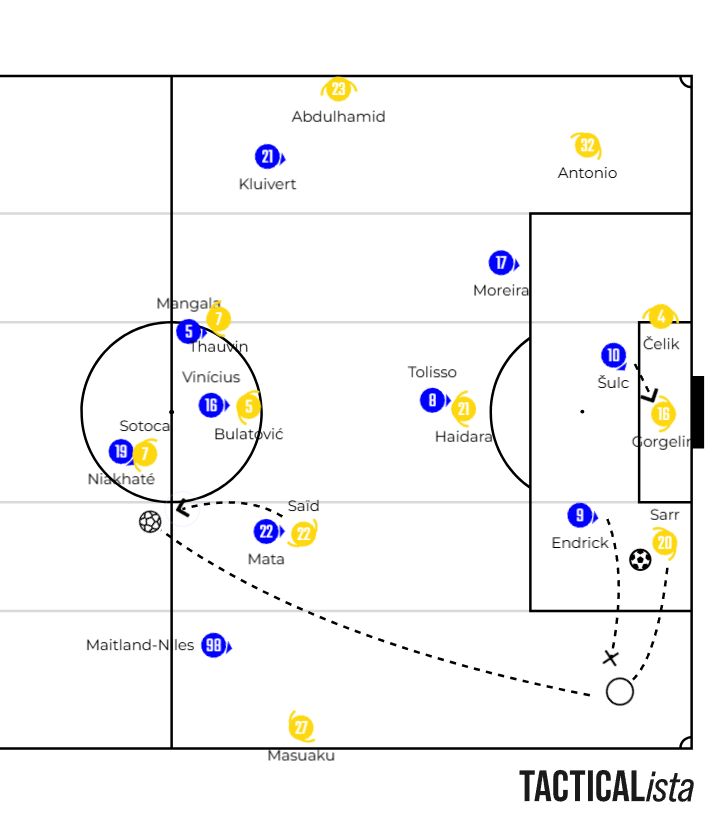
Image 1. One of the few times Lyon pressed Lens man-to-man from a goal kick. The move eventually ended in a dangerous Lens transition after Mata’s interception fell short, but just before that, Endrick had nearly won the ball directly off Sarr. Lyon could have attempted this type of aggressive pressing much more often throughout the match.
This Lens structure during Gorgelin’s buildup repeated itself several times, but Lyon quickly abandoned the idea of pressing man-to-man, alternating instead between passive 4-3-3 and 5-2-3 medium blocks. Šulc continued to lock onto Haidara behind the centre-backs, but Lyon’s wingers remained static, making it easy for Lens to bypass the first line of pressure. When a team becomes too passive, reacting to movements in time becomes increasingly difficult. That is how Sotoca’s dropping movements into the empty central space between disconnected lines repeatedly hurt Lyon.
Mata and Maitland-Niles exposed
Lens’ opener rewarded their excellent start and highlighted another recurring issue in Lyon’s defensive structure. In addition to their passivity, Lyon were not compact enough when forced to defend deeper. One of the key advantages of a system with three centre-backs and two wingbacks is the occupation of width in possession. Therefore, Lyon’s back four needed to remain compact to close interior gaps. Since Moreira and Endrick stayed high to initiate transitions, Lyon’s midfield trio needed to slide across constantly to compensate for Lens’ wingback advances. Problems in this area appeared throughout the match, especially on Lyon’s right side involving Mata, Maitland-Niles and Vinícius.
On the opening goal, Masuaku’s throw back towards the defence triggered a completely disorganised movement from Lyon’s block. Maitland-Niles partially abandoned his right-back position, forgetting about Saïd behind him in order to move closer to Masuaku near the touchline. Vinícius could also have recognised the danger and refrained from tracking Haidara centrally, but the main responsibility lies with the English fullback. Antonio then had a huge passing lane to find Saïd inside the box with a difficult through ball, and the striker perfectly finished with the inside of his right foot.
A brief Lyon response
The goal briefly sparked a reaction from Lyon, who produced one of their best build-up sequences of the match. By attracting Lens to one side, Mata found Šulc dropping centrally before the attack progressed down the left. Moreira accelerated past Abdulhamid and delivered a cross into the middle that narrowly missed Endrick, who arrived slightly late. The Portuguese winger was one of the few Lyon players to stand out thanks to his sharpness and work down the left flank. Abdulhamid struggled badly whenever he attacked the outside.
Saïd’s second goal looked remarkably similar to his first, with nearly the same culprits on Lyon’s side. Initially, everything was under control: Mata and Maitland-Niles doubled up on Thauvin before the winger laid the ball back to Saïd. The number 22 then played a one-two with Haidara and burst completely unmarked into the half-space. Mata moved in the opposite direction to cover a possible pass towards Sotoca, even though Niakhaté was already marking the Lens captain, and arrived too late to block Saïd’s near-post strike. Maitland-Niles, meanwhile, remained static and almost disconnected himself from the action once Saïd released the pass towards Haidara, who was also left entirely free to provide the assist.
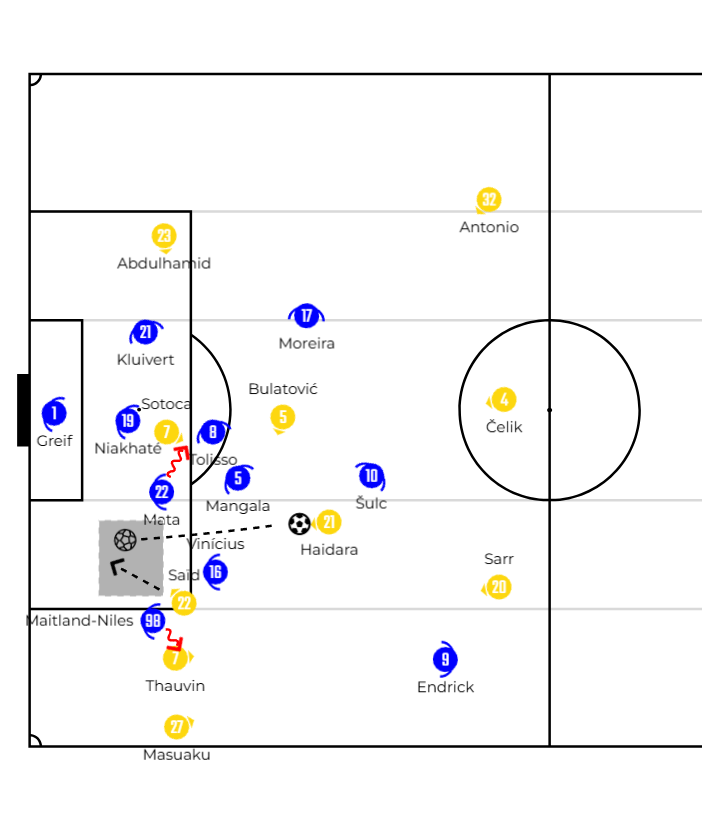
Image 2. Thauvin’s dropping movement moments earlier certainly disrupted Lyon’s defensive references, but the back four’s lack of awareness regarding both opposition movements and the spaces they needed to cover is glaring here. Maitland-Niles is rooted to the spot between Saïd and Thauvin, while Mata drifts centrally to block a passing lane that should already have been covered by Niakhaté.
Lens’ third goal arrived somewhat against the run of play after a short spell during which Lyon had enjoyed more possession. But once again, the ease with which Lyon lost the ball was alarming. Thauvin then eliminated Niakhaté with a left-footed turn before releasing Sotoca between the lines. Certainly, the captain’s run destabilised a retreating defence, but a player simply cannot start a run from the centre circle and never be tracked or disturbed before reaching the penalty area. It was Sotoca’s first goal of the season. Olympique Lyonnais could only blame themselves for such a lack of intensity.
Often forced into long balls against Lens’ pressing during the first half, Lyon lacked the right player profiles to win second balls high up the pitch. Fonseca reacted by replacing both fullbacks with Roman Yaremchuk and Hans Hateboer. The Dutchman replaced Maitland-Niles directly at rightback, while the Ukrainian striker joined the attack. Vinícius moved to leftback and Šulc dropped into midfield. Pierre Sage simply replaced the booked Sarr and Abdulhamid with Matthieu Udol and Ruben Aguilar.
Moreira (almost) alone against the storm
After the break, Lyon’s combinations down the left between Vinícius, Moreira and Šulc improved significantly, exploiting the natural delay in Lens’ defensive rotations whenever the wingback stepped out to press Vinícius, the nearest centre-back shifted towards Moreira and Bulatović tracked Šulc’s movement.
This triangle appeared several times before Lens’ fourth goal finally killed the game. The move illustrated Lens’ intelligent movement and Lyon’s collective and individual difficulties in handling it. As Lyon pressed almost man-to-man from a Gorgelin goal kick, the 35-year-old goalkeeper launched long towards Sotoca, who drifted wide with his run and dragged Mata away from the centre. Hateboer poorly cleared the ball and Bulatović recovered possession. The Montenegrin produced a magnificent chest control before releasing Thauvin into the space vacated by his captain. The former Udinese man’s lob was perfect and Greif had no chance. Vinícius, however, had tracked Thauvin’s movement from the beginning and simply cannot allow that much space for his opponent to accelerate into.
Lens considerably lowered the tempo after this final blow. Moreira continued to be Lyon’s most dangerous player and wasted a good chance with a completely mishit effort while alone inside the box. For once, Lens’ pressing had failed and Aguilar was out of position. One minute later, the former Sporting CP player tried again, but his half-volley was blocked by one of the many Lens defenders crowding the box.
Lyon’s best opportunity came from Yaremchuk, whose effort struck the crossbar and denied him a fifth league goal of the season. Lens were actually somewhat disconnected during Greif’s clearance, while Lyon made the correct decision to overload central areas in search of the second ball. The resulting shot came after a one-two between Šulc and Yaremchuk inside the penalty area.
Lens eventually settled into a comfortable 5-2-3 block that managed width well but occasionally left openings through the middle. Lyon failed to capitalise on the 12 corners they won during the second half. Yaremchuk’s presence also freed Šulc to move more fluidly between the lines. That is how the Czech was eventually found between Čelik and Ganiou. Played through by Endrick, the number 10 lost his duel against Gorgelin.
Proof that Olympique Lyonnais still managed to create a few chances in a match where their defensive organization, in particular, fell short. The introductions of Malick Fofana and Ernest Nuamah added offensive weight, but the confidence and composure needed to pull off a miraculous comeback were simply not there.
Takeaways
Lyon were admittedly somewhat unlucky not to at least reduce the deficit, but luck — good or bad — is something you make happen. And the attitude of Paulo Fonseca’s side wasn’t that of a team determined to secure a direct spot in the Champions League league phase. Instead, they will now have to navigate difficult qualifying playoffs, particularly considering the likely player sales required to improve the club’s fragile financial situation.
Lens, meanwhile, celebrated a 22nd Ligue 1 victory of the season — their eighth on the road — before facing OGC Nice at the Stade de France. Winning the first Coupe de France in the club’s history would be the perfect way to conclude a season that fully deserves admiration.
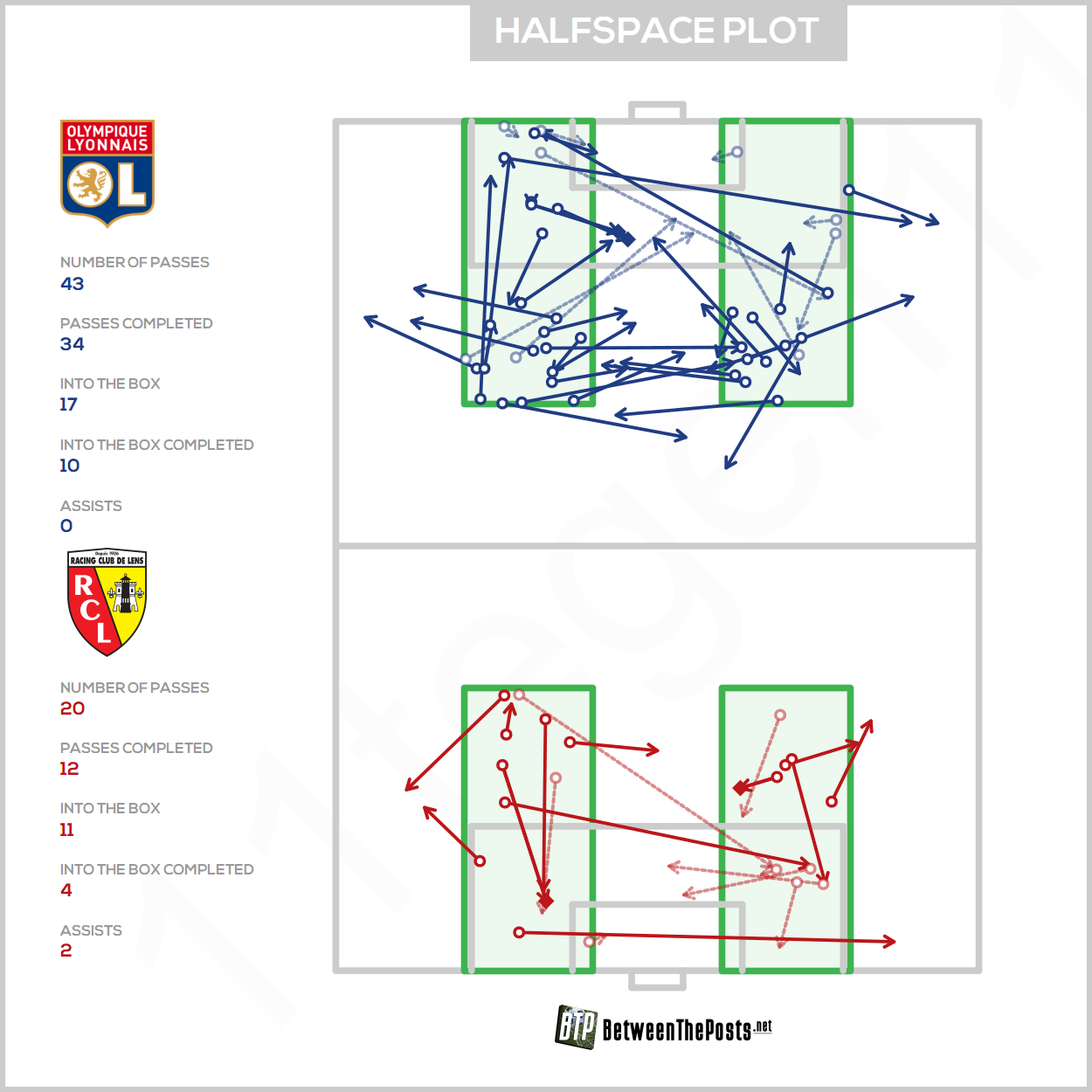
Use the arrows to scroll through all available match plots. Click to enlarge.
Check the match plots page for plots of other matches.

Comments