

Paraguay – Australia: When Caution Became The Safest Route To The Knockout Stage (0-0)
With qualification hanging delicately in the balance, Paraguay and Australia produced a goalless draw that suited both sides more than an all-out pursuit of victory. The contest was defined by disciplined defensive structures, measured possession and a noticeable reluctance to overcommit, as neither team wanted to jeopardise its path to the knockout rounds. While Australia secured second place in Group D, Paraguay’s point proved enough to keep their World Cup hopes alive through the best third-placed rankings, making pragmatism the defining tactical theme of the evening.
Tactical analysis and match report by Mustafa Hassan
Paraguay entered their final Group D fixture knowing that a positive result could be enough to extend their World Cup journey, although their fate also depended on the outcome elsewhere. Gustavo Alfaro’s side had responded impressively after an opening defeat by defeating Türkiye, placing themselves in contention for one of the best third-placed qualification spots. Their priority was to maintain the defensive resilience that had become a hallmark of their tournament.
Australia, meanwhile, required only a point to secure second place behind the United States after collecting three points from their opening two matches. Tony Popovic’s team approached the contest with a pragmatic mindset, aiming to avoid unnecessary risks while relying on their disciplined defensive structure to frustrate Paraguay and guarantee progression to the knockout stage.
Alfaro retained his preferred 3-5-2 system. Orlando Gill started in goal behind Gustavo Velázquez, Gustavo Gómez and Omar Alderete, while Juan Cáceres and Alan Maidana operated as the wing-backs. Andrés Cubas anchored the midfield alongside Diego Gómez and Matías Galarza, with Julio Enciso partnering Gabriel Ávalos in attack.
Popovic selected a 3-4-2-1 formation. Patrick Beach started between the posts behind Alessandro Circati, Harry Souttar and Lucas Herrington. Jordan Bos and Aziz Behich occupied the wing-back roles, while Jackson Irvine partnered Aiden O’Neill in central midfield. Cristian Volpato and Connor Metcalfe operated behind Nestory Irankunda, who led the Australian attack.
Australia’s Right-Sided Build-up Structure
Australia adopted a patient and highly structured build-up in possession, accepting Paraguay’s compact 5-2-3 mid-to-low block rather than attempting to force central progression. The first phase began with Circati, Souttar and Herrington positioned almost on the same horizontal line close to the halfway line. Circati regularly drifted slightly wider on the right side, subtly inviting the circulation towards that flank and establishing the preferred direction of the attack. Ahead of them, Aiden O’Neill and Jackson Irvine positioned themselves close to the centre circle but within the half-spaces, remaining available as secure passing options whenever Paraguay’s first line shifted across.
Once Australia advanced into the second phase of possession, their attacking structure became even more predictable but equally deliberate. With Paraguay defending extremely deep, there was little space available between the lines, forcing Australia to prioritise width instead of central penetration. Although both Jordan Bos and Aziz Behich initially stretched the defensive line by occupying wide positions, the progression was consistently channelled towards the right side. As the ball travelled in that direction, Cristian Volpato abandoned his inside position and moved towards the touchline in a significantly higher area of the pitch. His movement created an additional passing angle for Bos while also attracting one of Paraguay’s wide defenders, allowing Australia to secure possession near the flank.
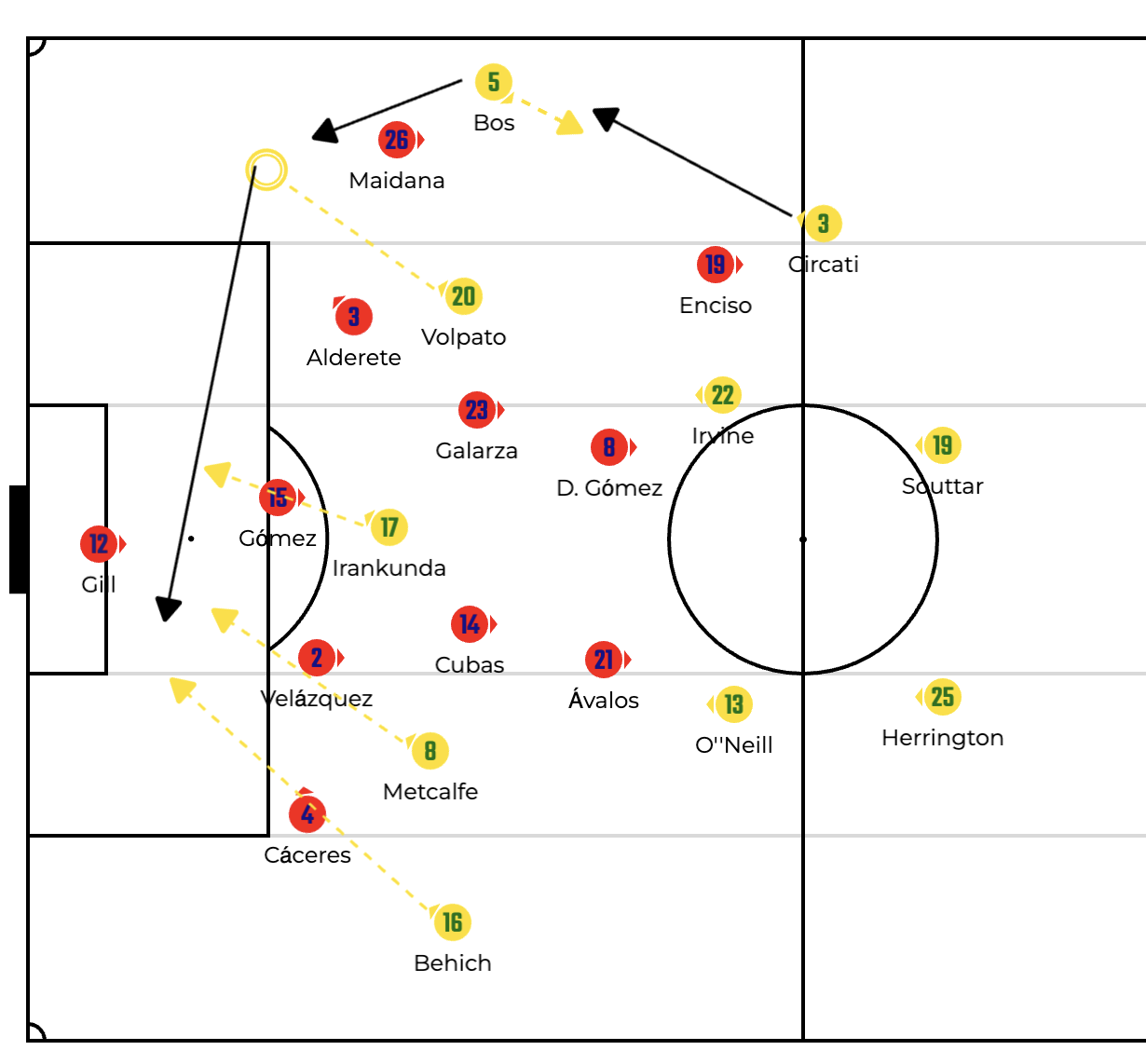
Australia consistently directed possession towards the right flank, where Volpato’s movement alongside Bos created their primary crossing platform against Paraguay’s deep 5-2-3 block.
From there, Australia’s objective became increasingly straightforward. Rather than attempting combinations through Paraguay’s congested central corridor, they repeatedly worked the ball into crossing positions from the right wing. Paraguay had effectively sealed the central channel with their compact back five and disciplined midfield pair, leaving aerial deliveries as Australia’s most viable attacking route. Although the approach generated territorial control and sustained possession, Paraguay’s numerical superiority inside the penalty area ensured that the majority of crosses were comfortably defended, preventing Australia from converting their dominance into clear-cut goalscoring opportunities.
Paraguay’s U-Shaped Circulation Without Penetration
Paraguay’s possession map reflected the limitations of their attacking structure, with circulation repeatedly forming a distinctive U-shaped pattern around Australia’s compact defensive block. Rather than progressing through central areas, Gustavo Alfaro’s side consistently recycled possession across the back line before directing play towards either flank. Australia’s narrow defensive organisation denied access into the central corridor, leaving Paraguay with little option but to move the ball horizontally.
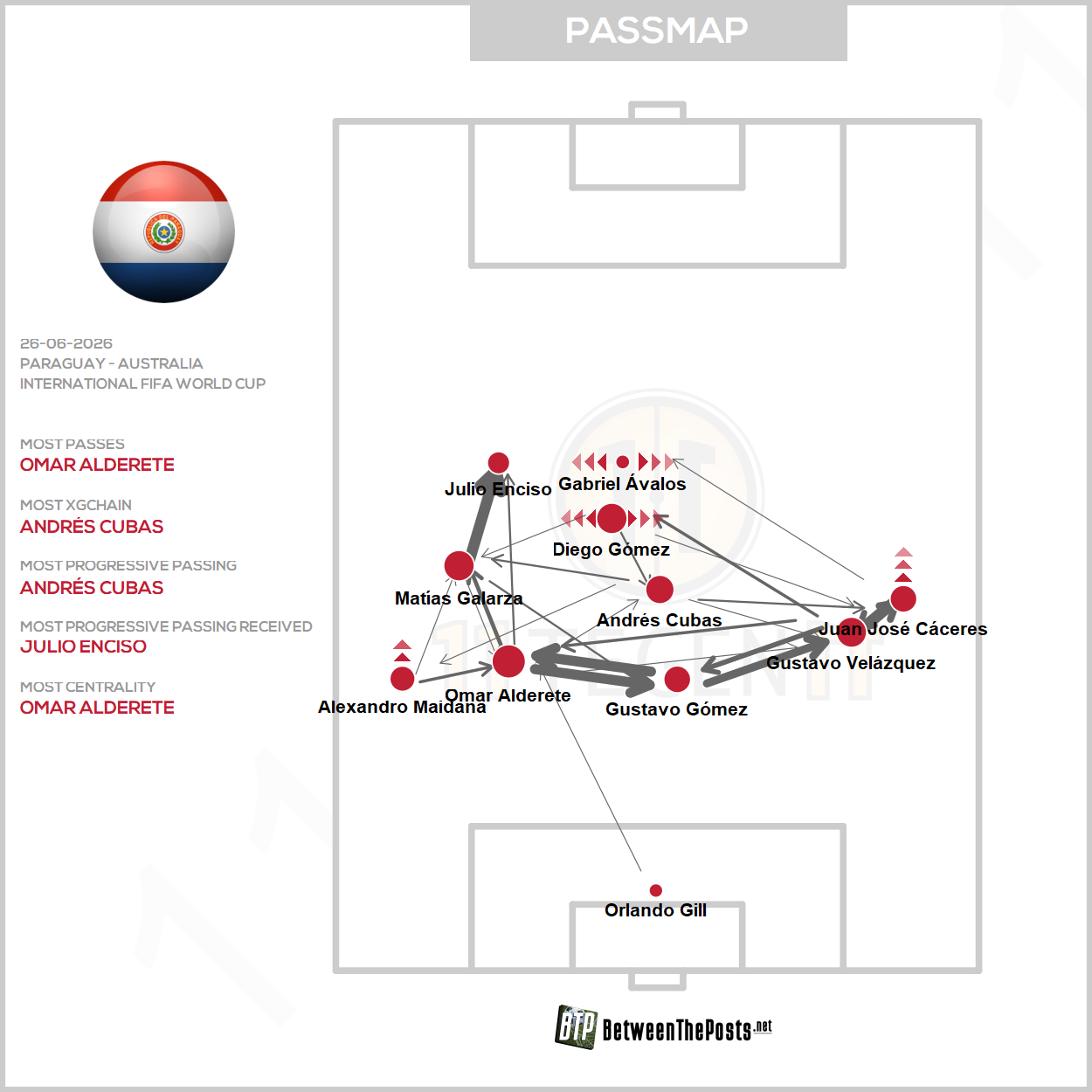
Paraguay’s passing network formed a clear U-shaped structure, with possession repeatedly circulating around Australia’s compact block while central progression remained almost entirely unavailable.
As a result, the majority of their passes were completed around the outside of Australia’s defensive shape instead of between the lines. Although this approach allowed Paraguay to retain possession for extended periods, it generated very little territorial progression or meaningful attacking momentum. The passing network illustrated a team capable of controlling the ball but unable to disrupt Australia’s compact structure. With the central channel effectively closed throughout the contest, Paraguay’s circulation became increasingly predictable, as possession travelled from one side of the pitch to the other without creating numerical superiority or opening passing lanes into dangerous areas.
The mechanism behind this circulation followed a repetitive pattern. Omar Alderete and Diego Gómez frequently exchanged passes during the initial stages of possession, attempting to provoke Australia’s first line of pressure before switching play towards one of the flanks. Once the ball travelled wide, Paraguay continued progressing along the touchline until it reached Juan Cáceres. Gustavo Velázquez then moved closer to provide short support, while Andrés Cubas advanced from the right half-space to offer an additional passing option.
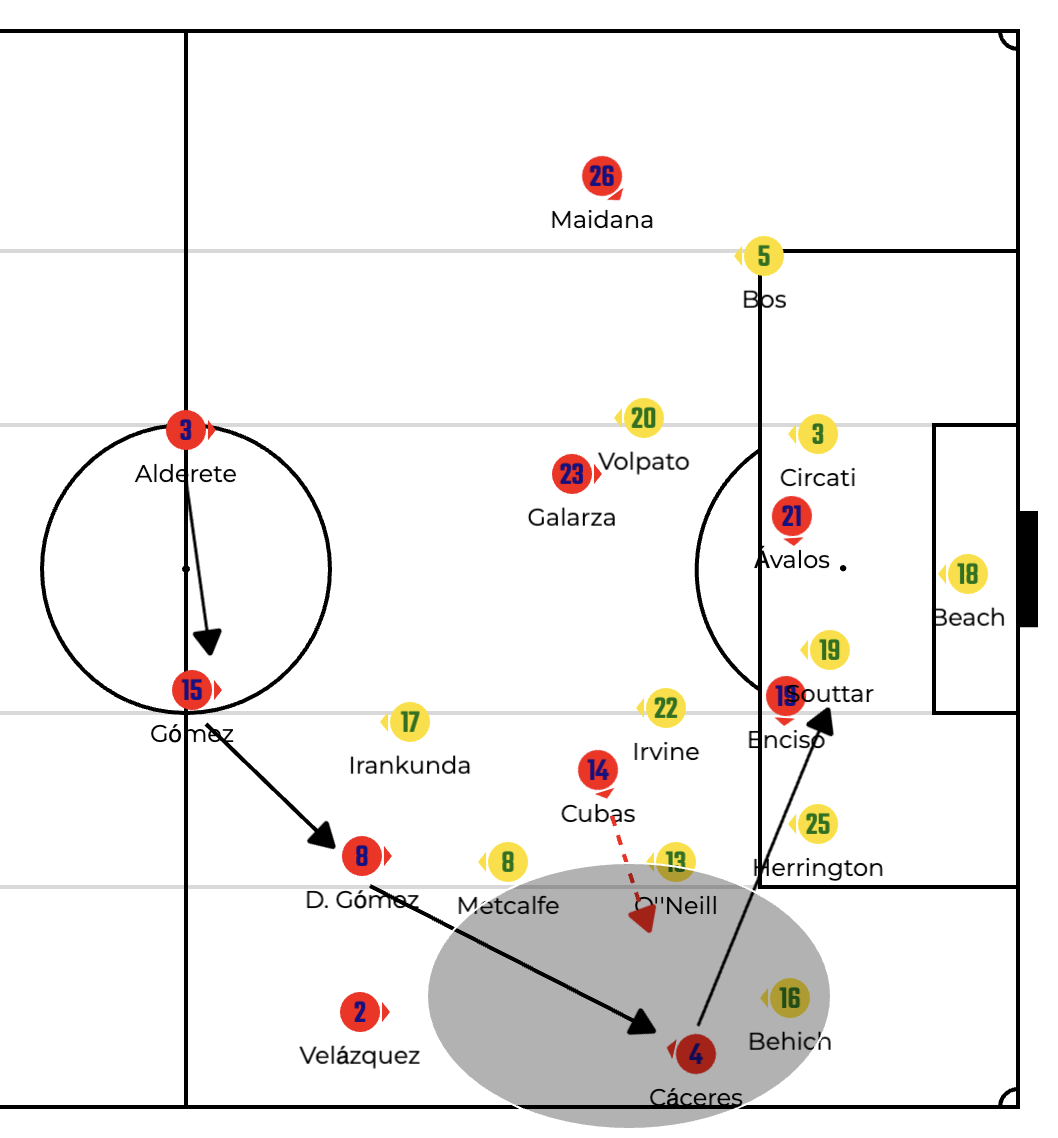
Alderete and Diego Gómez initiated circulation before Paraguay repeatedly progressed towards Cáceres, with Velázquez and Cubas offering support outside Australia’s completely sealed central corridor.
However, Australia’s compact defensive block continued to seal the central corridor, preventing Cubas from receiving on the turn or accessing advanced areas between the lines. With no vertical route available, Paraguay were repeatedly forced to recycle possession backwards before restarting the same sequence on either side. The pattern maintained ball retention but carried almost no attacking threat, as reflected by Paraguay’s expected goals total of just 0.38 xG across the entire match. Their structured circulation therefore became an exercise in possession without penetration, illustrating Australia’s success in controlling the most dangerous spaces throughout the contest.
Hrustić’s Interior Influence
Australia introduced greater positional fluidity after Ajdin Hrustić entered the match in the second half, adding a different attacking dynamic to their previously predictable possession. Rather than remaining fixed on the touchline, Hrustić frequently received possession on the left before immediately driving infield onto his stronger foot. His movement altered Australia’s attacking structure by encouraging Jordan Bos to vacate the wide channel and instead occupy the left half-space. This rotation created a natural positional exchange, with Bos drawing defensive attention inside while simultaneously vacating the flank for Hrustić to attack.
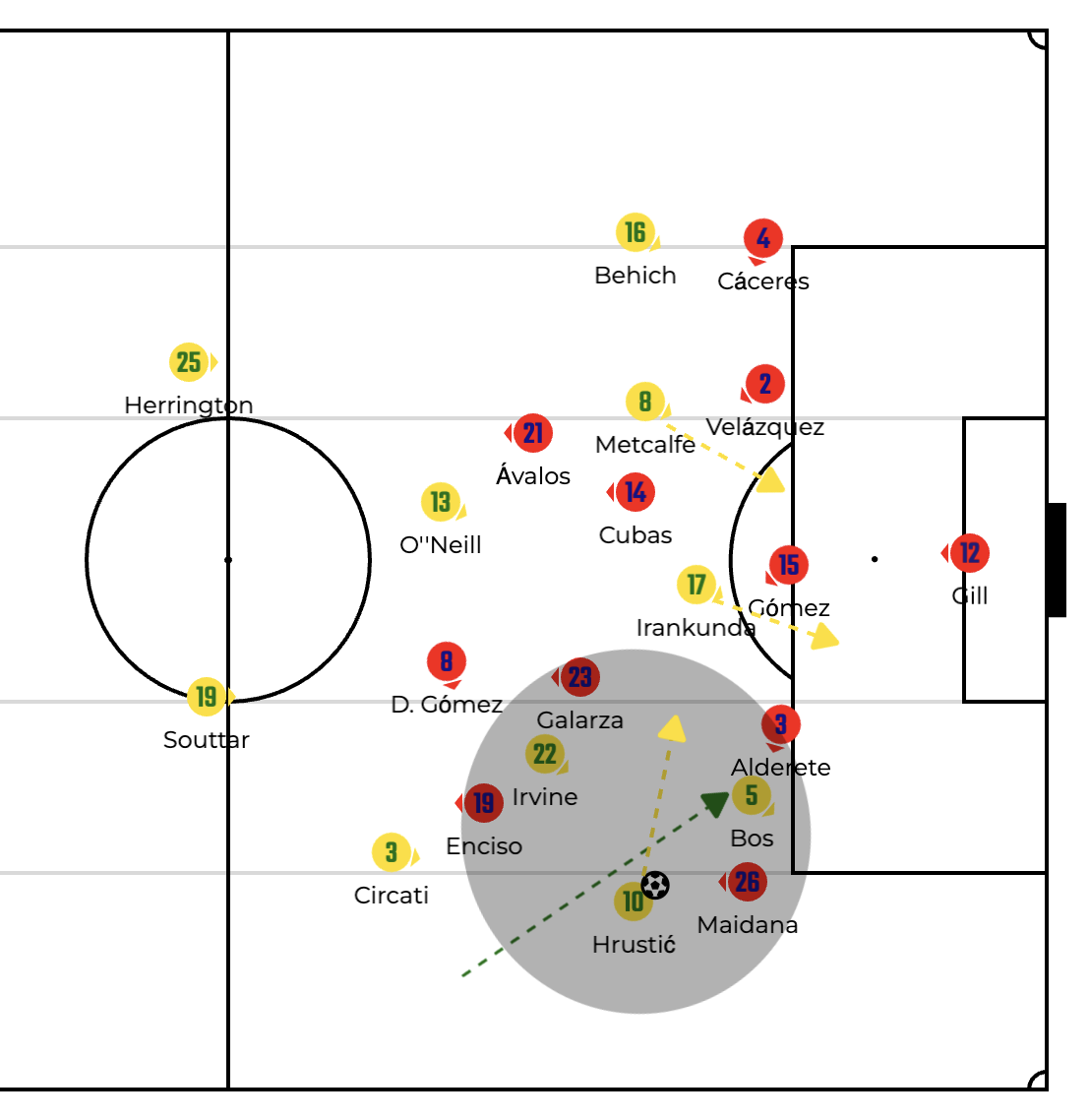
As Hrustić drifted inside from the right, Bos occupied the left half-space, creating the width and interior rotations that opened shooting lanes towards the edge of Paraguay’s defensive block.
The movement served two tactical purposes. Firstly, Bos’s occupation of the half-space pinned Paraguay’s nearest midfielder and wide centre-back, preventing either defender from stepping aggressively towards Hrustić. Secondly, the newly created outside lane allowed Hrustić to carry the ball diagonally into the inside channel, where he could threaten the edge of the penalty area with either a direct shot or a disguised through ball.
Instead of relying exclusively on crosses from wide areas, Australia briefly diversified their attacking approach by creating central shooting opportunities through positional rotations. Although Paraguay’s compact defensive block continued to limit the quality of clear-cut chances, Hrustić’s introduction injected greater unpredictability into Australia’s possession and offered a more effective method of attacking the spaces just outside the defensive line than had been seen during the opening period.
Takeaways
Australia controlled space rather than chasing risk. Popovic’s side accepted a patient possession game, repeatedly directing attacks towards the right flank while maintaining excellent defensive compactness. Their disciplined structure prevented Paraguay from exploiting central areas and ultimately delivered the point required for qualification.
Paraguay dominated possession without penetration. Their passing network formed a clear U-shaped circulation around Australia’s defensive block, but the inability to access the central corridor meant possession rarely translated into meaningful chances. Their total of just 0.38 xG reflected the lack of attacking efficiency despite sustained ball retention.
Hrustić added variety but not a breakthrough. His second-half introduction created greater positional rotations with Jordan Bos, opening interior shooting lanes instead of relying solely on crosses. Although the adjustment made Australia’s attack less predictable, Paraguay’s organised low block continued to deny clear-cut opportunities, ensuring the match finished as a tactical stalemate that suited both teams.


Comments