
Racing Club – River Plate: River Plate Make It Four Wins In a Row Following a Hard Fought Victory Over Racing (0 – 2)
It was an end-to-end game that was decided by the teams’ actions in both boxes. Racing would feel hard done by with the referee’s decision as an important sequence was decided by the referee for River’s first goal. However, Racing continued to pile the pressure as their second-half performance looked to give the team life. Racing’s momentum throughout the second half disappeared following the red card. River’s frontline did the damage as they earned yet another three points.
Tactical analysis and match report by Ebuka Ogoegbunam.
River Plate’s form was going to be put to the test against a Racing side that had only lost one game at home all season. River’s defence has been solid of late, keeping three clean sheets in their last three league games. Eduardo Coudet, who is yet to lose a game for River, had the chance to extend his unbeaten run and make a push for the top spot in the Apertura.
Coudet started Santiago Beltrán in goal with a defensive line of Gonzalo Montiel, Lucas Martínez Quarta, Tobías Ramírez, and Marcos Acuña. Fausto Vera paired up with Aníbal Moreno in the middle with Ian Subiabre and Tomás Galván on the left and right sides of the wings, respectively. Facundo Colidio and Sebastián Driussi led the attacking line in their 4-4-2 shape.
Facundo Cambeses started in goal for the home side with a backline of Ezequiel Cannavo, Marco Di Césare, Marcos Rojo and Agustín García Basso in front of him. The three-man midfield contained Santiago Sosa playing as the sole pivot with Adrián Fernández and Bruno Zuculini playing higher up. Baltasar Rodríguez, Santiago Solari and Adrián Martínez made up the front three in their 4-3-3 setup.
Chaos Vs Control
The game started off with River looking to control the game with their setup. Both fullbacks pushed up with the wingers tucking into narrow areas of the pitch. This looked like a 2-2-6 but on many occasions, one of the midfielders, Vera or Moreno, dropped into the first line to form a back three in build up. This meant River often switched from a 2-2-6 to a 3-1-6 in the game depending on the midfielder’s rotations.
Racing started the game, conceding control early on. They had to keep an eye on the positioning of River’s fullbacks, who were high up the pitch. Rodríguez tracked the movement of Molina and for a while, Racing defended with a back five to try to avoid getting overloaded in the last line.
River had the 3v2 overload in the first line. Defenders were able to drive into space without pressure and looked to play passes into the central areas of the pitch to find their teammates in the pockets.
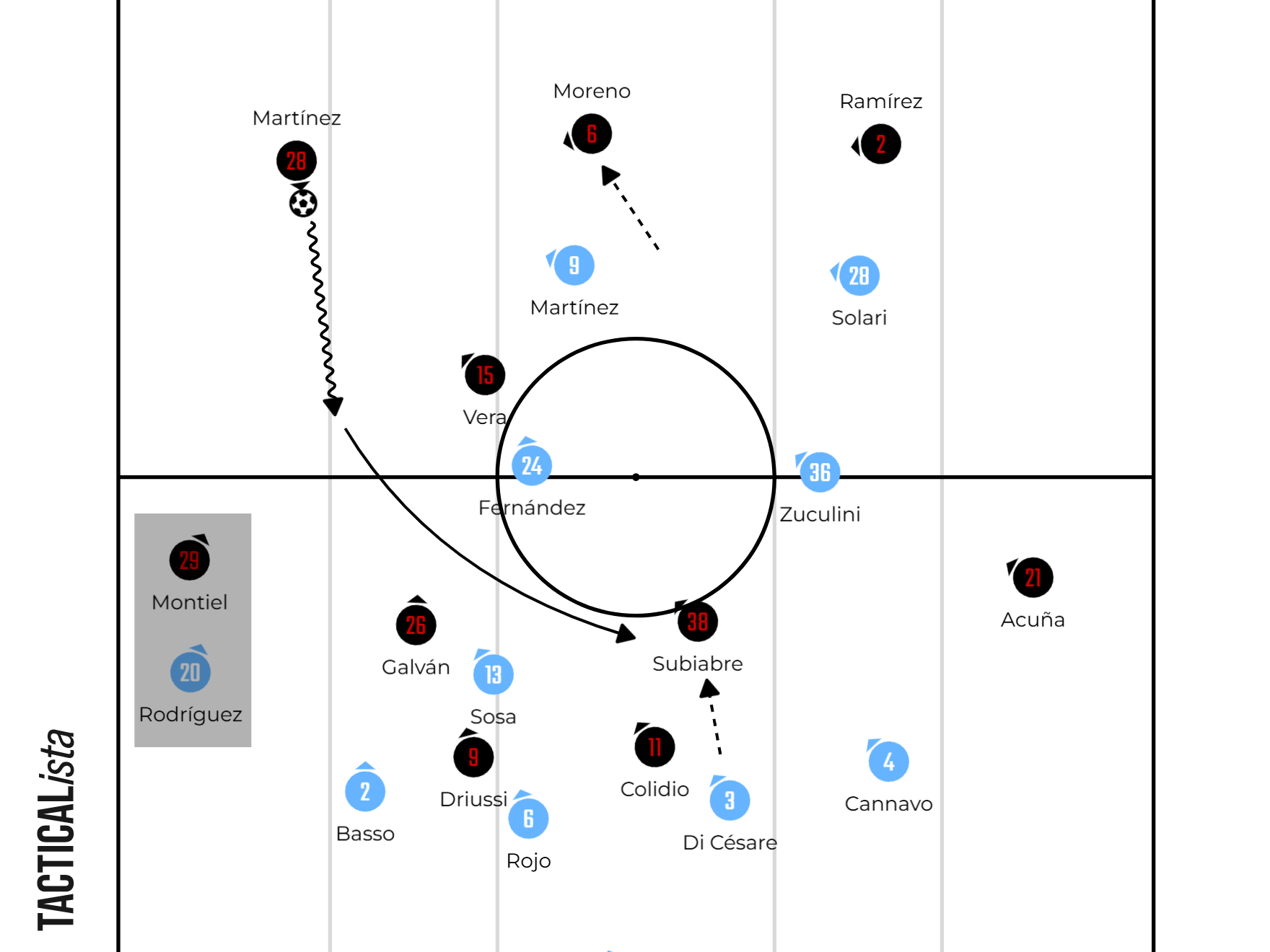
Martínez drove into space to play in his teammates in the pockets. Taking advantage of the 3v2 overload in the first phase of build-up.
Their hybrid press with Martínez and Solari leading the line had the fullback on the right, Cannavo, jump onto their fullback, Acuña. Racing always looked for the quick break to find moments to capitalize on the players River committed forward. They broke out on occasions where they won first and second balls.
The game quickly became more physical with a higher tempo. Racing’s increase in tempo affected the game, with both teams disrupting play and looking for ways to gain fouls. Racing’s increase in momentum was evident as the approach changed to River, looking to catch Racing on the break, while the game became more open with players taking more risks with and without the ball.
Racing’s Momentum
Racing Club adapted early in the first half to have a slight advantage in momentum. River dropped into their 4-4-2 mid block and prioritized remaining compact. For that period of time, Racing looked for solutions to break River’s 4-4-2 block. Basso pushed higher up the pitch, while Sosa dropped into the first line of buildup.
Racing were able to generate wide triangles on the flanks using their fullbacks high up and wingers in between the lines. River’s defensive line was very compact in the mid-block and nullified any threat Racing were going to offer.
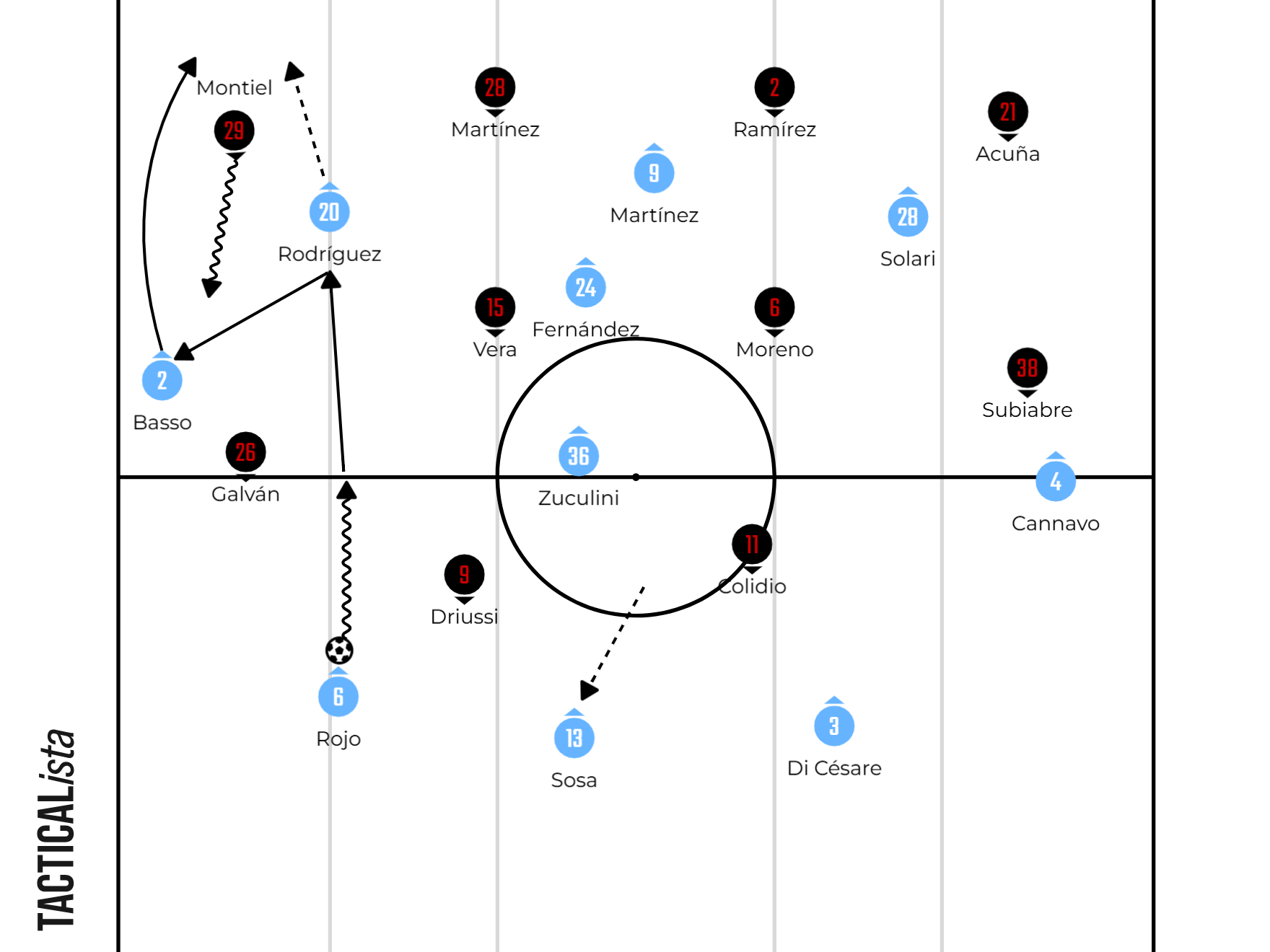
Rodríguez, combining with Basso to find space behind to attack the River backline.
River saw this as an opportunity to be a threat on the counter and this intent led to their first goal. Racing’s appeal for a penalty was quickly dismissed by the referee, which allowed Acuña to play a long ball in behind to take advantage of the spaces Racing left. Rojo mistimes his slide tackle to win the ball, which puts Driussi through on goal to take the lead.
Racing’s protest didn’t change the referee’s mind as the goal was given. One goal down at home following a controversial moment sparked the home side as they began to push for an equalizer immediately. Racing’s fullbacks began to get tight to River’s players between the lines, Galván and Subiabre, and this gave River an opening to exploit in transitions. River looked to their strikers as outlets in transitions. They dragged their markers wide to try to use the channels as a lane to help transition to an attack.
Driussi and Colidio helped the team in some transitional moments, drawing fouls and always looking to be direct. In moments where River often went long, Racing dropped their defensive midfielder, Sosa, into the defensive line to give a numerical advantage when controlling transitions.
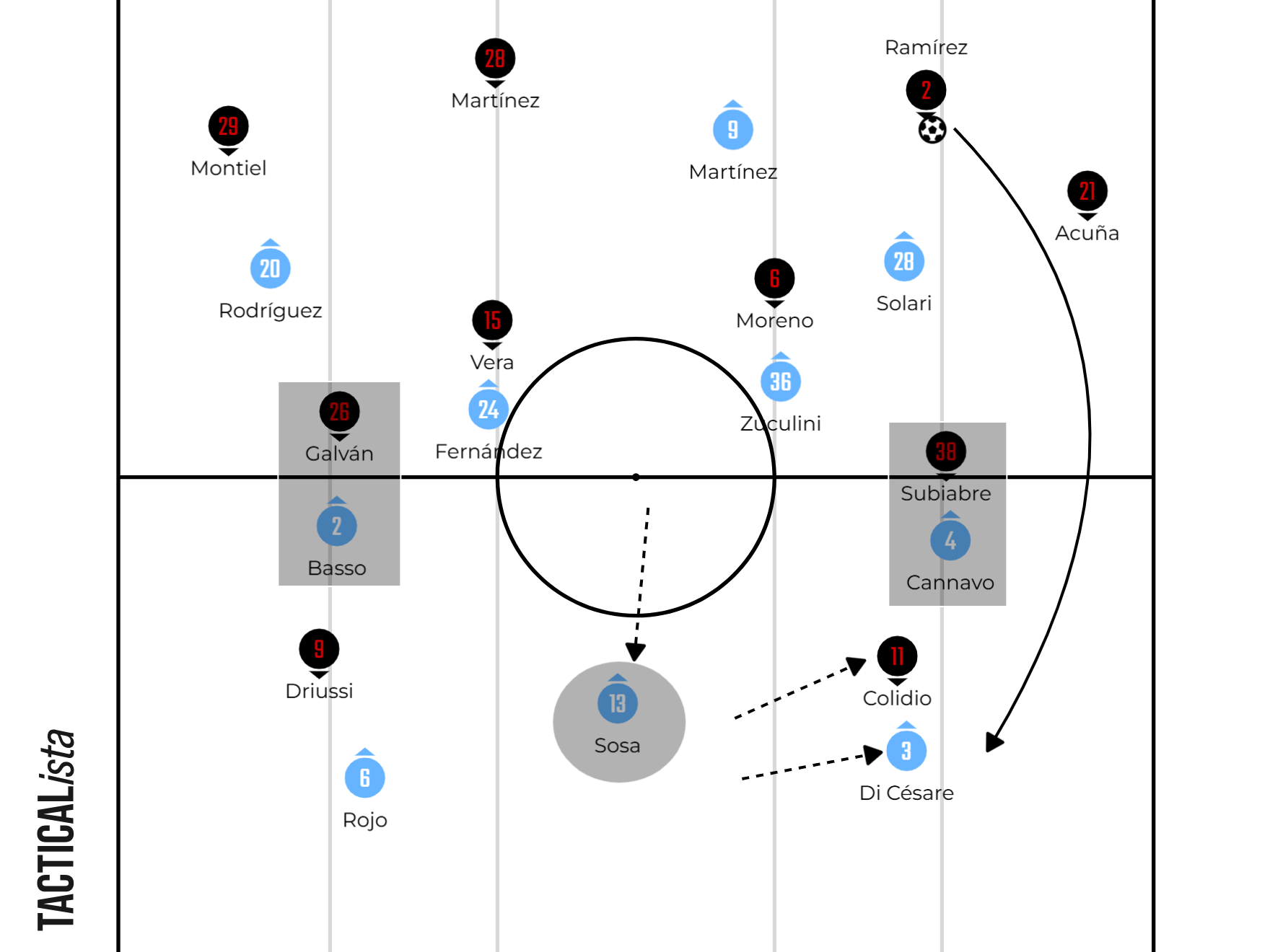
River’s direct play saw their forwards roaming into wide areas as the team looked for an outlet in transition.
Late drama for both teams
Racing became more dominant in the second half. Their counterpress against River, worked constantly, with their aggression being a key factor. The defenders, Di Césare and Rojo, were very tight to the River strikers later on. Racing got momentum and used this to create half-chances and chances. Their lack of decisiveness in the final third cost them time and time again.
River were still aggressive high up the pitch in their 4-1-2-3 press. Their structure limited Racing from having passing lanes in the middle of the pitch. Racing went long and didn’t risk trying to play through the diamond structure.
Galván and Subiabre often stayed in narrow positions beside one of the midfielders pressing the opposition pivot. They occupied narrow positions initially in the press but looked to press players in wide areas. River’s zonal press meant that they had an extra defender in the last line to keep a solid shape.
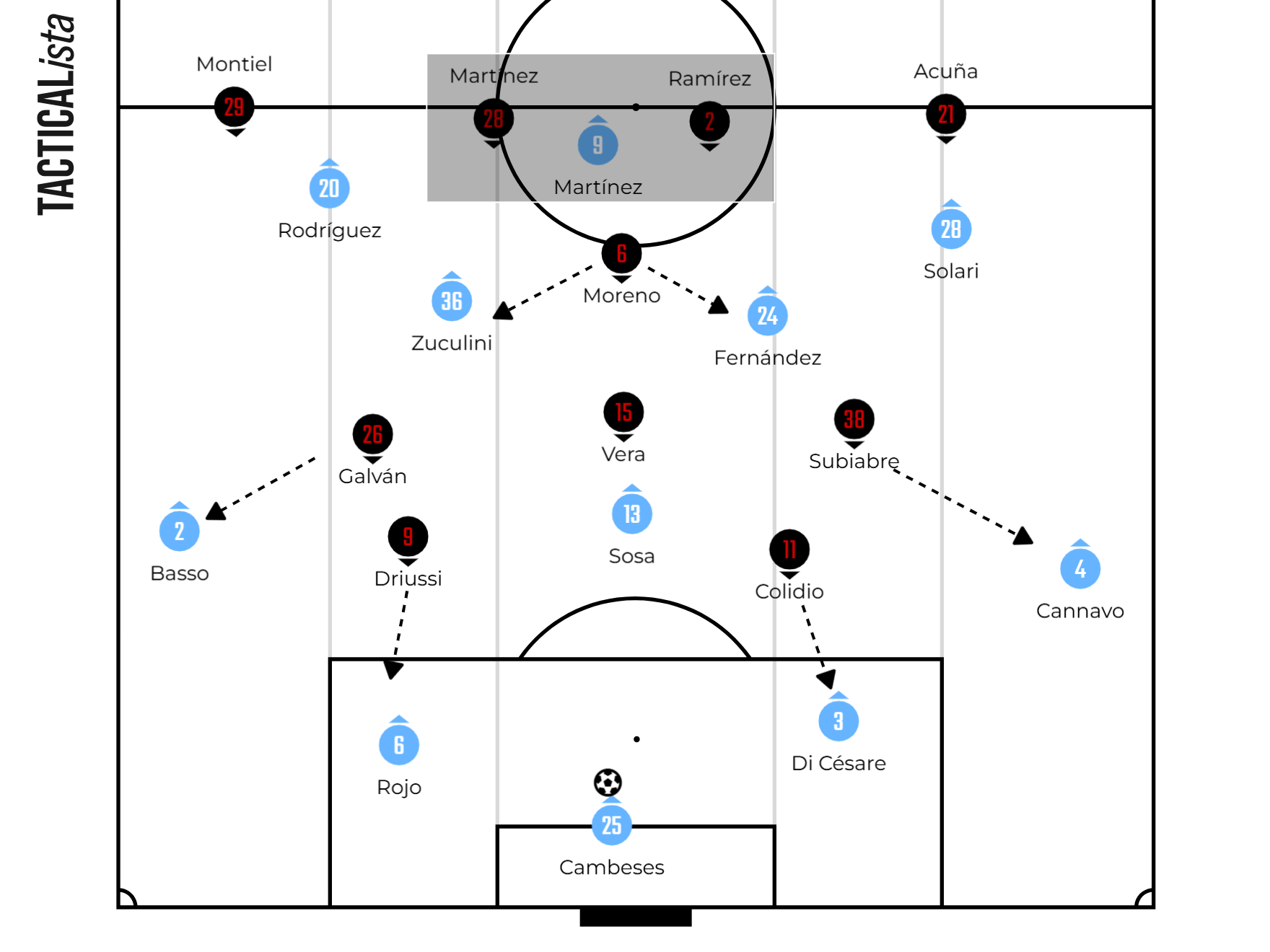
River’s 4-1-3-2 diamond press, covering the central lanes while pressing wide areas.
Racing’s momentum quickly faded following a red card from Rojo, who was found guilty of hitting a player with his hand on purpose while attacking a corner. Fans in the stands could feel the game slipping away from their hands, but Racing didn’t give in.
Racing continued to push forward so late in the game, even with ten men, until they shot themselves in the foot again. Basso tried to clear the ball in his defensive third and, unfortunately, the ball deflected off the substitute, Juan Cruz Meza to find its way into the feet of Colidio, who laid the last man down before passing the ball into the back of the net.
Takeaways
Racing Club vs River Plate was a high-tempo, transitional game defined by control vs chaos, which then changed to a chaos vs chaos affair. River initially dominated possession with flexible build-up structures. Racing adapted by increasing intensity, using wide combinations, and counterpressing to gain momentum.
The key turning point came with River’s first goal scored in transition after a controversial refereeing decision. This shifted the game state. Racing responded strongly, especially in the second half, but lacked efficiency in the final third. A red card to Marcos Rojo killed their momentum, and River sealed the win late after a defensive error.
Big win for River Plate to make it four wins in a row with another strong defensive performance leading to a clean sheet. Harsh result for Racing Club as they feel they deserved more. They have to be clinical enough to deserve the three points in the coming games.
Match plots will be added as soon as possible.

Comments