
RB Leipzig – Bayern Munich: Second Half Rout Guards Unbeaten League Run (1-5)
Ole Werner’s side had a strong first half performance with their intense in- and out-of-possession approaches. However, a costly mistake early in the second half led to a momentum shift for Bayern Munich, who piled on the pressure. The comeback was sealed in commanding fashion to protect their unbeaten Bundesliga form, which looked under threat very briefly.
Tactical analysis and match report by Fahd Ahmed.
We decided to make this article free to read. If you want to support our work, consider taking a subscription.
The runaway league leaders have showcased further strength and dominance in the last few weeks, especially with their attacking form. Bayern Munich scored 22 goals in the last five Bundesliga games whilst conceding just four. They have been unbeaten domestically, and their only loss in Europe was to Premier League leaders Arsenal in an away fixture.
RB Leipzig have experienced a good season so far, as they are in the mix for Champions League qualification. Recent form has left supporters desiring a little more, having lost against Union Berlin and Bayer Leverkusen before the winter break. However, they got back to winning ways last week as they defeated Freiburg 2–0.
Having met each other earlier this season, a clash between Leipzig and Bayern was going to be intriguing. Vincent Kompany’s side were rampant that night with a commanding 6–0 scoreline, which was one-sided, to say the least. Thus, the tie on Saturday was going to provide an indication as to whether the gap between them was thinner.
Werner only made two changes to the team he fielded against Freiburg, with both wingers swapped. Assan Ouédraogo and Tidiam Gomis were benched for Antonio Nusa and Yan Diomande. Kompany similarly only had a couple of personnel alterations, with both to the backline. The injured Konrad Laimer was replaced by Tom Bischof, and Kim Min-jae was rested while Dayot Upamecano started instead.
Proactive defensive approach despite facing a heavyweight
There are very few teams that dare to press Bayern man-to-man. Due to the usual disparities in player quality, oppositions usually refuse to aggressively and intensely defend in such a manner. Werner clearly wanted his side to be fearless, and considering that they were playing at home, Leipzig were instructed to be on the front foot.
Thus, Leipzig pressed man-to-man during Bayern’s build-up phases. In the middle third, Werner had them set up in a compact 4-4-2 middle block with a high defensive line. It was designed as such to provide the team with a platform from which they could again lock on player-for-player, since it, on paper, matched Bayern’s usual 2-4-4 in-possession shape.
Instead of always pressing Bayern man-to-man in the middle third, only to later run out of gas and get picked apart, Leipzig were selective with their moments of transitioning defensive approaches. Furthermore, the relatively high defensive line prevented them from being pinned deep too easily.
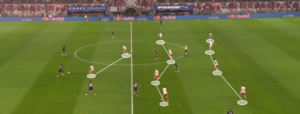
Leipzig structured in a 4-4-2 middle block from which they transitioned into a man-oriented press.
During Bayern’s build-up phases, as already mentioned, Leipzig strictly locked on man-to-man. This provided the visitors with an opportunity through Harry Kane. It was similar to the game against Borussia Dortmund, where Bayern won 2–1 earlier this season. Kane constantly caused issues for the opposition by dropping into midfield, where he would either receive the ball unmarked or generate a spare man if he was marked.
Against Leipzig, since Castello Lukeba and Willi Orbán stayed tight to their players whilst Bayern tried progressing from deep, Kane would test them by dropping to receive. Serge Gnabry also made similar movements along with Kane to drag both centre-backs.
Kane has the quality to collect the ball with his back to goal and turn to find a through pass to the near-side runner, making this move dangerous to defend. Especially with the Leipzig centre-back duo willing to leave their position, it could lead to situations where there is a hole through the centre of the backline.
In the 14th minute, Bayern were building from deep with Leipzig pressing man-to-man. A diagonal pass from Bischof found Gnabry, who passed it to Kane with a clever flick. The striker spotted the run of Lennart Karl into the vacant space. Unsurprisingly, Kane’s pass was inch-perfect. Karl and Luis Díaz were isolated in a two-versus-two, with the former trying to square a pass to the Colombian. However, Karl’s cross was slightly miscued, leading to a goal kick for the opposition rather than a tap-in for Díaz. Nevertheless, it still signified the dangers of pressing Bayern man-to-man.
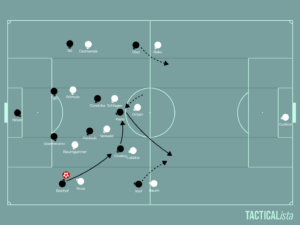
Bayern created a dangerous chance in the 14th minute with Leipzig pressing player-for-player.
It is worth adding that Leipzig held their own offensively with quick vertical attacks. Early chances fell to Nusa and Seiwald. However, they soon took the lead.
Benefits of double width contribute to the opener
During settled possession phases, Leipzig formed a 4-3-3 shape whilst Bayern defended in a narrow 4-4-2. A key tactic in Werner’s on-ball system includes the usage of double width. It essentially refers to the supporting runs offered by the full-back to the winger. This primarily tests the defensive concentration and awareness of the opposition winger, who will have to track the movement.
However, in the 20th minute, Karl tried to initiate a man-oriented press, but the rest of the team was not ready to engage. The Bayern backline should be held responsible for not reacting quickly enough, as Karl’s movement should have automatically triggered Bischof to jump to Raum whilst Upamecano picked up on Nusa.
This did not happen, and instead it left Bischof overloaded on the right side after David Raum made a run. The left-back managed to crash into the penalty box and receive the ball in space, since Bischof had too much ground to cover. Raum was then able to deliver a sharp cross, which the striker, Rômulo, scored after executing a well-timed run.
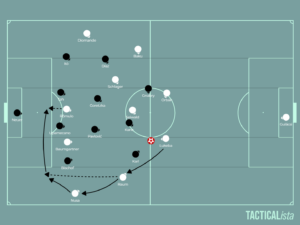
Raum’s quick underlapping run was not tracked tightly enough by Karl, leading to Rômulo’s goal.
Costly mistake initiates the Bayern comeback
The visitors started the second half intensely as they proactively tried to change the tide of the game. Leipzig had to weather the storm and protect their lead to ensure that the momentum shift would be temporary and not permanent, given that they had a strong first half performance.
However, within just five minutes after the break, Leipzig conceded a goal after a self-inflicted error. The move originated with a deep turnover after a Bayern attack. Raum collected the loose ball and attempted to release it but was under immediate pressure from Karl. He passed it out to Christoph Baumgartner, whose body orientation was square and who did not scan well enough to shift the ball away from the path of Upamecano’s pressure. Thus, the defender was able to force a turnover, which fortunately fell into the path of Gnabry, who slotted it past Péter Gulácsi.
After this point, the momentum shift seemed likely to stay, especially since Kompany introduced key players like Michael Olise and Joshua Kimmich. Bayern began controlling more possession and dictating the flow of the game. Leipzig had to rely on counters but still managed to produce a few chances, with Seiwald and Rômulo testing the opposition defence.
Bayern found another breakthrough, yet again, from a counter-press to turn possession over after a failed attack. It led to Olise receiving the ball out wide before feinting to cut inside. Raum took the bait and overextended to tackle the Frenchman, who instead chopped back outside to deliver a cross to the back post. Kane was well positioned to receive and brought the ball down with his right foot, after which he shifted and shot.
Following the goal, Bayern began pouring on the chances from deep build-up and counter-attacking situations. As seen in the post below, when attacking vertically, the Bavarians can be quite ruthless as they generate valuable chances. One of those transitions led to a corner kick from which Jonathan Tah scored. Shortly after, Aleksandar Pavlović and Olise got their goals from transitional situations.
Bayern attract pressure from the opposition (below are examples from the Leipzig game last weekend) before playing through the man-oriented press. A common theme is diagonal passes from deeper areas to the forwards, as shown in clips 1 and 2. pic.twitter.com/KpIIFoiebM
— Fahd (@fahdahmed987) January 19, 2026
Takeaways
Although the scoreline may not suggest much of an improvement from their meeting earlier this season, the first half performance displayed that Leipzig have the capacity to compete at a high standard. Consistently delivering to this standard is the next step for Werner, which is a process that takes time. Without having European cup games, unlike their close competitors, Werner will relatively have more time to work on the training ground to sort out these issues and rest key players. However, the stakes keep rising as the race for Champions League qualification remains watertight.
Bayern seem to approach every match with a level of laser-sharp focus, despite already shaping up to be the runaway Bundesliga winners. With greater ambitions this season, they will not want to let any momentum slip and affect them in the Champions League, where they are going stride for stride with the best teams in Europe.
Use the arrows to scroll through all available match plots. Click to enlarge.
Check the match plots page for plots of other matches.


Comments