

Roma – AC Milan: Pellegrini’s Penalty Snatches Point After De Winter Strike (1-1)
Roma controlled large spells of the opening half as Milan adopted a compact, conservative block and looked to manage the tempo without the ball. The hosts circulated possession well and created pressure around the penalty area, but lacked the final incision before the break. After half-time, Milan grew into the contest and struck first through Koni De Winter, whose well-timed header gave the visitors the lead against the run of play. Roma responded with renewed intensity and were rewarded when Lorenzo Pellegrini calmly converted from the spot, restoring parity. Despite late momentum swings at both ends, neither side could find a decisive breakthrough, and the clash at the Olimpico ended all square.
Tactical analysis and match report by Mustafa Hassan.
We decided to make this article free to read. If you want to support our work, consider taking a subscription.
The starting XIs reflected two distinct yet clearly structured tactical approaches. Roma, under Gian Piero Gasperini, lined up in a 3-4-2-1, prioritising structural stability and controlled progression rather than constant vertical aggression. Mile Svilar started in goal behind a back three of Mancini, Ndicka and Ghilardi, a unit focused on maintaining compact distances and protecting the central corridor.
The wing-backs, Zeki Çelik and Wesley, were tasked with providing width and depth in possession, while Cristante and Koné formed a functional midfield pairing aimed at ball circulation and defensive balance rather than advanced box occupation. Ahead of them, Dybala and Soulé operated as free interior creators between the lines, supporting Donyell Malen, who functioned more as a mobile reference point to stretch Milan’s defensive line than a fixed penalty-box striker. The overall shape suggested an intention to control rhythm and spacing, though it relied heavily on individual creativity to destabilise Milan’s block.
Milan, adopted a more pragmatic 3-5-2 under Massimiliano Allegri, built around midfield control and transitional security. Mike Maignan anchored the side behind a back three of Tomori, Gabbia and De Winter, capable of stepping into midfield when required while preserving numerical superiority at the back.
In midfield, Modrić operated as the deep organiser, dictating tempo alongside Rabiot and Ricci, whose roles combined physical coverage with vertical support. The wing-backs, Saelemaekers and Bartesaghi, provided width and crossing outlets, particularly during settled possession phases.
Up front, Nkunku and Rafael Leão offered a complementary pairing of movement and penetration, allowing Milan to alternate between sustained build-up and direct transitional attacks. The structure prioritised balance and game management, reflecting Allegri’s emphasis on control rather than sustained territorial dominance.
AC Milan’s Build-Up Pattern
Milan’s build-up structure against Roma was deliberately patient and manipulative, designed less to progress quickly and more to provoke specific defensive reactions. In the first phase, Mike Maignan played a central tactical role, repeatedly retaining possession under minimal pressure to invite Roma’s first line to step higher. Rather than accelerating circulation, Maignan’s pauses on the ball acted as a trigger, encouraging Roma to commit bodies forward and narrow their defensive spacing. Once this pressure was established, Milan intentionally directed play towards the flanks, most commonly through Bartesaghi on the left or Saelemaekers on the right, using the touchline as a reference point to stretch Roma’s compact 3-4-2-1 block.
As the ball travelled wide, Luka Modrić subtly dropped into the near-side half-space, positioning himself diagonally behind the ball-carrier. This movement served a dual purpose, it provided a secure passing angle while simultaneously dragging Roma’s midfield line towards that side.
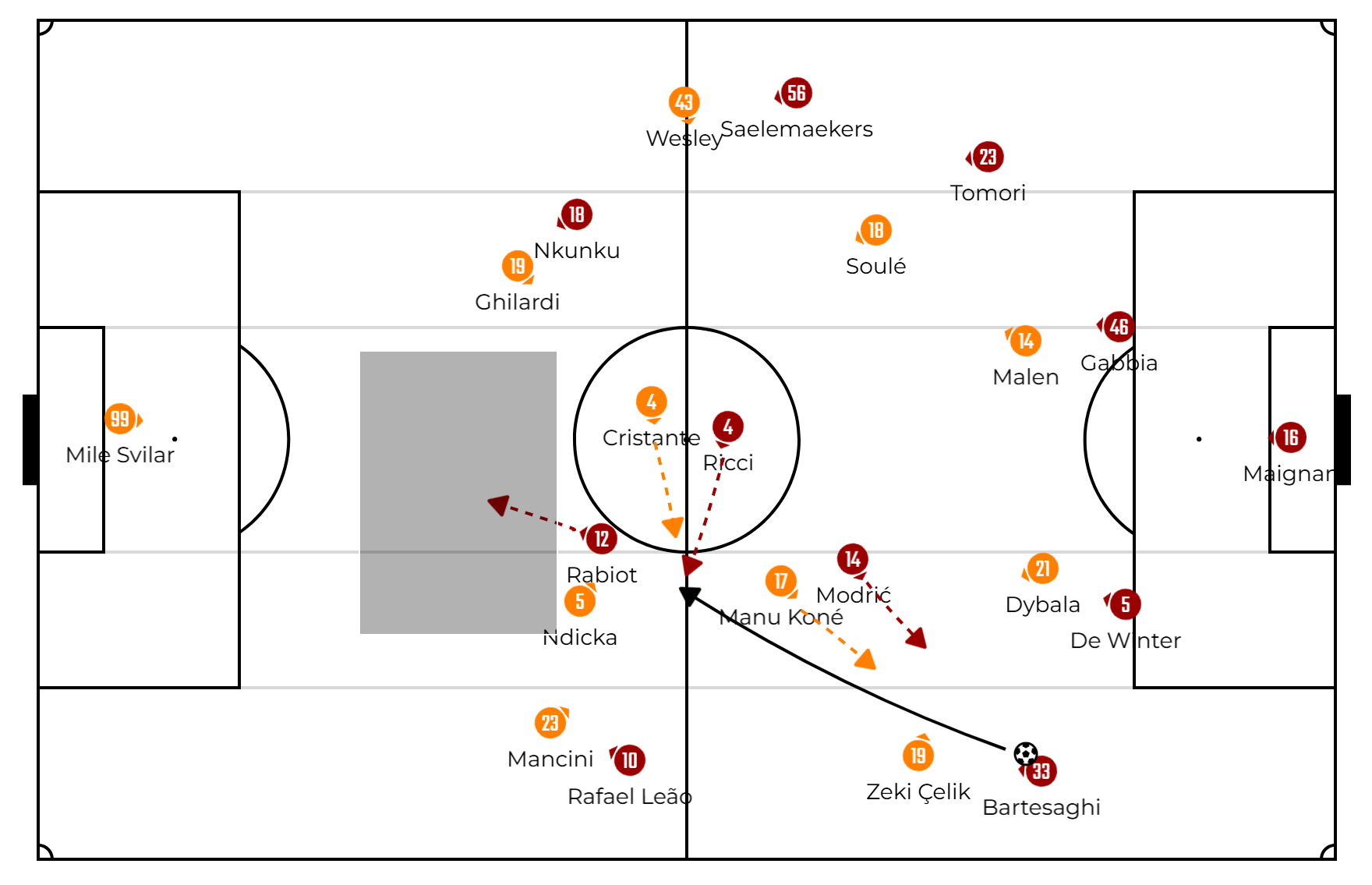
Luka Modrić subtly dropped into the half-space, positioning himself diagonally behind Bartesaghi
Nkunku complemented this by drifting into the same corridor, occupying interior defenders and pinning Roma’s central structure. Rafael Leão held extreme width on the opposite side, effectively fixing the far-side wing-back and preventing horizontal compactness. This collective spacing created a central pocket for Rabiot to attack, allowing Milan to progress through controlled third-man combinations rather than direct vertical passes.
Here, for example, the pattern becomes clearer the moment the ball is played out to Bartesaghi on the left flank. At this point, Luka Modrić deliberately drops into the left half-space, a movement that draws Manu Koné out of Roma’s midfield line and disrupts its compact shape.
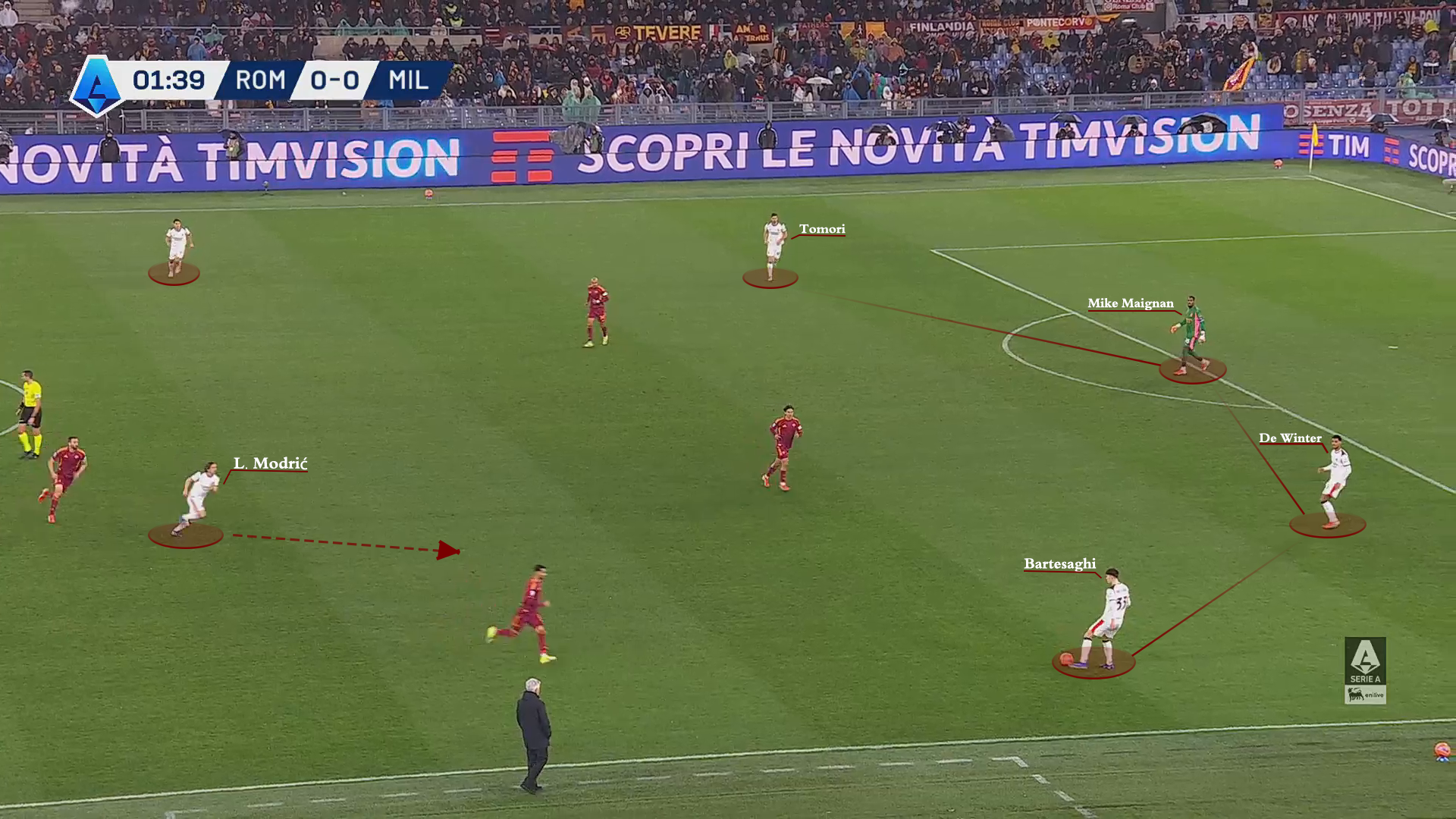
Luka Modrić drops into the left half-space, drawing Manu Koné out of Roma’s midfield line
This action signals Milan’s transition into the second phase of build-up. Simultaneously, Rafael Leão holds an extremely wide and high position, acting as a fixed passing reference and forcing Roma’s back line to stretch laterally. With the defensive line expanded, Nkunku positions himself on the same horizontal line as Modrić, offering a reliable bounce option between the lines and facilitating secure circulation in central areas.
As the ball moves through these interior connections, a different space begins to open, not between the lines, but behind Roma’s defensive line itself. Rabiot exploits this by arriving from deep midfield with well-timed, delayed runs, attacking the space beyond the defence rather than operating in crowded pockets.
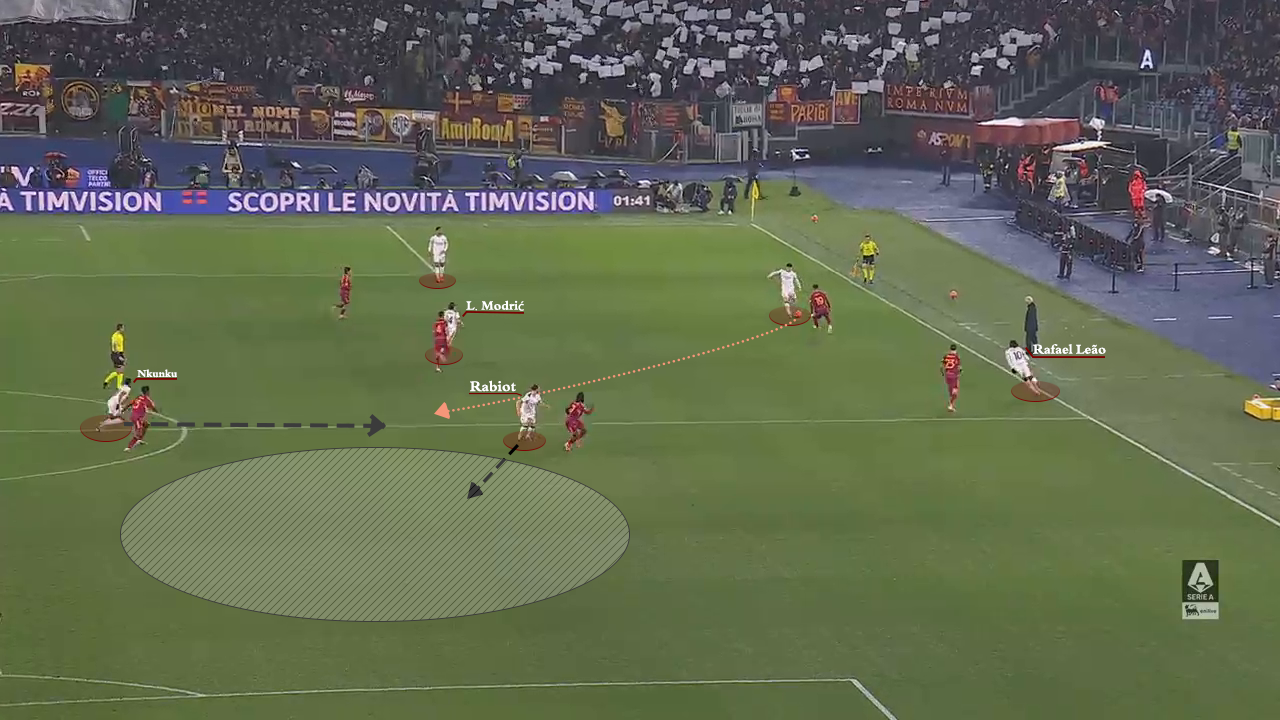
Rafael Leão holds an extremely wide and high position, Nkunku positions himself on the same horizontal line as Modrić.
The emphasis is firmly on precision and positional discipline, using coordinated movements to engineer access behind Roma’s back line rather than forcing rapid progression.
Milan’s Defensive Phase
Out of possession, Milan settled into a compact 5-2-3 defensive structure, with short distances between the lines both vertically and horizontally. The back five remained narrow to prioritise protection of the central corridor, while the midfield pair positioned themselves to screen direct access into Roma’s interior players. In theory, this compactness limited central pockets and reduced clean progression through the middle. However, the structure showed clear vulnerabilities in the half-spaces, which Roma repeatedly targeted.
As Milan’s front three curved their positioning to block central passing lanes and force play wide, slight disconnections occasionally emerged between the first and second lines. When the midfield pair shifted laterally with delayed timing, Roma were able to access the near-side half-space, particularly between the wing-back and the outer centre-back. The narrow back five required aggressive and perfectly coordinated stepping out, but inconsistencies in this movement opened brief vertical gaps.
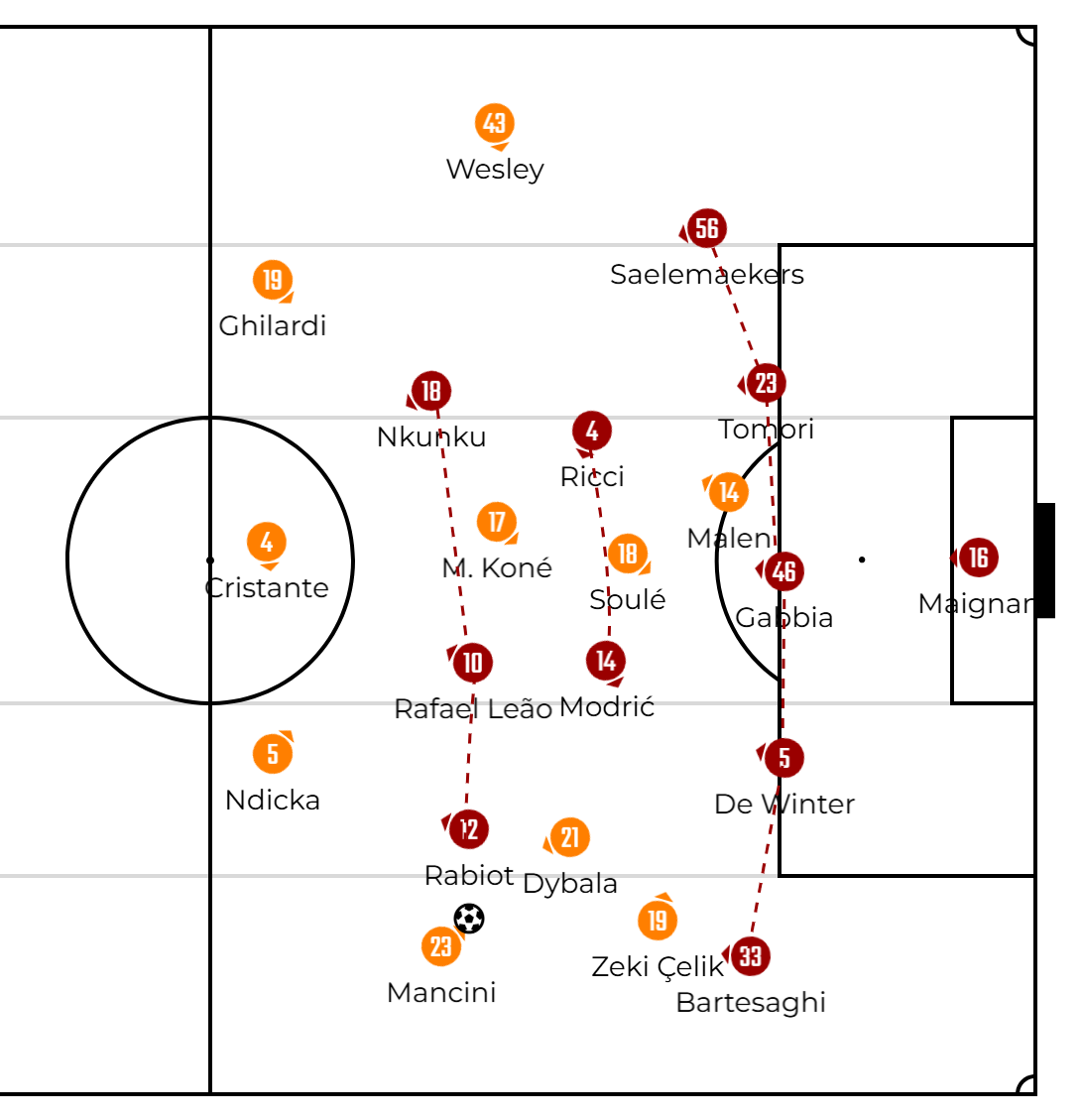
Milan’s compact 5-2-3 defensive shape in action.
Roma exploited these moments through quick combinations and rotations, finding receivers who could turn or link play before pressure arrived. As a result, Milan’s compact block reduced risk centrally but could not fully neutralise half-space access.
Roma’s Flank Overloads in Build-Up Play
During the build-up phase, Roma frequently sought to exploit the wide areas, overloading the flanks to destabilise Milan’s compact defensive structure. The ball was often circulated extensively in the defensive third, with the centre-backs and deep midfielders moving laterally to draw Milan’s forwards and midfield out of position.
Once the right side became the focal point, Dybala would drift wide, occupying the half-space between the touchline and the wing-back. This movement allowed Zeki Çelik, who pushed high up the pitch, to occupy the fully open wide channel, effectively creating numerical superiority against Milan’s right-back and the adjacent centre-back.
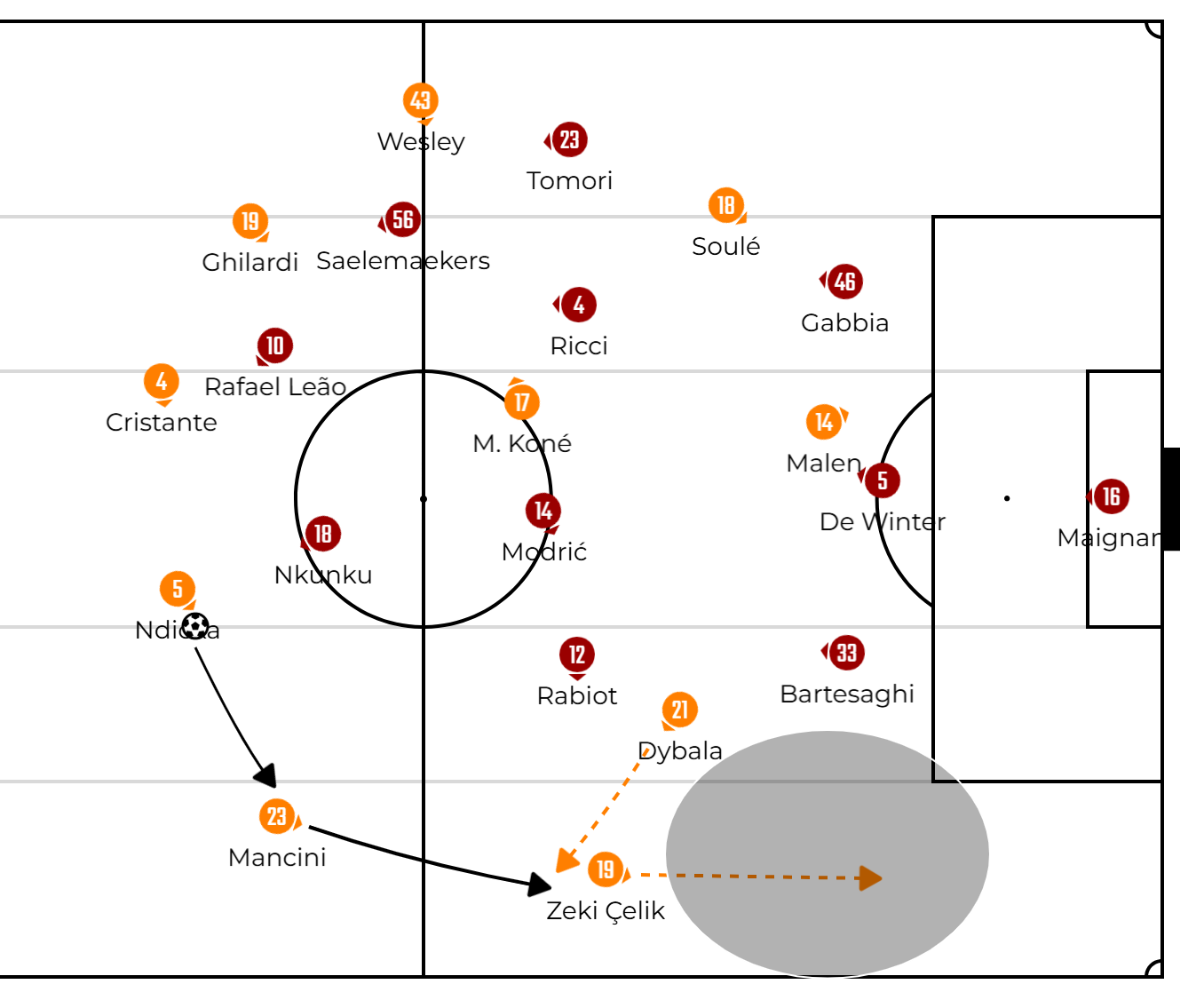
During Roma build-up, Dybala occupying the half-space between the touchline and the wing-back, allowed Zeki Çelik, who pushed high up the pitch.
This combination of movements forced Milan to make tough defensive choices, stretching their 5-2-3 block horizontally and creating exploitable gaps between the lines. Roma’s overloads on the flank also facilitated quick vertical switches and diagonal passes, often targeting players arriving late from midfield to exploit the space vacated by the defensive shift.
Here, for example, when Mancini receives the ball and directs play towards the right flank, Dybala signals Zeki Çelik to push forward. While Çelik advances, he drags the Milan central midfielder with him towards the wing, effectively creating space in the half-channel.
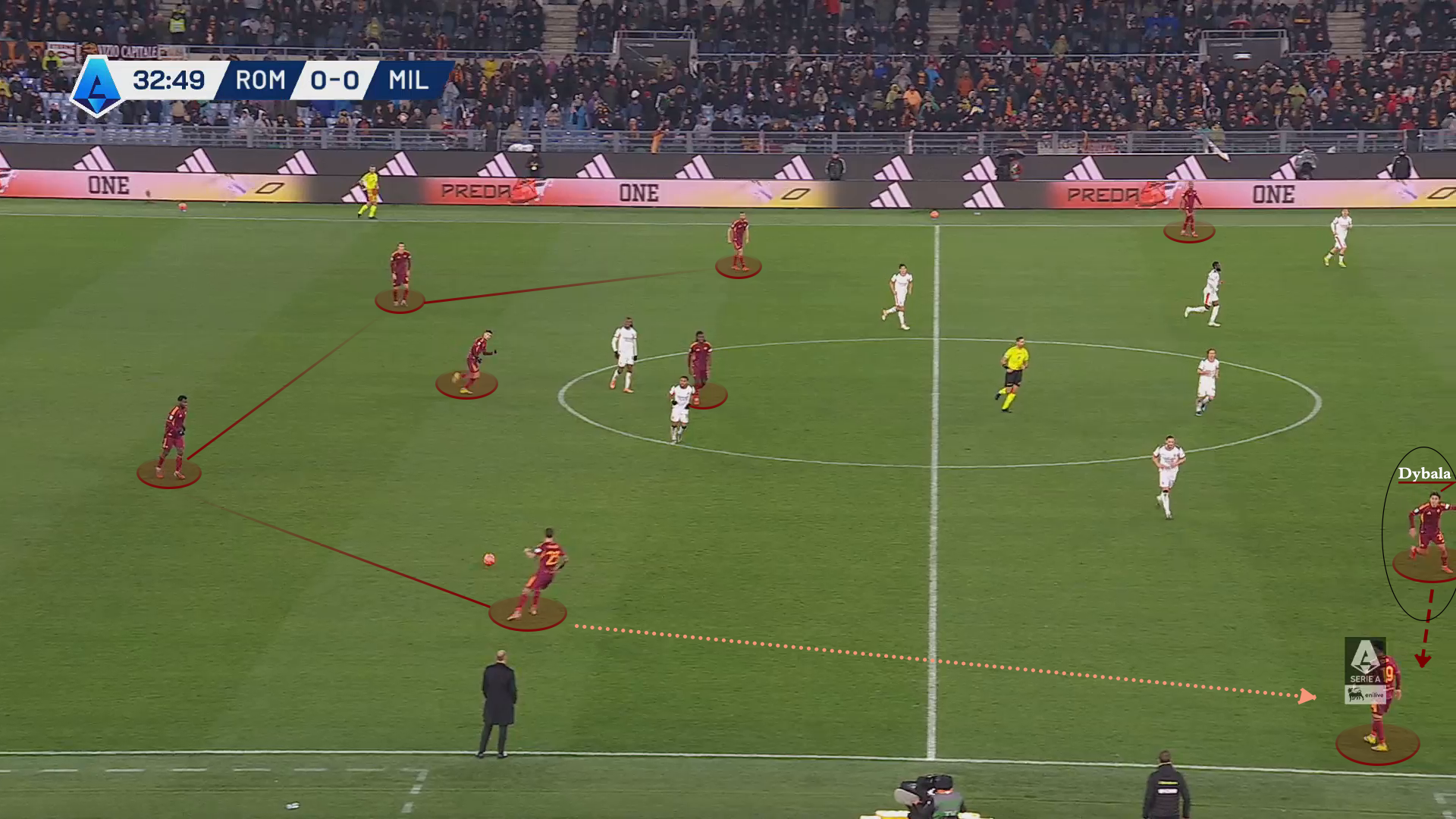
Mancini receives the ball and directs play towards the right flank, Dybala signals Zeki Çelik to push forward.
This coordinated movement opens a clear corridor for a cross or cut-back, pulling Milan’s defensive shape out of alignment and allowing Roma’s interior players to receive the ball in pockets behind the first line. Such carefully orchestrated flank overloads were key to Roma’s strategy, facilitating ball progression while generating positional superiority in threatening areas.
Roma Targeting Half-Space Gaps
Roma repeatedly targeted the half-space gaps left by Milan’s compact 5-2-3 block, exploiting moments when the defensive line shifted laterally under ball circulation. Donyell Malen frequently drifted into these interior channels, timing his movements to coincide with lateral passes from the flank back into the central areas.
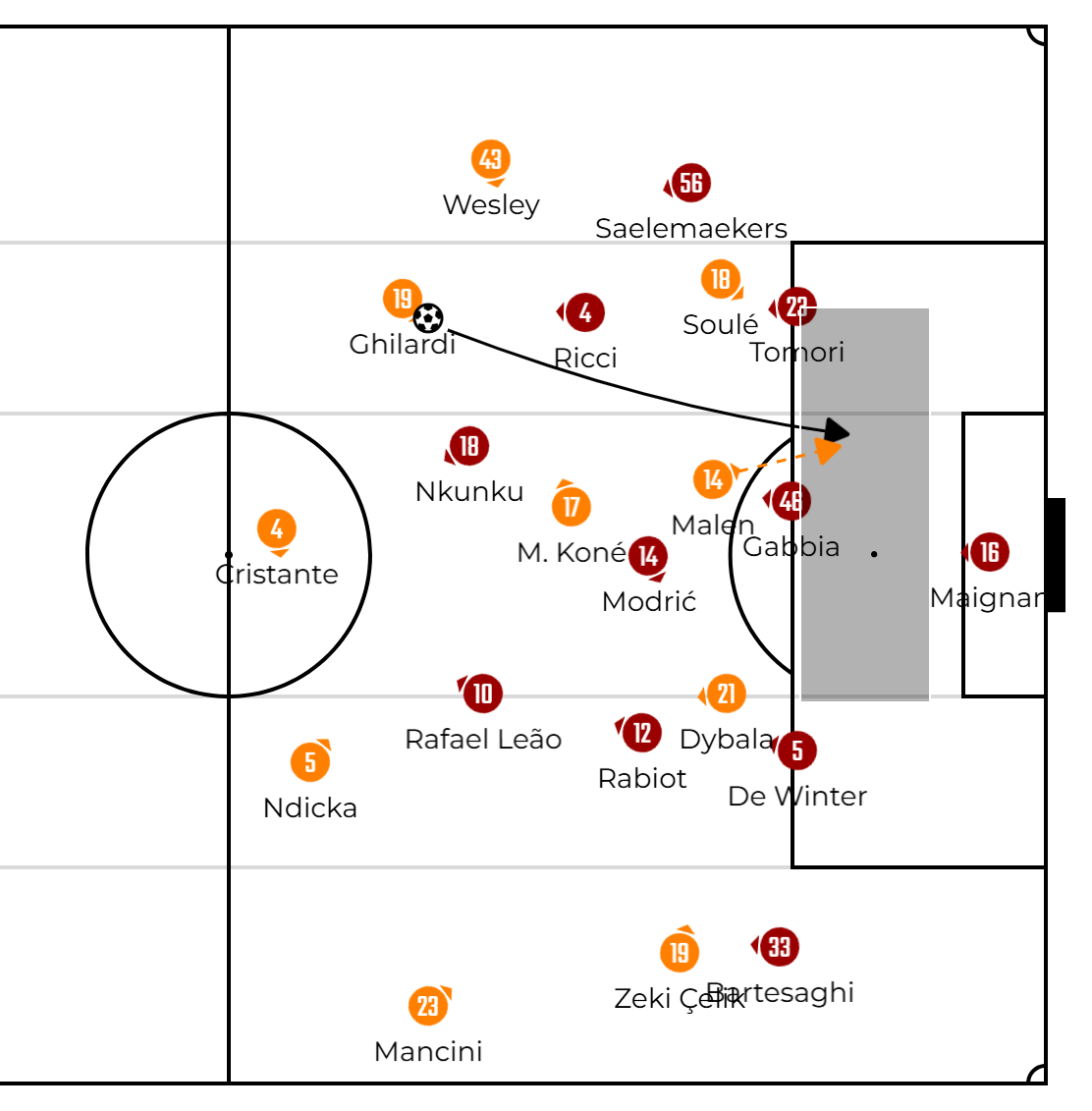
Donyell Malen frequently drifted into these interior channels.
By occupying the half-space, he drew Milan’s midfielders out of position, creating pockets between the lines for Roma’s other attackers to exploit. Quick combinations and angled rotations allowed receivers to turn or advance before pressure arrived, effectively turning brief structural inconsistencies in Milan’s defensive block into sustained attacking opportunities. These half-space incursions were central to Roma’s positional strategy.
Roma’s Diamond Overload in Attack
In attacking scenarios, Roma often concentrated possession on one side of the pitch before constructing a four-player diamond on the opposite flank, away from Milan’s pressing structures.
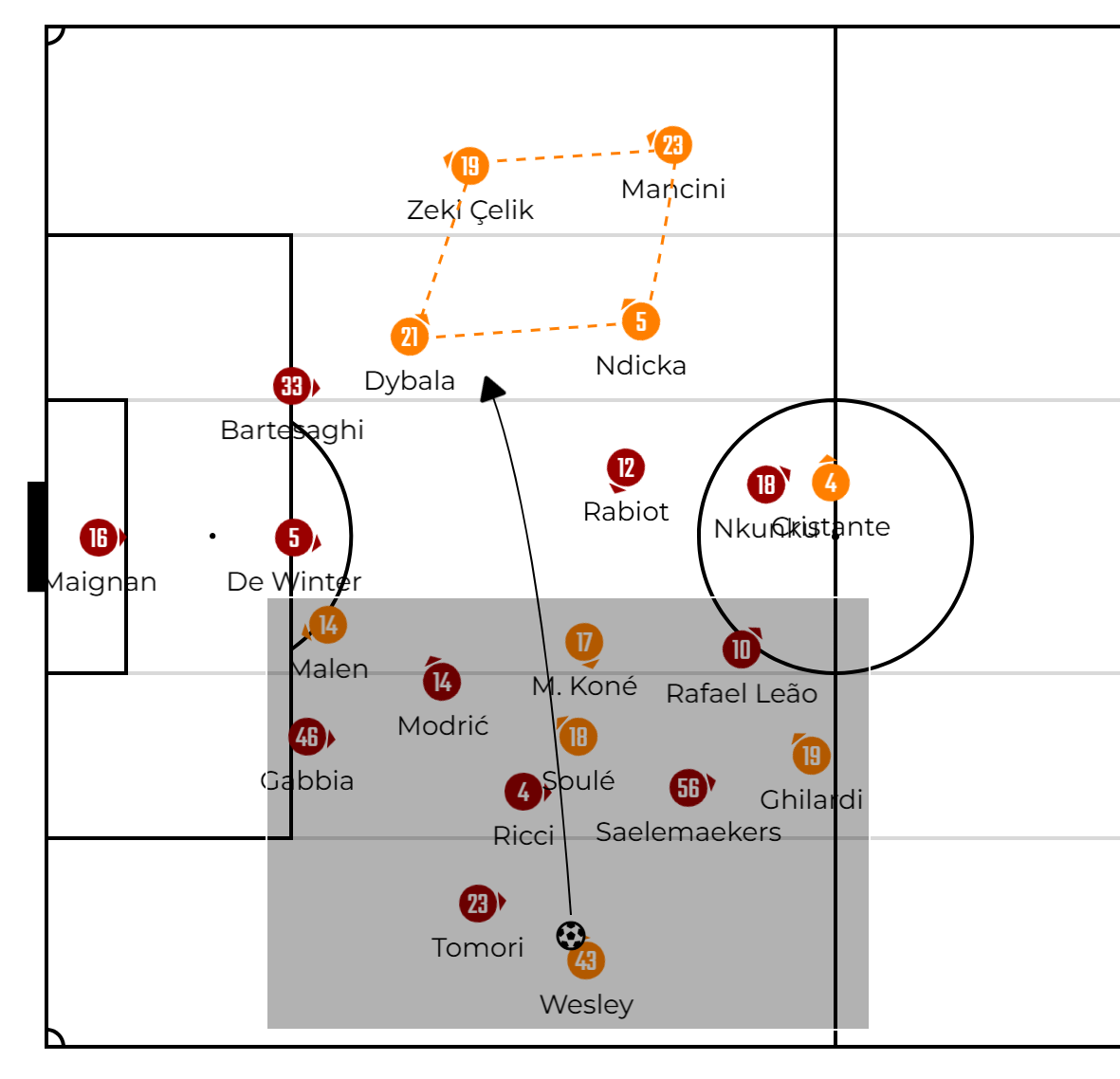
Roma concentrated possession on one side of the pitch and constructing a four-player diamond on the opposite flank.
This diamond moved as a cohesive unit into the open half-spaces left in the central channels near the penalty area, exploiting areas free from immediate pressure due to Roma’s weighted overload on the other side.
By shifting collectively, the quartet created numerical superiority and positional flexibility, allowing quick combinations, diagonal passes, and off-the-ball rotations to destabilise Milan’s compact block.
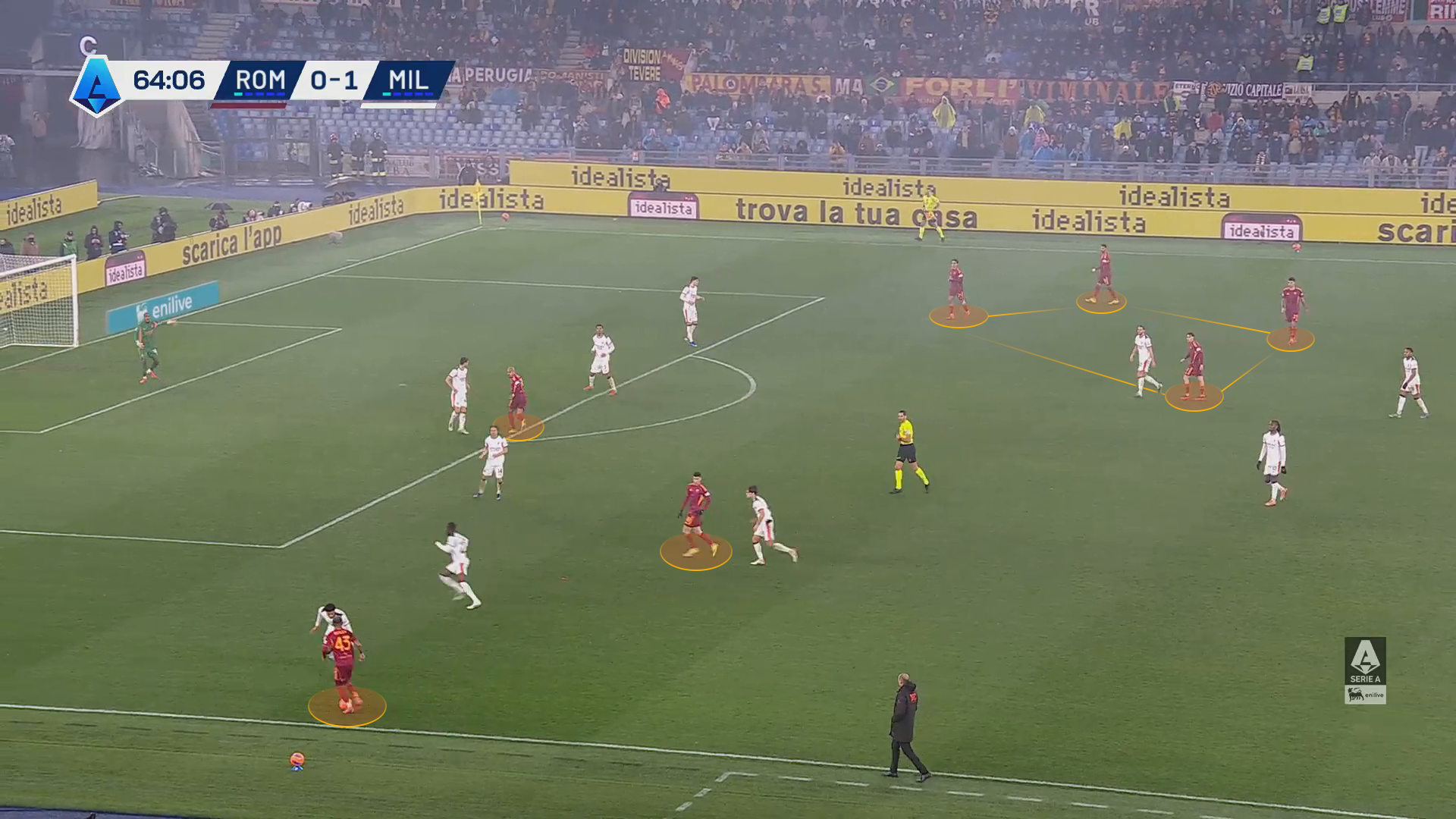
The diamond moved as a cohesive unit into the open half-spaces left in the central channels near the penalty area.
On multiple occasions, this tactic opened clear attacking corridors, including the moment that led to Roma winning a penalty, ultimately converted into their only goal of the match. Such diamond overloads were a central component of Roma’s attacking strategy, allowing them to manipulate space, bypass defensive pressure, and generate high-quality scoring opportunities.
Takeaways
Roma controlled much of the opening half with structured possession and rotations from a 3-4-2-1. Wing-backs provided width while Dybala and Soulé linked play between the lines, probing Milan’s compact 5-2-3 and creating half-space pockets, culminating in a penalty opportunity.
Milan’s 3-5-2 under Allegri focused on midfield control and transitional security. Maignan’s calm possession invited Roma forward, while Modrić and Nkunku exploited half-spaces. Lateral wing-back movements stretched play, creating central pockets for Rabiot, enabling controlled progression without compromising defensive stability.
Roma targeted half-space gaps with diamond overloads, generating numerical superiority near the box. Milan countered with lateral rotations and disciplined pressing. Both teams exploited spatial imbalances, producing key moments, including Roma’s penalty and De Winter’s header, highlighting a tactical duel of possession versus structured counterplay.Roma repeatedly targeted half-space gaps and used diamond overloads to generate numerical superiority and positional flexibility, particularly in channels near the penalty area.
Use the arrows to scroll through all available match plots. Click to enlarge.
Check the match plots page for plots of other matches.


Comments