

Santos – Fluminense: Fluminense move away from crisis turning the game around in a great night for the number nines (2-3)
Fluminense had been considered one of the best teams in the country, but a run of four matches without a win created a “crisis”, including pressure from fans at the training ground. To move past this poor moment, they came back to beat Santos on Matchday 12 of the Brasileirão. This was an important match for Neymar ahead of the World Cup, but the highlight ended up being the strikers, the number nines, from both teams.
Tactical analysis and match report by Marcus Arboés.
Santos have been finding a consistent starting lineup, with Neymar showing his best form since returning to Brazil after the arrival of the new head coach Cuca, who was suspended for this round. The team lined up with Gabriel Brazão (former Internazionale) in goal; Igor Vinícius, Lucas Veríssimo (former Benfica), Luan Peres and Barreal forming the defensive line; the young Bontempo as right midfielder, Willian Arão and Gustavo Henrique as pivots and Moisés as the right winger; further forward, Neymar was deployed as the number ten and Gabriel (former Inter and Benfica) as the number nine.
The visitors had more absences and needed to manage workload, so they rested key players such as Samuel Xavier and Martinelli, setting up in a 4-3-3 outline with a more conservative midfield: Fábio, the veteran with the most appearances in football history, as goalkeeper; Guga at right fullback and Guilherme Arana (former Sevilla) at left fullback, with Jemmes and Freytes as center backs; the midfield was formed by the Uruguayan Bernal, Hércules and Alisson; in attack, Savarino (Venezuela National Team) played on the right, Serna (Colombia) on the left and Castillo as the number nine.
High pressing, the key to the first half
From a general evaluation, Neymar had a poor game, with bad decisions and key losses of possession, but it’s undeniable that there has been physical and defensive development, especially in the opponent’s first phase of build up. By pressing high, Santos managed to disrupt Fluminense’s build up well and the first goal came from that. Later, the equalizer also came from a transition moment.
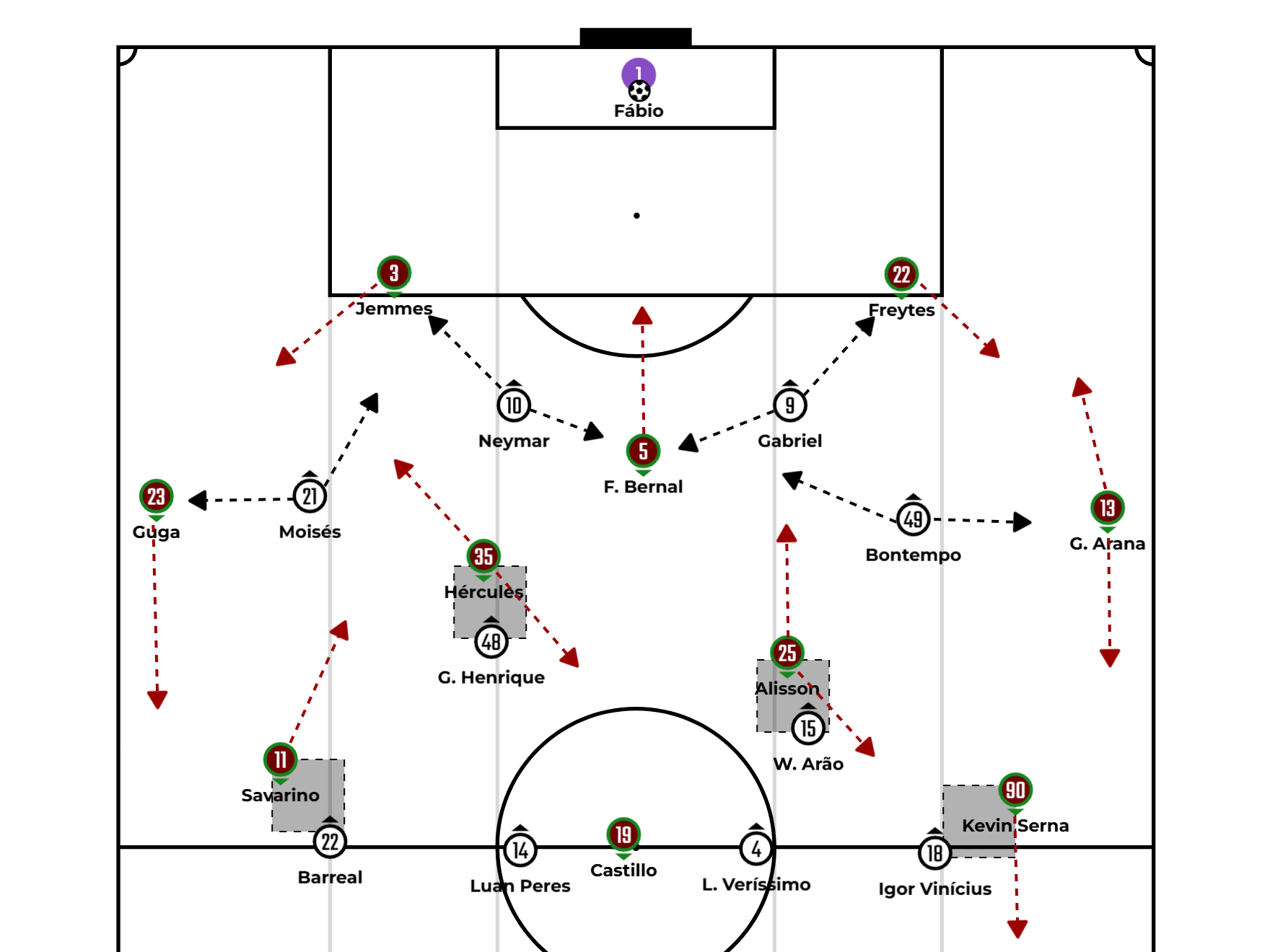
Fluminense build up in a 4-3-3 shape against Santos high press with man oriented marking in a 4-4-2 formation.
Fluminense set up in a 4-3-3 formation for the first phase of build up. In practice, the team is symmetrical, but structures its build up through vertical and diagonal movements to create and exploit spaces, for example: Hércules drags his marker and Savarino drops for a frontal support, freeing the right channel for Guga; Bernal drops between the center backs to create superiority in the first line; Alisson drops and attracts defenders, opening space for a diagonal run from Hércules.
This can be effective against a team that presses man to man in a disorganized way, but that was not the case with Santos, even though some vertical attacks in open space worked in the first half. Moisés and Bontempo out wide, Neymar and Gabriel higher inside, balanced defensively, marking the nearest opponent among the five players involved in Fluminense’s initial build up.
Santos fullbacks followed Fluminense’s wingers individually and the pivots marked Hércules and Alisson. This is how Santos scored the first goal. Willian Arão followed Alisson’s support movement after Neymar had blocked the passing angle, intercepting the ball. Neymar carried it forward and, after engaging the defense, Gabriel finished with quality.
Santos also struggled in build up when pressed high, but it was from a mid block situation that Fluminense’s pressing was effective in recovering the ball and, in transition, the target man Castillo assisted Savarino, who scored a great long range goal. In a way, the strongest point for both teams in the first half was defensive, including counterpressing.
Positional attack, aerial play and Fluminense’s comeback
Toward the end of the first half, Fluminense had a strong period of superiority, creating offensive volume and interesting situations in the attacking half from a positional 2-3-5 shape, with variations through player movements, organizing through roles and runs into spaces created within this structure.
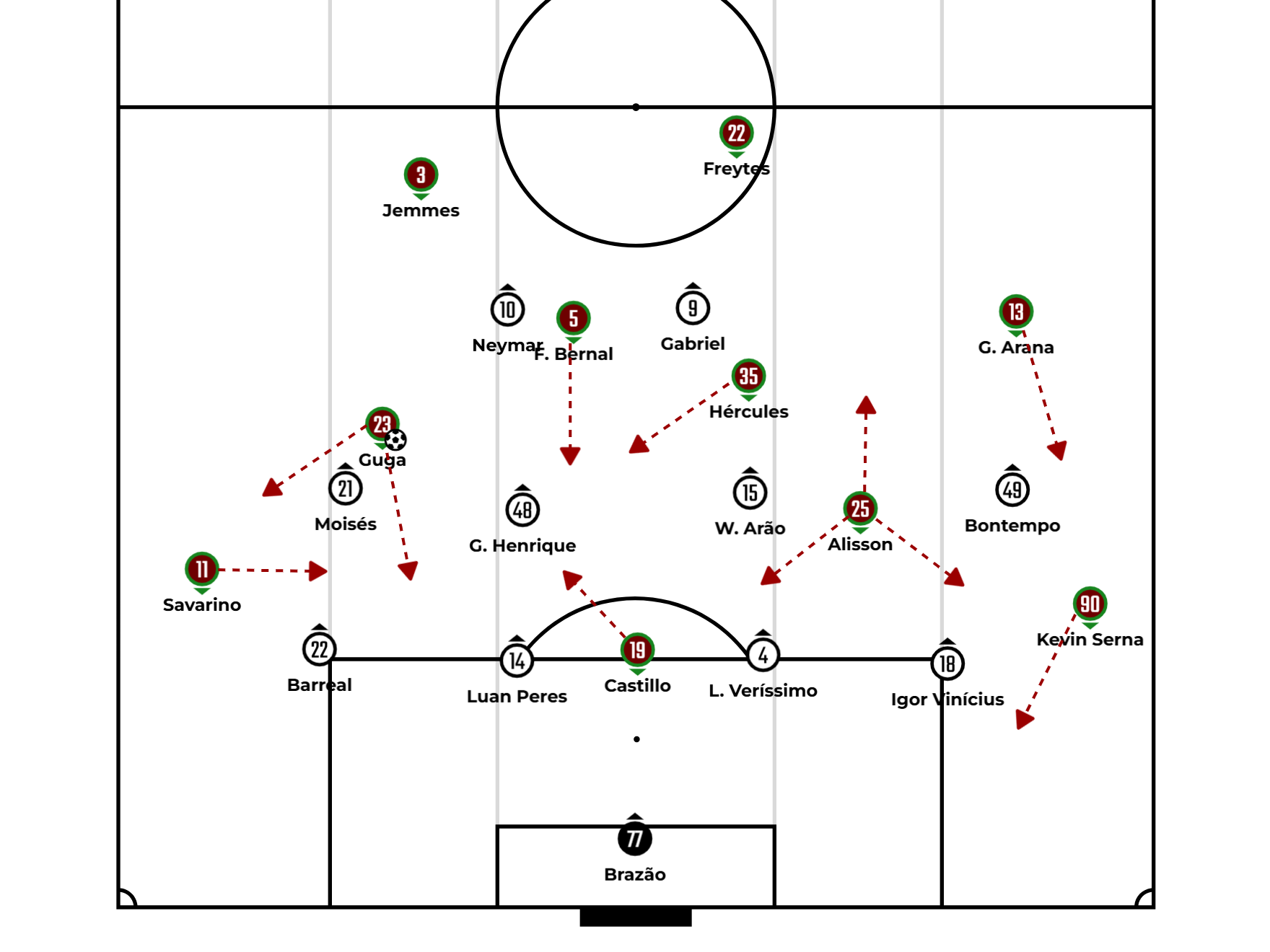
Fluminense positional attack in a 2-3-5/3-2-5 shape in the first half.
Bernal and Hércules alternated in staying closer to the defensive line, while Alisson moved to offer support underneath, inside and outside. Guilherme Arana, on the left, played slightly deeper but always attacking in combination with Kevin Serna, while Guga operated almost like a midfielder, frequently appearing inside to assist build up, while Savarino, who is comfortable inside, stayed wide. It may seem counterintuitive, but it worked and was key to the victory.
The key point is understanding that Fluminense creates dynamics to generate small numerical advantages, even inside the box. However, the team was surprised early in the second half, as Santos made a small adjustment, bringing on the young fullback Rafael Gonzaga for Moisés to push Barreal higher, and quickly benefited from it. In transition, Gabriel assisted Barreal, who turned past his marker and chipped the experienced goalkeeper Fábio with great technical quality.
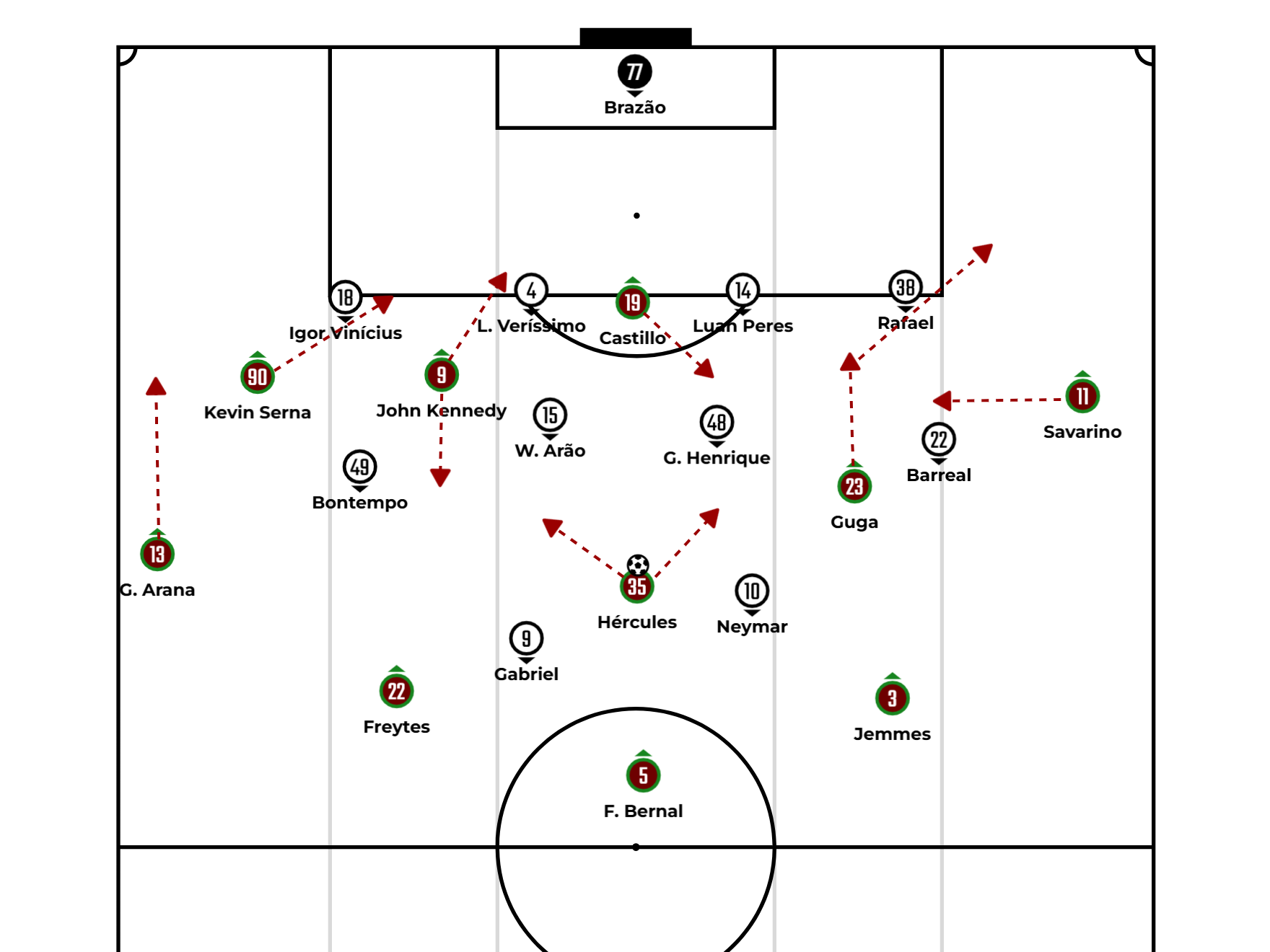
Fluminense positional attack in a 3-2-5/3-1-6 shape in the second half.
Right after the goal, Luis Zubeldía made a bold change that had a major impact. Alisson, who was no longer creating advantages, was replaced by John Kennedy, the team’s top scorer this season. Bernal became more fixed alongside the center backs, while Hércules acted as the main pivot, supporting both sides and ensuring counterpressing. Arana pushed higher, allowing Serna to attack the box more, while John Kennedy operated as a second striker between the last two defensive lines, also entering the box.
However, the key to the comeback was right fullback Guga. Beyond playing inside and facilitating build up, he became a crucial tactical piece in the absence of Martinelli. One key pattern involved Savarino receiving wide while Guga made an inside to outside run, as the Venezuelan dribbled inside and found Guga in crossing positions. The equalizer, a header by Castillo, came from such a situation after a second phase cross.
The third and winning goal also came from a cross, where Guga received in space thanks to right winger Riquelme stretching the defense. The delivery was precise, again targeting numerical superiority inside the box. This time, the overload favored John Kennedy, who finished with his foot.
Does Neymar have the level to play in the World Cup?
This question has shaped Brazilian sports journalism in recent months, but the football discussion was overshadowed because Neymar left the pitch touching his ears, and many in the media accused him of a gesture toward the crowd. What matters is what happens on the pitch. And Santos showed much more than just Neymar.
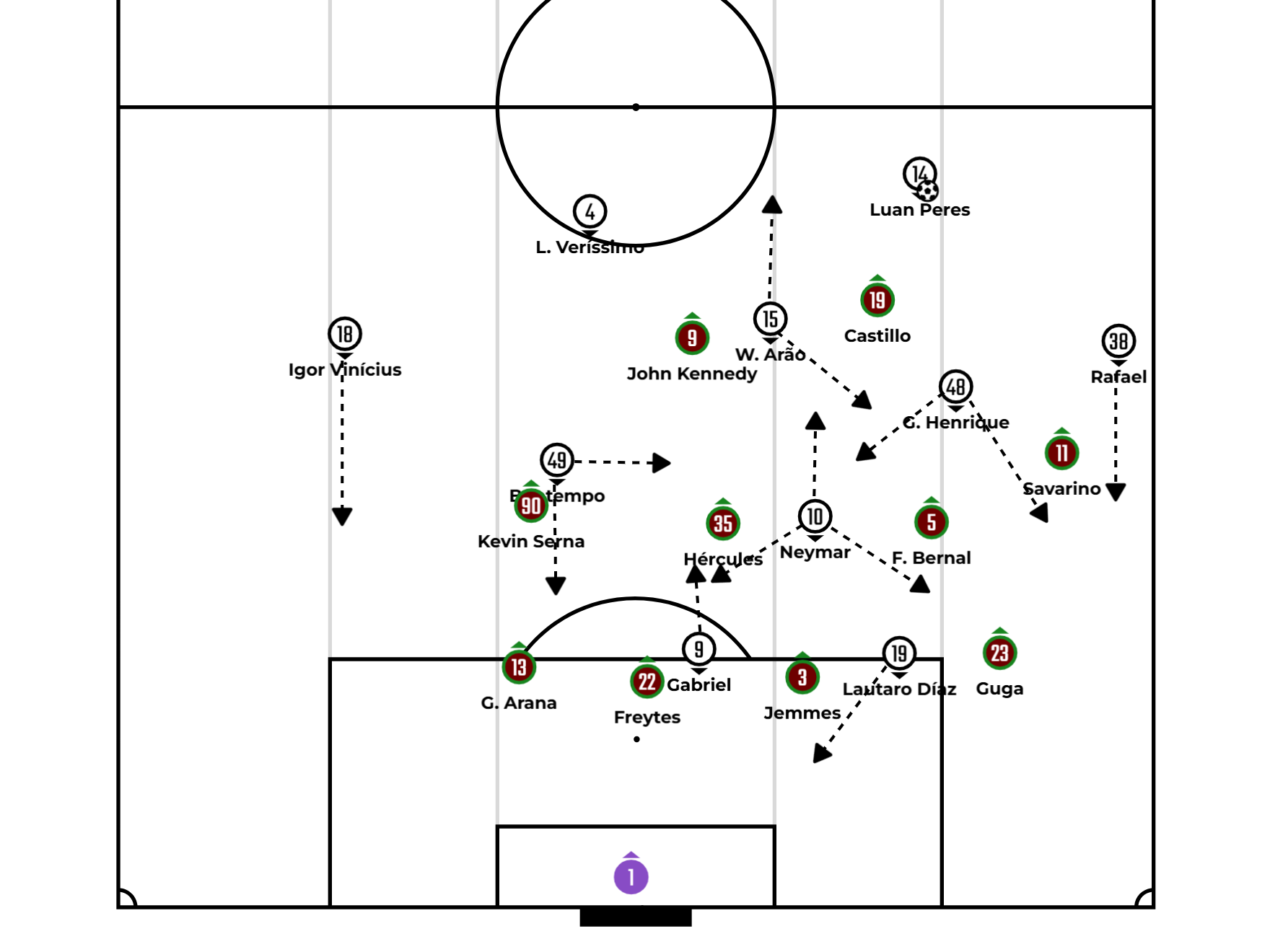
Santos relational/functional attacking organization.
Santos attacked by overloading players on the flanks in a 4-2-3-1 shape, with wingers moving inside or providing frontal support. Even if Neymar was not at his best, two young players helped sustain the team’s midfield structure. Gustavo Henrique, as the main pivot, supported Neymar in creating advantages, attacked space, covered possession losses and operated across all heights. Bontempo has emerged as a major prospect.
Unlike previous matches where Neymar performed well technically, in this game he looked more unstable, making poor decisions in the final third and missing passes unusually, appearing nervous at times. However, regarding his chances of going to the World Cup, it’s important to consider that Carlo Ancelotti has made it clear that to be selected, players must be physically fit, and in that sense Neymar showed one of his best performances in terms of physical and defensive capacity.
Takeaways
The home defeat after leading was costly for Santos, who had been improving. With only 13 points, the team is very close to the relegation zone, just one point above 17th place. In the upcoming week, they will face two difficult matches: Coritiba, who are performing well in the league, in the Copa do Brasil, and Bahia, one of the best playing teams in the country, on Matchday 13.
In the next Matchday, Fluminense will face Chapecoense, who are bottom of the table. Before that, they will play Operário, a second division team, in the Copa do Brasil. With the win over Santos, the team recovered from a mini crisis and held on to third place in the Brasileirão.


Comments