
Saudi Arabia – Uruguay: Bielsa’s Adjustments Rescue a Point Against Donis’ Men (1-1)
Saudi Arabia produced one of the defensive performances of the tournament to frustrate Uruguay for long periods, before Marcelo Bielsa’s second-half tweaks transformed the dynamic of the match. A game that initially exposed Uruguay’s structural flaws eventually became a showcase of tactical adaptation, as Saudi Arabia’s compact 4-4-2 was slowly worn down by a more coherent Uruguayan attack. Based exclusively on the match notes provided by the user.
Tactical analysis and match report by Sebastián Parreño.
We decided to make this article free to read. If you want to support our work, consider taking a subscription.
Uruguay’s initial possession structure was characteristically ambitious. Uruguay went all out with two attacking fullbacks, and with Manuel Ugarte operated as the lone pivot. The other midfielders, Rodrigo Bentancur and Viñas positioned themselves in the spaces between Saudi Arabia’s midfield and defensive lines. Their objective was clear: receive between the lines or attack the space behind the Saudi back four through forward runs. However, the execution lacked the necessary tempo and connectivity to trouble the opposition.
Georgios Donis prepared a simple but excellent defensive plan. Saudi Arabia defended in a compact mid-high 4-4-2 block, with their two strikers alternating responsibilities when pressing Uruguay’s build-up. Whenever the ball traveled to Olivera on the left side, Al-Buraikan stepped out to press while Al Juwayr shadowed Ugarte. When possession shifted to Cáceres on the opposite side, those roles were reversed. This intelligent rotational pressing ensured Uruguay’s pivot was rarely free and prevented stable central progression.
Uruguay responded by dropping Ugarte between the center-backs, creating a temporary back three. At the same time, fullbacks Viña and Varela advanced aggressively, while Valverde and Araujo, initially the wingers, drifted inside to create central overloads. In theory, this generated a 3-1-6 attacking structure with significant numbers on the last line. In practice, however, it produced the opposite effect.
The distances between Uruguay’s players became excessive. Bentancur was the only true midfielder, and he was far away from the back three. Their movements were predictable, combinations lacked fluidity, and the tempo was remarkably slow. Most importantly, there was almost no penetration through the center. Although Uruguay often had numerical superiority high up the pitch, many attackers occupied similar central zones, allowing Saudi Arabia’s compact block to defend multiple players simultaneously.
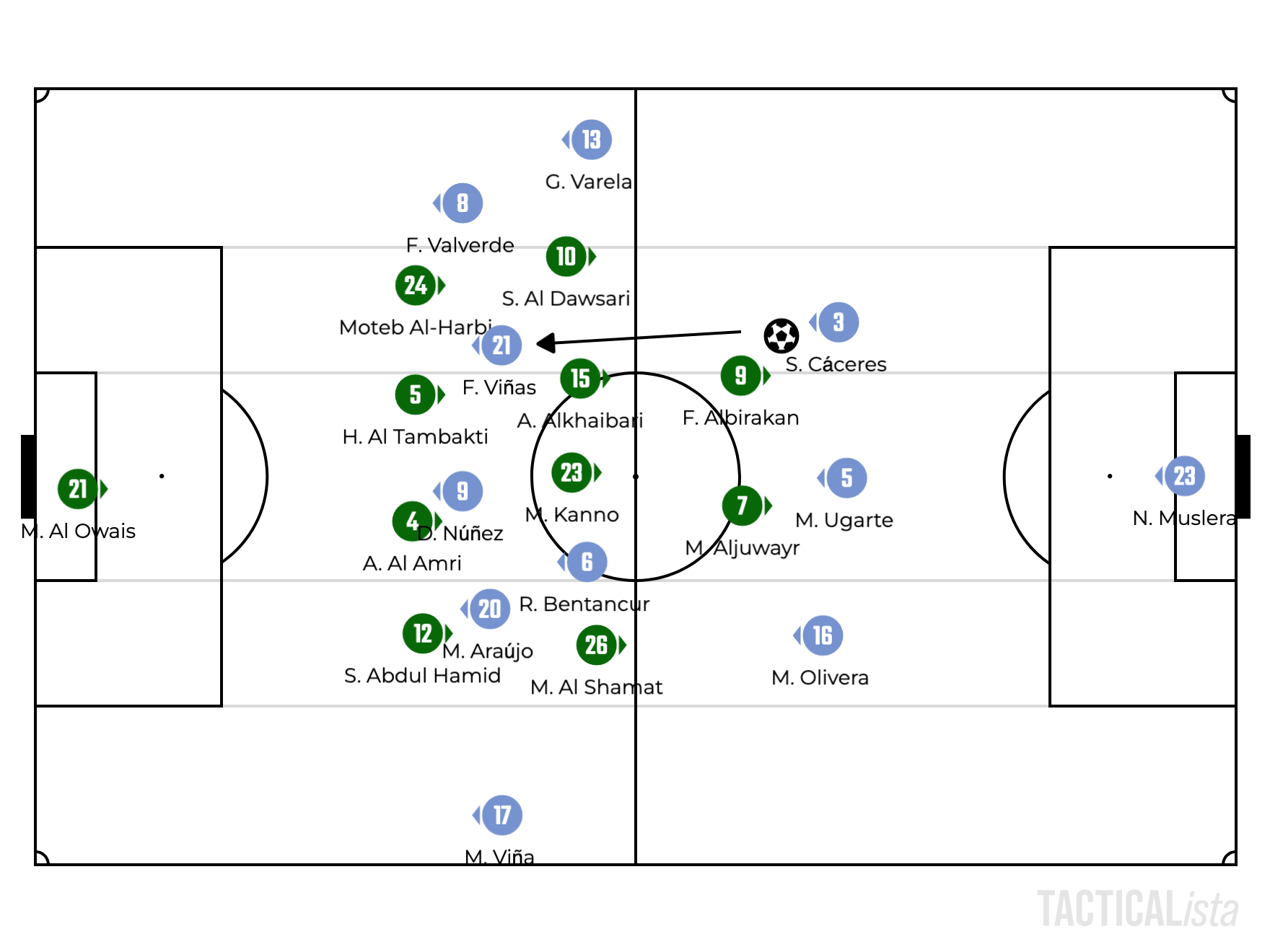
Uruguay’s first half structure against Saudi Arabia’s compact 4-4-2. Uruguay failed to create any danger as their lines were too separated, with basically no midfield presence.
Bentancur occasionally dropped deeper in an attempt to facilitate progression, but these movements rarely broke lines. Instead, he frequently returned possession backward. Wide players also dropped to receive, only to be tracked diligently by Saudi defenders and forced into recycling possession. Saudi Arabia’s passive approach was therefore perfectly suited to the circumstances: Uruguay monopolized possession without generating genuine danger.
There was one positive side effect for Uruguay. Their compact clustering of attacking players made counterpressing effective after losing possession, allowing them to quickly recover second balls and sustain attacks.
Saudi Arabia’s Positional Intelligence and Attacking Ideas
Saudi Arabia’s defensive performance went beyond merely sitting deep. Their players tracked Uruguay’s advancing fullbacks with remarkable discipline, adjusting whether the danger appeared outside the defensive line or inside the halfspaces. Such flexibility prevented Uruguay from exploiting their preferred wide overloads.
The work of the wingers and forwards without possession was particularly impressive. Donis’ 4-4-2 reduced Uruguay to almost nothing offensively despite the South Americans committing numerous players forward. Defending a 3-1-6 structure is never easy, yet Saudi Arabia consistently protected the central corridor and denied access to dangerous areas.
With the ball, Saudi Arabia showed far more bravery than their defensive reputation might suggest. Mohamed Kanno provided the midfield with physicality and ball-winning ability, while a fluid front three of Salem Al-Dawsari, Al Juwayr, and Abu Al Shamat offered movement between the lines. The trio constantly searched for pockets of space and gave Saudi Arabia meaningful possession sequences.
Uruguay defended in a zonal 4-4-2 block for much of the match, an unusual sight for a Marcelo Bielsa team. While there were occasional man-oriented movements to counter Saudi Arabia’s relational play, these also created vulnerabilities. Saudi Arabia repeatedly manipulated these tendencies by creating gaps behind Uruguay’s midfield line. Al-Shamat frequently moved inside from the wing while the fullback maintained width, generating situations that Uruguay struggled to track. On several occasions, Al-Shamat received freely between the lines, though Saudi Arabia’s final execution prevented them from capitalizing fully.
Even Uruguay’s goal kicks became problematic. Saudi Arabia’s press began from a 4-4-2 shape but transformed into aggressive man-to-man marking whenever Uruguay attempted to play short. This forced Bielsa’s side into long balls toward Darwin Núñez and disrupted their rhythm in possession.
Set Pieces Give Saudi Arabia the Lead
The first half’s clearest chances arrived through Saudi Arabia’s set pieces. Uruguay defended corners with a hybrid scheme: man-marking combined with two zonal players protecting the near post. The system proved vulnerable.
The first warning came when Fernando Muslera produced an excellent save from a Saudi corner. Soon after, another delivery caused chaos. Muslera again intervened but spilled the rebound into a dangerous central area, where Al-Amri reacted quickest to score and give Saudi Arabia a deserved lead. The goal reflected not only Saudi Arabia’s effectiveness from dead balls but also Uruguay’s struggles defending second phases.
At halftime, Saudi Arabia’s plan had worked almost perfectly. Uruguay dominated possession but lacked incision, while Donis’ team defended with discipline and threatened through carefully designed moments.
Bielsa Rebuilds Uruguay’s Structure
The turning point arrived after the interval. Bielsa introduced Sanabria for Viña and Canobbio for Darwin Núñez, changes that fundamentally altered Uruguay’s positional relationships. Viñas moved to center-forward, Canobbio occupied the right wing, and Valverde shifted into midfield.
More importantly, Ugarte permanently positioned himself between the center-backs during buildup, while Bentancur and Valverde operated much closer to the base of play. The previously disconnected structure suddenly became compact and functional. Distances shortened, passing angles improved, and Uruguay finally gained access to central progression that culminated on outside danger.
The fullbacks maintained their attacking roles, but now their movements were synchronized with the rest of the team. Wingers could move inside and attack channels or arrive in the box for crosses. Uruguay’s structure resembled a clearer 4-3-3, with fullbacks supporting buildup when necessary before advancing higher. Meanwhile, Bentancur and Valverde balanced their responsibilities between playmaking and attacking the halfspaces.
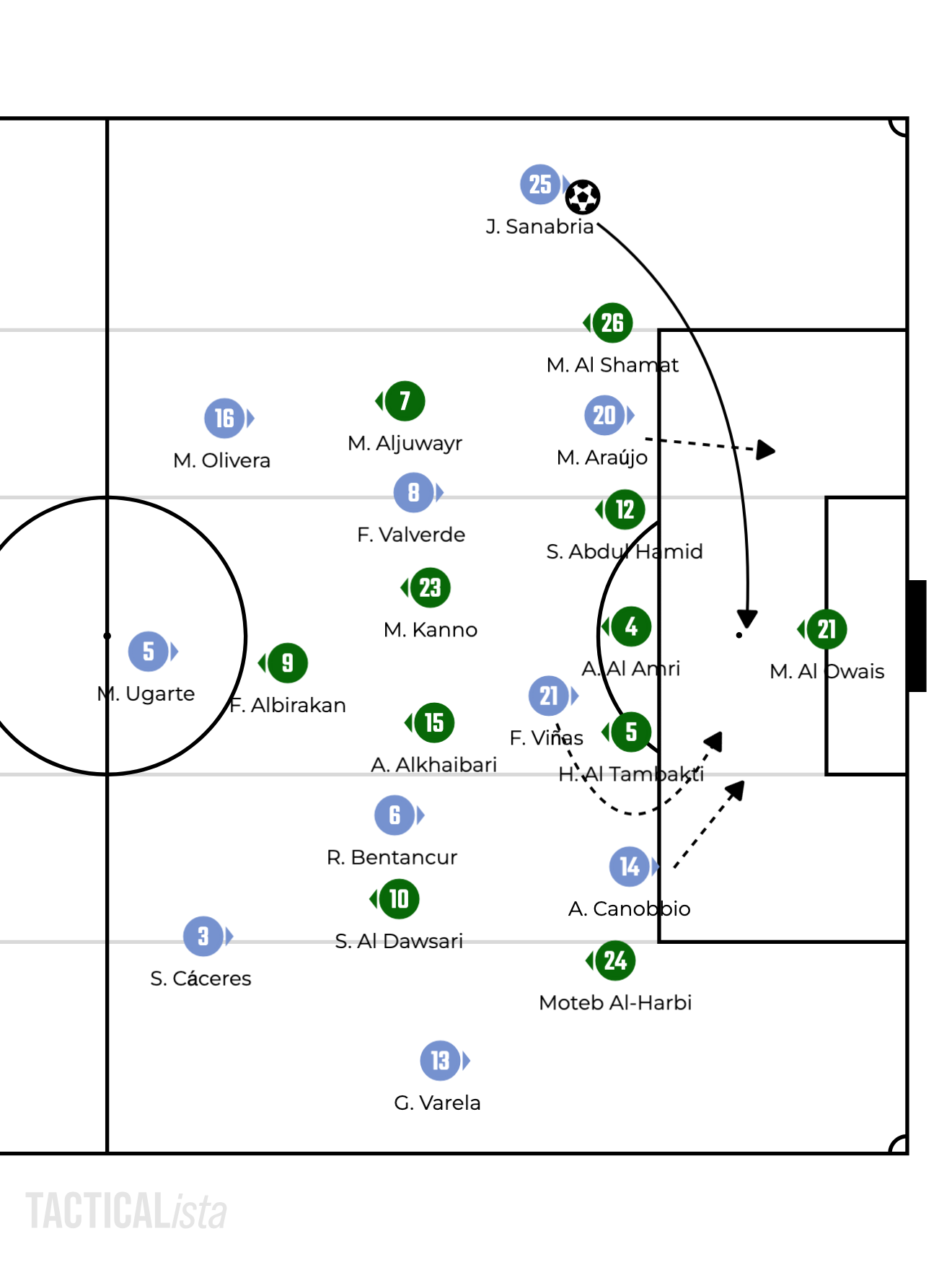
Uruguay’s second half structure after Bielsa’s adjustment, forcing Saudi Arabia to turn into a back 5 and creating danger through crosses.
The effect was immediate. Uruguay became far more fluid, sustaining attacks and generating danger repeatedly. Saudi Arabia were forced progressively deeper, while crosses emerged as Uruguay’s primary weapon. Canobbio frequently attacked the far post, and the pressure mounted.
As Uruguay improved, Saudi Arabia had to commit their wingers closer to the defensive line in order to help contain the advancing fullbacks. This gradually reduced their ability to transition into attack.
Saudi Arabia Retreats and Uruguay Finally Break Through
Recognizing the shift in momentum, Donis reacted around the hour mark by introducing an extra midfielder and switching to a 5-4-1 system. Abu Al-Shamat dropped from winger to wing-back, reinforcing the defensive line.
Yet the structural change came with a cost. Saudi Arabia struggled to threaten in transition because their attackers were more comfortable receiving to feet than attacking open spaces. Without a credible transition threat, Uruguay could commit even more players forward with little fear of counterattacks.
Fatigue compounded Saudi Arabia’s difficulties. As players tired, retaining possession after regaining the ball became increasingly difficult. The game turned into a prolonged defensive exercise, with Uruguay pinning the Saudis near their own penalty area.
Uruguay also discovered another method to break the low block: center-back carries. With the fullbacks pinning Saudi wingers, defenders such as Olivera found space to drive forward and provoke the opposition’s defensive line, creating openings elsewhere.
The equalizer eventually arrived through Uruguay’s most effective attacking mechanism: crossing. Olivera advanced into space unopposed and delivered an excellent cross from deep. Viñas timed his movement perfectly, attacking the blind side of Altambakti while the left wing-back failed to close the space. His header forced a save from Al-Owais, but the rebound fell kindly for the centrally positioned Araujo, who converted to level the match.
Just as Muslera’s rebound had led to Saudi Arabia’s goal, Al-Owais’ second action created the opportunity for Uruguay’s equalizer, a reminder of how decisive second phases can be in tightly contested matches.
Takeaways
This match was a study in tactical adaptation. Saudi Arabia produced one of the most organized defensive displays of the tournament, with Donis’ 4-4-2 expertly neutralizing Uruguay’s ambitious but initially dysfunctional 3-1-6 structure. Their pressing triggers, tracking responsibilities, and compactness reduced a talented opponent to sterile possession for an entire half.
However, Bielsa’s halftime adjustments transformed the game. By shortening distances between players, clarifying roles within a 4-3-3, and improving buildup through Ugarte’s positioning, Uruguay finally generated sustained pressure and deservedly equalized. The draw ultimately reflected two strong tactical performances: Uruguay’s ability to adapt and Saudi Arabia’s remarkable defensive discipline.
Use the arrows to scroll through all available match plots. Click to enlarge. Check the match plots page for plots of other matches.

Comments