

Tottenham Hotspur – Arsenal: Intense Arsenal Claim Derby Victory (1-4)
Arsenal started this game in dominant fashion, able to play through Spurs’ 5-3-2 defensive shape and attack down their right side. Their first half goal was answered quickly, but the second half saw them run away with the game, helped by their defensive intensity and solidity.
Tactical analysis and match report by Josh Manley.
We decided to make this article free to read. If you want to support our work, consider taking a subscription.
A defeat at home to Newcastle last time out proved to be the final straw for Tottenham and Thomas Frank, with the Dane being relieved of his duties to make way for a caretaker manager in Igor Tudor.
Arsenal meanwhile did themselves no favors in the title race by being held to a draw by rock-bottom Wolves in midweek. The Gunners were five points clear of Manchester City coming into this game and knew that keeping up the pace was a necessity.
Spurs lined up in a 3-5-2 formation for this match, with a back three of João Palhinha, Radu Drăgușin, and Micky van de Ven. Yves Bissouma played at the base of midfield with Conor Gallagher and Pape Matar Sarr ahead of him. Archie Gray and Djed Spence were then deployed as wing-backs, while Xavi Simons joined Randal Kolo Muani up front.
Mikel Arteta meanwhile used a 4-2-3-1 shape, with Jurriën Timber, William Saliba, Gabriel Magalhães, and Piero Hincapié making up the back line. Martín Zubimendi and Declan Rice partnered in midfield, while Eberechi Eze played as the number ten. Bukayo Saka and Leandro Trossard then flanked striker Viktor Gyökeres.
Arsenal start aggressively
This week’s draw at Wolves will have angered Arteta and his players, and this seemed to reflect in the intensity with which they started this game. They dominated the opening stages and were playing at a tempo above their opponents.
In possession, Arsenal sometimes used a chain of three in buildup against Spurs’ 5-3-2 defensive shape in the opening exchanges. Zubimendi could drop between the center-backs to give extra stability against Spurs’ pressing front two.
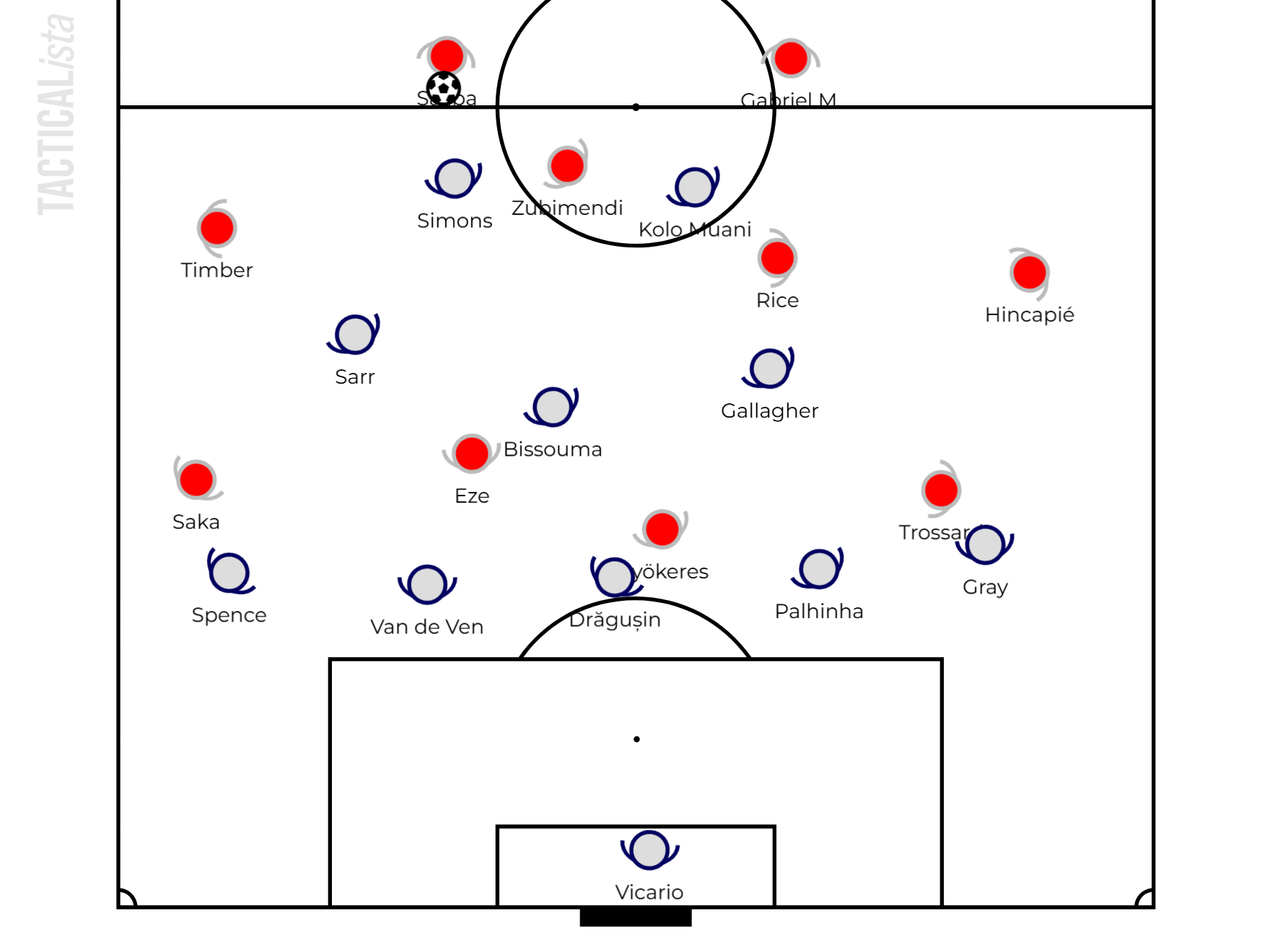
Arsenal’s established possession phase.
Alternatively, Arsenal would build in a back four and use their fullbacks to play out, since there was space in wide areas against Spurs’ narrow midfield and attack units. If Spurs’ wing-backs tried to jump forward, this involved executing the handover of Arsenal’s wingers to the wide center-backs, while also arriving quickly enough to get meaningful pressure on the ball carrier.
Arsenal were able to demonstrate the risk posed if Spurs’ central midfielders tried to jump forward to help get pressure on Arsenal’s backline in buildup. In these cases, the weakened defensive connection between Bissouma and his central midfield colleagues was exploited by Arsenal’s fullbacks or wingers arriving dynamically into the halfspaces to exploit the spaces left either side of Bissouma.
Right-sided threat
Further up the pitch for Arsenal, Saka would hold the width on the right, while Eze played from the number ten role with a slight right-sided bias as Trossard often tucked in from the left. Hincapié would then make underlapping or overlapping runs in accordance with Trossard’s behavior. Rice would also make forward runs from deep on this side depending on the situation.
Much of Arsenal’s attacking play in their organized possession phases went down their right side, where Saka was a key threat. He combined well with Timber, who was able to provide well-timed supporting runs. Saka was also a threat when running in behind Van de Ven, who struggled to adequately track the diagonal runs of the English winger.
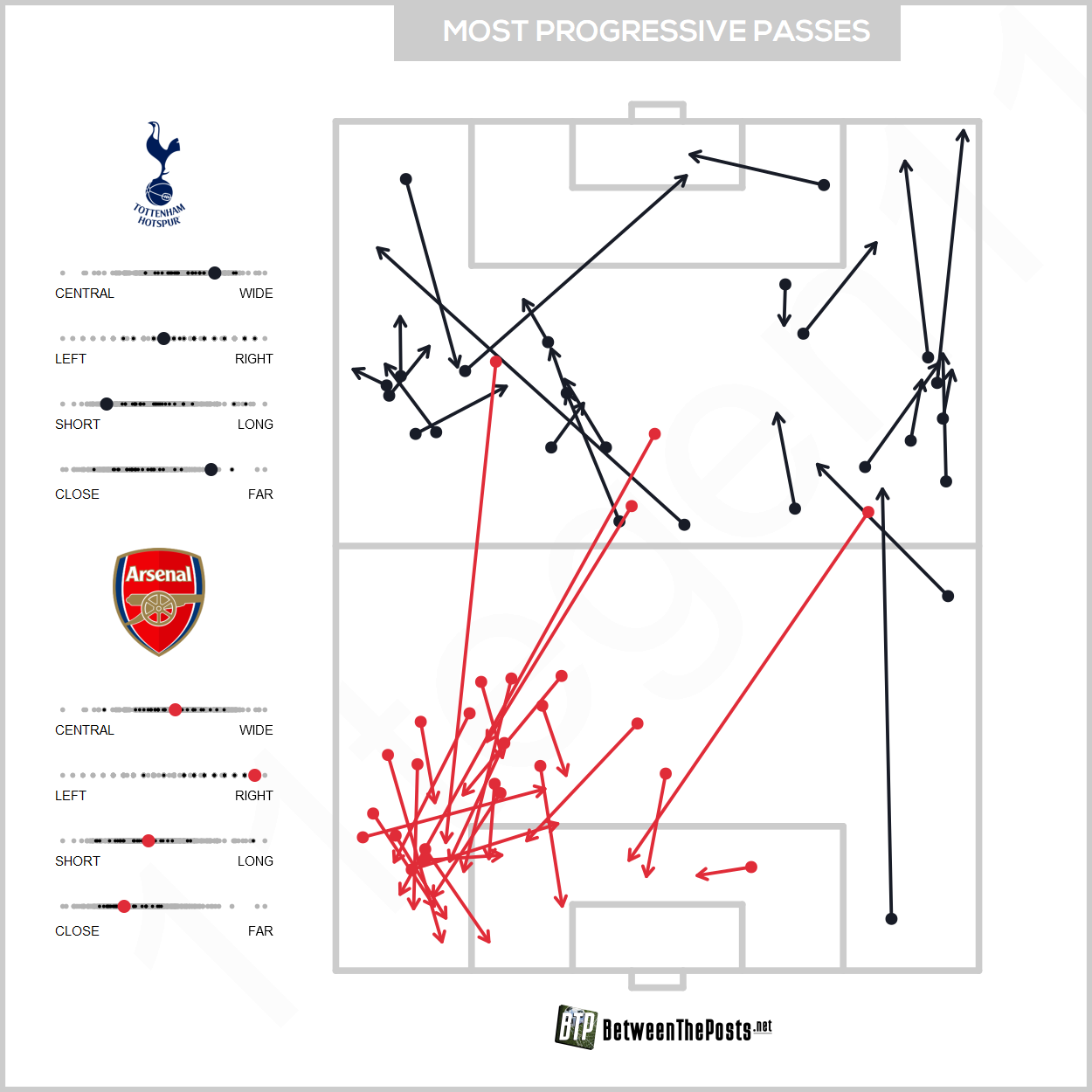
Arsenal favored attacks down the right side.
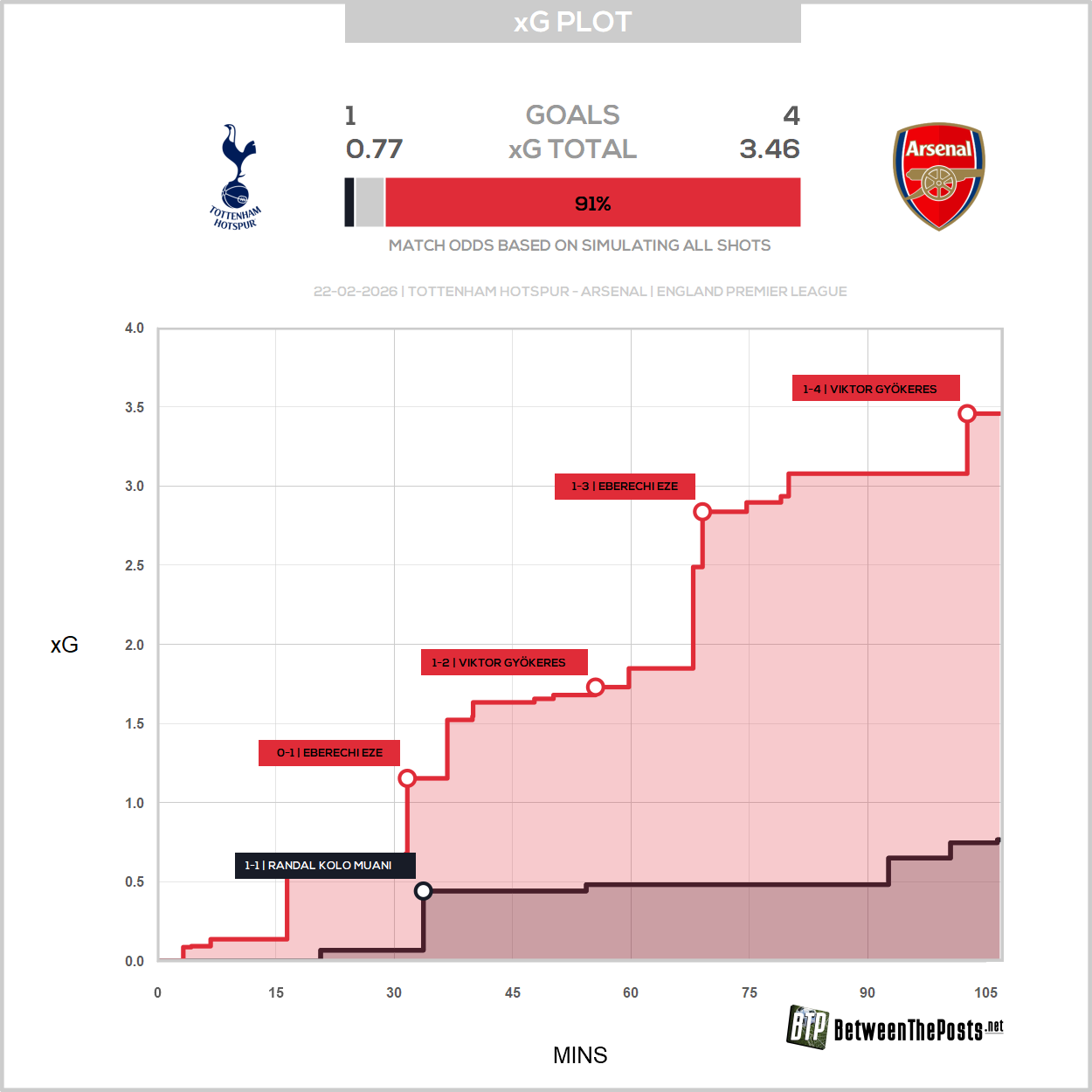
Arsenal’s first goal came from their right-sided attack, with Saka being able to bundle the ball past Sarr who was covering behind Spence who had gone to pressure Timber. The resulting low cross was fired home by Eze. Arsenal’s lead would last barely two minutes though, as Kolo Muani immediately replied after Rice was dispossessed close to his own goal.
Gunners victorious
Arteta’s side had the perfect start to the second half. Another assist was given from the right side as Timber’s pass found Gyökeres on the edge of the box who lashed the ball past Guglielmo Vicario.
A third goal for Arsenal followed just after the hour mark. It came from a second ball situation – another area of the game where Arsenal were much sharper than Spurs throughout. On this occasion, it resulted in Saka getting in behind Van de Ven, Vicario rushing out, and the ball eventually falling to Eze who found an empty net.
Spurs had very little possession in the first half due to Arsenal’s dominance. They mostly tried to play long, which Arsenal were relatively happy to face. In the second half, Tudor’s side were able to gain a larger share of the ball but still achieved very little with it.
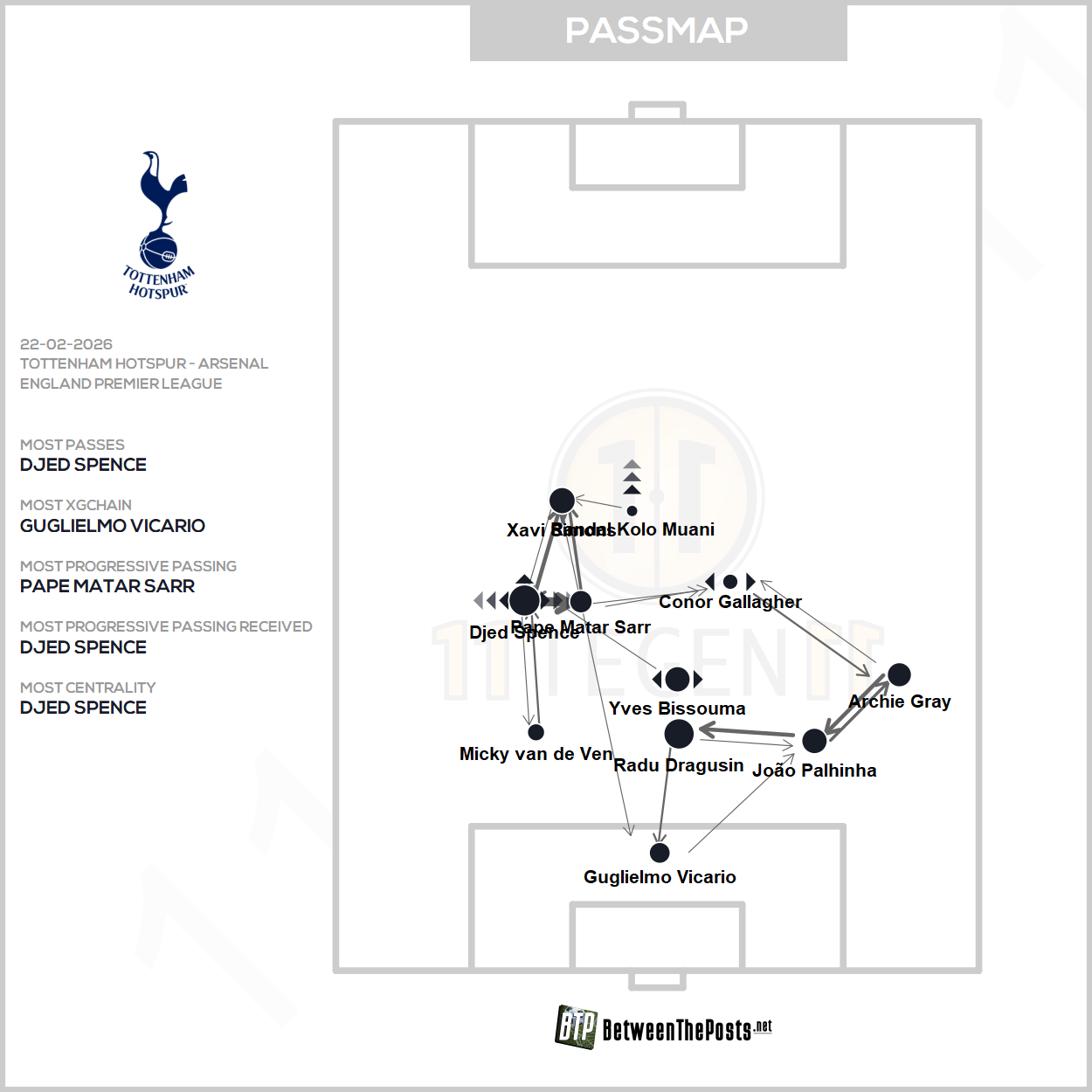
Spurs did not connect particularly well through midfield.
Spurs were building in a 3-5-2 shape, and Arsenal’s 4-2-3-1 formation made it very easy for them to match up man-to-man against Spurs. It’s early days for Tudor at Spurs, but there is clearly work to be done on their possession phase. Simply by matching up man-to-man against Spurs’ formation and defending with strong intensity, Arsenal were able to force Spurs into long, hopeful passes as the main means of progression.
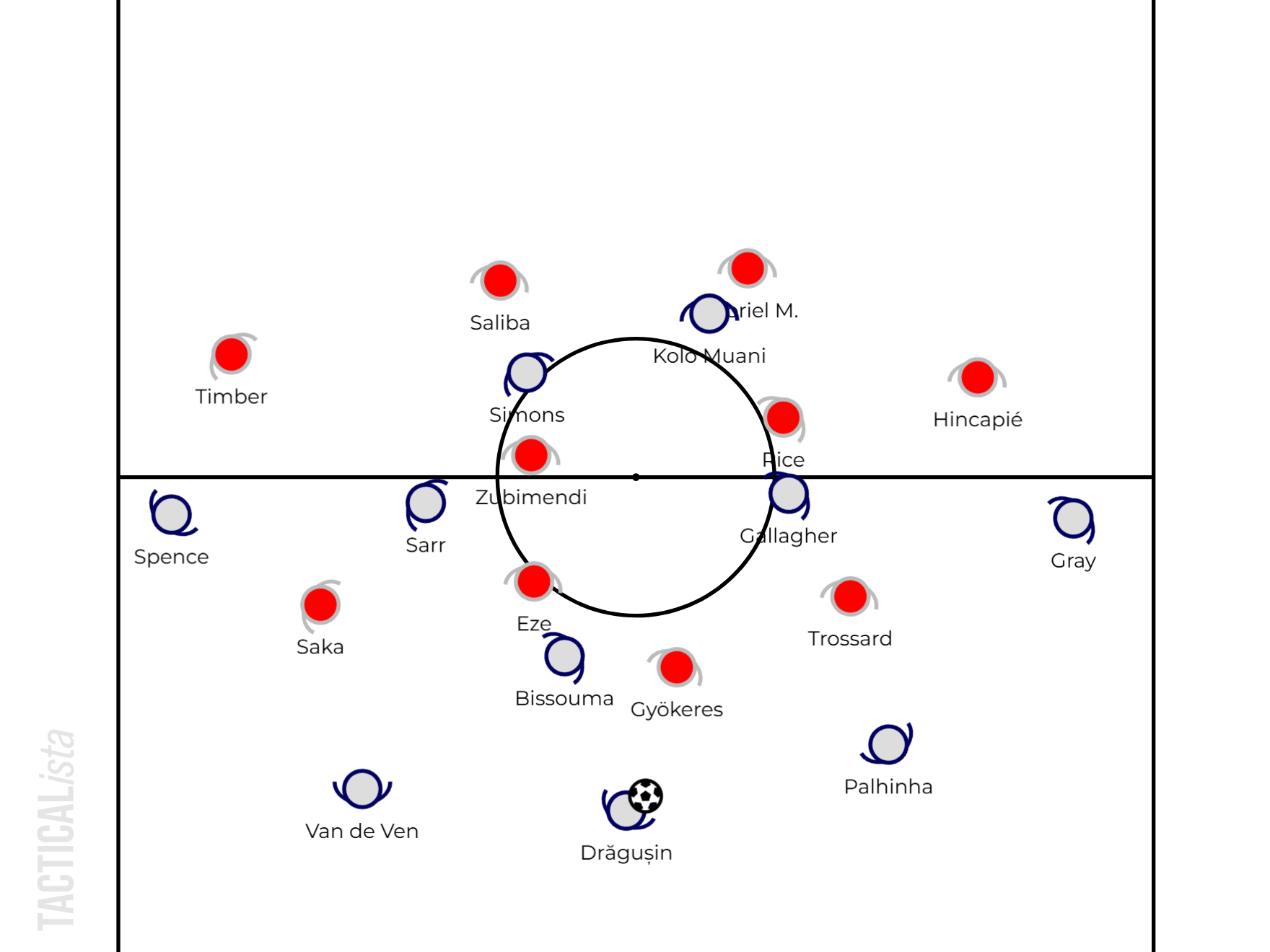
Spurs’ organized possession phase.
The home side made changes after the hour mark, with Dominic Solanke and Richarlison replacing Gallagher and Kolo Muani, meaning Simons moved back into a midfield role. The Dutchman roamed the pitch attempting to create dynamics for Spurs in buildup, but found it difficult due to Spurs’ general deficiencies in buildup combined with Arsenal’s intensity and compactness.
Aside from a near-miss where David Raya had to get down smartly to claw Richarlison’s backheel off the goal line, Arsenal were relatively comfortable. There was still more to come for them, as Gyökeres added his second of the game with powerful running in behind the Spurs defense to make it 4-1 in added time.
Takeaways
Spurs find themselves four points above the relegation zone currently, having not won a Premier League game yet in 2026. For now, they continue to struggle in their buildup phase as they did under Frank. Time is of the essence for Tudor to make an impact on the squad to ensure that they avoid the unthinkable.
Arteta will be pleased with this response from his side after the Wolves result. Arsenal showed excellent intensity in this game and had the answers to unlock Spurs’ defensive 5-3-2 formation, while also being able to match Spurs up against the ball and limit their attacks.


Comments