

Vélez Sarsfield – Boca Juniors: Vélez’s Quickfire Double Proved To Be Enough Against Boca Juniors (2-1)
What looked like a tightly contested first half was transformed after the break. Vélez emerged with clearer intent and sharper tactical coordination, and Pellegrini’s brace reflected his willingness to make direct, decisive runs. Boca Juniors failed to capitalize on their first-half advantages, with their final-third problems becoming increasingly evident. While their attack struggled to create anything meaningful, the influence of Valdés and Lanzini in advanced areas gave Vélez the edge that ultimately decided the game.
Tactical analysis and match report by Ebuka Ogoegbunam.
Vélez Sarsfield aimed to continue their strong start to the Apertura after three wins in four games, knowing their last result made a home victory feel essential. Boca Juniors, meanwhile, chased back-to-back wins and a third triumph of the season, but with Exequiel Zeballos and Ander Herrera missing, their challenge was significantly tougher.
The home team, under Guillermo Barros Schelotto, looked to exploit the spaces between the lines of Boca with a 4-2-3-1 setup. Wingers occupied narrow positions with fullbacks holding the width.
Álvaro Montero guarded the goal, supported by a back four consisting of Emanuel Mammana, Lisandro Magallán, Elías Gómez, and Joaquín García. In midfield, Claudio Baeza and Tobías Andrada formed a solid duo, shielding Diego Valdés, who operated as the central attacking midfielder. Up front, the attacking trio was made up of Matías Pellegrini, Manuel Lanzini, and Florián Monzón.
Boca Juniors’ Claudio Úbeda made three changes from his last game. Agustín Marchesín starts in goal with a back four of Juan Barinaga, Ayrton Costa, Lautaro Di Lollo, and Lautaro Blanco. Milton Delgado, Leandro Paredes, and Santiago Ascacíbar all start in midfield. Kevin Zenón and Gonzalo Gelini are the winger pairing, with Miguel Merentiel leading the line.
Boca’s squandered advantage
Vélez and Boca tactically set up to nullify each other, with Boca’s 4-1-4-1 switching to 4-4-2 in a full press and Vélez 4-2-4 mid-block clogging up spaces. In possession, both teams adopted similar dynamics, positioning their wingers narrowly to create space for overlapping fullbacks
On the ball, Boca Juniors were patient during build-up and looked to bait Vélez before playing through the press or going long. However, Vélez’s 4-2-4 narrow press had a major flaw. The front two, who were Monzón and Valdés, often left huge distances between each other during the press. Delgado should have been covered by one of the strikers, and if he wasn’t, Baeza would’ve jumped to him.
As the game wore on, Ascacíbar and Paredes found space when they dropped deep, with their markers unable to close them down quickly enough. Boca’s numerical superiority in the first phase allowed them to break Vélez’s press and push the opposition into a deeper block. However, their progress stalled in the final third, where poor passing and heavy touches undermined their attacks.
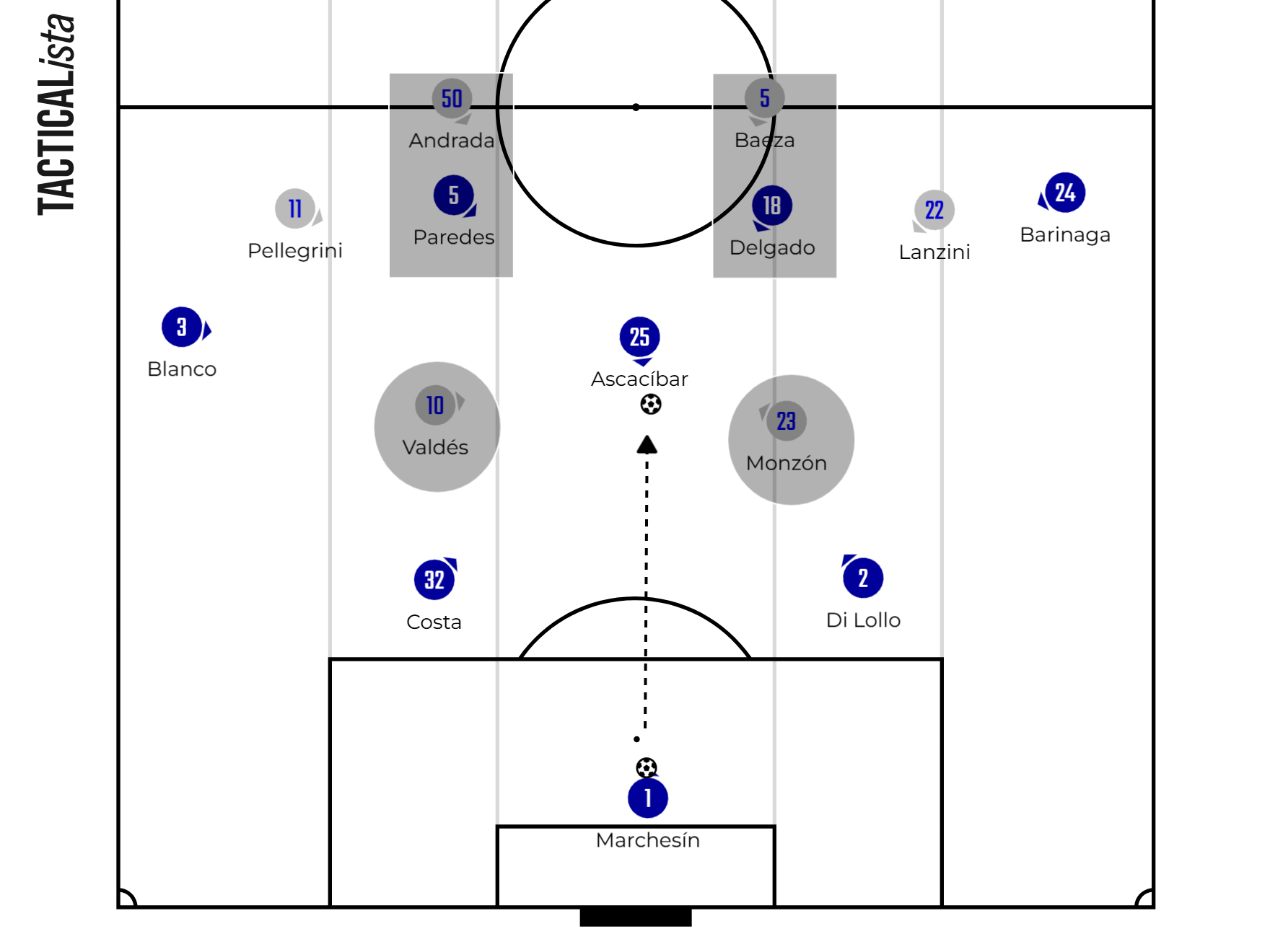
Marchesín found Ascacíbar when he dropped deep to overload Vélez’s first line of pressure. Ascacíbar took advantage of the spaces between Valdés & Monzón in the press when Baeza and Andrada were pinned.
Vélez’s 4-2-4 shape created gaps between the lines due to poor vertical compactness. Boca exploited these spaces through Zenón and Ascacíbar in central areas. Their positioning helped them enter the final third regularly. However, their play became too central, making Vélez’s defending easier. Out wide, Blanco and Barinaga delivered poor crosses that offered the forwards little to attack.
Vélez’s Sign Of Strength
Schelotto’s men showed eagerness for the ball across the pitch. Vélez thrived when their key players held possession in tight spaces. With clever rotations, Lanzini and Valdés dropped deep to help progress through pressure. This movement was vital to Vélez’s quick attacks after breaking lines. Their build-up gave them control and speed going forward.
Boca’s 4-1-4-1 press applied little pressure without triggers. These triggers came when Ascacíbar or Paredes stepped up to support Merentiel in the front line. Baeza sometimes dropped into defense to bait the press, opening central spaces for Vélez.
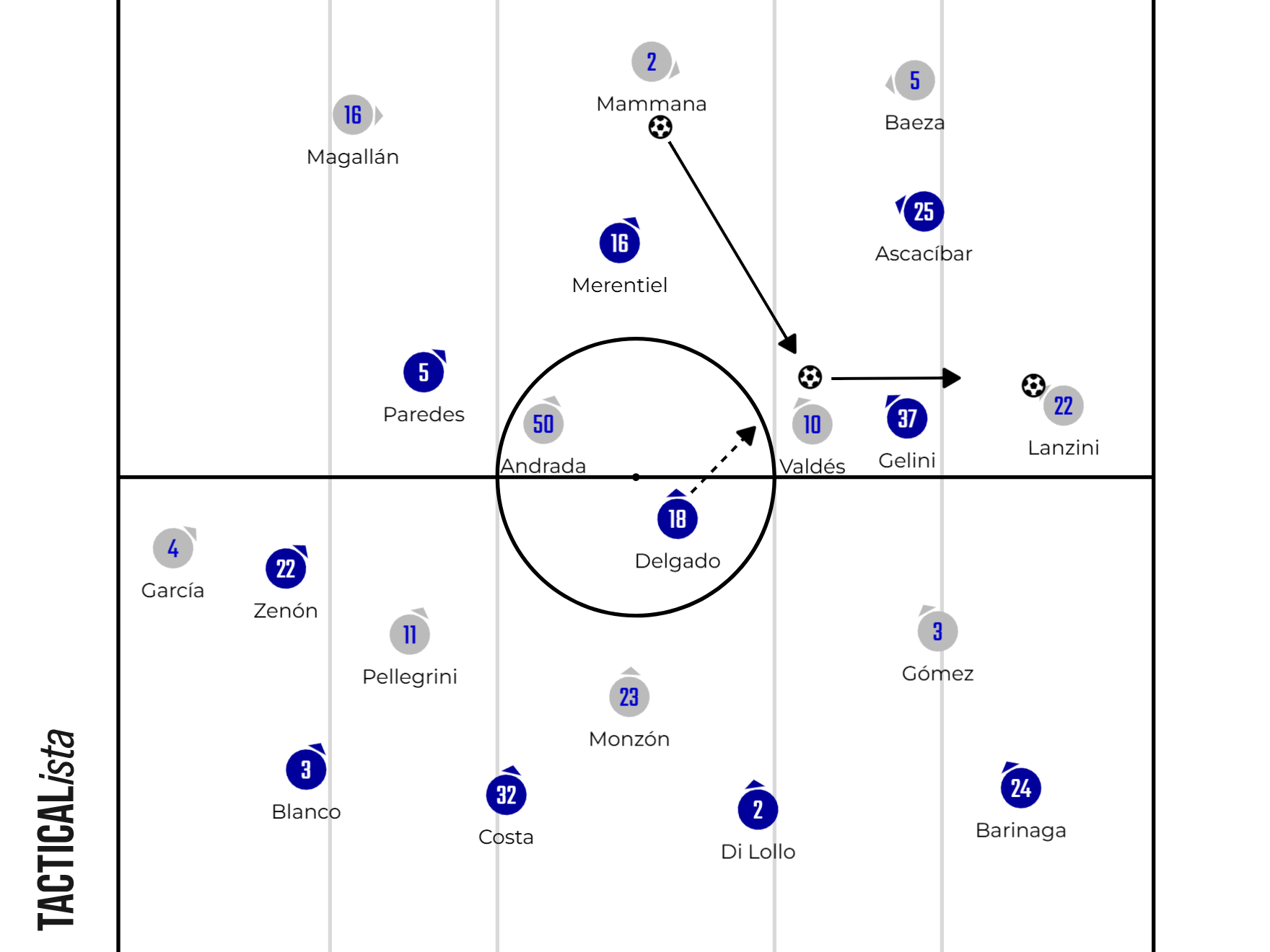
Baeza drops into the last line while Valdés and Lanzini stay deep as Vélez play through the lines of press.
The Breakthrough Moments for Vélez
Vélez’s direct style perfectly complemented their fullbacks’ attacking runs and crossing threat. García and Blanco found plenty of space to exploit, especially when Zenón and Gelini failed to track their movements. On several occasions, Blanco was given the freedom to consistently deliver dangerous crosses into the box.
Even when closely marked, the fullbacks excelled in one-on-one situations, producing quality deliveries for their teammates. Unlike Boca, Vélez created good chances for their fullbacks to attack effectively and get crosses in for the strikers to feed off. This was the pattern for Vélez’s first goal.
Vélez worked their way into wide areas, and with Gómez making an overlapping run, this movement drags Blanco away, which allows Valdés to put in a cross with no pressure on him before Pellegrini heads the ball in the back of the net.
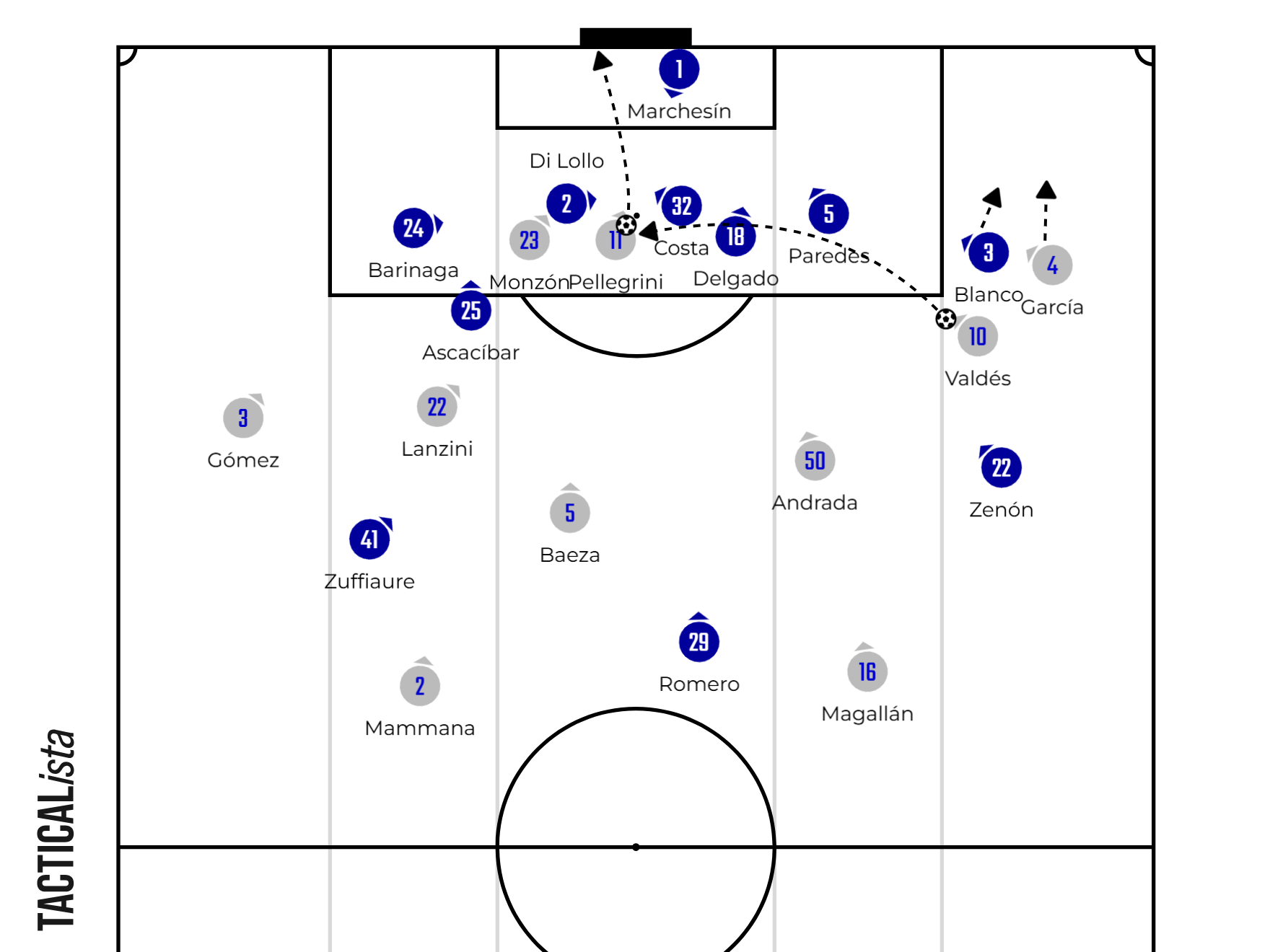
Garcia’s movement dragged Blanco away from Valdés, who had time and space to find Pellegrini in the box.
The opening goal shifted the momentum firmly in Vélez’s favour and gave them even greater confidence to attack. Even before the goal, Lanzini, Valdés, and Pellegrini had already been positioned narrowly between the lines, ready to spring forward at any moment.
As the game opened up, this positioning became even more dangerous whenever Boca conceded turnovers in central areas, allowing Vélez to transition vertically with speed and purpose.
Vélez’s 4-2-4 press forced Ascacíbar to concede possession, while their narrow positioning kept them compact and ready to attack. Valdés received between the lines and released Pellegrini, who timed his run perfectly into the space behind Boca’s defence.
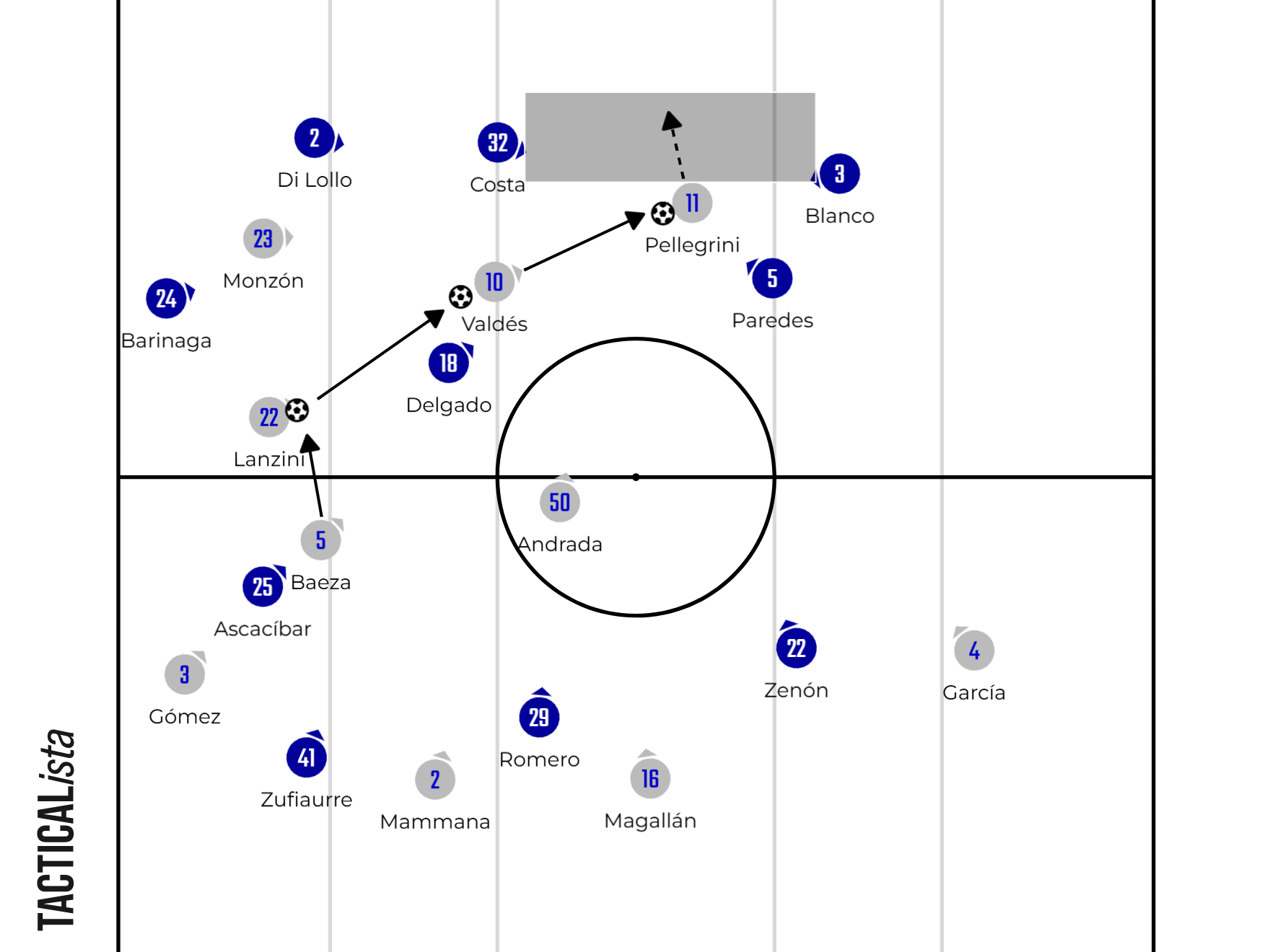
Vélez’s high press forces a turnover, which leads to Valdés and Pellegrini attacking the spaces left behind Boca’s backline.
A Little Too Late For Boca
Boca’s attacking issues throughout the game were rooted in their inability to effectively exploit the spaces between Vélez’s lines. Although they repeatedly found pockets of space in central areas, particularly through the positioning of Zenón, Merentiel, and Ascacíbar, they lacked the precision, timing, and creativity to turn those moments into clear chances.
Boca’s consolation goal actually stemmed from the same structural advantage they had throughout the game. The space between Vélez’s midfield and defence had been available all game, but Boca finally exploited it decisively.
Takeaways
What began as a chess match gradually evolved into a lesson in efficiency, structure, and decisive moments as Vélez Sarsfield outmaneuvered Boca Juniors 2–1. The first half felt like a contained battle of ideas with two teams mirroring each other in shape, both seeking control through narrow wingers, patient build-up, and access to the spaces between the lines.
Boca’s 4-1-4-1 in possession aimed to overload Vélez’s first line by dropping Ascacíbar and Paredes in build-up. This created temporary numerical superiority against Vélez’s narrow 4-2-4 press, which often left excessive horizontal distances between Monzón and Valdés. As a result, Boca were able to bypass the initial pressure and force Vélez into a deeper mid-block.
Boca appeared to be the more comfortable side in the early phases, using their numerical superiority in the first line to break Vélez’s press. They lacked cutting edge. Their play slowed in the final third, becoming too central, too predictable, and too imprecise, allowing Vélez to defend with relative comfort.
The decisive attacking patterns came from Vélez’s exploitation of wide channels. Boca’s wingers failed to consistently track fullback movements, allowing García and Blanco to receive with time and momentum.
Overall, Vélez won through superior pressing coordination, smarter use of wide areas, and greater efficiency in decisive moments, while Boca’s structural advantages were undermined by their lack of sharpness in the final third.
For Boca Juniors, the defeat was costly. Remaining on six points after four matches, they sit in the middle of the table, level with several teams but behind in consistency. Despite the loss, Boca missed the chance to move closer to the top three and instead stayed clustered among other teams.


Comments