
Internazionale – Juventus: Cupid Shoots His Arrow With Blue And Black Tassels (3-2)
The Derby d’Italia, scheduled for Valentine’s Day, seemed a fitting gesture for how this game would pan out. Goals, scandal, mood swings and passion: this game delivered once again as Internazionale delivered a result of great significance, even when the first half told a different story.
Tactical analysis and match report by Joel Parker.
We decided to make this article free to read. If you want to support our work, consider taking a subscription.
Five points ahead of Milan, nine points ahead of Napoli: the contenders required a big performance from Juventus to keep the title race alive.
After losing the Derby della Madonnina, Inter have hit inevitable form to create separation at the top of the Serie A standings. Cristian Chivu’s team have been dominant; Inter have posted a higher Expected Goals in all twelve games against their opponent, in eight games they posted a 1.5 difference against their opponents, and only four teams posted more than one expected goal against them. The draw against Napoli (who put up 1.43, the highest in this time period) was the only time they dropped points. However, it’s the record against the big teams where the Inter title challenge appears vulnerable, against Juve, no win since February 2024.
Under Luciano Spalletti, Juve have rejuvenated to play some of the best football in Serie A since his appointment. In possession, the team is fluid and benefited players like Pierre Kalulu and Weston McKennie, whilst Manuel Locatelli has operated as a strong base. Out of possession, the strong man-to-man pressing has been expertly managed by Locatelli and Khéphren Thuram in the double pivot. They are now comfortably back in the top four conversation, but results against Atalanta in the Coppa Italia and a 2-2 draw at home to Lazio highlight a team that still has some limitations.
Chivu received a huge boost as Nicolò Barella and Hakan Çalhanoğlu returned to training in mid-week. Barella was put straight into the midfield in place of Henrikh Mkhitaryan, the only change from the team that beat Sassuolo 5-0 last weekend.
Spalletti was without Khéphren Thuram, who missed this game with a bruised leg. As a result, Fabio Miretti joined the midfield, whilst Francisco Conceição shook off a knee issue to start on the right of the attack, the two changes that Juve made from the draw against Lazio. They switched to a back four, so Teun Koopmeiners was back on the bench and Juan Cabal was replaced by Andrea Cambiaso, who switched from right wing-back to left fullback, which has been the order when they’ve played in a 4-1-4-1/4-2-3-1 system.
Deep dribbles around David
From the start, this was a game that was in the balance when it came to possession. Inter was willing to leave the three-versus-two created when Locatelli dropped between Bremer and Lloyd Kelly, but out of possession, Juve was less willing to jump onto Inter. Spalletti arranged his team in the 4-1-4-1 off the ball and took some bold risks. When Barella pushed higher, Miretti remained between his fellow Italian national and Piotr Zieliński (who acted as the regista). On the left side, in-form Federico Dimarco was left as Conceição jumped to Alessandro Bastoni, and Weston McKennie tracked Petar Sučić in the second line. When the ball was positioned on the left, Kalulu could jump, but Inter found themselves having to make long switches if they were to connect with Dimarco in space.
In the center of the buildup, this was a familiar Inter layout as Zieliński dropped to create a back-four and the center-midfielders bounced between lines and were occasionally joined by a center-back pushing forward. As Jonathan David was a lone figure in the 4-1-4-1 structure, spaces arose for Manuel Akanji (or sometimes Zieliński) to carry the ball around the Canadian’s right side. Inter were able to maintain circulation, with support in the second line and flexible movements to maintain structure. However, these moments were not entirely progressive as movements from Barella aided the rest defense, as opposed to making aggressive runs against the defensive line. Kenan Yıldız and Andrea Cambiaso could jump outward and Miretti could switch targets to mark the third man run, or Locatelli’s zonal defense further compacted the center of the block.
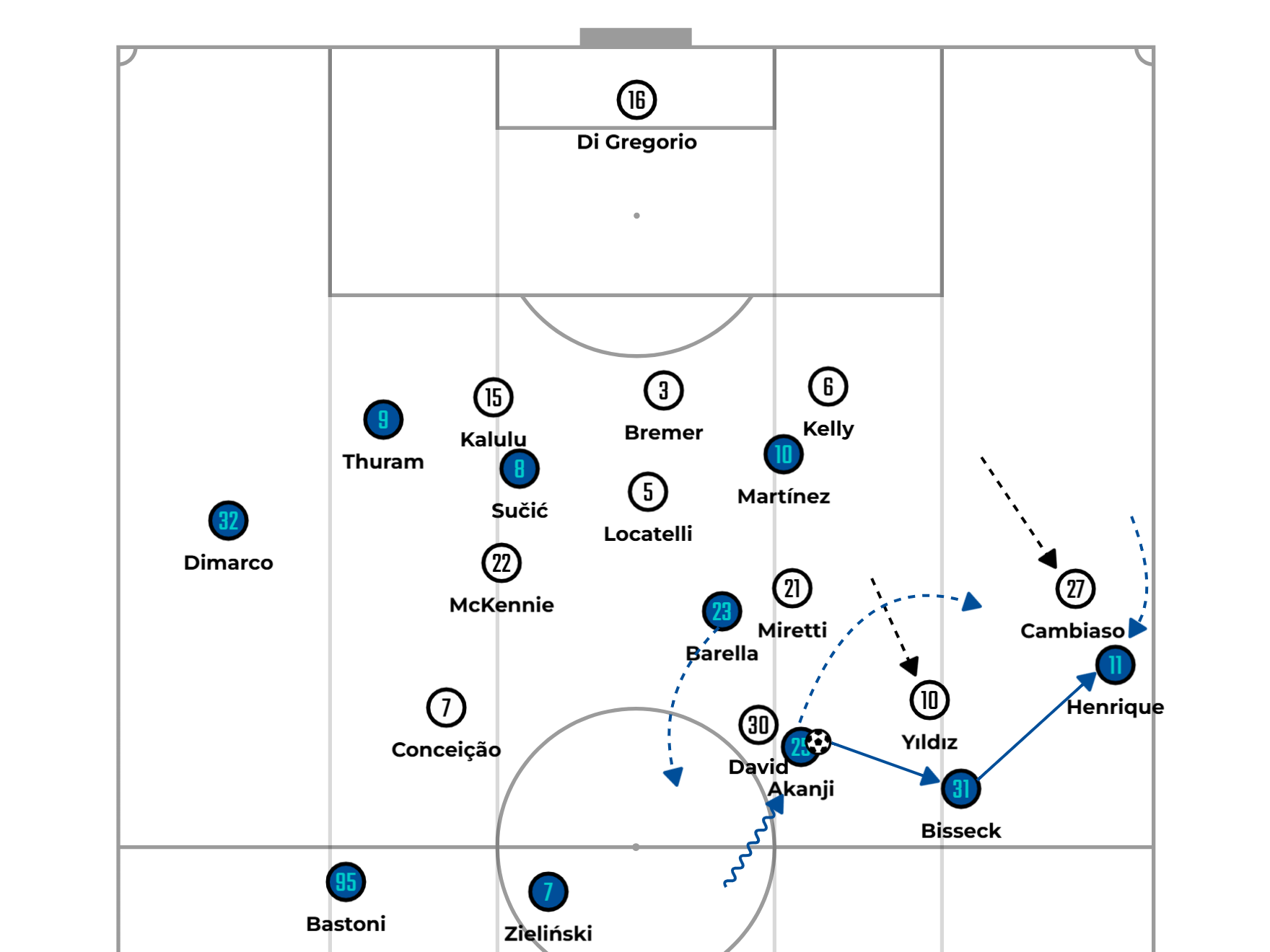
10th minute: Akanji dribbled around David on the right side of the Inter buildup. However, Barella dropping into the pivot space served as protection, rather than progression. As a result, Juve could jump onto Yann Bisseck and Luis Henrique, whilst Miretti tracked Akanji in the second line. Inter recirculated.
Despite Juve restricting the Inter attack in the early stages, the space left on Dimarco was problematic in the defensive set-up. Not only did the wing-back have the transitional threat, but Marcus Thuram constantly moved into wide-left situations to make the overload on the outer channel. Sixteen minutes in, Akanji carried into the middle third and the switch was made to Dimarco. The ball funneled backwards and onto the right side. Inter appeared to have lost the move after Locatelli intercepted, and David headed towards McKennie, but an excellent counterpress from Sučić created the turnover. Thuram carried and passed to Henrique to the right of the box, whose low cross spun off Cambiaso and bounced over a weak attempt from Michele Di Gregorio to stop it. One-nil Inter.
Juve active between the lines
In-possession, Juve had a fluid base that was more effective in playing between the lines. This was active as Locatelli stayed between Kelly and Bremer (situationally appearing on the left too) and the six-versus-five or seven-versus-five could be created through a number of rotations. Cambiaso inverted in the left halfspace, whilst Miretti was joined by a dropping David in some phases.
This was all subject to change. Yıldız also took up halfspace positions depending on Cambiaso’s location. On the right side, McKennie pushed up to attack the last line, so Kalulu situationally moved into the spot inside of Conceição. As the ball circulated between the channels, Miretti drifted towards the ball side, which was a key asset for Yıldız when he tried to take the ball around Henrique.
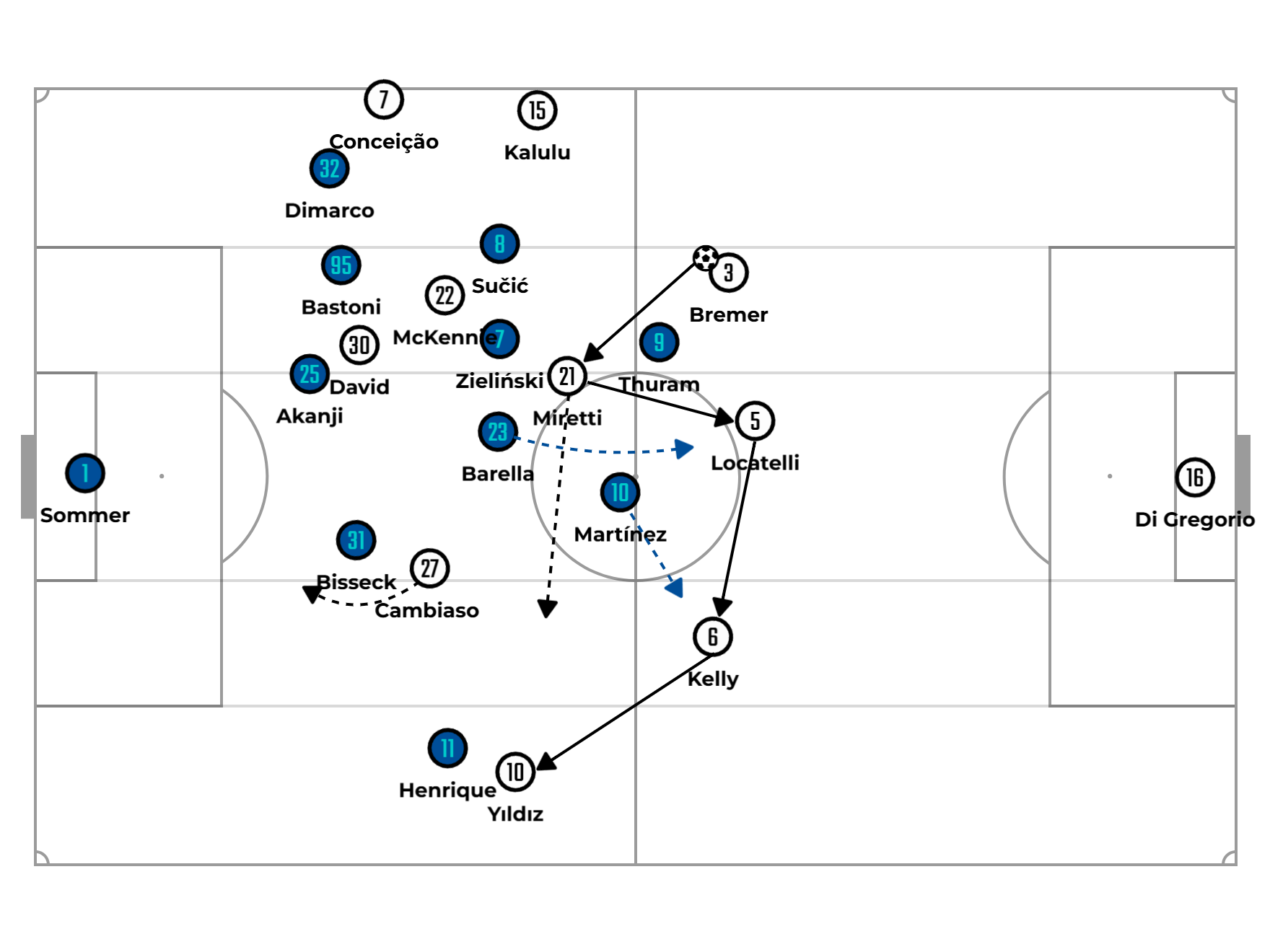
19th minute: Key rotations for Juve in-possession. Locatelli remained deep to make the three-versus-two, McKennie and Cambiaso acted in the halfspaces and Miretti drifted laterally from the pivot position to support Yıldız. As Barella had jumped into the first line, this move supported the Turkish attacker as he was isolated with Henrique. In this phase, Yıldız chose to carry down the touchline, and even though Henrique made a clearance by the byline, Locatelli recovered the ball to continue the move.
Against a flatter 5-3-2 block, Juve was reliable in playing through the lines, especially when Locatelli had the time to pick his pass. However, the final third activity came from the wide overload situated on the right side: Kalulu was often positioned in the space behind Conceição, but the French defender was comfortable when pushing ahead of the winger. This enabled McKennie to target runs from the inside and it was clear that he would cause the most difficulty for the Inter defense. A header from the American threatened twenty minutes in, which forced a save out of Yann Sommer.
However, it did not take long for Juve to find an equalizer. On the right, Bremer attempted some more direct passes with Kalulu/McKennie in positions inside the winger to compete. Even when these duels did not work out, Juve were positioned on the counterpress to keep the pressure against Inter. Kalulu poked a pass to McKennie in the halfspace, and Henrique fell asleep at the back post when Cambiaso moved inward to beat him to the ball and scored from close range: a goal apiece for both teams by Cambiaso.
Red cards can ruin games
The first thirty minutes were balanced in possession, but Juve had utilized it in better fashion, even if the shot count was limited at this stage. However, the game started to tease a more frantic game state as both opposition blocks left the far side unattended. Switches to Kalulu sparked carries forward, and Juve had more spaces down the right side of their attack for transitions to appear. Half an hour in and pressure from Miretti saw uncharacteristic chaos as Barella’s back pass flew past Sommer, and Inter nearly conceded a corner.
However, Inter could threaten through directness too. Traditionally, out of the striker duo, Lautaro Martínez acts more as the connector in tighter spaces or areas out of the forward line, but it was Thuram who caused a lot more threat in this regard. Thirty-four minutes in, Barella dropped into the pivot space, and Zieliński replicated the third man run, this time against the last line. A creative flick from Thuram took the ball past Kelly and the Polish midfielder charged through the very center of the Juve block. His dink bobbled over Di Gregorio, but there was not enough power to bypass Bremer. In the second phase, Sučić dribbled into the box and teed Martínez, but the Argentine could not bend his shot around the defenders.
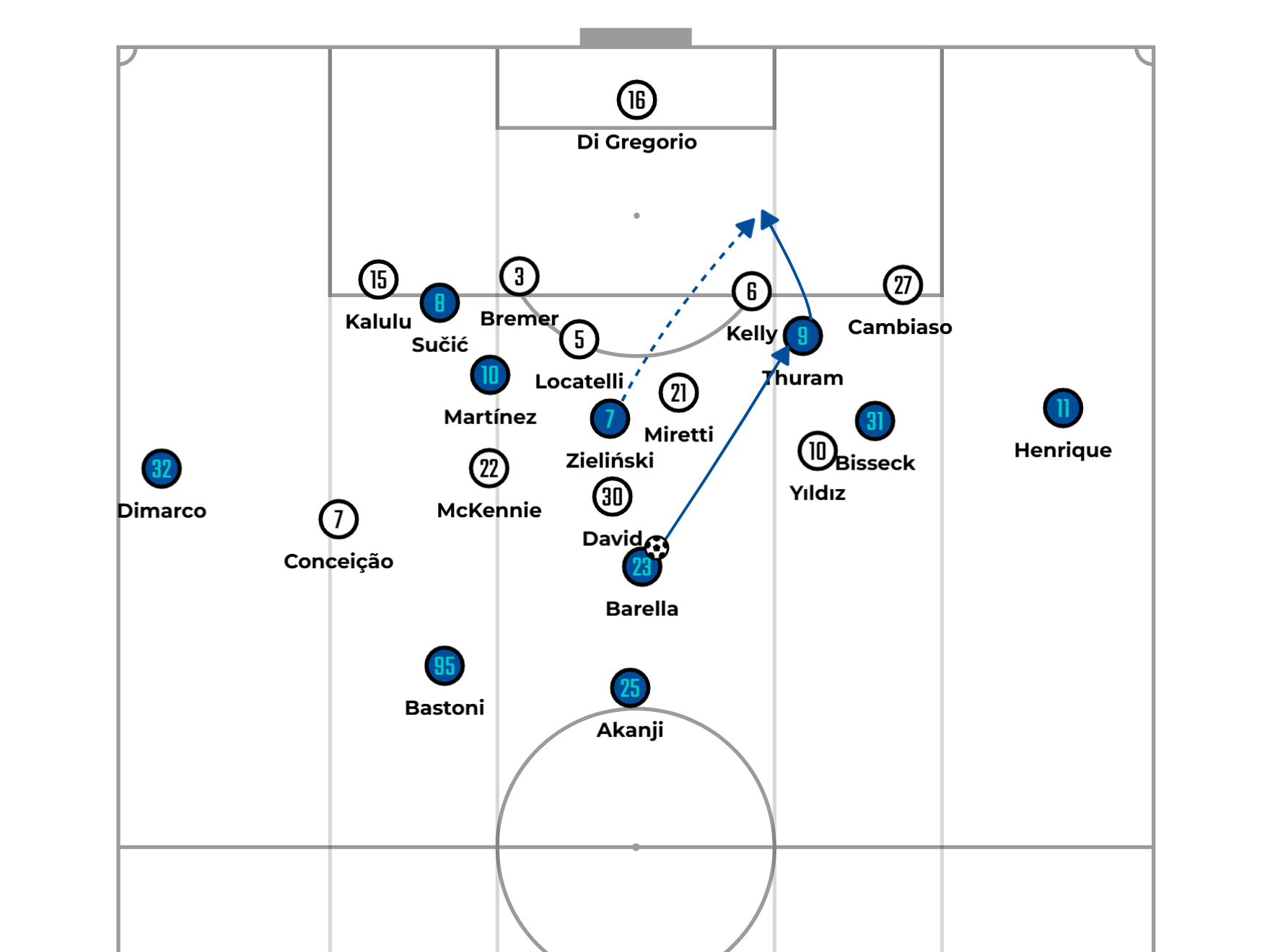
34th minute: Buildup to Zieliński’s chance. In the defensive set-up, Locatelli has dropped between the center-backs in previous situations for Juve, but in this phase, the wide center-backs remained without coverage. This was a great platform for Zieliński to make a run against the last line, and Thuram’s back-heel connected the direct move into the penalty area.
More transitions were made, as Miretti counterpressed from one duel and Thuram connected another, both saw spaces open up on the same side of the pitch (Inter’s left and Juve’s right). Forty minutes in, Thuram was involved as Sučić got possession up to Dimarco, and Inter won a corner. From there, a crazy sequence. The subsequent corner saw Thuram’s header saved and a shot from Bastoni deflected off Locatelli to hit both posts. Cambiaso picked out David, and Juve led a charge forward. Inter had reset as Juve knocked the ball from left to right, but Miretti’s loose pass encouraged a 50/50 between Bastoni and Kalulu. No touch from the Frenchman on Bastoni, but as the referee had brandished a second yellow, VAR could not correct a poor decision just before half-time.
The old lady keeps her teeth in
Conceição was replaced by Emil Holm, his first Serie A appearance for Juve since signing on loan from Bologna. He would replace Kalulu in the vacant right fullback spot, whilst Bastoni, who was also on a yellow card, was switched for Carlos Augusto. Juve defended in a 4-4-1 formation, McKennie filling in on the right of the midfield line and Miretti next to Locatelli when out of possession.
In-possession, Inter started to exchange passes in a different fashion. There was little emphasis on the circulation and protecting the deeper spaces, so passes started to fly through at a faster rate. Inter may have grown in confidence, but a Juve opportunity just a few minutes into the second period gave them a scare. Their 5-3-2 block still left spaces on the far side in which Juve could utilize: Cambiaso carried the ball from the halfway line, past Bisseck and into the box before his shot was parried upwards by Sommer. It seemed destined that McKennie would shoot on the rebound, but he tried to knock it towards David. Miretti and then McKennie would test Sommer with low shots from the edge of the box, but Juve should have produced a much better opportunity.
A yellow card for Barella saw Chivu instantly take the midfielder off, a move which saw Çalhanoğlu take his place as the regista and pushed Zieliński further forward. With an extra player and facing a deeper block, it was only natural that Çalhanoğlu dropped between the center-backs with a lot less frequency. This only encouraged Inter to attack with some more directness, wall passes were more prevalent, more support was around Dimarco (Thuram still dropped wide-left on the occasion, but Zieliński and Augusto were also higher), and more crosses were floated into the box for Inter to try and attack.
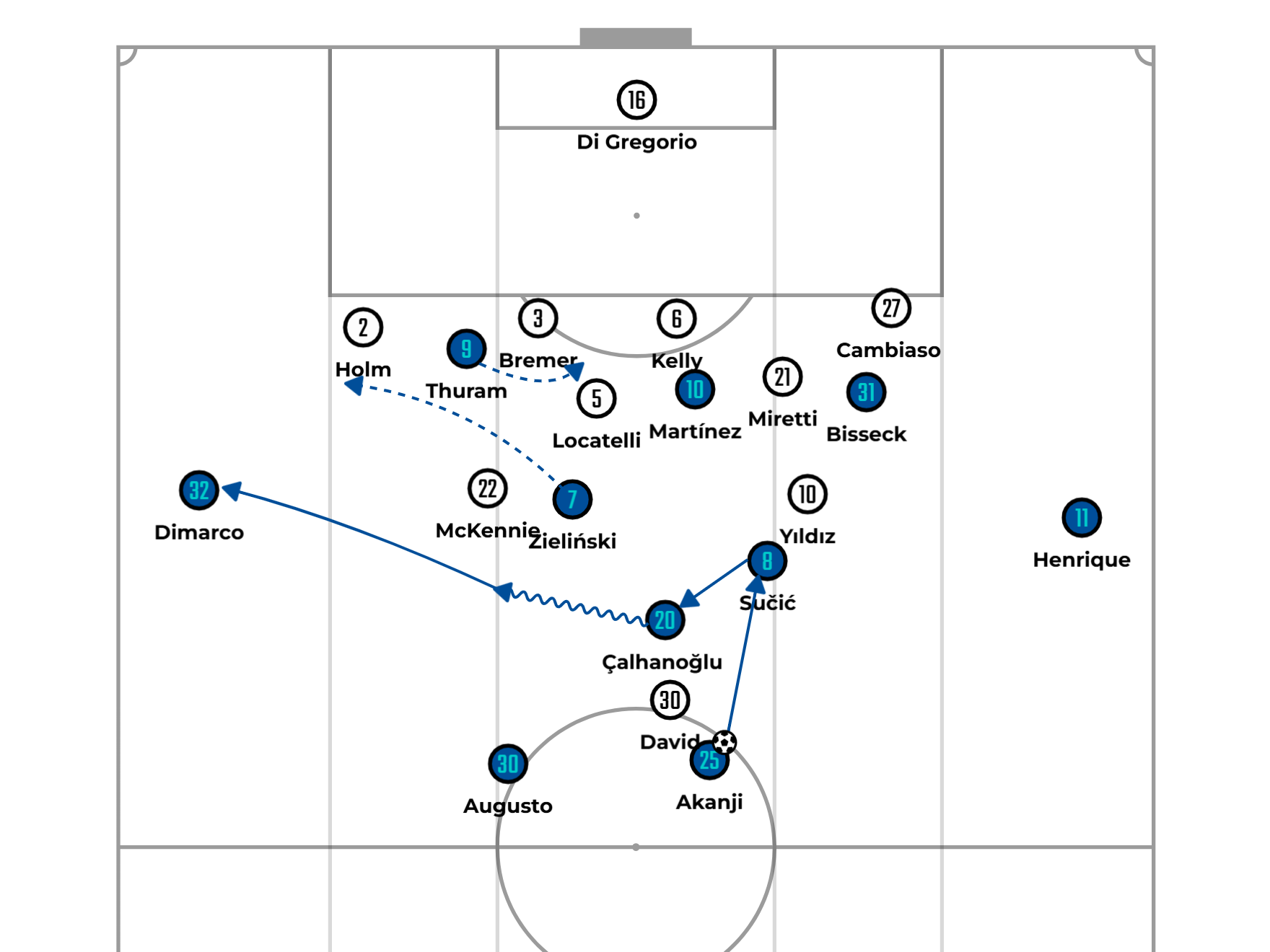
55th minute: More directness and pressure on the last line from Inter’s buildup. The wall pass from Sučić encouraged the tempo of the attack to increase as Çalhanoğlu carried possession and played outward to Dimarco. On the left of the attack, Thuram takes up a position for the cross and Zieliński moved outward. In this phase, Zieliński would underlap, and the cross would come later from Dimarco, but was cleared by the Juve defense.
Spalletti’s two substitutions on the hour mark would indicate his contentment with the situation. Juan Cabal replaced David and Miretti was taken off for Koopmeiners, defensive reinforcements as Cambiaso was pushed to the left of the second line. It was a shame that Juve did not keep another player who could support McKennie or Yıldız on the transition, considering that Juve were still finding some routes through. Chivu called for more offensive firepower, Francesco Pio Esposito replaced Henrique, so another striker was on the field. Andy Diouf filled in on the right as he replaced Sučić.
Inter had just one shot at Juve’s goal up to this point, in the second half. However, the substitutions soon came into effect when Çalhanoğlu forced an excellent save out of Di Gregorio after a corner was cleared. Esposito had a header saved a minute later, although this effort did not have enough power to test the goalkeeper.
Kneel before your coiled snake
Inter started to take aim as Juve had lost its transitional ability down the right side. More crosses arrived as Esposito remained in the very center of the box, whilst distanced shooters were still on the field, as this fixture has proved on so many occasions. On the left side of the Inter buildup, Thuram appeared more and more on the outer channel of Dimarco, now that Esposito had taken place in the box. Not only did this give him the license to cut in and shoot, but it also bought more room for Dimarco to pick his cross, a decision which showed its worth with the game about entering the final quarter.
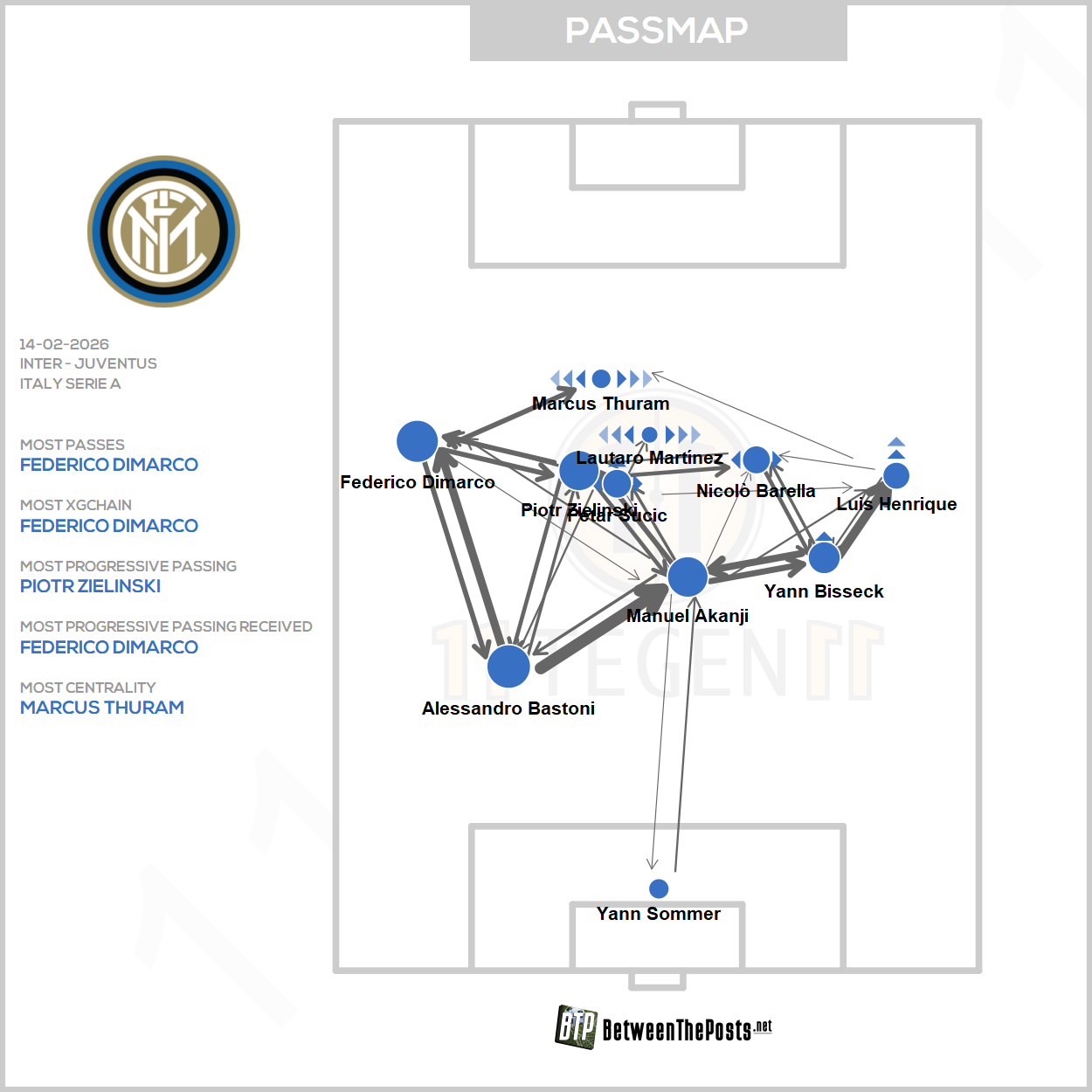
Strong links between Zieliński and Thuram, with Dimarco, show just how active the wing-back was in the attack. In total: Dimarco attempted fourteen crosses, completing five of them.
After a throw-in was recirculated, Dimarco had time to pick out his cross, and Esposito’s header into the far corner was glorious. Inter went ahead, a huge goal for the young Italian and another contribution for Dimarco, his twelfth assist of the season (seventh in the last four Serie A games) as well as his seventeenth goal contribution of the Serie A campaign.
Only then would Spalletti stick on another attacker. Jérémie Boga was introduced before the goal, but Cambiaso was taken off for Loïs Openda for the last thirteen minutes. Juve started to get more territory but nearly conceded a third after an indirect free-kick was defended, and Dimarco finished a five-versus-three into the stands behind the goal of the San Siro. Juve got territory, but it looked like Inter would be able to block an attack out before countering forward to kill time. Yet Juve threw a final twist.
Bremer robbed Martínez of possession, and Locatelli spread the play to McKennie on the right side. Bremer joined the attack and as Locatelli faked to shoot, Bremer put the ball back into McKennie just inside the penalty area. He played it into Locatelli, his low shot bounced into the bottom far corner as Juve brought the game level. Eight minutes from time.
Inter were suddenly back in the same situation, and it looked like Juve had destabilized Inter enough to stop the shots from constantly coming through. Two minutes from time, another Dimarco cross connected with Bisseck, but an excellent save from Di Gregorio denied the league leaders once more. Going into the last seconds of normal time, Inter continued to move forward. Diouf took the ball into the final third, and Bisseck played a pass to Zieliński outside of the box. He shifted onto his left, and his low, powerful strike pierced through the crowd and into the bottom corner for a dramatic winner at the death.
Takeaways
A win over Juve in February came at a pivotal moment in their last ride towards the title. In that game, Inzaghi’s team won the game more convincingly against a direct contender. In this game, Inter’s flaws were still visible, yet the absurdity that this fixture has brought in recent seasons finally fell onto their side, and based on the chances produced in the final twenty minutes, it was deserved. Milan is still within distance, but Inter’s tenacity in the Serie A schedule has not been matched by anyone.
A poor red card decision totally changed the dynamics of the game. This will be the big talking point amongst Juve, but they should feel encouraged that they had the best of Inter throughout the game. For them, crucial games against Galatasaray, Como and Roma all wait.
Use the arrows to scroll through all available match plots. Click to enlarge.
Check the match plots page for plots of other matches.


Comments