

São Paulo – Palmeiras: Palmeiras win third consecutive derby against São Paulo and extend lead at the top (0-1)
Palmeiras have been highly successful against São Paulo recently. On Matchday 8 of the Brasileirão, they won their third consecutive “Choque-Rei”, as the derby between the teams is known. Jhon Arias, a Colombia National Team player, scored the goal that put Palmeiras alone at the top of the table in a direct clash for first place.
Tactical analysis and match report by Marcus Arboés.
São Paulo fans were surprised by the unexpected dismissal of Hernán Crespo, who had been doing a good job despite the club’s political instability. Roger Machado took charge under criticism and has struggled to deliver. In the derby, he lined up: Rafael in goal; Lucas Ramon, Alan Franco, Sabino and Enzo Diaz in defense; Danielzinho, Marcos Antônio (former Lazio), Bobadilla (Paraguay National Team) and Cauly in midfield; Luciano and the Argentine Calleri in attack.
On the other side, Portuguese manager Abel Ferreira, the most successful coach in Brazil in recent years, reinforced his squad with targeted signings that significantly raised the team’s level. Even without a full-strength lineup, he set Palmeiras up in a 4-2-4 outline: Carlos Miguel (former Nottingham Forest) as goalkeeper; Giay at right-back and Piquerez (Uruguay National Team) on the left; Murilo and Gustavo Gómez (Paraguay National Team) as centerbacks; Marlon Freitas and Andreas Pereira (former Fulham) as the double pivot; in attack, Arias (former Wolverhampton) on the left wing, Allan on the right, Maurício (Paraguay National Team) as center-forward and Flaco López (Argentina National Team) as striker.
Verticality: Palmeiras’ main weapon
Palmeiras and São Paulo had both been among the best-performing teams in Brazilian football at the start of 2026. Recently, Palmeiras had already beaten São Paulo in the São Paulo state championship, which they went on to win. In this new encounter, under a different coach, the match was once again decided by a goal from Jhon Arias, using verticality as the key weapon.
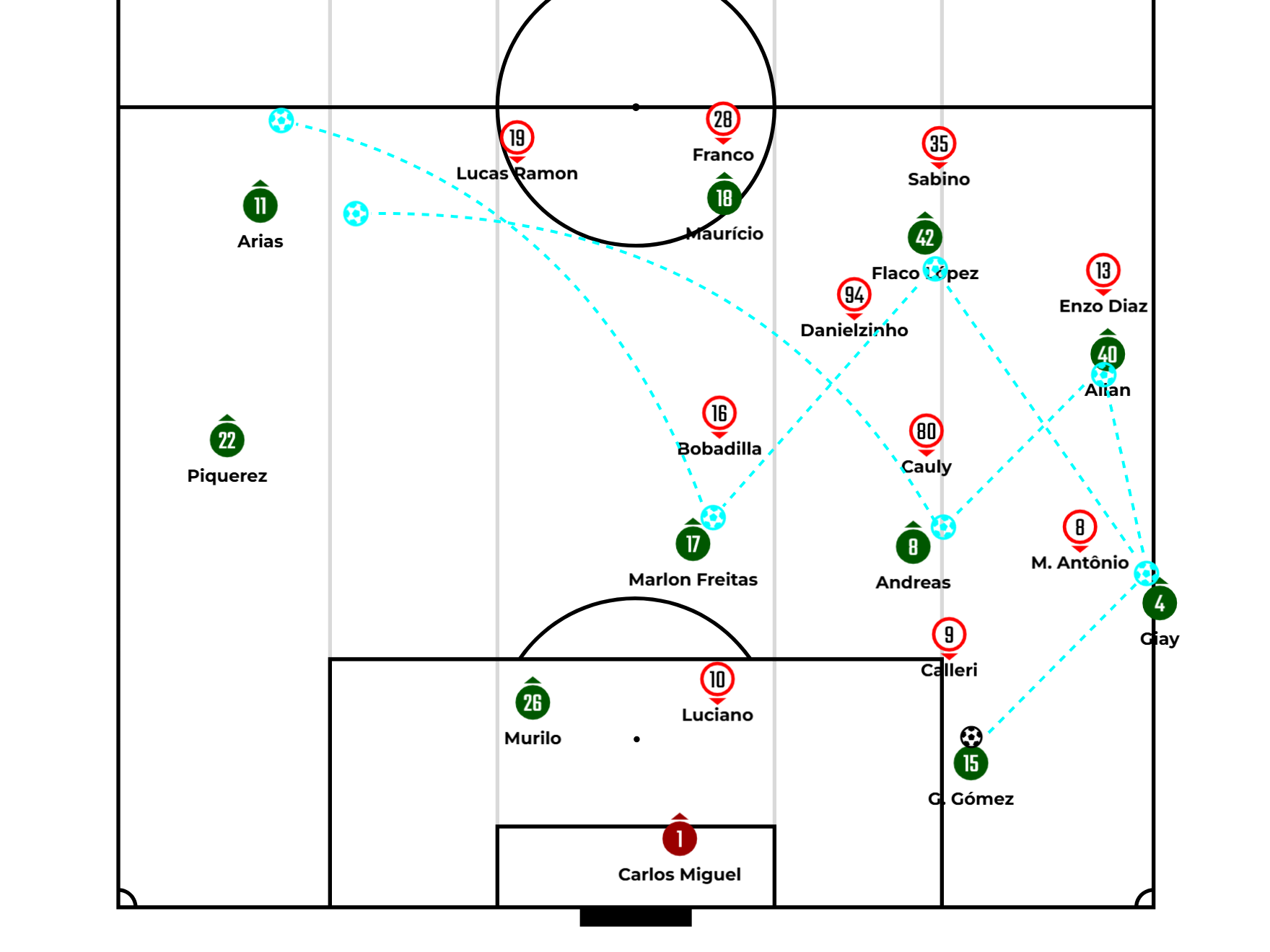
Palmeiras buildup in a 4-2-4 shape facing São Paulo’s compact high press.
Arias’ goal came early and proved decisive. Beyond his individual technical quality to carry the ball, escape pressure and finish precisely, the move originated from a well-rehearsed buildup pattern that Palmeiras repeated multiple times. Essentially, the team used one or more players as support so that Andreas Pereira or Marlon Freitas could switch play to the opposite side.
From a 4-2-4 shape, the winger and fullback occupied one corridor, while one of the forwards dropped inside to offer support. The idea was to attract São Paulo’s high pressing block to one side, allowing the midfielders to switch play to the opposite flank. This is exactly how Palmeiras manipulated São Paulo’s pressing references, switching the ball to Arias and Piquerez on the far side, where they were better positioned to launch a quick attack.
This strategy appeared several times throughout the first half. In addition, Palmeiras focused on creating chances through counterattacks. Trailing early, São Paulo continued pressing high but also spent long periods attacking in the opponent’s half, which exposed them to transitions.
São Paulo’s tactical adjustment
Roger Machado has tried to build on what worked best for São Paulo. The squad’s main reinforcements are central midfielders like Cauly and Danielzinho. With few natural wingers available, he needed to find a structure that used fullbacks for width while concentrating technical quality centrally. As a result, he deployed a 4-3-1-2 outline with clearly defined roles.
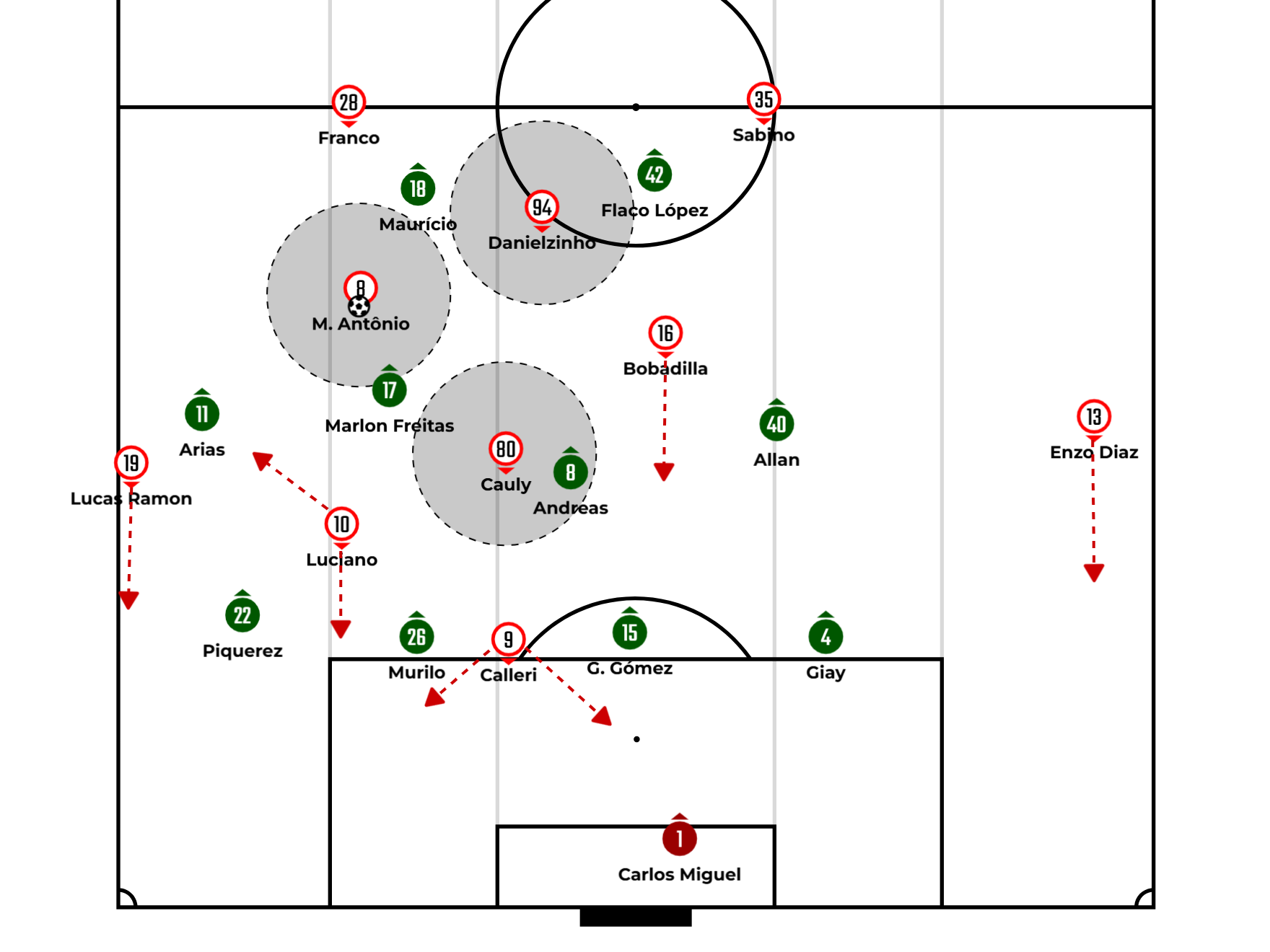
São Paulo attacking in a 4-3-1-2 formation, concentrating players centrally.
While the fullbacks provided width, the rest of the team focused on creating central superiority. Danielzinho played even deeper, sometimes dropping into the defensive line to help build up, acting as the initial playmaker. Marcos Antônio was the main creative force, drifting to wherever needed to break opposition pressure. Bobadilla attacked available spaces and added offensive presence, while Cauly operated as an advanced playmaker, often close to Luciano.
However, Palmeiras’ 4-4-2 defensive structure neutralized São Paulo’s central overload through strong horizontal compactness. When the ball reached the fullbacks, who were key outlets, wingers Allan and Arias tracked back diligently to double up with their fullbacks without leaving gaps. As a result, São Paulo’s attacks in the first half were largely ineffective, despite their possession.
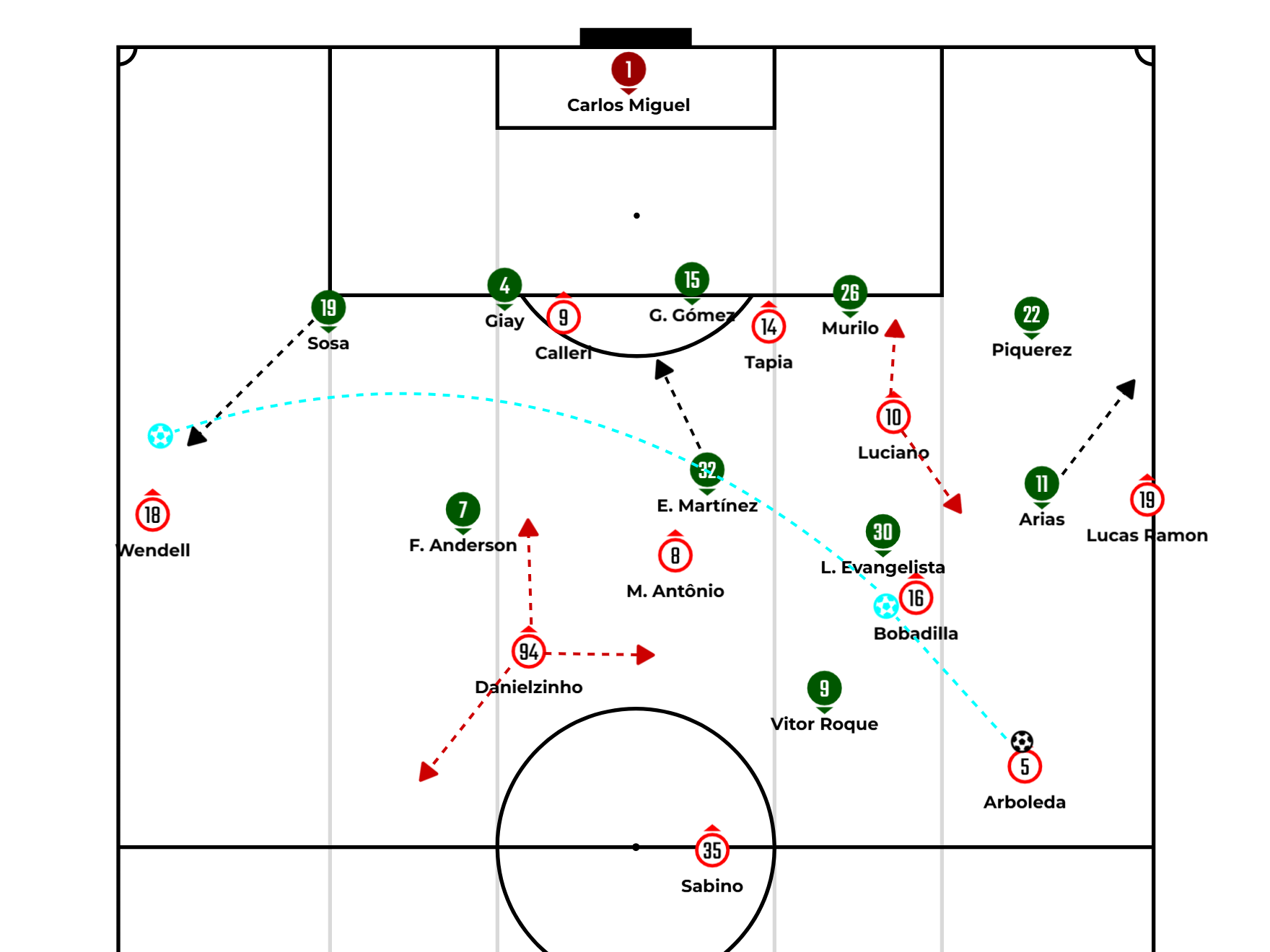
Second-half scenario with São Paulo using two strikers against Palmeiras’ 5-4-1 defensive shape.
In the second half, Roger Machado made a bold triple substitution: he removed Cauly, who had been neutralized between the lines, and introduced Tapia, adding a second aerial striker. Wendell (former Porto) replaced Diaz, and Arboleda (former Ecuador National Team) came in for Alan Franco. The change clearly shifted the strategy: instead of central superiority, São Paulo now focused on crossing toward two number nines.
Danielzinho became a deeper support player in buildup, while Bobadilla and Marcos Antônio alternated roles to attract pressure and switch play toward the fullbacks. This worked for much of the second half, as São Paulo circulated possession and switched play to Wendell and Lucas Ramon to attack wide and deliver crosses.
However, Abel Ferreira responded tactically. He refreshed almost the entire midfield and attacking line to restore intensity. Vitor Roque replaced Flaco López, while Martínez and Lucas Evangelista came in as midfielders. The key adjustment came with the substitutions of Maurício and Allan for Sosa and Felipe Anderson, which altered the team’s structure. Sosa dropped into the defensive line, forming a compact 5-4-1 shape that reduced space on the flanks and limited São Paulo’s crossing opportunities.
Takeaways
Palmeiras extended their lead at the top of the Brasileirão, reaching 19 points with their third consecutive win over São Paulo, one of their biggest rivals. Their next match is against Grêmio after the international break, but Abel Ferreira already knows he will be without left-back Piquerez, who suffered a serious injury while on duty with Uruguay.
Meanwhile, São Paulo not only saw their rival pull away but were also overtaken by Athletico, who defeated Botafogo in a postponed match. Roger Machado has barely started his tenure and is already under pressure from fans who did not accept Crespo’s dismissal. Coincidentally, his next chance for redemption comes against his former club Internacional, who began the season in the relegation zone but have won two consecutive matches to recover.


Comments