

Chelsea – Leeds United: Enzo Fernandez Fires Blues Into FA Cup Final (1-0)
Chelsea defeated Leeds United 1-0 at Wembley to qualify for the 2025/26 FA Cup Final. A solitary goal from Chelsea’s Enzo Fernandez was enough to decide the game as the Blues held firm defensively to make it to the final.
Tactical analysis and match report by Gaurav Krishnan.
We decided to make this article free to read. If you want to support our work, consider taking a subscription.
Things have quickly come full circle for Chelsea in recent weeks. Liam Rosenior’s swift departure after losing five games in a row was a necessary wake up call for the Chelsea squad, that this simply would not do.
Rosenior was axed quickly by the Chelsea owners amidst widespread protests against the Blueco regime in the weeks leading up to Rosenior’s departure. In truth, Chelsea have been pretty abysmal in the league which has seen them drop in the table from 6th to 8th, with Champions League qualification now seeming distant & out of reach.
However, there were some positives for Blues fans after Chelsea beat Leeds in this game to make it to the FA Cup Final against Manchester City. Chelsea started the game dominantly with their possession-based approach and began to slowly make inroads against the Leeds defense, leading upto the first half goal.
Things have also quickly come full circle for Enzo Ferndanez. The talismanic Chelsea midfielder was suspended for two games by Liam Rosenior following comments he made about living in Madrid during the last international break, a comment which urged Rosenior to suspended the Blues midfielder alluding that a line had been crossed.
Neverthless, it was Enzo Fernandez who was captaining the Chelsea side at Wembley against Leeds who popped up in the box to head home a Pedro Neto cross to give Chelsea a 1-0 lead in this semi-final. And that goal was enough for Chelsea to see out a 1-0 win against Leeds, who pushed and probed but couldn’t finish in the final third.
Leeds did test Chelsea with a few attempts on goal. But Robert Sanchez was on hand to make some crucial saves to deny Leeds any semblance of a comeback in this game. In the end, Chelsea won 1-0 with stand-in interim manager Callum McFarlane guiding the Blues to the FA Cup Final, where they will face Man City.
Chelsea lined up in a 4-2-3-1 formation. Robert Sanchez started in goal with a back four of Malo Gusto at right-back, Trevoh Chalobah and Tosin Adarabioyo at center-back, and Marc Cucurella at left-back. The midfield double pivot was anchored by Romeo Lavia and Moises Caicedo with Pedro Neto down the right, Alejandro Garnacho down the left and Enzo Fernandez in the no.10 slot. Meanwhile, Joao Pedro led the line as the central striker.
Leeds lined up in a 3-4-2-1 shape. Lucas Perri started in goal with a back three of James Justin, Jaka Bijol and Pascal Struijk. Jayden Bogle started at right wing-back with Gabriel Gudmundsson at left wing-back while the midfield comprised Ethan Ampadu and Ao Tanaka. Brenden Aaronson and Noah Okafor started as the dual attacking midfielders with Aaronson down the right and Okafor down the left, while Dominic Calvert-Lewin led the line up front.
Chelsea Start Brightly
Chelsea’s 4-2-3-1 under interim head coach Calum McFarlane became a fluid 3-2-5 in possession. Marc Cucurella tucked inside as a left-sided centre-back alongside Chalobah and Tosin, creating a back three that allowed the full-backs to push high while the double pivot of Romeo Lavia and Moises Caicedo screened centrally. This base baited Leeds’ man-oriented OOP press from their 5-2-3/5-4-1 block.
Pedro Neto and Alejandro Garnacho pinned Gudmundsson and Bogle respectively, preventing the wing-backs from stepping up freely. Joao Pedro varied his role as a 9 or deep-lying forward, occupying Pascal Struijk or Jaka Bijol to create half-space pockets for Enzo Fernandez in the no.10 role or Malo Gusto, who often inverted or pushed up, to receive between the lines. What was particularly interesting was the positioning of Gusto and Fernandez, both of whom dropped into the left and right midfield half spaces receiving between the Leeds lines and progressing the ball.
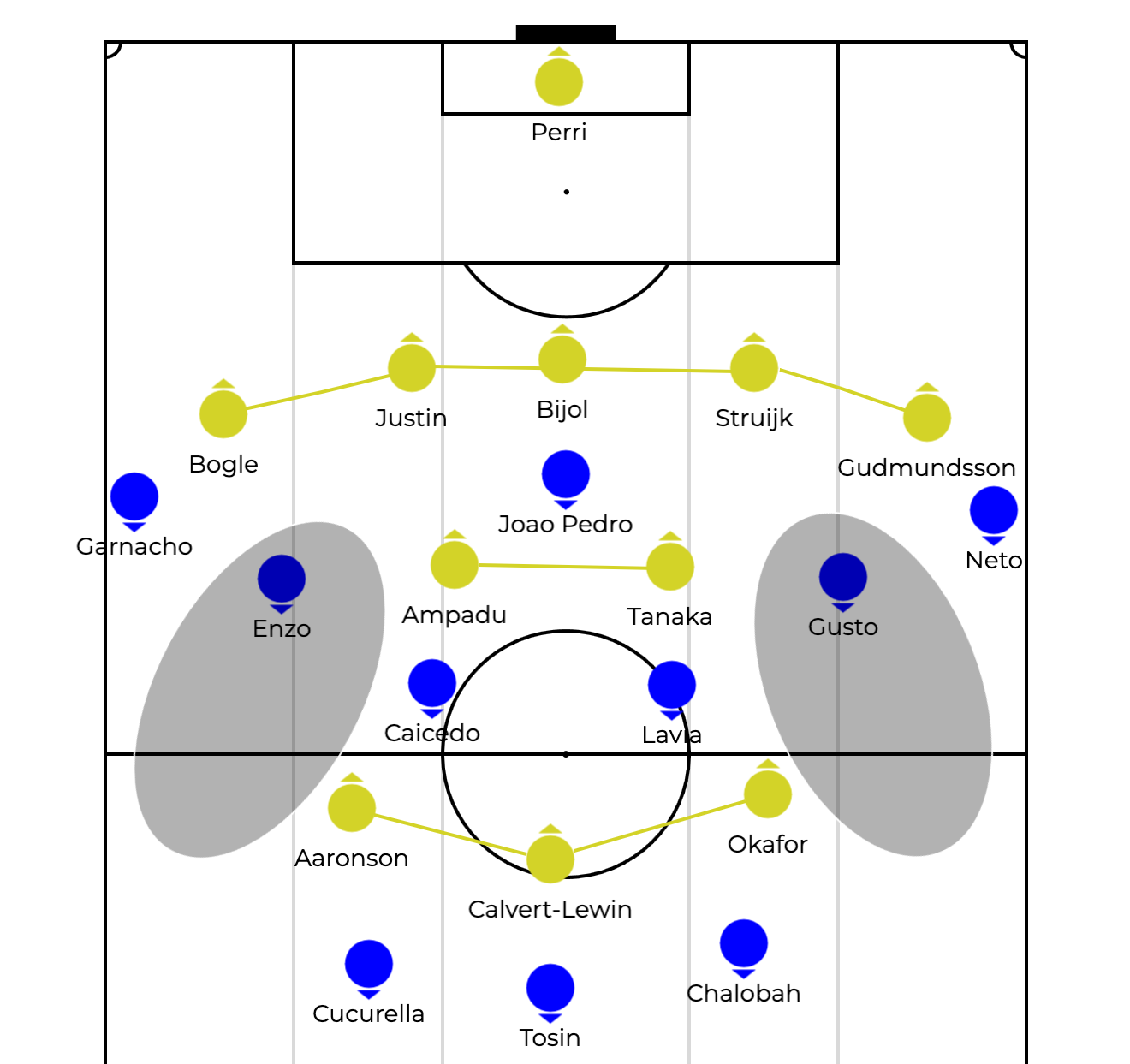 Chelsea build in their 3-2-5 IP shape against Leeds’ 5-2-3 OOP block. Gusto and Enzo Fernandez occupy the space between the lines between the Leeds CB & WB and wide of their CMs. This was a recurring theme in the game and allowed Chelsea space to progress the ball via Enzo and Gusto.
In the opening 15 minutes Chelsea occasionally built short from Robert Sanchez, inviting Leeds’ aggressive front press. When Leeds pressed man-to-man, Chelsea switched to direct play using long balls into Joao Pedro or long diagonals or chipped passes. This stretched Daniel Farke’s side and created second-ball opportunities for the Blues. Gusto and Fernandez dropped into the axis of space between Leeds’ wide centre-back and wing-back, receiving with time to turn or carry.
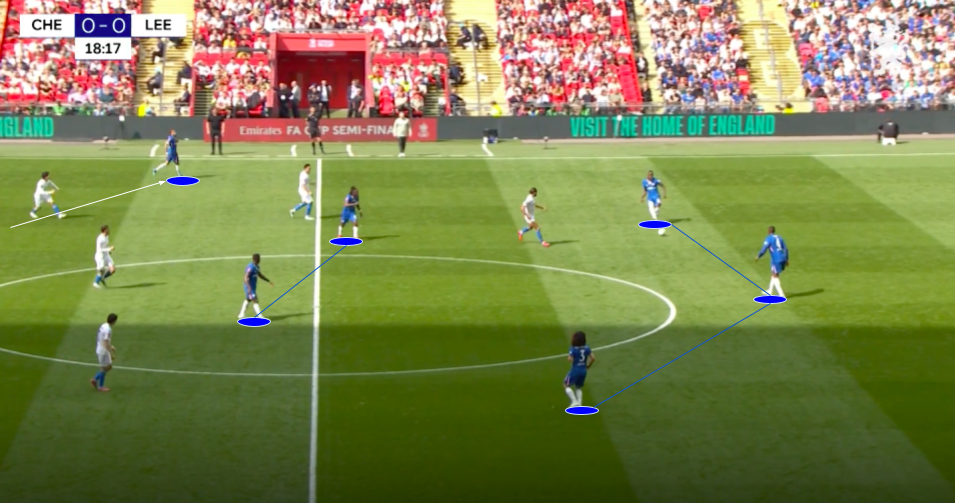 Gusto’s positioing in Chelsea’s 3-2-5 build up. Gusto (far right), like Fernandez on the opposite flank, but slightly differently inverted into midfield from RB and then dropped into the right midfield space pocket between the Leeds WBs and CBs and wide of the Leeds midfield pivot. This allowed fluid ball progression for the Blues & confused Leeds backline when they attempted to jump.
Neto and Garnacho provided depth on the flanks, forming triangles with Cucurella & Gusto. Wide triangles would often form between either Garnacho, Cucurella and Enzo on the left or Neto, Gusto and Joao Pedro on the right. These connections exploited the distance Leeds’ wing-backs had to cover when jumping & also led to confusion as to when to jump as the Leeds backline didn’t know when to press and when to sit.
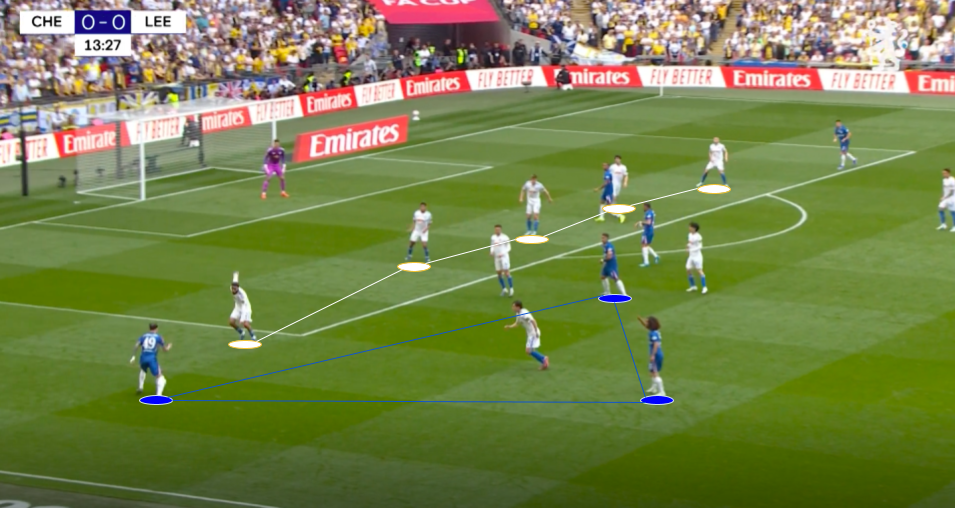 An example of Chelsea’s wide triangles. Here Garnacho, Enzo and Cucurella form a wide triangle attacking Leeds’ 5-4-1 OOP block. This wide triangle overload was utilised quite often on both flanks as Chelsea made inroads against the Leeds backline, with Garnacho particularly finding purchase, however, he was rather wasteful in end product.
Leeds deployed a hybrid 5-2-3 to 5-4-1 OOP shape to defend against Chelsea. Leeds shifted shapes using a 5-2-3 in higher phases and 5-4-1 in a low block in their own half when Chelsea kept the ball in their half. Ethan Ampadu and Ao Tanaka sat as a double pivot in a 5-4-1 low block when deeper, with the back three and wing-backs forming a compact five. The press aimed to force errors in Chelsea’s 3-2 build-up but left gaps when Chelsea bypassed the first line with direct balls or quick switches.
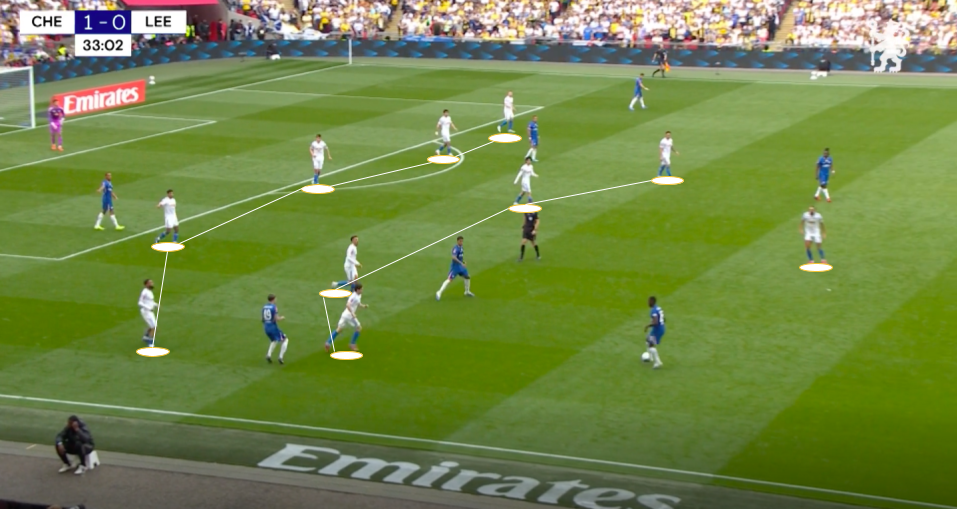 Leeds sit in their 5-4-1 OOP block whilst defending deep in their own half against Chelsea possession.
Struijk’s positioning was particularly vulnerable to long balls over the top, as seen for the Chelsea goal.
Enzo Fernandez Fires Blues Ahead As Aaronson Tests Sanchez
Leeds in their in possession IP shape relied on verticality through the wing-backs and the two attacking midfielders dropping to link with Calvert-Lewin. Bogle and Gudmundsson provided width, but the narrow 3-4-2-1 structure made them susceptible to being pinned.
Early on in the first half, Leeds created the game’s clearest chance when Calvert-Lewin’s superb through-ball released Aaronson, whose low shot was diverted away by Sanchez’s outstretched leg. This counter-attack exposed Chelsea’s defensive weaknesses but also highlighted Leeds’ reliance on individual quality and counter-attack breakaways.
The 23rd-minute goal for Chelsea underpinned the Blues’ direct approach against Leeds’ press. A long ball from Sanchez and then a high press from Joao Pedro forced Struijk into a loose touch in midfield. Chelsea transitioned instantly with quick wide play that released Neto, whose inch-perfect right-wing cross was met by an unmarked Fernandez, who had timed his arrival from the No 10 role to perfection, to head into the Leeds net.
The header gave Chelsea a deserved lead after they had grown into the half, dictating tempo with 65% first-half possession. Fernandez’s movement of dropping outside the press and arriving late in the box and also him dropping from the no.10 slot into the wide left midfield space to playmake, became a recurring theme in the game.
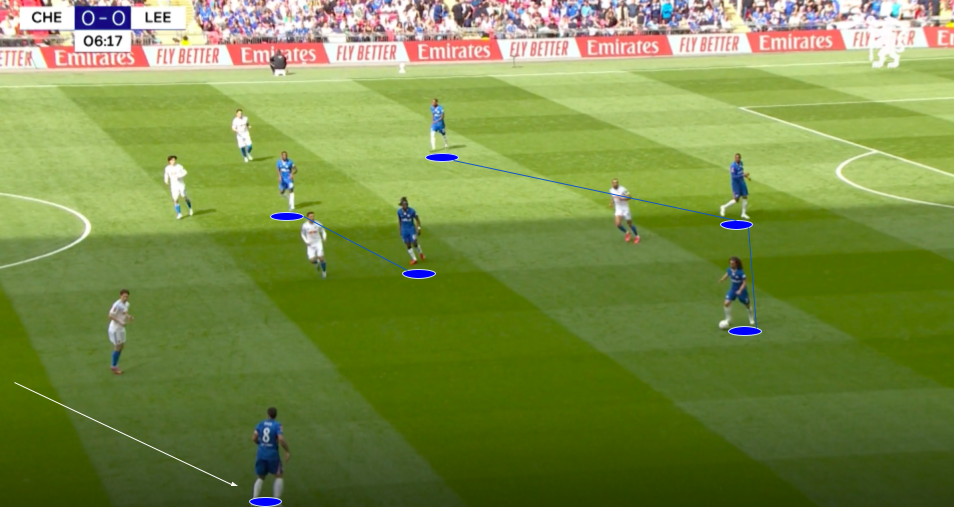 In Chelsea’s 3-2-5 build up, Enzo Fernandez drops into the left midfield space from the no.10 slot. This happened quite often with Enzo dictating the game from midfield as Leeds found it difficult to cut him off.
Joao Pedro’s hold-up play and link-up were central to Chelsea’s control. He lifted balls over defenders, combined slickly with Neto and Garnacho, and created a near-post chance that struck the woodwork just before the goal. Garnacho’s runs on the left created depth for Cucurella to overlap or underlap but Garnacho was largely wasteful despite a lot of Cheslea’s play running through the left, while Neto’s directness on the right stretched Leeds. The midfield pivot of Lavia shielding & Caicedo progressing provided balance with Lavia’s higher positioning as an 8 allowing Chalobah to step up, without leaving gaps in behind. Meanwhile, Enzo dictated the game from midfield popping up in the pockets and connecting play, and he also got the decisive goal.
Enzo Fernandez leads all the Chelsea players in Ball Progression: Pass + Carry % vs Leeds
— Statocaster Gaurav (@statocastgaurav) April 28, 2026
And he ranks highest by a midfielder from both Leeds & Chelsea in this game#FACup #CHELEE
(via @markstatsbot) pic.twitter.com/o0ralzdPfv
Leeds Push & Probe But Can’t Finish As Sanchez Saves
Chelsea’s out-of-possession OOP shape was a 4-1-4-1 with Joao Pedro leading the line, Fernandez and Lavia pushing as the 8s to mark Ampadu and Tanaka as Caicedo sat in the pivot. Chalobah stepped aggressively as the right centre-back to engage half-space runners while Tosin covered behind, suiting their defensive profiles. This created a high-intensity counter-press that forced turnovers in dangerous areas. Sanchez’s early save of Aaronson’s 1v1 was the first major test; it preserved the clean sheet and allowed Chelsea to settle.
At half-time Farke adjusted Leeds’ personnel and shape. Bijol was replaced by Anton Stach giving a more dynamic midfield presence and Justin came off for Joe Rodon. Leeds shifted toward a back-four or 4-3-3 hybrid, which became a 2-3-5 in higher phases against Chelsea with Leeds pushing the wing-backs higher and flooding midfield via Stach and Tanaka, to match Chelsea’s numbers. This granted them more possession of 57% in the second half and allowed Stach to roam.
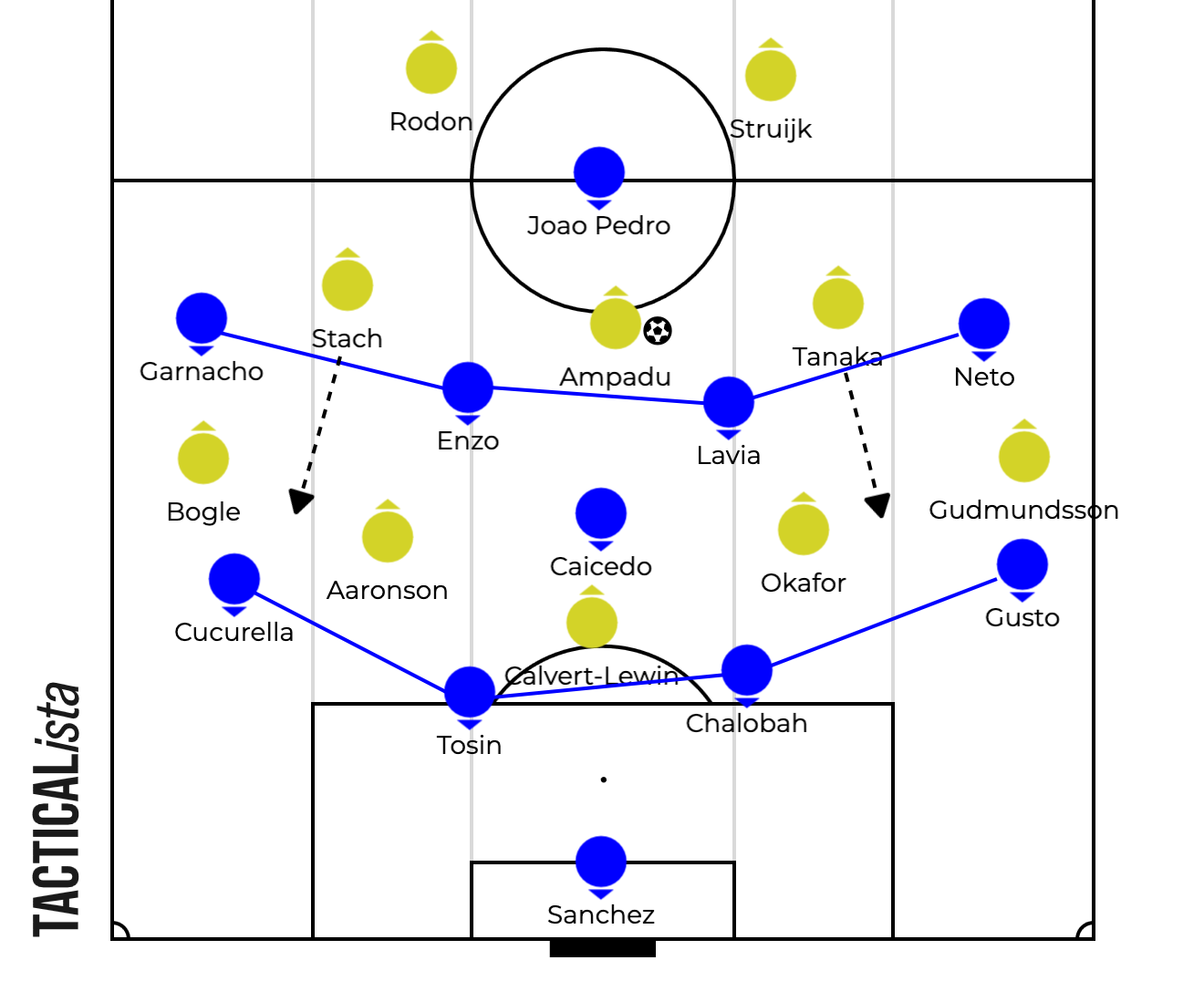 Farke’s changes in the 2nd half as Leeds shift to a more aggressive 2-3-5 in their IP shape in higher phases from a 4-3-3 hybrid shape against Chelsea’s 4-1-4-1 block. Tanaka and Stach push higher from midifeld to overload the space betwen Cheslea’s FB and CBs as Ampadu sits in the pivot progressing the ball. However, Leeds can’t score despite a thunderous strike from Stach which was saved by Sanchez.
Stach’s immediate piledriver from long range, saw Sanchez tipping the ball over the bar. Calvert-Lewin continued as the lone striker but now benefited from deeper support runs from Stach, Aaronson and later substitutes Lukas Nmecha and Willy Gnonto.
Chelsea adapted without panic. McFarlane’s side dropped into a more compact 4-1-4-1 to 4-4-2 mid-block when Leeds built, using Fernandez, Lavia and Caicedo to screen while the full-backs tucked in. The counter-press remained sharp as Lavia and Caicedo recovered quickly to prevent transitions. Sanchez’s command of the box was decisive. He parried Stach again and dealt with Calvert-Lewin’s header by catching the ball expertly. Tosin and Chalobah marshalled the strikers effectively, winning aerial duels and covering half-spaces.
Substitutions reinforced Chelsea’s control of the game. Lavia’s 65th-minute exit for a more defensive option in Andrey Santos tightened the midfield. Garnacho made way for Cole Palmer at 71 minutes and then Neto switched flanks, while Palmer operated on the right with freedom to roam. These changes maintained width and creativity without sacrificing Chelsea’s structure. Palmer’s late involvement added a threat on transitions, including a long-range effort.
Leeds’ late push featured more direct balls and set-pieces where they are a dangerous aerial threat, but Chelsea’s defensive organization held firm. Caicedo’s booking on the hour and subsequent flashpoints reflected rising tension, yet Chelsea refused to concede territory. McFarlane’s game management shone in this game as Sanchez’s brief “injury” treatment widely interpreted as a tactical time-wasting timeout broke Leeds’ momentum. The time-wasting and deliberate slowing of play drew criticism but proved effective in this tight affair.
Farke admitted post-match that Leeds were “clumsy in build-up” and “a bit nervous” at Wembley, despite superior xG and shots. Their 7-game unbeaten run came to an end because they could not convert their second-half pressure into clear chances against Chelsea’s renewed grit under McFarlane. McFarlane’s disciplined structure delivered Chelsea’s first goal against top-flight opposition since March and their first clean sheet in weeks since Liam Rosenior was sacked. In the end, Chelsea won 1-0 without being outrightly tested too much in a much-needed win for the club and the Blues fan base.
Chelsea 1 : 0 Leeds
— Statocaster Gaurav (@statocastgaurav) April 28, 2026
- Penbox shots: 5 - 4
- Deep Entries: 9 - 5
- Buildup completion: 83.5% - 83.1%
- PPDA: 8.6 - 9.5
- High turnovers: 6 - 2#FACup #CHELEE
(via @markstatsbot) pic.twitter.com/TskXCJeM2Y
Takeaways
For Leeds, this was a game that they could have and should have got more purchase from. However, they couldn’t convert the chances they had into goals against a resolute Chelsea backline. Sanchez saved and denied Leeds and despite more dominance in the second half, they couldn’t progress into the FA Cup Final. Farke and the Leeds fans will certainly feel that they could have done more, but it wasn’t to be.
For Chelsea, this was an important win for the club and the club’s fans despite being under management of interim boss Callum McFarlane. After the uncertainty following Liam Rosenior’s departure and the abysmal results under the former Chelsea boss, this was a huge win for the club and the Blues fan base. It was certainly a game where they turned their fortunes around with a gritty and passionate display that secured a 1-0 win to qualify for the FA Cup Final, something that was clearly missing under Rosenior. Chelsea will now face Man City in the final with the hope of winning some silverware by the end of the season.
Use the arrows to scroll through all available match plots. Click to enlarge. Check the match plots page for plots of other matches.


Comments