
Liverpool – Chelsea: Reds & Blues Rue Missed Chances As They Play Out Tepid Stalemate At Anfield (1-1)
Liverpool and Chelsea drew 1-1 at Anfield in a stalemate that elucidated the frustrations from both clubs’ fan bases with their respective teams’ performances this season. Ryan Gravenberch’s early opener was cancelled out by Enzo Fernandez scoring from a free kick as the game ended agonisingly level by full-time.
Tactical analysis and match report by Gaurav Krishnan.
We decided to make this article free to read. If you want to support our work, consider taking a subscription.
This has been a season to forget for both Liverpool and Chelsea. For the Reds, Arne Slot’s rebuild hasn’t gone according to plan. Despite breaking the bank to sign top players and spending over 400m, the Reds have hugely underperformed this season from the heights of their Premier League title triumph last season, in Slot’s first season in charge at Anfield.
Meanwhile for Chelsea, their managerial uncertainty and the revolving door of managers hasn’t helped their cause. Enzo Maresca was unceremoniously sacked midway through the season and his replacement Liam Rosenior couldn’t steady the ship as Chelsea lost five games in a row in the Premier League leading to Rosenior’s sacking. With their loss to Nottingham Forest in the last gameweek, that run extended to six losses on the trot going into this fixture against Liverpool.
So this game was one where both clubs were caught in a flux. And the result and performance from both sides on the evening perhaps reasserted that. Liverpool took an early lead via Ryan Gravenberch’s strike that flew into Filip Jorgensen’s net. However, Enzo Fernandez’s wicked free kick evaded everybody to nestle into the Liverpool net making it 1-1 in the first half.
Both sides had chances as the game progressed with two goals disallowed for offside after VAR checks as Cole Palmer and Curtis Jones’ goals were stricken off. In the end, the game ended level with both sides sharing the points at Anfield.
Liverpool moved into 4th place in the Premier League table as they remain on course for Champions League qualification. But for Chelsea, this draw meant they moved to 9th place, with qualification for the Champions League increasingly getting out of their grasp.
For Chelsea, in the end, interim manager Callum McFarlane did end their woeful run of six consecutive losses by getting a draw and a point against the Reds at Anfield. But now all eyes will firmly be on the FA Cup Final against Manchester City coming up for the Blues.
Liverpool lined up in a 4-2-3-1 shape. Giorgi Mamardashvili started in goal with a back four of Curtis Jones at right-back, Ibrahima Konate and Virgil van Dijk at center-back and Milos Kerkez at left-back. The midfield double pivot was anchored by Ryan Gravenberch and Alexis Mac Allister. Jeremie Frimpong started down the right, Rio Ngumoha down the left and Dominik Szoboszlai in the no.10 role while Cody Gakpo led the line up front.
Chelsea lined up in a 4-2-3-1 formation. Filip Jorgensen started in goal with a back four of Malo Gusto at right-back, Wesley Fofana and Levi Colwill at center-back and Jorrel Hato at left-back. The midfield double pivot was anchored by Andrey Santos and Moises Caicedo. Cole Palmer started down the right, Marc Cucurella down the left with Enzo Fernandez in the no.10 slot. Meanwhile, Joao Pedro led the line as the central striker.
The First Half Ends Level
Liverpool’s 4-2-3-1 became a 3-2-5 in their in possession IP build up shape. The right-back Curtis Jones often tucked inside and inverted into midfield to create central overloads or support rotations. One midfielder, typically Gravenberch or Mac Allister, dropped alongside the centre-backs to form a temporary 3-2 base which became a 3-1-6 shape in deeper phases, aiding to better ball progression and supporting the Liverpool rest defense.
The Reds left winger young Rio Ngumoha held width aggressively, combining with Kerkez for overlaps and 1v1 and 2v1 isolations against Gusto who was Chelsea’s RB. This allowed quick switches to the far-side, creating 1v1 attacks with Kerkez overlapping late.
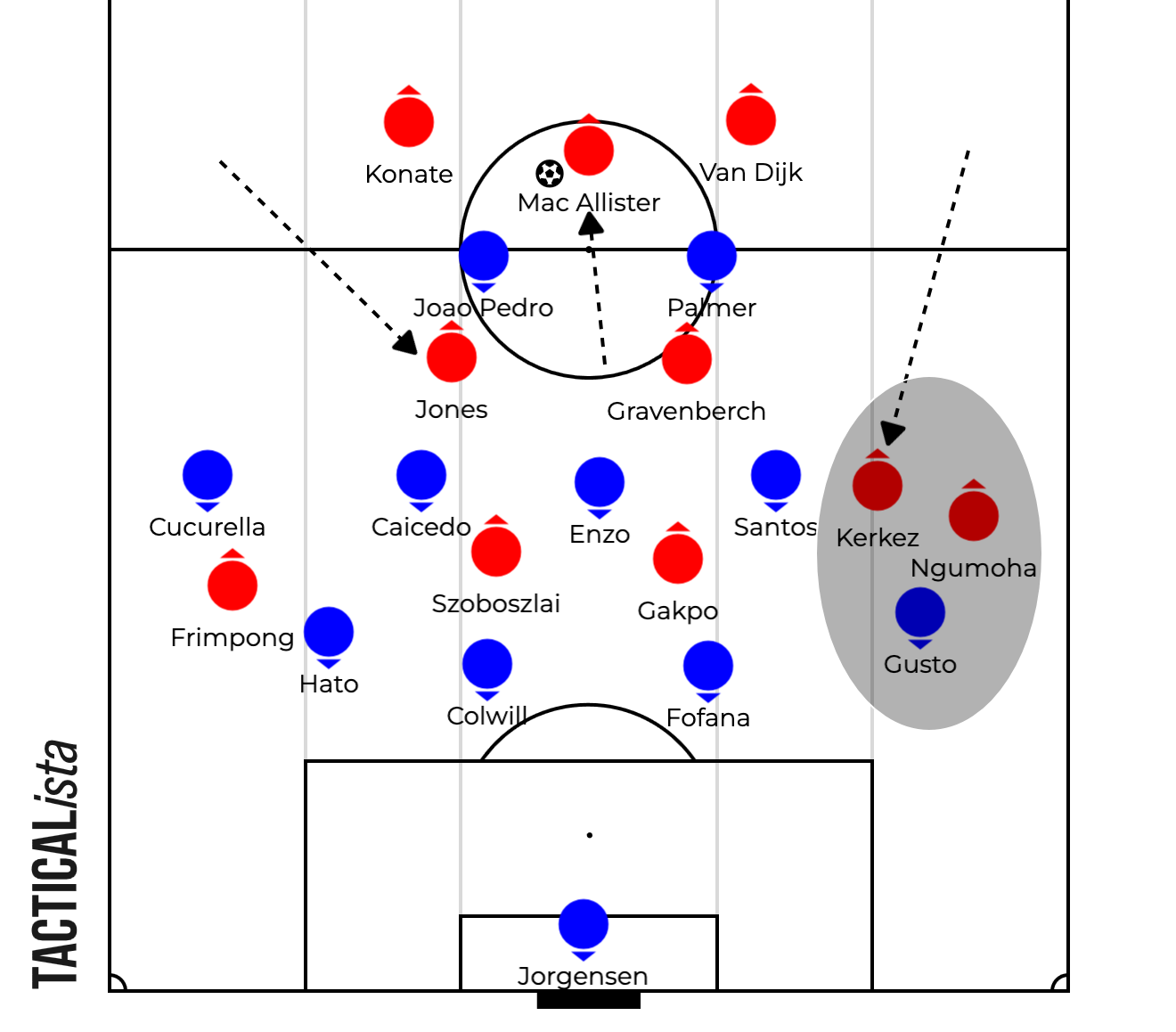 Liverpool build up in a 3-2-5. Jones inverts from RB into the midfield pivot as Mac Allister drops into the back three to progress the ball. Meanwhile, Kerkez inverts higher up from LB to create a 2v1 against Chelsea’s RB Gusto along with Ngumoha.
Early on, faster diagonals and aggressive Zone 14 occupation created threats for the Reds. However, too many touches, slow switches, and predictable central play allowed Chelsea to settle. Wide isolations generated Liverpool’s best entries into the Chelsea box, but their overall xG around 0.56 (as per Sofascore) for Liverpool at home was their worst in a Premier League home game in a long time. Frimpong offered pace on the right but faced criticism post-match for his limited output and defensive lapses.
Ngumoha was key early on, linking with Kerkez before teeing up Gravenberch’s curling opener from the edge of the box in the 6th minute. Liverpool used third-man combinations, runs from half-spaces, and overloads via ball circulation & rotations against Chelsea as Szoboszlai operated as a dynamic no.10 with forward runs, while Gakpo acted as a focal point. However, Gakpo was largely isolated and contributed few touches in the first half.
Without the ball, in their OOP shape, Chelsea alternated in a compact 4-4-2 mid-block with aggressive 4-2-4 presses on goal kicks and press triggers. The Chelsea double pivot of Santos & Caicedo mitigated Liverpool’s central progression. While the wingers tucked in intelligently with the distances staying compact. This frustrated Liverpool’s central penetration despite their possession dominance early on in the first half.
Chelsea’s pressing in 4-4-2 shape with the first line Palmer & Joao Pedro made build-up difficult for Liverpool early on. They grew confident as Liverpool sat off, using the block to spring transitions on the counter. Chelsea were defensively solid overall with their CB pairing of Fofana & Colwill staying compact & organised, although they were vulnerable to quick wide switches.
The equaliser from Chelsea came in the 35th minute as Enzo Fernandez’s low free-kick into the box evaded everybody and flew into the bottom corner of the Liverpool net. That made it 1-1 and poised the game evenly going into half-time.
Chelsea and Liverpool have goals disallowed
In their in-possession IP shape Chelsea resorted to a 3-2-5 in the second & third phases, with both wing-backs pushing high. Cucurella was particularly influential as an inverted or overlapping threat from the left side of the pitch, in the game. Chelsea’s 3-2-5 shape created low 5v4 advantages centrally against Liverpool’s block.
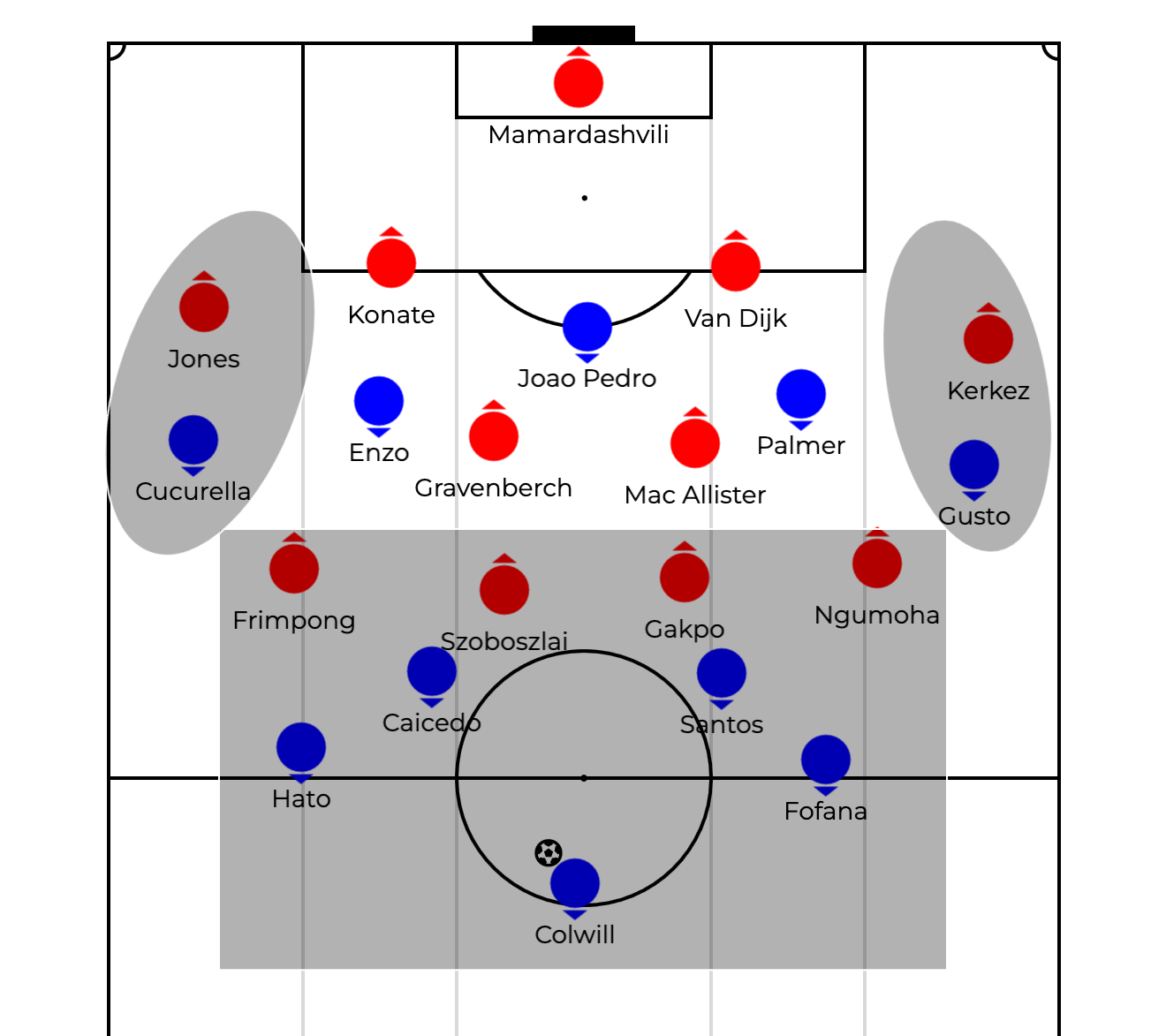 Chelsea’s 3-2-5 build up creating a 5v4 advantage in midfield against Liverpool. Meanwhile, Cucurella and Gusto isolate the Liverpool FBs 1v1.
Attacks from Chelsea were transition-heavy and direct. They bypassed the Reds press via vertical outlets, attacking the channels quickly, and forcing Liverpool’s CBs Van Dijk & Konate into being pulled out of position and defending through balls. Joao Pedro acted as a focal point, receiving to feet, pinning the Reds CBs, and bouncing first-time passes for runners including Fernandez, Palmer, and the wing-backs to exploit depth. When Joao Pedro dropped alongside Enzo and Palmer, it created a 3v2 advantage against Liverpool’s double pivot. This disrupted Liverpool’s OOP significantly.
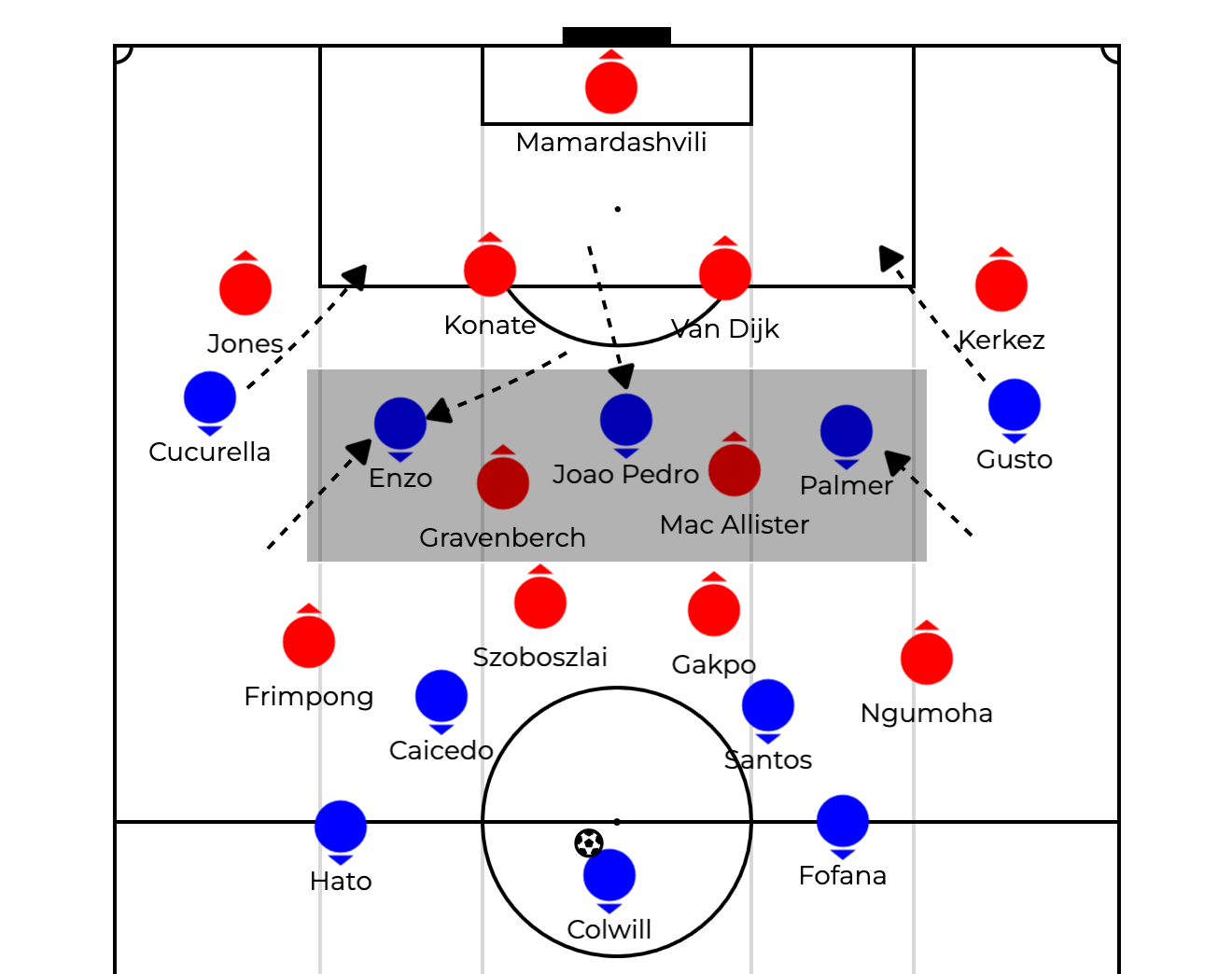 Joao Pedro drops from CF into midfield alongside Enzo and Palmer as Enzo drifts from the no.10 position and Palmer from the right-flank. This creates a 3v2 advantage for Chelsea against Liverpool’s double pivot. Meanwhile, Cucurella and Gusto attack the space in behind the Liverpool FBs and CBs.
Cole Palmer & particularly Moises Caicedo found space to thread balls, often targeting Cucurella’s runs off the ball and movement down the Chelsea left causing problems for the Liverpool defense via through-balls and 1v1s down the left side of the pitch. Meanwhile, rotations on the right including Palmer & Gusto also targeted Liverpool’s right side.
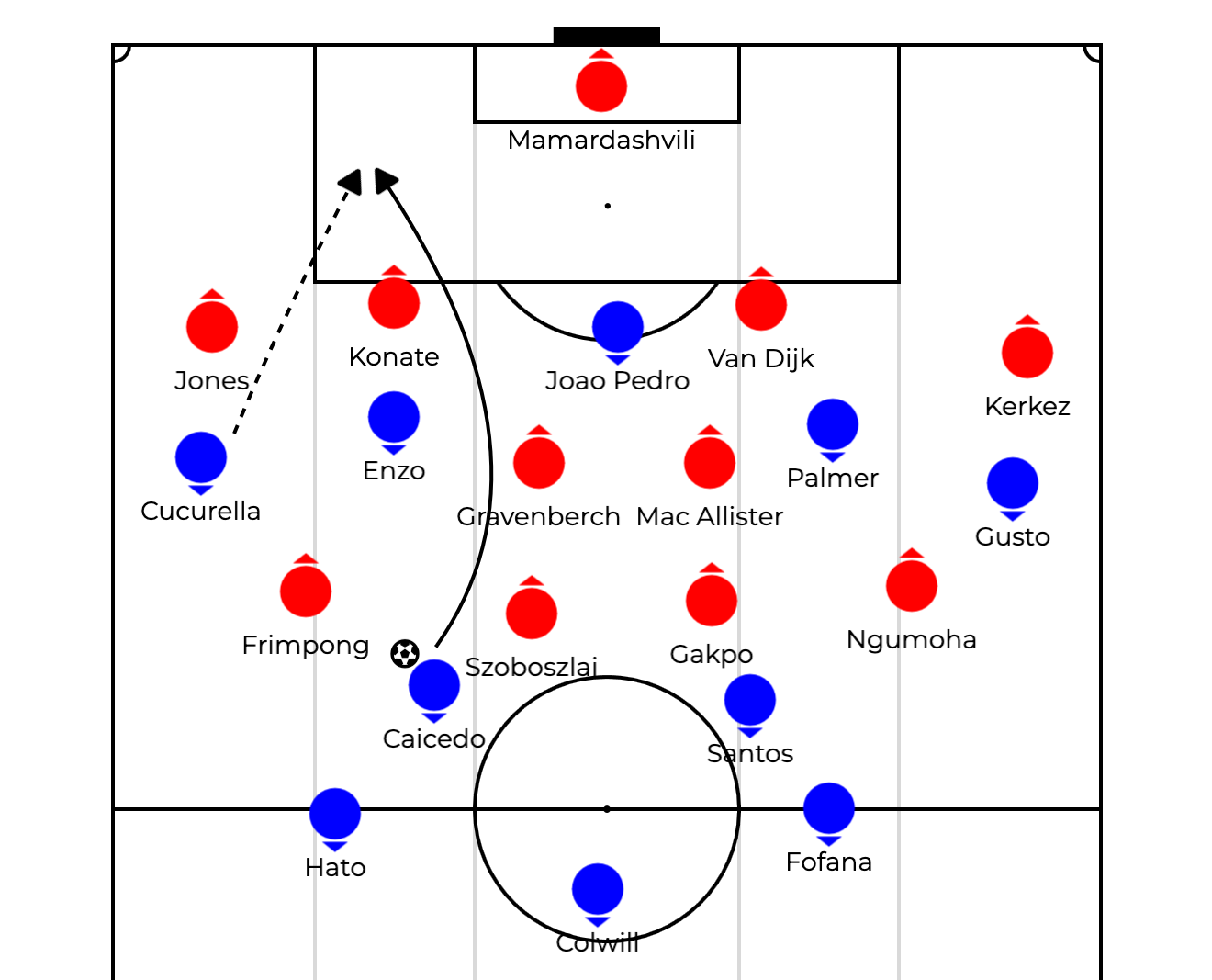 A recurring theme in the game. Cucurella made runs in behind the Liverpool defense between the FB and CB as Moises Caicedo repeatedly found him via a ball over the top creating several chances for Chelsea.
In their OOP shape, Liverpool initially pressed high in a 4-4-2 diamond with Mac Allister splitting between Chelsea’s double pivot of Santos & Caicedo with the Liverpool CBs creating a +1 on Joao Pedro. After the Chelsea equalising goal, they dropped into a more passive stance using a mid to low zonal 4-4-2 block, inviting Chelsea forward and struggling to sustain intensity or win the ball high.
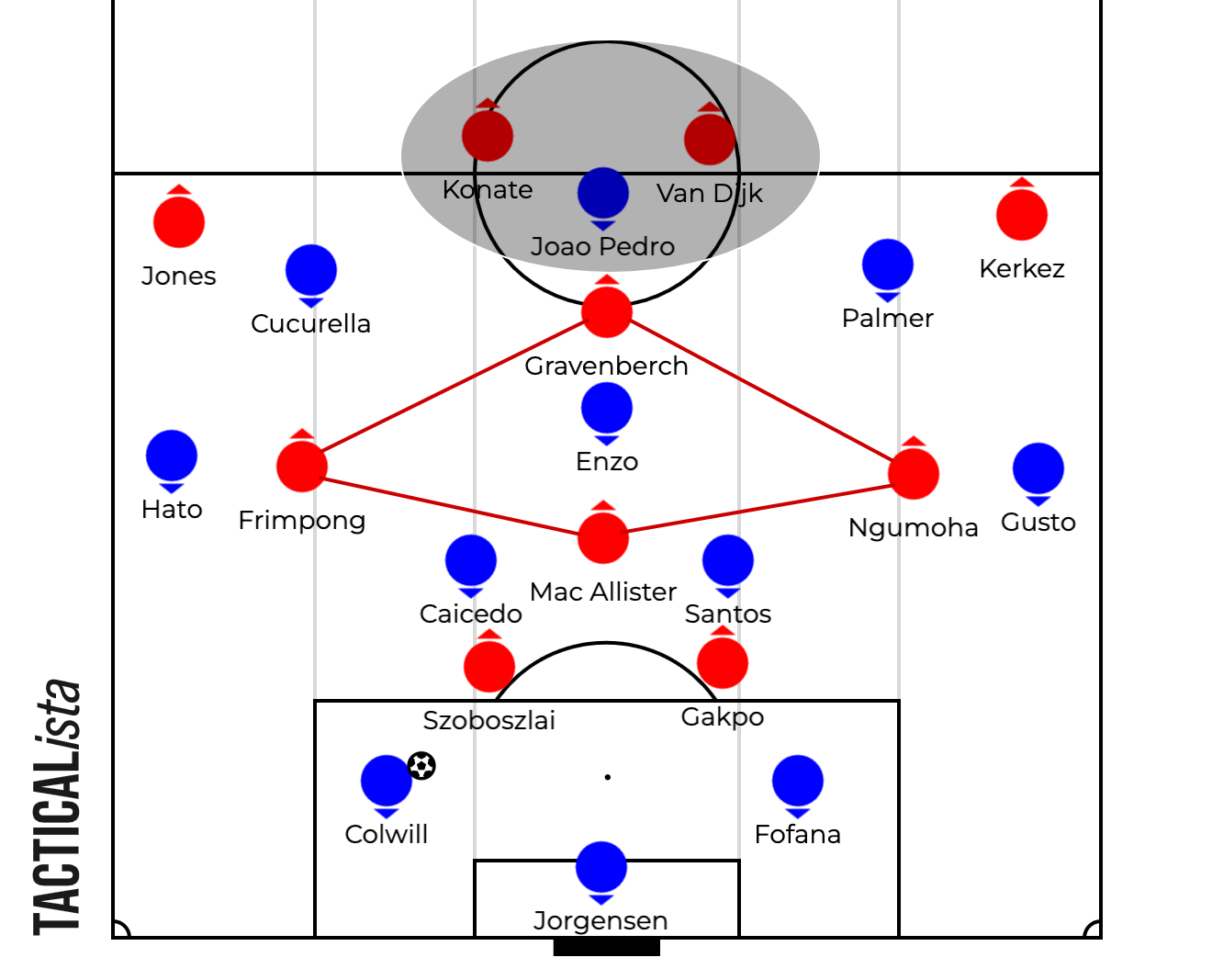 Liverpool press high up the pitch in a 4-4-2 diamond. Mac Allister presses the Chelsea pivot of Santos and Caicedo as the Liverpool CBs Van Dijk and Konate have a +1 against Joao Pedro. Meanwhile, Gakpo and Szoboszlai form the front pressing two.
This handed initiative to Chelsea, who exploited channels and through-balls especially on their left side. Defensively, the back four with Jones at RB faced issues against Chelsea’s rotations, while set-piece vulnerabilities persisted for the Reds as well.
In the second half, both sides had goals disallowed. VAR called for offside for Palmer’s goal as Cucurella drifted offside in build-up for Chelsea, While Jones’ goal for Liverpool was also stricken off for an offside for Cody Gakpo who had strayed slightly offside before his headed-assist into Jones.
The Game Ends In A Stalemate
Liverpool began with a higher intensity and hit the woodwork twice with some late chances. Szoboszlai’s strike bounced off the post, and Van Dijk’s header hit the crossbar. Chelsea shepherded what was left of the dangerous Liverpool breaks & chances by staying compact.
Chelsea’s 3-2-5 & compactness in their OOP shape earned praise for pinning Liverpool back at times, with Cucurella’s energy & industry the standout for the Blues going forward. Liverpool’s passivity after scoring was duly criticised for being lethargic, lacking intent, inviting pressure from a side like Chelsea who were low on confidence & coming into this game having lost six in a row in the Premier League.
McFarlane’s setup using rotations, Pedro as the central target man and wide play disrupted Liverpool effectively on the counter. While Slot’s side showed flashes with Ngumoha’s early promise, and the Liverpool counter-press working efficiently, but they largely struggled with sustained intensity, shape, and set-piece management.
Low shot volume in the game, i.e. 14 in total with 8 for Liverpool and 6 for Chelsea underscored a cagey low SoT contest. As Liverpool’s xG of 0.56 and Chelsea’s xG of 0.50 further elucidated the lack of attacking threat from both teams in the game.
Both sides pushed late for a goal, but there was no winner in the end.
Takeaways
For Liverpool this was yet another game where they were tepid in attack and failed to score more than one goal against a reeling Chelsea side. They did hit the post in the second half, but were largely passive for long spells in the game. The plus point is that Liverpool have almost secured qualification for the Champions League as they moved into 4th after this result. However, in the broader sense, Slot will have to contend with this season being a failed one.
For Chelsea, at least interim boss Callum McFarlane ended their 6-game losing streak by securing a draw. And Chelsea could have won the game if it wasn’t for Cucurella’s offside for the Palmer goal. There were some positives for the Blues with the return of Levi Colwill and Reece James, however, Champions League qualification now seems out of reach. It’s all eyes on Wembley in the FA Cup Final now for the Blues.
Use the arrows to scroll through all available match plots. Click to enlarge. Check the match plots page for plots of other matches.


Comments