
Belgium – Egypt: The First Transitional Game Of The Tournament? (1-1)
Belgium and Egypt went through all the phases. Egypt was the more proactive team, with Hossam Hassan making a bold call with Mohamed Salah, before Belgium bored with poor buildup play. In the second half, Rudi Garcia made another change that saw the game open up to the transition.
Tactical analysis and match report by Joel Parker.
We decided to make this article free to read. If you want to support our work, consider taking a subscription.
Fragments of a golden generation remain, but is Belgium on the verge of a dark age or an industrial revolution?
Gone are the days of Roberto Martínez trying to crowbar attackers into wing-back positions, with the protection of Vincent Kompany, Jan Vertonghen and Toby Alderweireld: Rudi Garcia has Belgium in a back four, whose high fullbacks have offered less security. Kevin de Bruyne is still a valuable piece to the structure, although his technical and physical condition is far from his peak. However, the team has regenerated in terms of its wide attackers. Jérémy Doku has taken his game further than being just an elite one-versus-one winger, having finished the season in excellent form for Manchester City. Charles De Ketelaere can also lessen the creative burden.
Egypt are also on a limited time with their best-ever player. Mohamed Salah may also be at a reduced level, yet he still has the potential to light up the tournament. Hossam Hassan has a team comfortable in sitting deeper, a defense built on the spine of Al-Ahly, Egypt and Africa’s most successful team, whilst being spearheaded by world-class Premier League talents, Salah and Omar Marmoush. Their record in tournaments has been sketchy, zero points in 2018 and not present in Brazil or Qatar. It would not take much for Hassan to deliver a more competitive performance.
Garcia opted to have no traditional striker, in his 4-2-3-1 formation, Romelu Lukaku on the bench and De Ketelaere up front. Leandro Trossard was added to the attack, with Aston Villa duo Amadou Onana and Youri Tielemans in the double pivot. Lille defenders Thomas Meunier and Nathan Ngoy made the right side of the back four, with Brandon Mechele and Timothy Castagne on the left. Having missed EURO 2024 due to injury, Thibaut Courtois was back between the posts.
Hassan had both Salah and Marmoush available, also in the 4-2-3-1 shape. Behind them were Egyptian Premier League regulars and Hamdy Fathy, who plays in Qatar. Mostafa Shobeir started in goal, with Mohamed Hany and Ahmed Fatouh as fullbacks. Fathy and Yasser Ibrahim were the center-backs, with Marwan Attia and Mohanad Lasheen in midfield. Emam Ashour and Mostafa Ziko completed the team in the attack.
Salah central and Ashour’s double movements
One particularly fun element of World Cups can be the quest of elite players, dragging their national team upward and having to take on roles that serve the entire team. This can be a detriment to a player’s strengths in establishing a more functional buildup. Deploying the elite in the number ten position means that they can service both sides of the field and are always in proximity to the ball. David Alaba for Austria is the most extreme example, but Salah’s position as the player behind the striker took some getting used to, having been so used to seeing him take up positions on the right.
Nevertheless, Egypt were the more proactive team at the start of the game. Their 4-2-3-1 system did not prompt major positional shifts: Shobeir often started the sequence with a switch or a direct pass to the left, and Lasheen was more active in dropping into the single pivot, whilst Attia had more involvement in possession on his right shoulder. Width was held by the fullbacks, so Ziko, the right-winger, could run between Michele and Castagne, allowing Salah to show for the pass.
Out-of-possession, Belgium arranged themselves in a passive 4-2-4/4-4-2 shape with Trossard on the right and De Bruyne/De Ketelaere in the center. In this block, Belgium faced issues. Firstly, both wingers were in too deep positions to make aggressive jumps onto the fullbacks and could not angle their jumps to block the player behind. Secondly, the passive nature of the block meant that small adaptations could see space drawn out wide, even if the winger was positioned higher. On the right, Attia (who could situationally occupy the right fullback space) had the space to move in Doku’s blind side and create even more space for Hany to receive the switch. On the left, it was the double movements of Ashour that gave Meunier a dilemma, whether to stick or follow. Combined with Trossard not shutting off the angle and Egypt’s expansive shape was rewarded with spaces opening in this area.
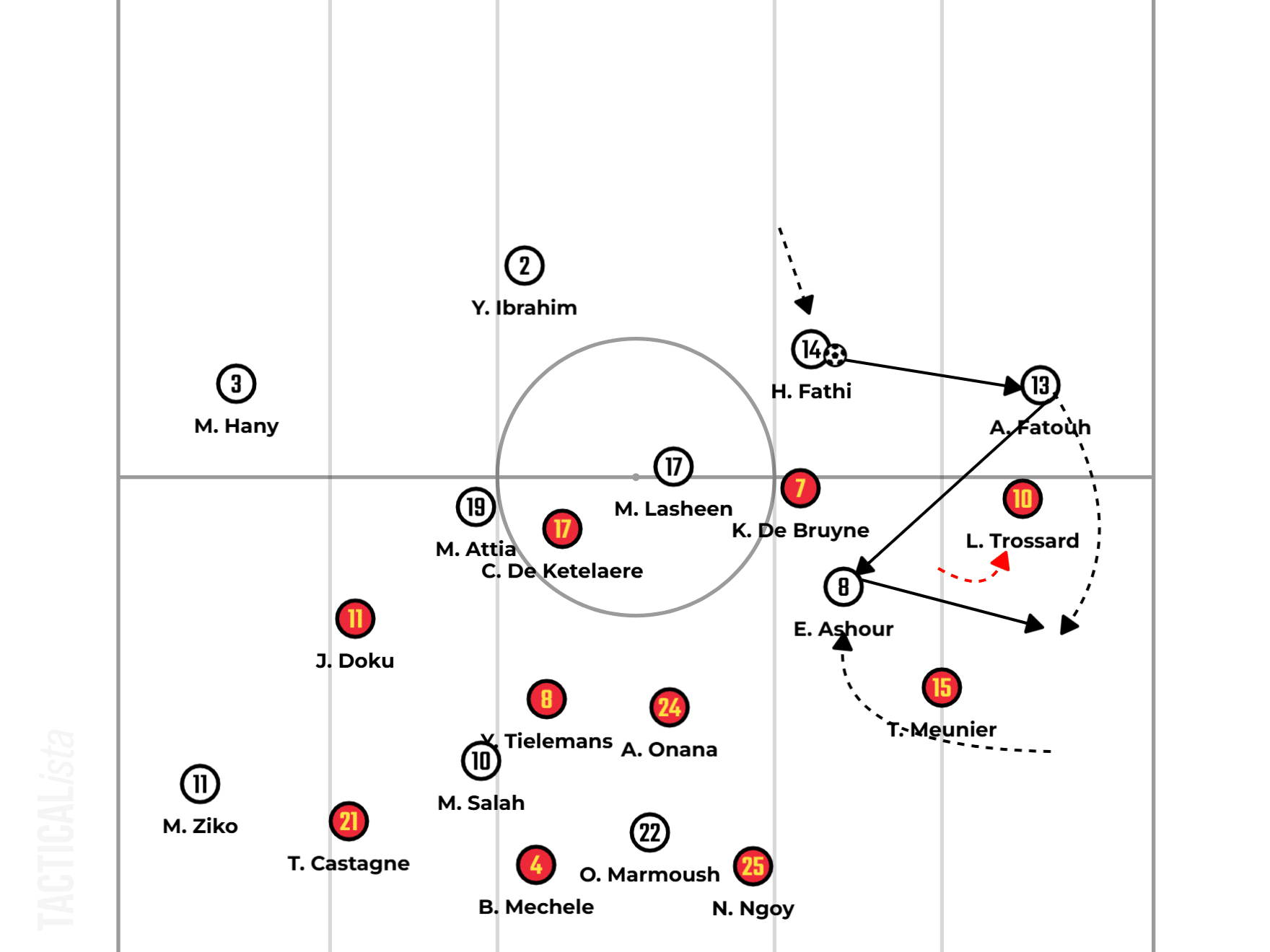
4th minute: Circulation and a rotation from Egypt in possession. As the ball moved out from the right and onto the left, Fathi stepped up with the ball and passed to Fatouh. Ashour moved out from the outer channel and into the halfspace, Meunier was stuck between tracking the player and marking the zone. Trossard did not close the passing lane to Ashour and a one-two was made between fullback and the winger.
Egypt showed that they could gain territory without overly committing themselves from deep. Tielemans and Onana were cautious in shifting into wide defensive positions, so as not to free up Salah or Marmoush to drive the ball against the center-backs. Their shot count was limited, but they had established themselves in possession.
Additionally, the choice to play Salah centrally and Ziko on the right also had a positive effect on the defensive transition. Doku was the avenue that all Belgian transitions looked towards, so having a winger who could put in the leg work and leave Salah high in the defensive block would be an important position when Egypt played on the counterattack. Nevertheless, it was the shift from Attia and Lasheen that stifled Doku’s game, performing an aggressive counterpress, and both slid out wide to stop the transition at source.
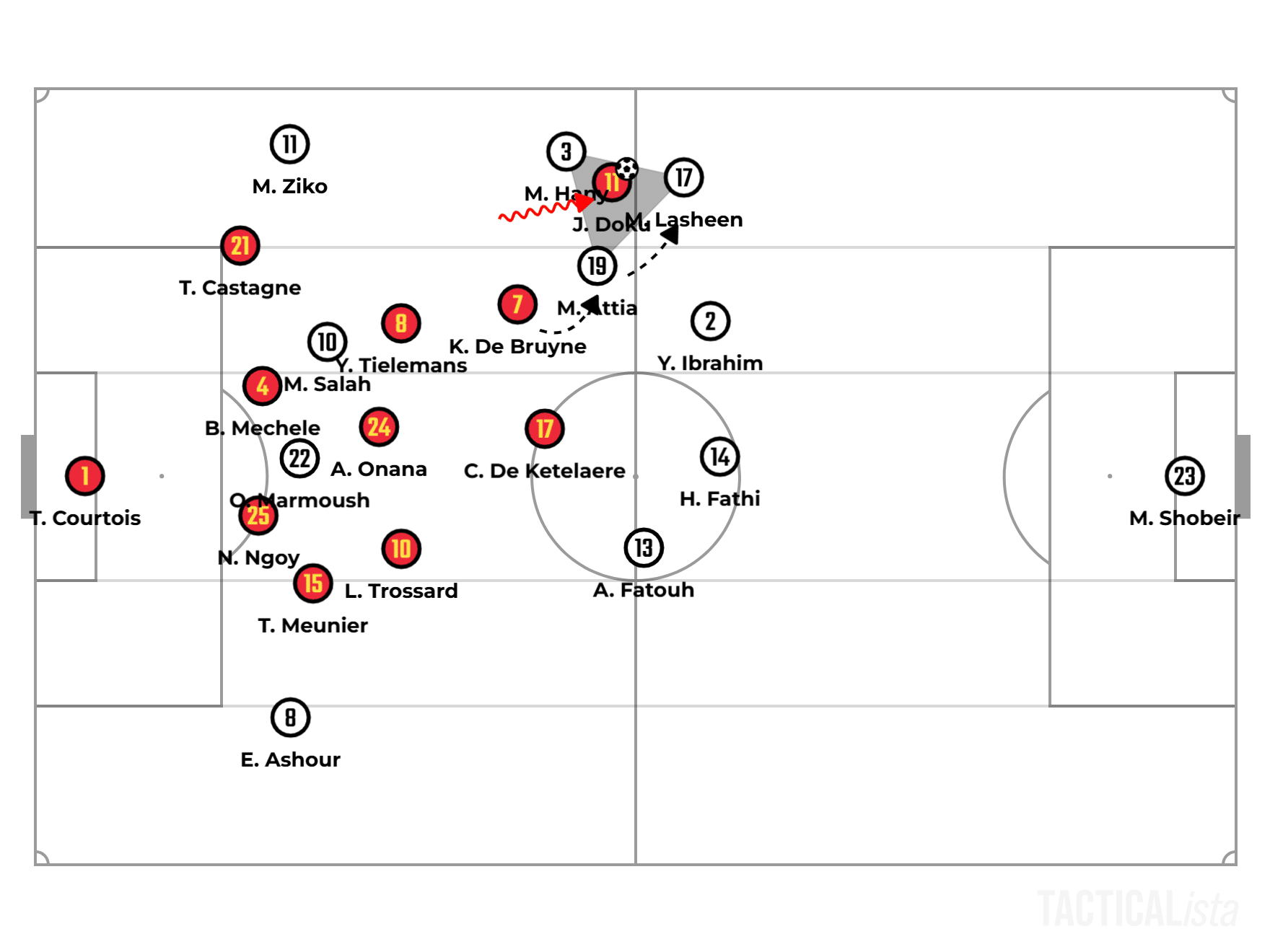
10th minute: Counterpress from Egypt after the cross was cleared. De Bruyne would flick the ball onto Doku and the winger attempted to run, only for both the double pivot to shift over and compress the space as much as possible. Attia made the tackle and forced the turnover.
After eighteen minutes, a positive Egyptian start was rewarded. Salah would drop behind the ball line as Hany and Ziko interacted. Salah opened his body and the diagonal lane was open with Trossard remaining higher. Plenty of space was available for Ashour to fake the run in behind and come short to receive on the edge of the semi-circle, with plenty of separation against Meunier. He still had a lot to do and a powerful shot flew past Courtois. A fantastic goal.
Lifeless Belgium
In possession, Belgium started the game with plenty of players around the base. Center-backs Mechele and Ngoy were not afraid to step forward with the ball to try and entice pressure, but with Onana fixed deep, as well as drops from both Tielemans and De Bruyne, Belgium ended up with multiple players outside of the opposition block. Doku held width on the left, whilst De Bruyne and De Ketelaere floated against the defensive line. The result was De Bruyne getting more of the central touches, De Ketelaere only getting the ball on the outside and no synergy or countermovements from the forwards, which could pull the defense open.
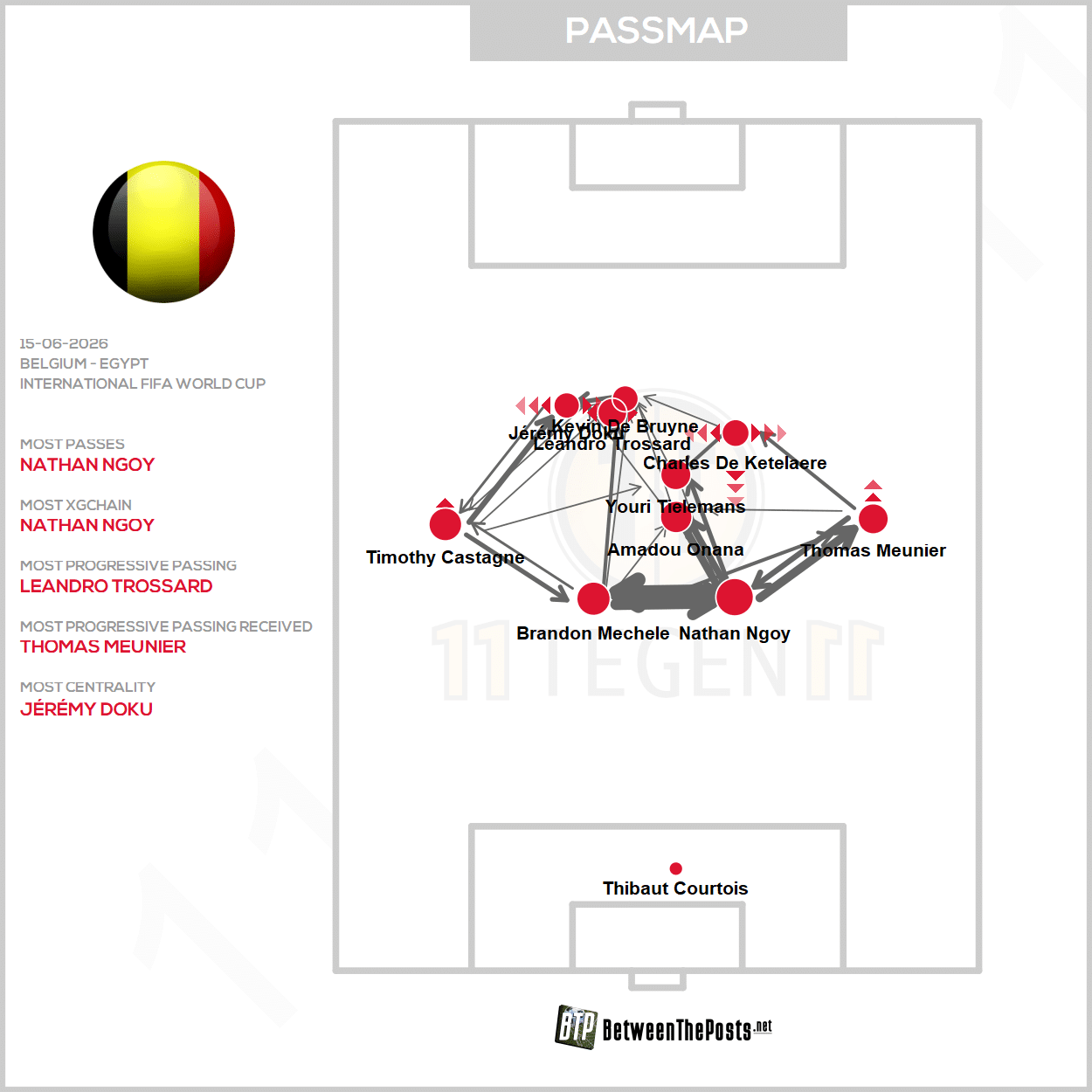
Plenty of passes but attackers bunched, far from goal, in the Belgium passmap.
Egypt was very organized off the ball. Lasheen frequently dropped between the center-backs when they were in the low block, which saw Hany keep his occupation on Doku and Ziko follow the underlapping runs that Castagne tried to produce. Lasheen and Attia’s close defensive work to the last line meant the spaces were open for Tielemans to receive on the half-turn, the first line of pressure from Egypt could be split with Marmoush and Salah overloaded. However, the narrow positions of Trossard meant that the next Belgium pass would be in a congested area, with no width holding from Trossard or Meunier in the process.
Then Garcia swapped the forwards. After thirty minutes, Trossard was the attacker holding width on the left, whilst Belgium tried to work situations where Doku was receiving the pass that Tielemans would receive. Meanwhile, the Aston Villa midfielder would push up into the attack more frequently on the right side and Doku would be one of the roamers from the right, to receive in central zones.
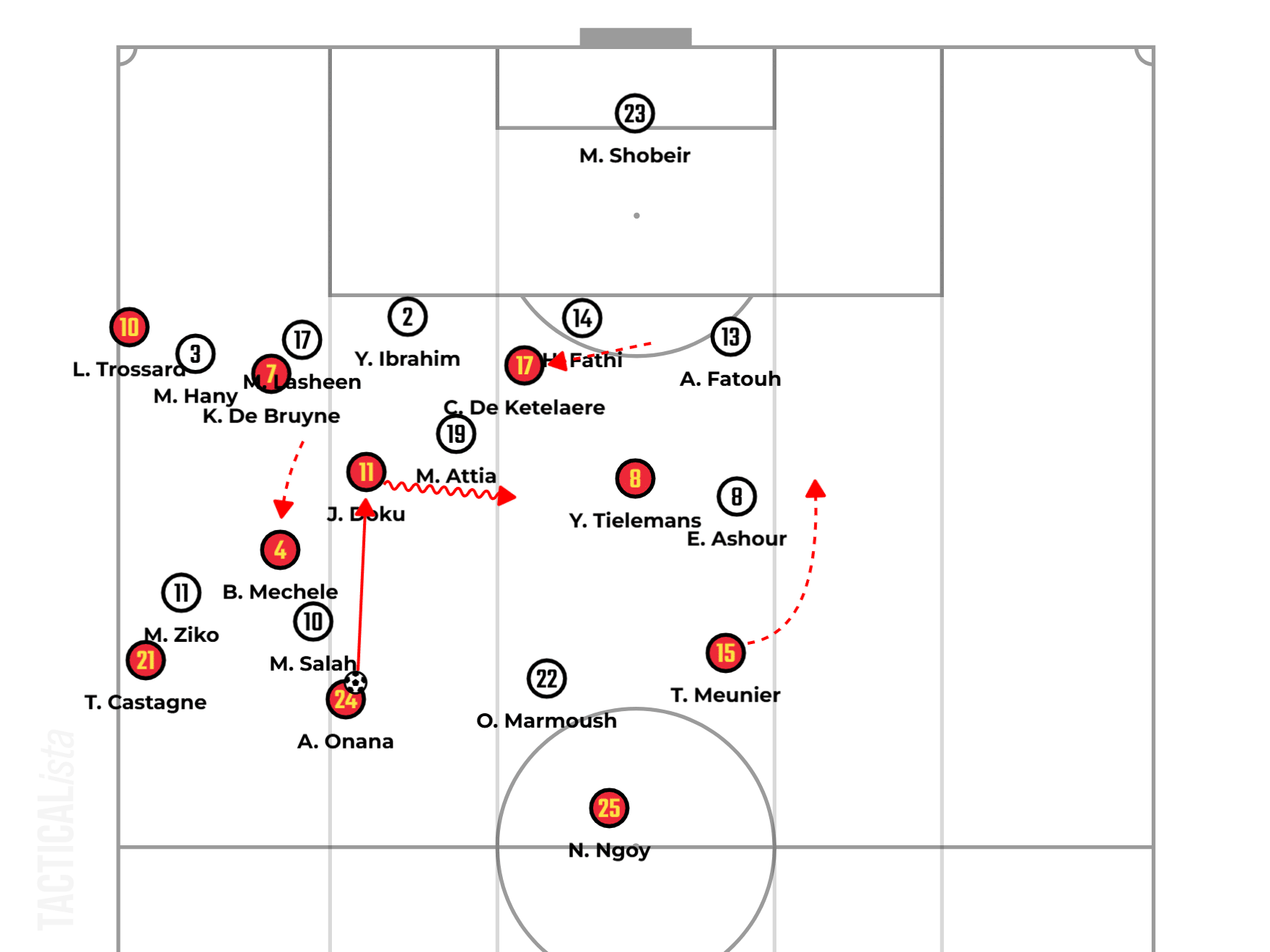
41st minute: Doku receiving in different positions. After a Mechele run and carry, Castagne passed back to Onana, who had the space to turn and pass to Doku, in a very different zone to what he was in earlier in the game. Despite being in space, Doku chose to move back onto his right foot and Belgium offered no final third creativity. De Ketelaere showed for the ball, Tielemans remained still and there was no player to directly attack the fullback. In this phase, Doku’s pass was intercepted before Meunier’s pass back inside spilled to the Egyptian midfield for a transition.
The constant switching of positions was designed to get plenty of interactions between Belgian attackers. In this regard, Garcia got his attackers close but only ever in front of Egypt’s back five and never behind it or high up in the final third. No countermovements or runs in behind, no rehearsed moves or patterns. Belgium offered very little against an Egyptian team that continued to target the outlet and dominated the ground duels in the process (27 won out of 45, in the first half).
A game of transitions opens and fades
Garcia switched again at the start of the second period. Doku was now the single figure spearheading the attack, whilst De Ketelaere offered maximum width on the right side. As Doku showed for the ball, De Bruyne and Tielemans were the midfielders moving around to try and force an opening, or at least, stretch the defensive block vertically. It is at this period that Doku’s dribbling had a more dangerous effect and he was able to utilize his strength to ride through the challenges of Attia. Two fouls won in good positions, one direct free-kick striking the outside of the post from De Bruyne.
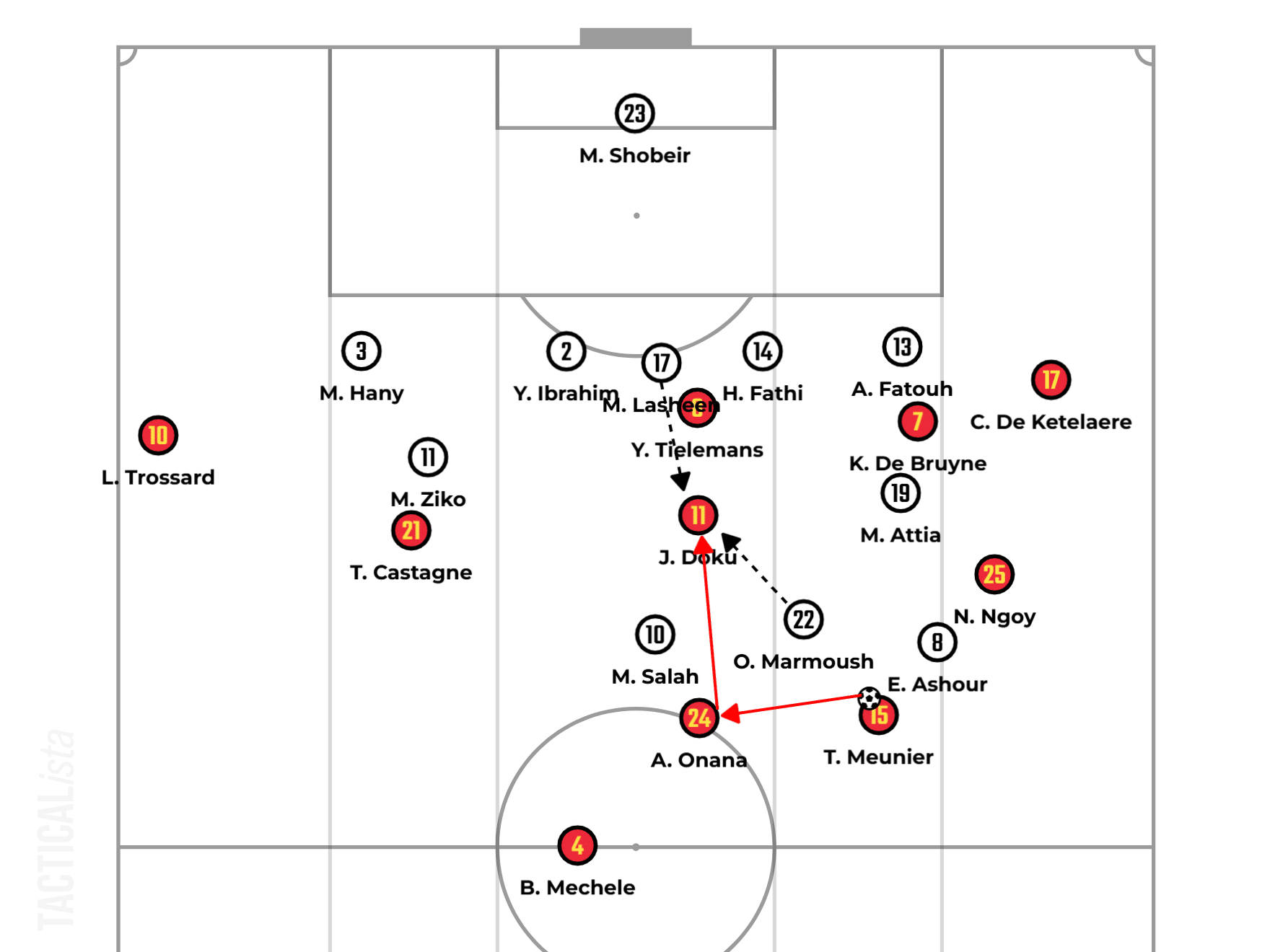
49th minute: Belgium’s attack changed again. By moving De Ketelaere onto the outside channel, Belgium stretched the Egyptian block vertically and Doku’s dribbles had a better effect.
As Belgium started to try to bring more speed, this game state suited Egypt better, with both Salah and Marmoush transitioning from central spots. Just before the hour mark, Egypt had a couple of decent chances to add a second to their tally, targeting Ngoy with runners on the outer left channel.
First, it was Ziko, who lapped onto a long ball from Fatouh as Meunier stepped too high. He passed to Marmoush into the box and the first phase was handled, only for a cross to come in from Fatouh and Salah’s header was theatrically saved from Courtois… only for the goalkeeper to push the header straight to Ashour. In space, close to goal and going for power, Ashour did not have the precision that he had to capitalize, and his shot spun out for a throw-in.
A few minutes later, Belgium transitioned after turning over a deep Egyptian throw-in. Trossard chopped back and Tielemans played a neat pass into the box, only that De Bruyne could not sort his feet out. From there, Attia found Salah and Marmoush knocked the ball around Ngoy to race through. Ngoy recovered enough to throw off the Manchester City striker, but it would be a chance rued.
Another chance would be played into De Bruyne inside the box, after Doku held up and Meunier overlapped to produce a cutback, but the goalkeeper saved a tame attempt. A few minutes later, Marmoush put pressure on Ngoy once more, thanks to Salah quickly linking the sequence as he knocked the pass over to the last line. Marmoush cut back and his deflected shot dropped wide of the far post.
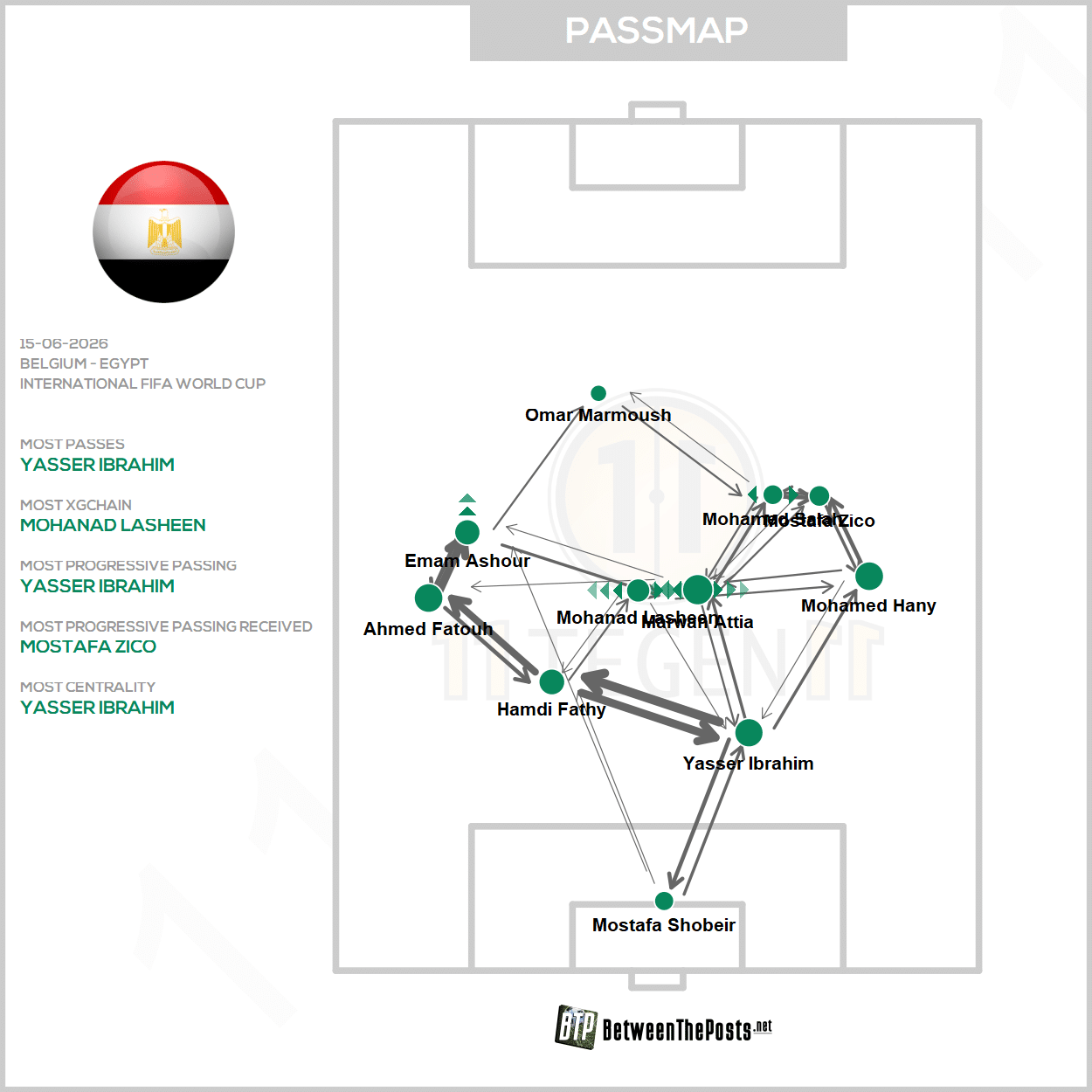
Decent circulation from Egypt, but a strong link between Marmoush and Salah, as well as high touches from the City striker, considering that he was having to take a lot of them on the counterattack.
Garcia had made two substitutions before bringing on Romelu Lukaku, but it was the addition of the striker that instantly produced. A long channel pass found Meunier on the overlap and he put the ball into the golden zone, as Lukaku steamrolled in, instantly after coming on. Not much of a celebration as he gathered the ball and sprinted back to the center circle: replays revealed that Hany finished the attempt into his own goal.
After the equalizer, the game slowed down after a period of rapid transitions, or at least, the clean actions from the likes of Salah and Tielemans were at a minimum and the chance creation was affected at this point. Both final opportunities came to Belgium: the first was from a second phase of a set play (not much of a surprise considering the tournament so far). After the goalkeeper punched, Tielemans stuck the cross at the back post and the header from Mechele forced an excellent save out of Shobeir. A few minutes later, Lukaku would have a legitimate chance of his own, only for his header, from Nicolas Raskin’s cross, to fly over the crossbar from close range.
Takeaways
Not many games have felt overly transitional so far in the tournament, but Belgium and Egypt dealt effective blows at the start of the second period, one which Egypt may feel more annoyed that they did not put the game out of sight. Nevertheless, it is a point that both teams could make peace with.
Belgium recovered after a limp first half, improved when they tried to inflict more positional play elements (although this was still very limited to moments where the Egyptian block was not set) rather than bunching their attackers together in one zone. Egypt had the better game plan and opening hour but failed to sustain attacks after the equalizer. Iran is next for Belgium, whilst Egypt play New Zealand.
Use the arrows to scroll through all available match plots. Click to enlarge. Check the match plots page for plots of other matches.


Comments