

Netherlands – Japan: a draw shaped by caution and flashes of quality (2-2)
The Netherlands and Japan cancelled each other out in a highly anticipated Group F clash between two of the tournament favourites. After a frustrating first half shaped by caution, both teams at least produced goals in a slightly more open second period, without abandoning their pragmatic approach. A 2–2 draw that ultimately reflects a shared reluctance to take excessive risks, with Japan left with the feeling they could have done more with their moments, while the Dutch will need more attacking dynamism to consistently break down structured opposition.
Tactical analysis and match report by André Martins.
We decided to make this article free to read. If you want to support our work, consider taking a subscription.
After Brazil–Morocco, where the Atlas Lions impressed against the five-time world champions, Japan–Netherlands was probably the next highly anticipated fixture of the opening round, with both nations arriving at this World Cup opener harbouring legitimate ambitions of reaching the latter stages of the knockout rounds.
Back in Qatar in 2022, Japan were cruelly eliminated by Croatia on penalties in the Round of 16. Before that, however, the Samurai Blue had topped the infamous “group of death” ahead of both Spain and Germany, a reflection of how dramatically Japanese football has progressed over the past decade. The Netherlands also saw their campaign end in a penalty shootout, this time against eventual champions Argentina. Yet the label of a traditional powerhouse unable to go all the way has followed the Oranje for quite some time now.
Now in 2026, and without their most unpredictable player Kaoru Mitoma through injury, Japan were once again expected to rely on their discipline, athleticism and collective organisation to trouble one of Europe’s traditional heavyweights.
On paper, Hajime Moriyasu lined his side up in a 3-4-3. Zion Suzuki started in goal behind Hiroki Ito, Shogo Taniguchi and Tsuyoshi Watanabe. Keito Nakamura and Ritsu Doan operated as wing-backs, with Daichi Kamada and Kaishu Sano forming the midfield pairing. Daizen Maeda and Takefusa Kubo supported central striker Ayase Ueda.
The Netherlands hoped their superior individual quality would allow them to dictate proceedings against a compact opponent. Ronald Koeman opted for a fairly rigid 4-3-3, with Bart Verbruggen behind a back four of Micky van de Ven, Virgil van Dijk, Jan Paul van Hecke and Denzel Dumfries. Tijjani Reijnders, Ryan Gravenberch and Frenkie de Jong formed the midfield trio behind Cody Gakpo, Donyell Malen and Crysencio Summerville.
Japan’s compact 5-4-1 against Dutch possession
Japan spent most of the game alternating between a 4-4-2 and a 5-4-1 mid-to-low block whenever they were out of possession. Everything depended on Keito Nakamura’s decision to either step out onto Dumfries or drop alongside the backline to deal with the width provided by Summerville. Whenever Nakamura pressed forward, Hiroki Ito stepped out onto the Dutch winger. Ahead of them, Maeda and Ueda screened the passing lane into Frenkie de Jong to prevent him from dictating the game, while Kubo shifted across to complete the midfield line. Kamada and Sano defended zonally while staying close to the Dutch eights.
Moriyasu may initially have intended to defend more aggressively, but the reality was that Japan spent large spells of the first half in a compact 5-4-1 mid-block. Malen’s powerful swivelled effort inside the opening three minutes, brilliantly saved by Suzuki, together with Gakpo’s diagonal pass splitting the Japanese shape shortly afterwards, may well have encouraged the Samurai Blue to adopt a more cautious approach.
The priority was to protect the centre and force the Netherlands wide. Even deep in their own half, Japan remained remarkably disciplined. Their attacking players defended with the same commitment as the backline. Doan, naturally a winger or midfielder at club level, defended almost as a full-back and tracked Gakpo diligently, while the midfield constantly shuffled across to close any spaces opening between the lines.
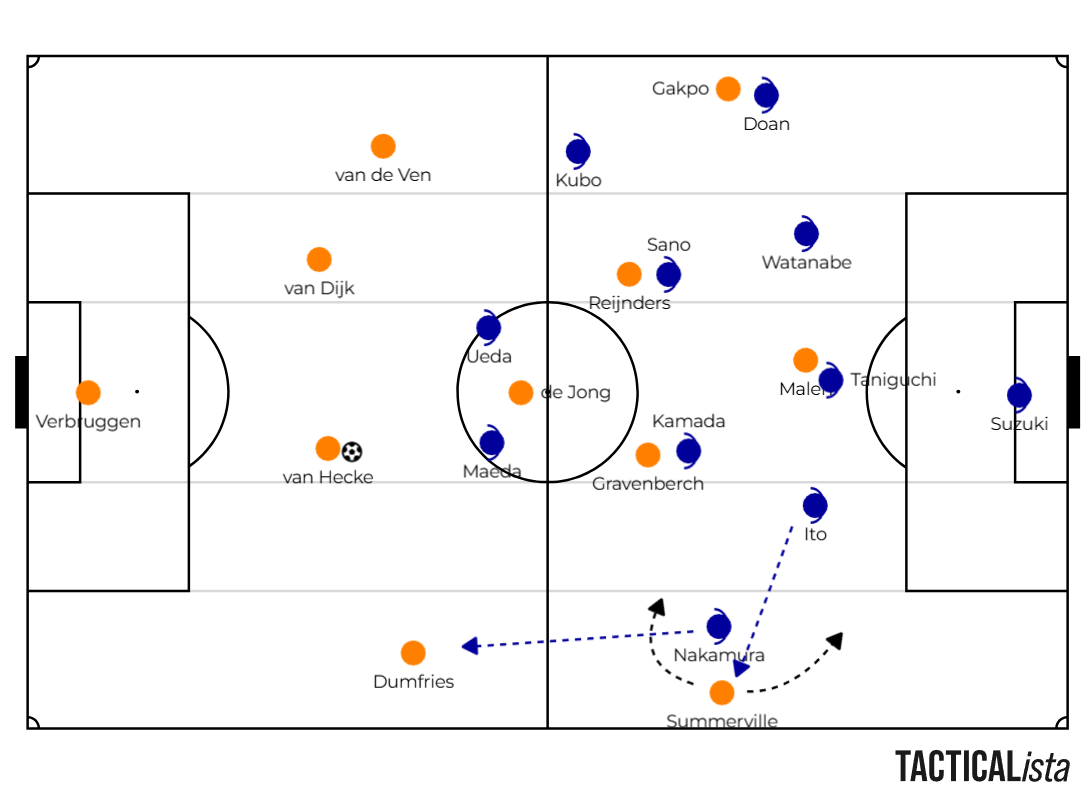
Japan alternates between a 5-4-1 and a 4-4-2 mid-block depending on Nakamura’s pressing trigger on Dumfries, forcing Ito to step out onto Summerville and momentarily destabilising the defensive line.
With the ball, Moriyasu’s side looked far more ambitious than their defensive structure suggested. Their build-up frequently evolved into a 3-1-6, with Daichi Kamada dropping alongside the centre-backs to orchestrate the first phase while Sano occupied the single pivot role ahead of him. Ito pushed into the left channel, allowing Nakamura to drift inside, while Maeda and Ueda pinned the Dutch centre-backs. Wide triangles formed on both sides of the pitch, although the timing and coordination of their movements often lacked the precision required to fully exploit them.
To escape the Netherlands’ man-to-man press from goal kicks, Japan often chose to play long. Maeda became the primary target, repeatedly attacking the space in behind with well-timed runs. Several of Japan’s promising attacks originated from this pattern, with the forward threatening the left half-space before looking for a cut-back or a lofted delivery into the box. Nakamura provided close support near the touchline, while Kamada completed the triangle from the inside.
Like their opponents, Japan briefly adopted a man-to-man press on Verbruggen’s goal kicks, forcing the Dutch goalkeeper to go long, before eventually retreating into a more passive defensive block.
Dutch control without enough movement
At the other end, the Netherlands responded with a surprisingly static attacking structure.
The back four remained almost permanently on the same line. Gakpo and Summerville initially provided width before drifting inside once they received possession, while Reijnders and Gravenberch occupied the two half-spaces. Responsible for orchestrating the first phase, Frenkie de Jong dropped in front of — and at times even alongside — the centre-backs. Combined with the conservative positioning of both full-backs, it often created a 4-1 in build-up, with arguably too many players behind the ball against a Japanese block that showed little intention of pressing aggressively.
Against a back five, the most common solution is usually to push a full-back higher in order to avoid easy two-versus-one situations on the winger. The FB can underlap into the half-space, pin the outside centre-back and leave the winger isolated against the opposition wing-back. The roles can be reversed as well. These off-ball movements provide an extra passing option and introduce the unpredictability needed to destabilise such a defensive structure.
While Dumfries and Summerville occasionally rotated to inject more pace down the right, it happened far too infrequently. On the opposite side, Van de Ven stayed very deep for most of the match, leaving Gakpo isolated against Japan’s defensive line. Understandably so, perhaps. As a centre-back playing at left-back, he simply does not possess the same comfort in tight spaces or the attacking instincts required to consistently overlap, underlap, invert into midfield or receive with his back to goal.
That could have encouraged the Netherlands to build more heavily down the right before switching play quickly towards Gakpo on the opposite flank.
More frequent rotations would also have created more favourable conditions for Gravenberch and Reijnders, neither of whom managed to influence proceedings as much as expected.
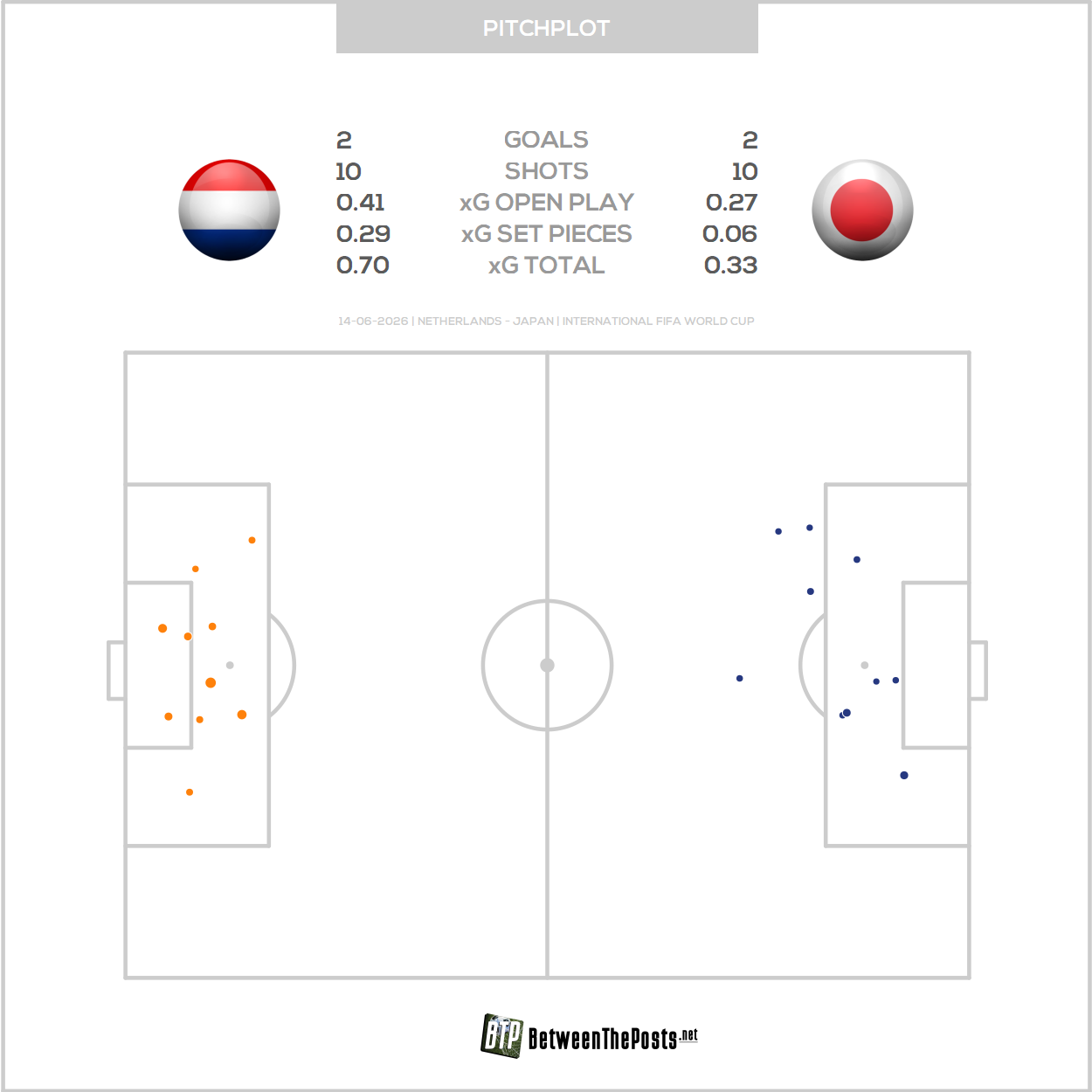
With two five-man blocks at the back and a tendency not to apply pressure when out of possession, it goes without saying that the chances created in open play are very limited.
More generally, the Netherlands simply didn’t move enough around Japan’s block. The side committed plenty of players to the first phase of build-up, but without enough complementary runs higher up the pitch to truly destabilise Japan’s defensive organisation.
Meanwhile, Japan defended with remarkable pragmatism. If clearing the ball into touch represented the safest option, they never hesitated to do so. That conservative approach probably cost them opportunities to play through pressure had they been willing to take slightly greater risks.
Looking beyond the block
One of Japan’s other attacking ideas was to attack diagonally in the final third.
It appeared only sporadically during the first half, became even rarer towards the interval, and unfortunately almost disappeared after the break as Japan twice found themselves chasing the game.
Whenever they managed to create their usual wide triangles, they looked to access diagonal passing lanes into runners arriving from the blind side. The movements around the receiver were not always complementary enough to fully exploit these situations, but Ueda’s opportunity just before half-time came from exactly this type of sequence.
Two minutes earlier, Nakamura’s low strike that drifted just wide had originated from another excellent off-ball movement. Watanabe underlapped from the backline before being released into space by Doan. These kinds of runs consistently gave Japan their best opportunities to enter the Dutch penalty area, whether through clipped deliveries towards the far post or low cut-backs across the six-yard box.
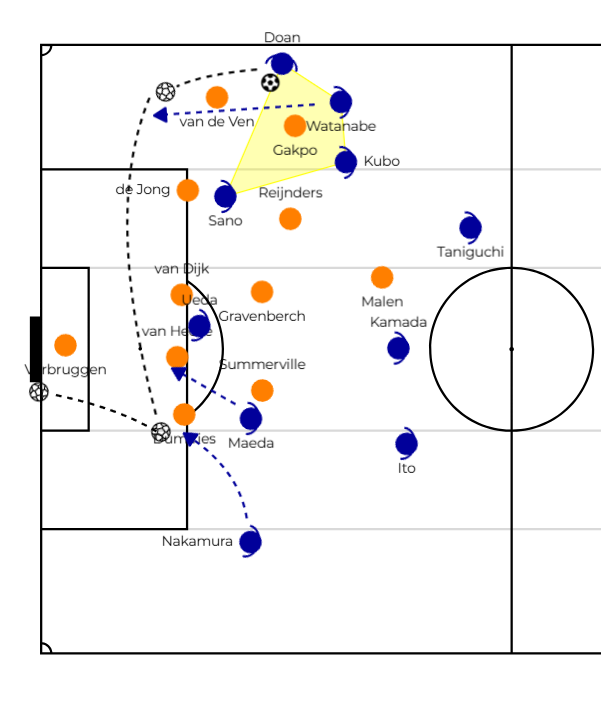
Japan overload the right side before Watanabe attacks the half-space from deep. Found by Doan, he delivered a clipped cross towards the far post, a recurring pattern designed to compensate for Japan’s aerial disadvantage against the Dutch back line.
At the other end, however, warning signs continued to appear. Suzuki was forced into another sharp save to deny a dangerous Malen header. The longer Japan defended so deep, the more the Netherlands’ aerial superiority felt likely to make the difference.
Breaking through at last
The second half resumed on similar terms.
Japan remained compact, while the Netherlands kept searching for solutions around the block. Dumfries became more involved higher up the pitch, his overlapping and underlapping runs from right-back creating more uncertainty inside Japan’s defensive shape.
It eventually took an aerial situation to break the deadlock.
Who better than Virgil van Dijk to convert one of the many deliveries into the box? After Japan partially cleared a corner, the ball found Gravenberch, whose deep cross picked out the Dutch captain . He did just enough to unsettle Watanabe before guiding a well placed header across Suzuki.
Given Japan’s compactness through central areas, crosses had increasingly become the Netherlands’ most realistic route towards goal.
Japan’s equaliser came from a combination between Nakamura and Kubo. Kubo first attacked the half-space in behind Dumfries — who had stepped out towards Nakamura —, drawing three Dutch defenders towards him inside the penalty area before releasing Nakamura on the edge of the box.
The kind of run discussed earlier as one of Japan’s most effective attacking patterns.
Fatigue sets in
As the second half wore on, Japan inevitably began to tire.
Doan, for example, increasingly struggled to follow Gakpo whenever the Dutch winger drove inside in possession. The distances within Japan’s defensive block also became punctually larger. One Verbruggen goal kick perfectly illustrated it: Japan’s front three attempted to press aggressively, but the rest of the team remained far too deep to step out and support them, allowing the Netherlands to outnumber the first line with ease.
Japan also became easier to read in possession.
Despite lacking any clear aerial advantage, they insisted on delivering crosses into the box. Yet their most dangerous attacks had come from runs into the half-spaces rather than traditional deliveries. The chance created around the 88th minute once again demonstrated how much more threatening they looked attacking depth.
Ironically, that very sequence earned the corner from which Japan equalised for a second time. Junya Ito delivered a driven cross, Koki Ogawa met it with a header, Kamada unintentionally redirected the ball beyond Verbruggen, and Japan’s persistence was rewarded.
The Netherlands had regained the lead through Summerville.
He cut inside before finding the bottom corner with a superb strike from distance. A finish made possible because Dumfries’ overlapping run created enough hesitation in Nakamura’s decision-making, leaving him a fraction too late to close the space.
Finally…
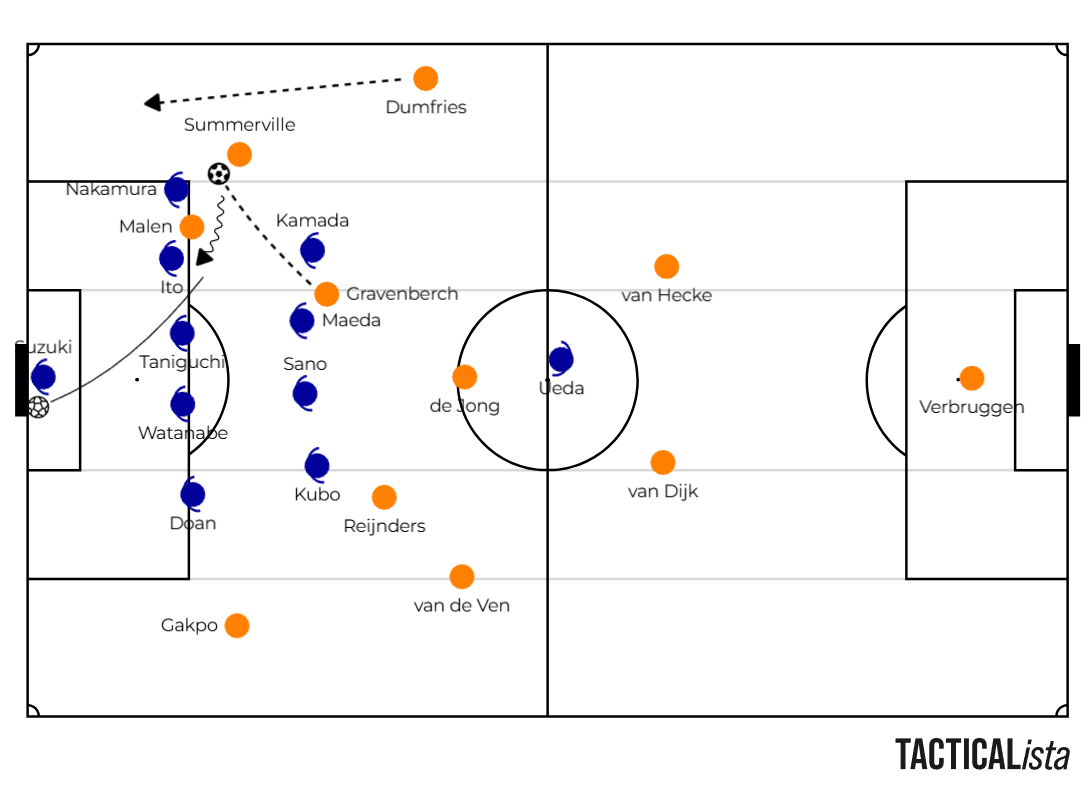
64th minute. For the first time, Dumfries’ overlapping run creates hesitation in Nakamura’s decision-making. Summerville attacks the inside lane, gains separation, and finishes from distance after a momentary structural imbalance in Japan’s back five.
Inviting pressure
Ronald Koeman’s substitutions contributed to the Netherlands surrendering the initiative in the closing stages.
Nathan Aké’s introduction for Ryan Gravenberch reduced the Dutch ability to control possession, while Teun Koopmeiners replacing Summerville disrupted the balance of their attacking structure.
Instead of keeping Japan pinned back, the Oranje gradually dropped onto the edge of their own box. Against an opponent already committing more players forward, that approach only encouraged further Japanese pressure until the equaliser eventually arrived.
Takeaways
You could sense from the opening whistle that neither side intended to prioritise the reward of three points at the risk of leaving with none. Between what were, on paper, the two strongest teams in Group F, a draw already places both nations in a strong position. One victory against either of the remaining opponents will almost certainly be enough to secure qualification, at the very least as one of the best third-placed teams.
Perhaps the game would have unfolded differently had it been a knockout tie.
That said, there is little reason to expect Japan to move away from the principles that have made them such an awkward opponent for the world’s biggest nations. From a Dutch perspective, this level of attacking dynamism cannot become the norm. A point each ultimately felt like a fair reflection of a tactical battle where neither side ever completely managed to impose its preferred game.
We decided to make this article free to read.
If you want to support our work, consider taking a subscription.
Use the arrows to scroll through all available match plots. Click to enlarge. Check the match plots page for plots of other matches.


Comments