

England – Croatia: Tuchel’s Tweaks Help England Overrun Croatia (4-2)
After a first half in which England were decent, but not overly impressive, Thomas Tuchel’s adjustments helped spur a strong second half, where their defensive intensity and their usual 4-3-3 attacking system helped earn them a win over Croatia in their World Cup opener.
Tactical analysis and match report by Josh Manley.
We decided to make this article free to read. If you want to support our work, consider taking a subscription.
England have been no strangers to facing Croatia in international tournaments over the past decade. The Croats have changed a lot in that time though, with their squad now aging, most notably the forty-year-old Luka Modrić.
Thomas Tuchel made a couple of interesting personnel selections for the opening game of England’s World Cup campaign. At the back, a centre-back partnership of Ezri Konsa and John Stones was chosen, with Marc Guéhi left out.
In midfield, Jude Bellingham was given a start after Tuchel had appeared to prefer Morgan Rogers as the most advanced midfielder in England’s 4-3-3 system. Elsewhere, Reece James and Nico O’Reilly were the fullbacks, while Elliot Anderson and Declan Rice continued to partner in midfield. The frontline consisted of Noni Madueke, Harry Kane, and Anthony Gordon.
For Croatia, Zlatko Dalić lined his team up in a 3-4-3 formation with a back three of Josip Šutalo, Luka Vušković, and Joško Gvardiol. Josip Stanišić and Ivan Perišić played as wing-backs either side of a central midfield pairing of Modrić and Mario Pašalić. Petar Sučić, Petar Musa, and Martin Baturina then made up the front three.
England’s against the press
In previous recent tournaments, one of Croatia’s strengths was their ability to establish stable possession in the midfield unit, allowing them to gain control of games even against top teams.
Modrić and Pašalić are still capable midfielders, but they lacked quite the same capacity for control in this game. What Croatia did try to execute though was a high press.
The front three of Croatia would push up onto England’s backline, looking to pressure the centre-backs while screening passes into midfield against England’s nominal 4-3-3 shape.
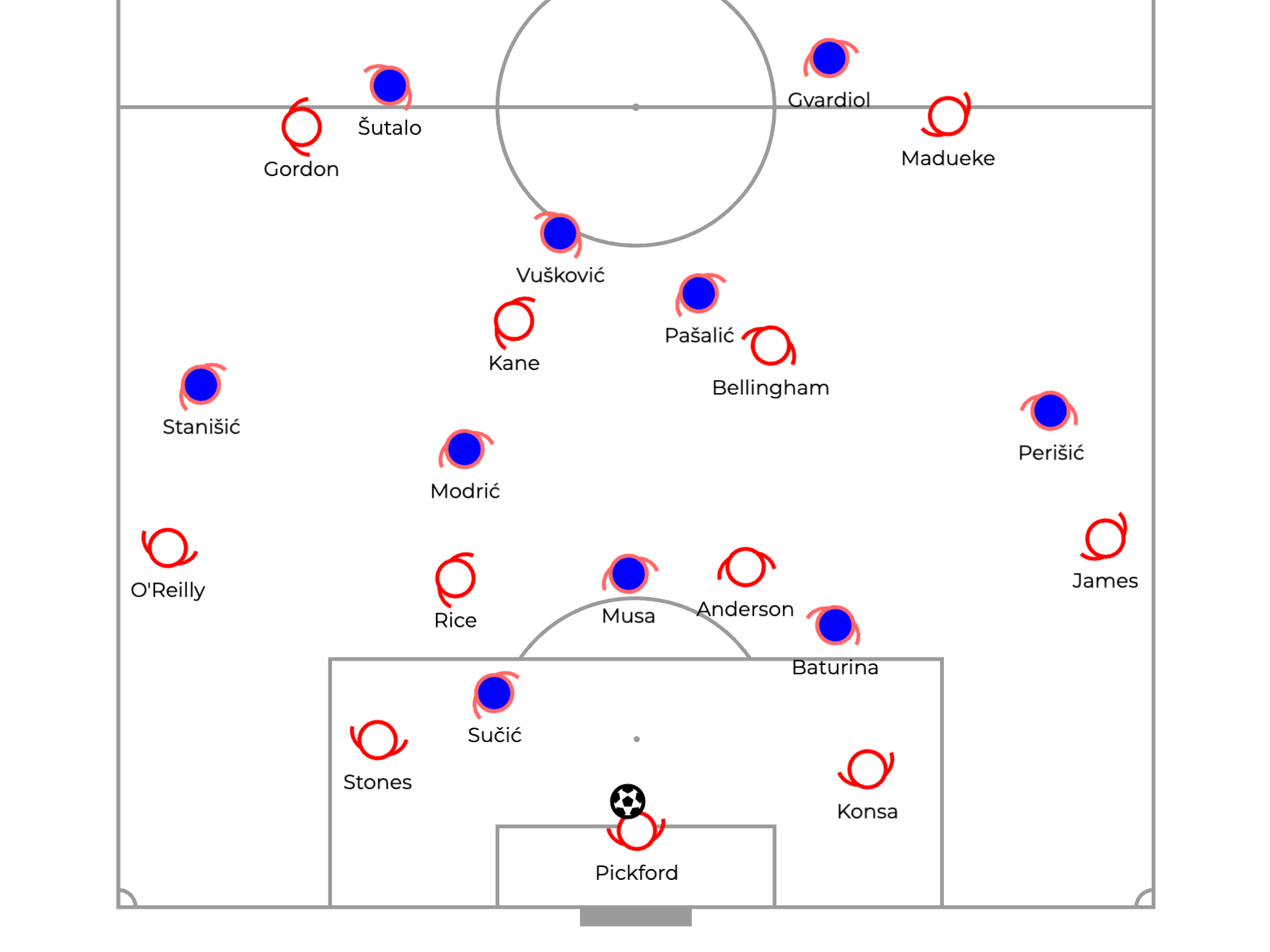
England against the high press.
In order to add an extra connection on the edge of the box and prevent the three-versus-three of Croatia’s front three versus Stones, Konsa, and Anderson, Rice would drop to form a double pivot in deep buildup.
This led England into a structure which has become relatively common in the buildup of elite teams from the goalkeeper. With Rice dropping, space was also there for Kane to drop, forming a box midfield with Anderson and Rice low, and Bellingham and Kane high. Madueke and Gordon would then stretch the Croatia defence in depth and width.
This gave England a couple of decent sequences in the first half. However, they also faced some issues which were summarised by assistant coach Anthony Barry at half time as well as Tuchel after the game. Namely, that England’s decision making in possession was not aggressive enough.
Tweaking the structure
In terms of their structure further up the pitch, England had a 4-3-3 with a focus on rotations in the wide triangles of the formation plus Kane’s false nine role. This has been characteristic of England’s play under Tuchel.
In the first half, Rice was often seen as the deepest of the left-sided players, while O’Reilly held the width and Gordon indented onto the last line, offering depth.
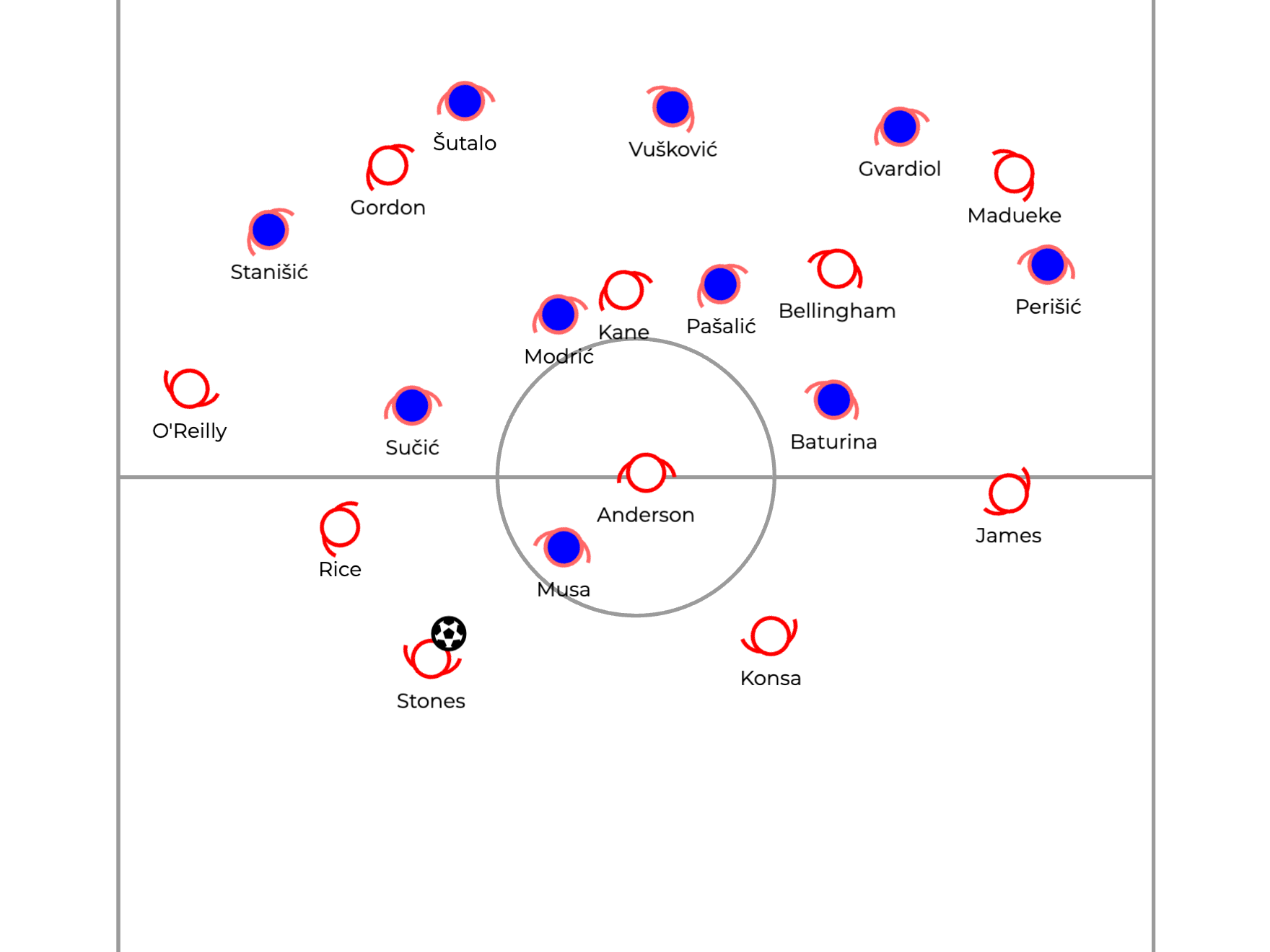
England’s first-half structure.
On the right, Bellingham started quite high, while James was lower but had the ability to run from deep, and Madueke provided a mixture of width and depth in coordination with his teammates. Anderson also occasionally drifted to this side to form a diamond structure with the aforementioned trio.
In the second half, after the aforementioned issues that England were facing in their open play attack, Tuchel made some adjustments. Rice moved higher in the left halfspace, and O’Reilly instead took the deeper role in the triangle, while Gordon stayed wider. On one or two occasions Rice and Gordon even rotated, with the Arsenal man ending up wide left.
The higher positioning of Rice seemed to help pin the Croatian midfield back more and also gave Stones more room to carry the ball forward from defence, where Rice had sometimes been a little too close to him in the first half. O’Reilly’s on-the-ball resourcefulness against pressing from deep left back areas was also more well-leveraged in the new arrangement.
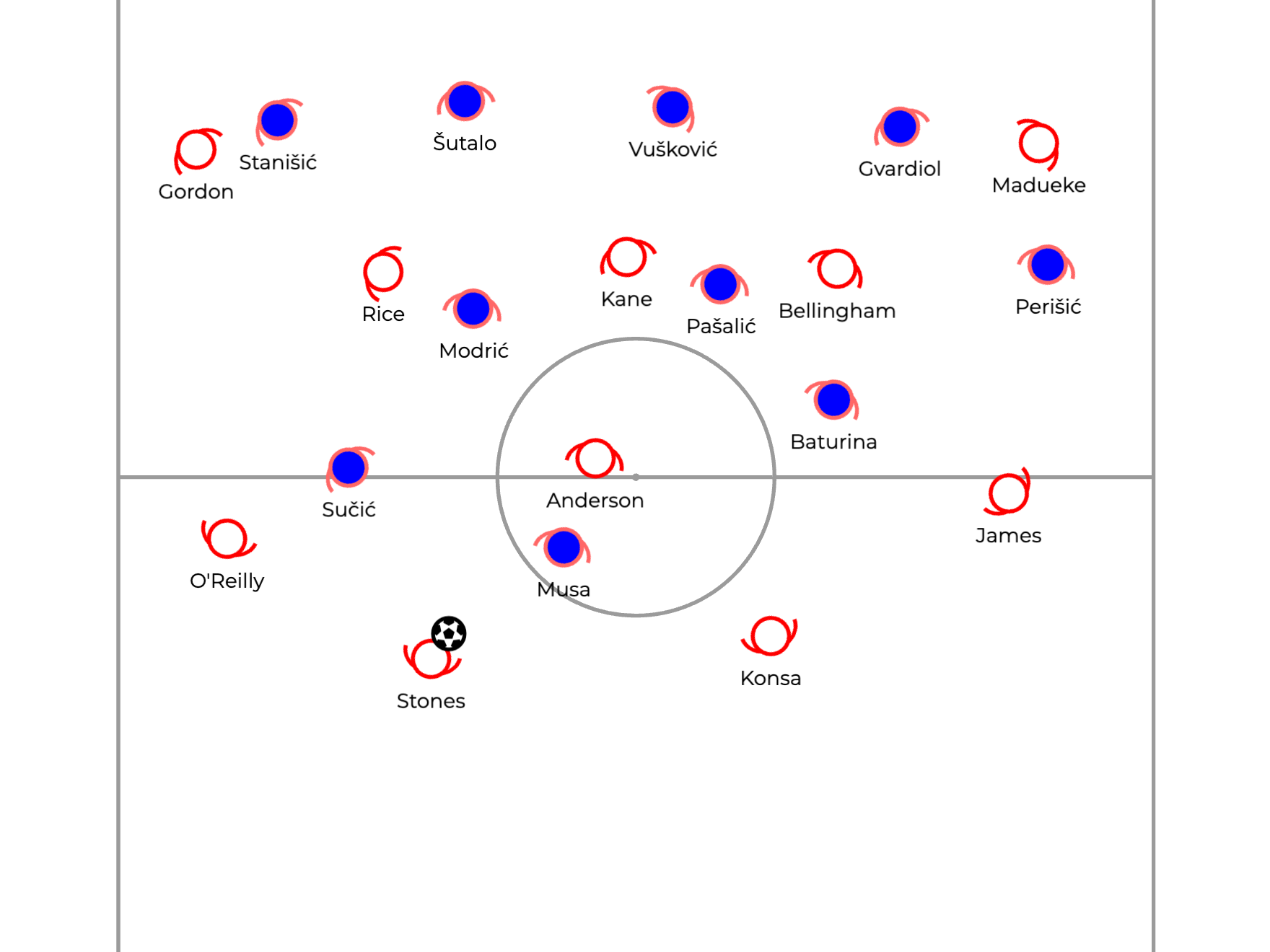
England’s second half structure.
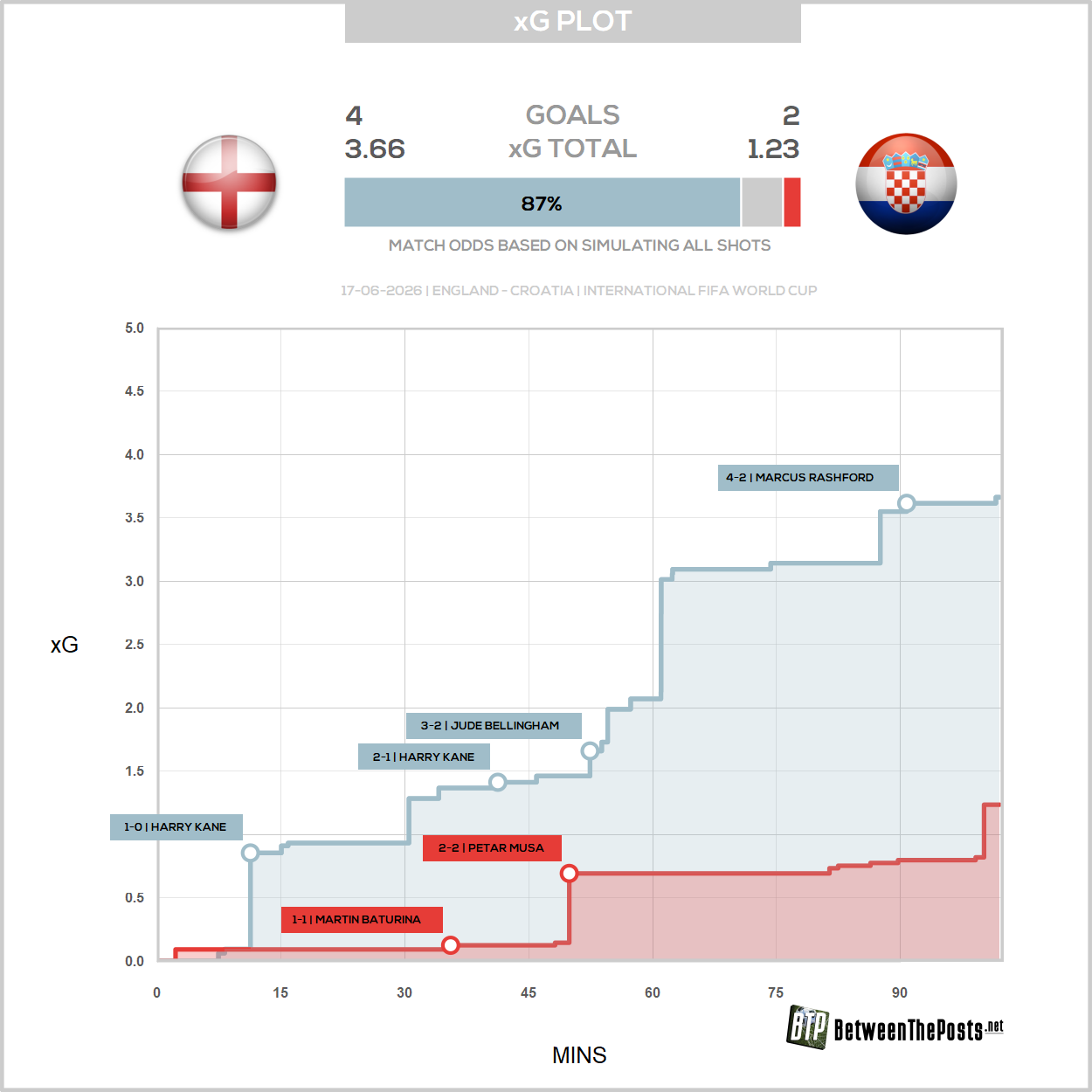
The early parts of the second half were England’s best in the match. They pummelled Croatia for a spell and were able to nudge ahead into a 3-2 lead after having conceded a sloppy goal late in the first half.
Intensity against the ball
It was apparent from Tuchel’s squad selection that he wants this England side to be physically dominant at this tournament. This was apparent in their pressing game too, where England jumped quickly from their nominal positions to try and pressure Croatia’s buildup.
In their initial 4-3-3 shape, England would defend in a man-oriented fashion. Bellingham and Rice could start with the Croatia central midfielders, while Anderson picked up one of the number tens.
From this shape though, they often sprang into a 4-4-2 formation, with Bellingham jumping up alongside Kane to pressure the defenders of Croatia, matched by Anderson jumping forward to cover the space Bellingham had left.
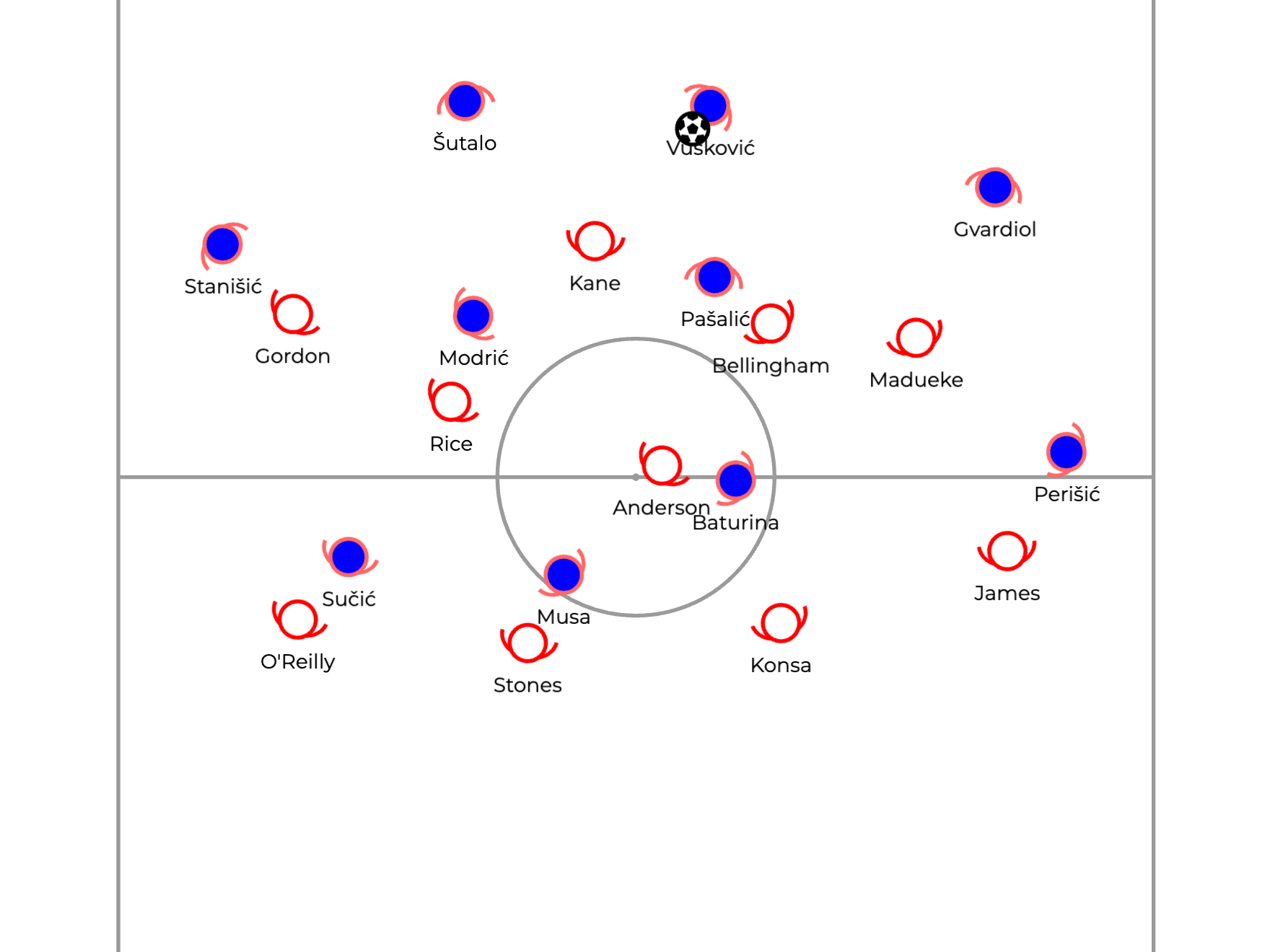
England’s initial shape without the ball, from which they jumped forward.
England’s pressing approach was successful in limiting the space for Modrić, who struggled to integrate himself well into Croatia’s possession setup anyway. His trademark floating movements into the deep halfspaces to dictate the tempo and thread passes forward were not present here. Instead, he got rather lost against the physicality of England’s trio and was substituted for Mateo Kovačić before the hour mark.
When England dropped deeper, as they did in the second half after going ahead, they could look a little flat, with too much space for the opponent to play around the edges of the shape. Tuchel himself again made reference to this after the game.
The man-oriented approach meant that England’s wingers could get pushed back, so sometimes there were back five or six variations if Croatia’s wide players pushed up aggressively. Along with the carelessness of the goal conceded in the first half through a lofted ball over the centre-backs, this was the main defensive concern for England.
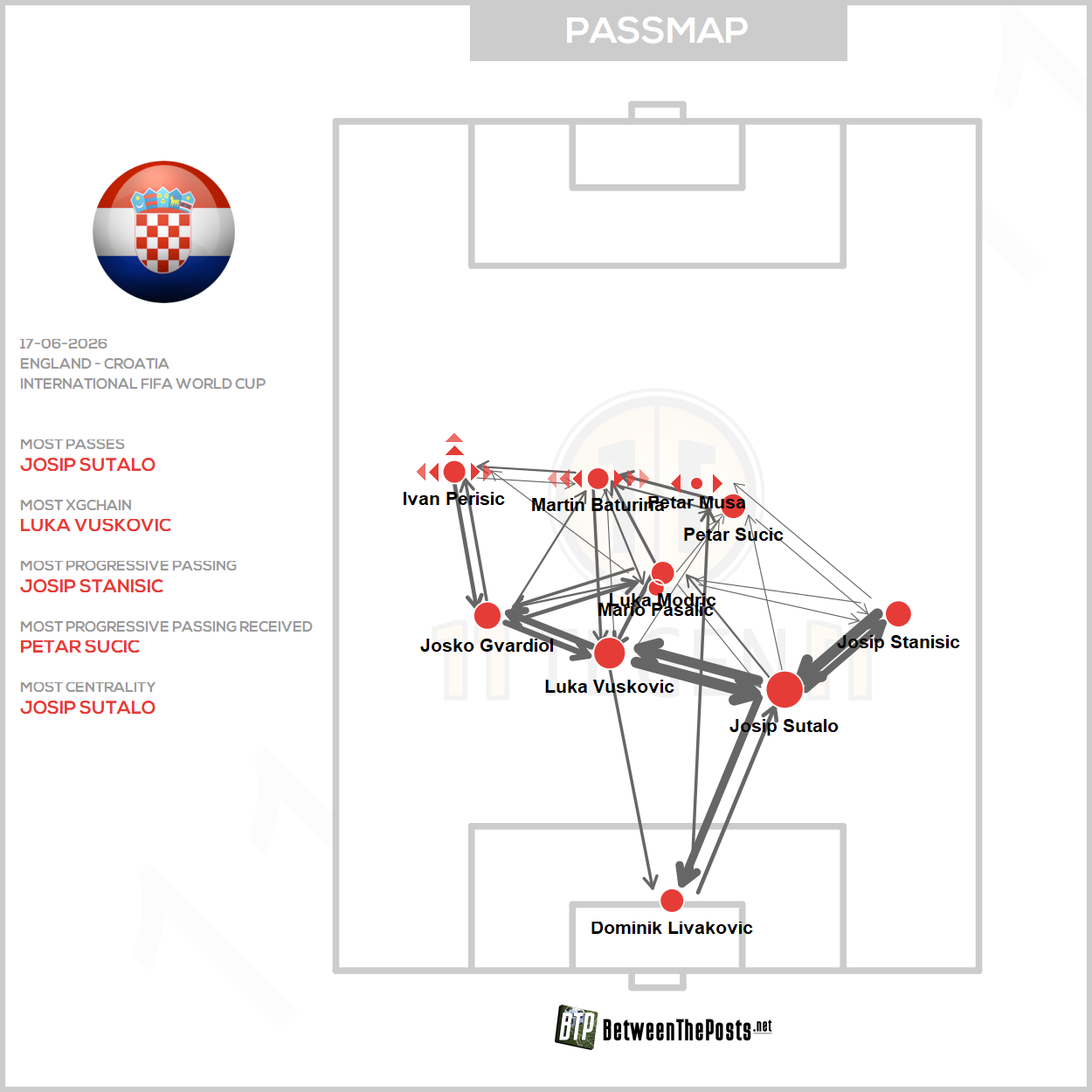
Modrić struggled to get into this game for Croatia.
Both sides made changes going into the final stages of the game. England brought Bukayo Saka, Morgan Rogers, and Marcus Rashford on for the two wingers and Rice, who had a slight injury concern.
Croatia meanwhile would eventually switch to a back four, although they had already shown plenty of back four variations in their possession phases with Gvardiol pushing into left back positions and Perišić going high on the left.
It was Rashford who eventually put the game to bed for England with an unerring finish with his instep, assisted by Saka, at the end of a swift counter-attacking move.
Takeaways
This was a satisfying performance from England, especially with the glimpses shown in the second half of the level that they are truly capable of. The fact that Tuchel and his staff were clearly unsatisfied with the first half performance, which overall was not bad, shows their ambition. With the blend of physical intensity, player quality, and tactical understanding shown in this game, England have reaffirmed themselves as one of the favourites for the tournament.
Croatia gave England some uncomfortable moments, but will likely struggle to recreate the deep tournament runs they have enjoyed in recent memory. Modrić had little influence here, and England largely overran them in the second half.
Use the arrows to scroll through all available match plots. Click to enlarge.
Check the match plots page for plots of other matches.



Comments