

Mexico – South Korea: Romo helps Mexico to clinch top spot in Group A (1–0)
Co-hosts Mexico secured their ticket to the knockout phase of the 2026 FIFA World Cup after grinding out a tense 1-0 victory over South Korea in front of a partisan crowd at the Guadalajara Stadium. Javier Aguirre’s men survived an opening half characterized by stagnant possession and structural frustration, but they burst to life shortly after the interval. A catastrophic 50th-minute goalkeeping error from Kim Seung-gyu handed midfielder Luis Romo the game’s solitary goal, prompting absolute pandemonium in Zapopan. Despite a frantic late onslaught from the South Koreans, a majestic double-save from local hero Raúl Rangel ensured El Tri took control of Group A.
Tactical analysis and match report by Aderemi Qoyum.
We decided to make this article free to read. If you want to support our work, consider taking a subscription.
The encounter presented a highly technical, tactical duel centered on regional variations of control. Mexico looked to construct sustained attacks from a traditional base, aiming to pin the opposition wide and recycle the ball through their interior midfielders. Conversely, South Korea utilized a reactive yet structurally rigid shape, attempting to break lines with swift between the lines movements and direct plays to stretch Mexico’s rest defense.
Ultimately, Mexico won the tactical war through persistence and in-game adjustments at halftime, capitalizing on a moment of defensive breakdown and trusting an impeccable defensive block and Rangel to neutralise South Korea’s late attacks.
For this crucial group stage clash, Javier Aguirre shuffled his deck, making three notable adjustments from the XI that defeated South Africa 2-0. Operating in a fluid 4-1-2-3 framework, Raúl Rangel started between the posts. The defensive line saw Jorge Sánchez and Jesús Gallardo occupying the fullback slots, flanking Johan Vásquez and defensive anchor Edson Álvarez—who deputized for the suspended César Montes. Érik Lira sat at the base of the engine room, providing structural freedom for Luis Romo and Brian Gutiérrez to push up into the half-spaces. Upfront, Raúl Jiménez spearheaded the attack, flanked by Roberto Alvarado and Julián Quiñones.
South Korea countered with an asymmetric, heavily-rehearsed 3-4-3 system under Hong Myung-bo. Kim Seung-gyu marshaled the defense behind a central defensive triad consisting of Lee Han-beom, Kim Min-jae, and Lee Gi-hyuk. The wing-back roles were assigned to Seol Young-woo and Kim Moon-hwan, tasked with dropping deep into a back five out of possession. Paik Seung-ho and Hwang In-beom formed a robust double-pivot, looking to screen central lanes and immediately supply the technical front three of Lee Jae-sung, Lee Kang-in, and world-class captain Son Heung-min.
Mexico’s fluid build-up faces South Korea’s aggressive press
When building up from deep, Mexico utilized a distinct 4-2-4 build-up shape where Luis Romo regularly dropped alongside Érik Lira to form a double-pivot, while a wide front four stretched the pitch horizontally. Javier Aguirre’s side looked to build short and use quick vertical combinations to find interior progressors between the lines, with Julián Quiñones operating as a highly effective early outlet, causing havoc with his strength and skills.
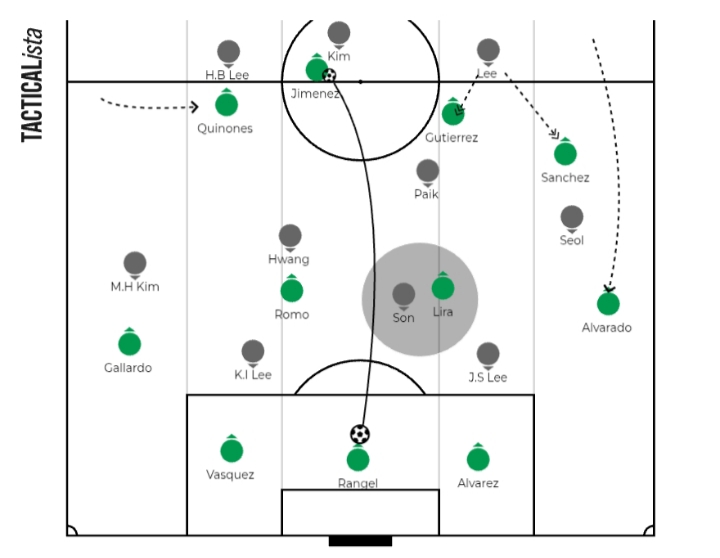
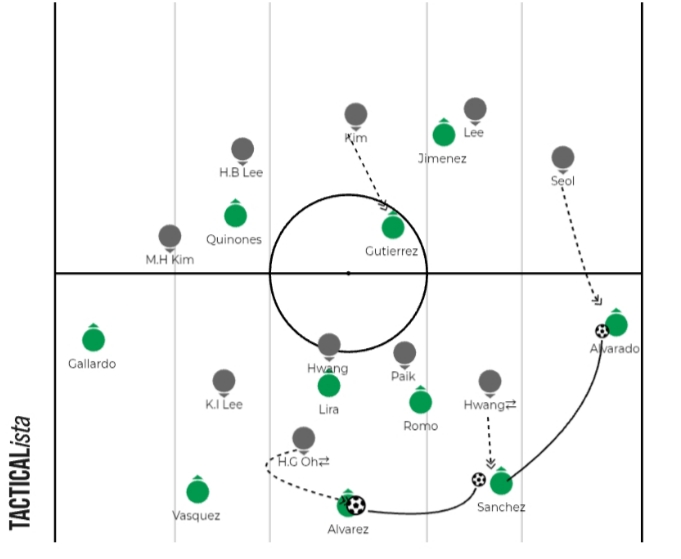
Minute 8′: Mexico’s early 4-2-4 build up shape was aggressively met by South Korea’s aggressive press. This sequence came when South Korea forced Mexico back as they jumped from a mid-block shape to this man-to-man press. Confusion on the left of South Korea: Paik and Seol want to jump on the oppositions in front of them, if they both go high, Gi-Hyuk Lee will be left with two men to mark.
South Korea met this structure by jumping into a bold, man-to-man high press; captain Son Heung-min dropped to track Lira, while Lee Kang-in and Lee Jae-sung tucked inward to press Mexico’s center-backs. However, this required South Korea’s wing-backs to jump long distances onto Mexico’s fullbacks, leaving them exhausted and repeatedly arriving too late during swift circulation from the Mexico backline.
This aggressive approach caused systematic confusion within South Korea’s central midfield area, as Paik Seung-ho and left center-back Lee Gi-hyuk suffered communication breakdowns over who should track Brian Gutiérrez. Because Roberto Alvarado’s deep movements commanded Lee’s attention whenever Seol jumped high, Paik and Gi-Hyuk were frequently forced to split his duties and cover Lira when Son couldn’t or the latter to cover Alvarado, leaving both players pointing at each other in confusion.
Whenever Mexico struggled to build short against this congestion, they comfortably adapted by going long to striker Raúl Jiménez. Jiménez used his elite physical frame to hold up play effectively and bring his onrushing teammates directly into the game. Once Mexico bypassed the press or South Korea retreated into a settled block, the tactical picture shifted into a shape similar to what worked for Mexico against South Africa. In settled possession, Jesús Gallardo pushed high up the left flank, though he maintained a slightly deeper, more cautious positioning compared to the previous match.
This structural tweak allowed Quiñones to tuck inside into the left half-space, where his imposing physicality and sharp technical abilities caused immense friction for the South Korean defense. To maintain balance, Romo regularly rotated out of the midfield engine room, dropping deep into the left-back slot to engineer a temporary back three, mirroring Álvaro Fidalgo’s tactical role in the prior game.
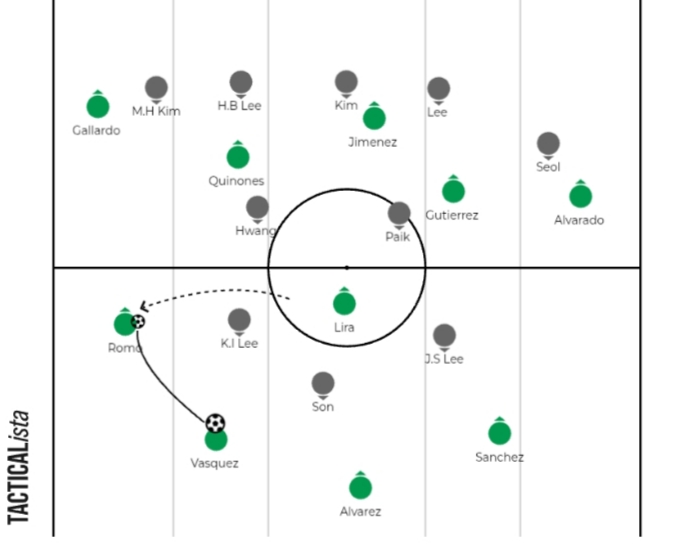
Minute 15′: Mexico IP shape. Sanchez stayed deep in this case, while Romo drifted to the left looking to receive outside the 5-2-3 block of South Korea
Conversely, the dynamics on the right flank offered a completely different structural profile as Roberto Alvarado chose to drop deep with high frequency to demand the ball at his feet. His inverted positioning pulled markers inside and granted Jorge Sánchez the absolute freedom to bomb forward from deep, executing high-volume overlapping runs that provided a more expansive attacking threat than Israel Reyes offered last time out.
South Korea attempted to contain these asymmetric overloads by digging into a rigid 5-2-3 defensive block. By keeping their front three tightly narrow, they successfully denied Mexico any simple central progression through the middle, purposefully forcing El Tri out into wide areas to compress the space against the touchline.
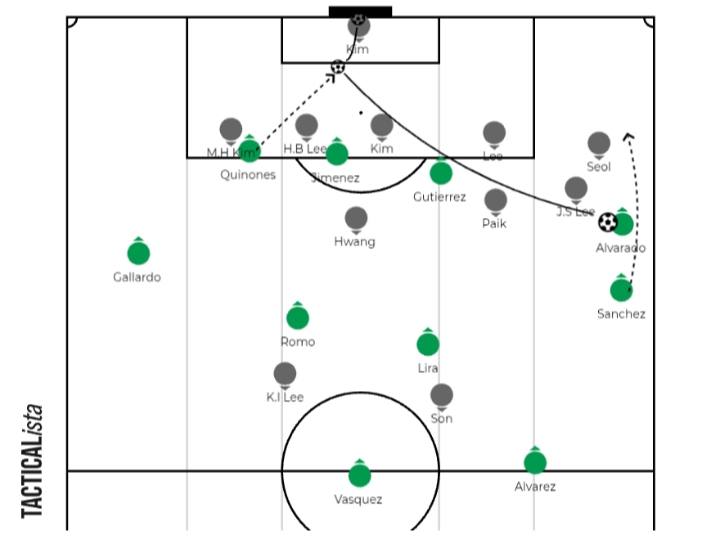
Minute 20′: After receiving from Sanchez, Alvarado cuts to his left before delivering an perfect inswinging cross to the six-yard box for Quinones to head goalwards, only to be denied by a diving Kim Seung-gyu.
The breakthrough
After the half-hour mark, the momentum of the encounter swung dramatically as South Korea began to put immense pressure on Mexico, pinning the tournament co-hosts back in their own defensive third for long periods. However, despite enjoying the lion’s share of possession during this spell, Hong Myung-bo’s side struggled to translate their territorial dominance into high-value scoring opportunities. The Taegeuk Warriors relied too heavily on speculative long balls directed toward Son Heung-min and other forward runners. These direct sequences routinely lacked precision; the passes either carried too much weight for the receivers or were comfortably dismantled by Mexico’s highly disciplined, well-coordinated offside trap.
Son Heung-Min showed his threat in the 17th minute with a lofted effort over Rangel that was brilliantly denied by Edison Alvarez on the goal-line, although the play ended up being ruled offside. Consequently, South Korea were restricted to just two shots in the entire first half: a poor, wayward effort from wing-back Seol Young-woo from the left flank, and a speculative long-range strike from Lee Kang-in that was easily blocked by the Mexican defense in the 44th minute.
Recognizing that passive horizontal possession would not break South Korea’s resistance, Aguirre adjusted Mexico’s approach immediately after the interval. El Tri raised their tempo higher and attacked South Korea with more energy and purpose. This tactical tweak yielded immediate dividends just five minutes into the second half.
Quinones skipped inside ahead of Kim Moon-hwan to curl a beautiful cross into the penalty spot for Raul Jimenez, who headed the ball up into the air while duelling with Kim Min-jae. Goalkeeper Kim Seung-gyu came off his line to claim the aerial ball but misjudged the trajectory under duress. He catastrophically clattered into his own center-back, Kim Gi-Hyuk, completely spilling the ball in the box. Positioned perfectly to exploit the chaos, Luis Romo reacted fastest, poking the ball first-time into the completely unguarded net.
South Korea’s second-half adjustments
Faced with a 1-0 deficit, Hong Myung-bo reacted decisively before the hour mark by making a bold double substitution that fundamentally reshaped his team’s structure and gave them more energy. Captain Son Heung-min and Lee Jae-sung were withdrawn from the fray, replaced by the fresh profiles of Besiktas’ Hyun-Gyu Oh and Wolverhampton Wanderers forward Hee-Chan Hwang. Following the changes, South Korea progressed the ball in an expansive 3-2-5 in-possession shape, with both the newly introduced Hwang and Paris Saint-Germain’s Lee Kang-in occupying the interior half-spaces.
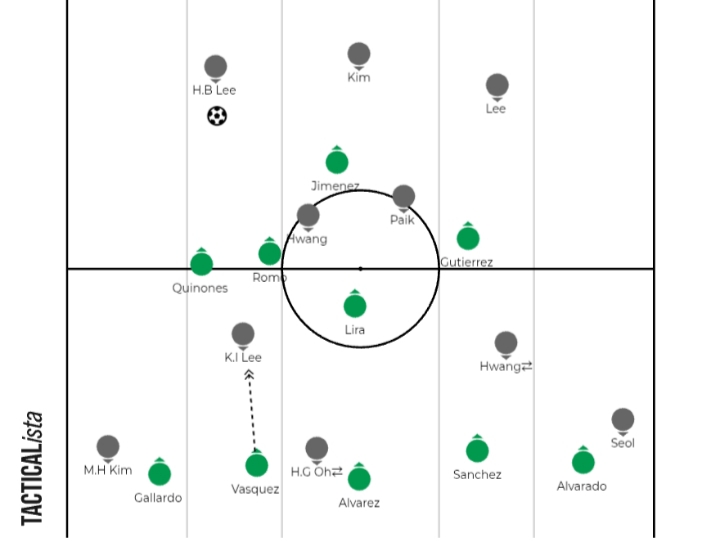
Minute 62′: The Tigers of Asia’s shape in possession against Mexico’s 5-4-1 shape as Alvarado dropped into right wingback role as he did against Bafana Bafana to avoid being overloaded at the back.
Lee Kang-in, in particular, was granted absolute tactical freedom throughout the match; he drifted seamlessly across both vertical and horizontal axes, frequently dropping deep to pull strings in build-up before drifting out to the left flank to spearhead overloads and slide intricate through balls behind the backline. Lee’s individual brilliance was undeniable, creating the most chances (3) and completing the most dribbles (4) of any player on the pitch, yet his creative masterclass ultimately proved insufficient to break down Mexico’s resolute rearguard.
Whenever South Korea lost possession, they immediately initiated an intense, man-to-man counterpress designed to choke Mexico’s transition avenues at the source. In this revised second-half defensive setup, the front three aggressively locked onto Israel Reyes and Mexico’s two center-backs, while Seol Young-woo focused heavily on tracking Roberto Alvarado, completely erasing the communication confusion that plagued their first-half display.
Behind them, South Korea’s three center-backs were able to easily pick up Mexico’s central triad of Jiménez, Gutiérrez, and Quiñones without any overlapping defensive responsibilities. Furthermore, the double-pivot of Paik Seung-ho and Hwang In-beom confidently jumped onto Érik Lira and Romo, secure in the knowledge that they possessed an organized defensive shield directly behind them.
Minute 66′: South Korea’s reorganized press to quickly win possession back in Mexico’s half.
This comprehensive structural overhaul completely suffocated Mexico’s attacking output, limiting the tournament hosts to minimal space and allowing South Korea to utterly dominate the second half. This dominance was reflected in a staggering 64% possession share compared to Mexico’s 36%, alongside an additional 7 shots and 3 big chances created. Yet, despite late, clear-cut opportunities falling to Cho Gue-sung and Yang Hyun-jun, South Korea were repeatedly denied by the impeccable reflexes of Raul Rangel in the Mexican goal, who preserved the slender lead until the final whistle.
Takeaways
Mexico delivered a tactically disciplined performance that highlighted their defensive resilience and adaptability under immense pressure. While their first-half possession lacked penetration, Aguirre’s high-intensity adjustments directly forced the error that decided the game. Combined with Rangel’s world-class goalkeeping, El Tri proved they can win tight tournament fixtures.
With six points from two matches, Mexico guarantees their spot in the Round of 32 as Group A winners. They will face Czechia in their final group stage match in a comfortable position, knowing their immediate knockout future remains on home soil in Mexico City. South Korea, meanwhile, sit on three points and must regroup tactically ahead of a crucial showdown against South Africa to keep their World Cup dreams alive.


Comments