

Argentina – Egypt: Argentina’s Late Show Does It Again, Breaking Egyptian Hearts (3-2)
When things weren’t going well for Argentina, Lionel Scaloni changed the game with his tactical and personnel tweaks. Egypt’s strength in transition put them in a good position and caused Argentina problems defensively. Argentina’s second half substitutes made the difference with Lionel Messi having an impact for Argentina once again.
Tactical analysis and match report by Ebuka Ogoegbunam.
We decided to make this article free to read. If you want to support our work, consider taking a subscription.
After Argentina’s win against Cape Verde in the round of 32, it looked like Argentina struggled against team that could put up a fight but from the other spectrum, that win showed how much the players were willing to fight for each other even in late game moments. In moments of adversity, Scaloni’s team showed they could keep fighting until the end.
Egypt knew the world champions was a huge test for them in this stage of the tournament and with their previous win against Australia in the round of 32, they had the chance to make their fans proud with a top performance against the reigning world champions.
In this tournament, Argentina have scored at least two goals in every game so far. Their attack has been in full flow all the way from group stage to the knockout round. Messi being Messi has been the key man for Argentina, topping the goal scoring charts, tied with Kylian Mbappe and Erling Haaland, heading into this game.
Lionel Scaloni selected Emiliano Martínez in goal with a defensive line of Nahuel Molina, Cristian Romero, Lisandro Martínez and Nicolás Tagliafico. Leandro Paredes started in this game as the sole pivot, with Enzo Fernández, Alexis Mac Allister and Rodrigo De Paul playing higher up in midfield. Julián Alvarez and Lionel Messi led the line for Argentina’s attack.
For Egypt, Hossam Hassan selected Oufa Shobeir to start in goal alongside a backline of Mohamed Hany, Ramy Rabia, Yasser Ibrahim and Karim Hafez in front of him. Mohanad Lasheen paired up with Marwan Ateya in midfield. Mohamed Salah played higher up in midfield as the attacking midfielder, while Emam Ashour and Haissem Hassan played to the left and right of him respectively. Mostafa Ziko led the line in attack for the Egyptians.
Argentina failed to find early momentum
Scaloni’s setup has been a huge contributor to Argentina’s goal scoring success in recent games. Argentina made changes in their starting XI. Paredes came in for Almada while Tagliafico came in for Medina. This didn’t change the team’s setup but it definitely changed some roles in the team.
In possession, Argentina set up in a 4-1-3-2 shape. Paredes was the sole pivot behind the midfield trio of Enzo, Mac Allister and De Paul. Enzo and De Paul dropped outside the block when their center backs were in possession. This allowed the fullbacks to push up to hold the width and attack the spaces in behind when they needed to do so.
Mac Allister, who usually played deeper in midfield, was used higher up the pitch to make attacking runs and occupy spaces between the lines for Scaloni. Egypt defended in a 4-4-2 mid block and were aggressive early in the game. Salah and Ziko led the press by managing the 3v2 overload in Argentina’s first line of build. Egypt’s front two put zonal pressure on the center backs and the pivot when they were forced to one side of the pitch.
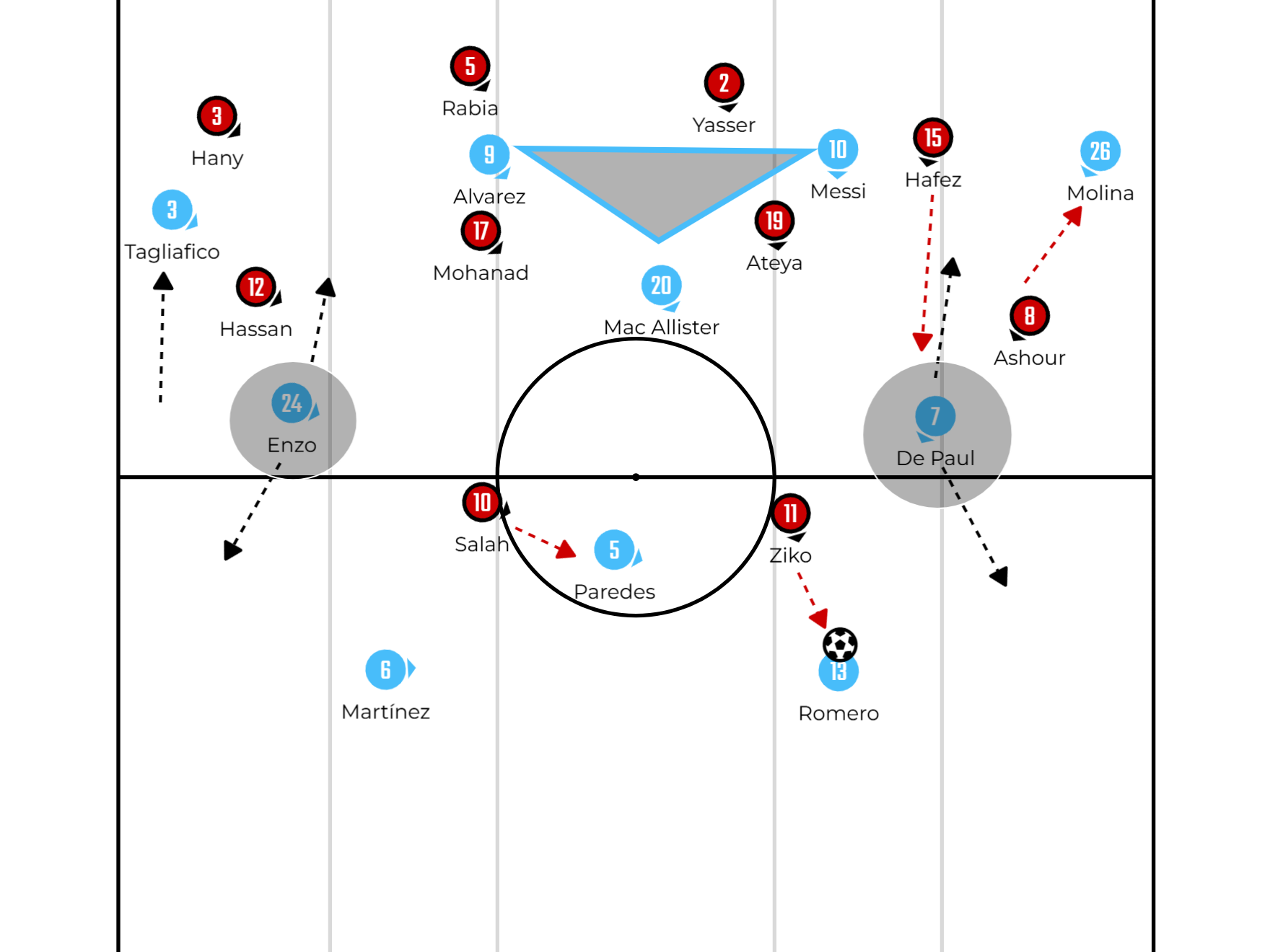
Argentina’s shape in possession. Enzo and De Paul dropped outside of Egypt’s block while the Argentine fullbacks pushed up. Egypt’s 4-4-2 mid block, while the front two put zonal pressure.
Argentina struggled to keep the ball consistently. Egypt’s pressure forced them to concede turnovers in deep areas. When Argentina got high up the pitch, they tried to find openings within the Egyptian mid block centrally but failed to find any inroads to attack. Argentina’s turnovers in the game led to Egypt being direct with the ball. They always looked to play forward with the ball when there was a free lane to.
The Egyptians kept the ball well, won fouls to increase their momentum. Their 4-2-3-1 setup, with Salah as the attacking midfielder, made efforts to draw out Lisandro when he made movements into the midfield. Paredes acted more as screening midfielder, calculating the moments when to jump to one of the Egyptian midfielder or when to hesitate to jump to cover Salah’s movements.
Multiple fouls mounted the pressure of Argentina and gave Egypt more confidence to play. Not long after, Egypt gained from this momentum with a goal. Ateya receives the ball resulting from a corner taken short and delivers a perfect cross to find Yasser who headed the ball past Martinez to take the lead.
Egypt took the lead after a good spell of pressure. Argentina’s sloppy passing was a factor to the result at that moment. Argentina’s will and drive showed as they kept the ball a lot better as the half progressed. Movements from Alvarez, Messi, Enzo and Mac Allister to drop and receive the ball helped in circulation.
Argentina’s attacking test
Egypt’s wingers were assigned to be tight to the Argentine fullbacks. Egypt’s block had six players in the last line in moments. The central areas were key active zones for Argentina with the wide areas being a zone for support. However, the fullbacks, Tagliafico and Molina, were eager to make forward runs beyond Egypt’s defensive line.
When these fullbacks made attacking runs, their teammates always looked to play these fullbacks in on goal. One of these sequence led to a penalty for Argentina after Hassan clipped Tagliafico’s trailing leg in the box. Messi stepped up to take the penalty which was then followed up by a save by Shoebeir in goal.
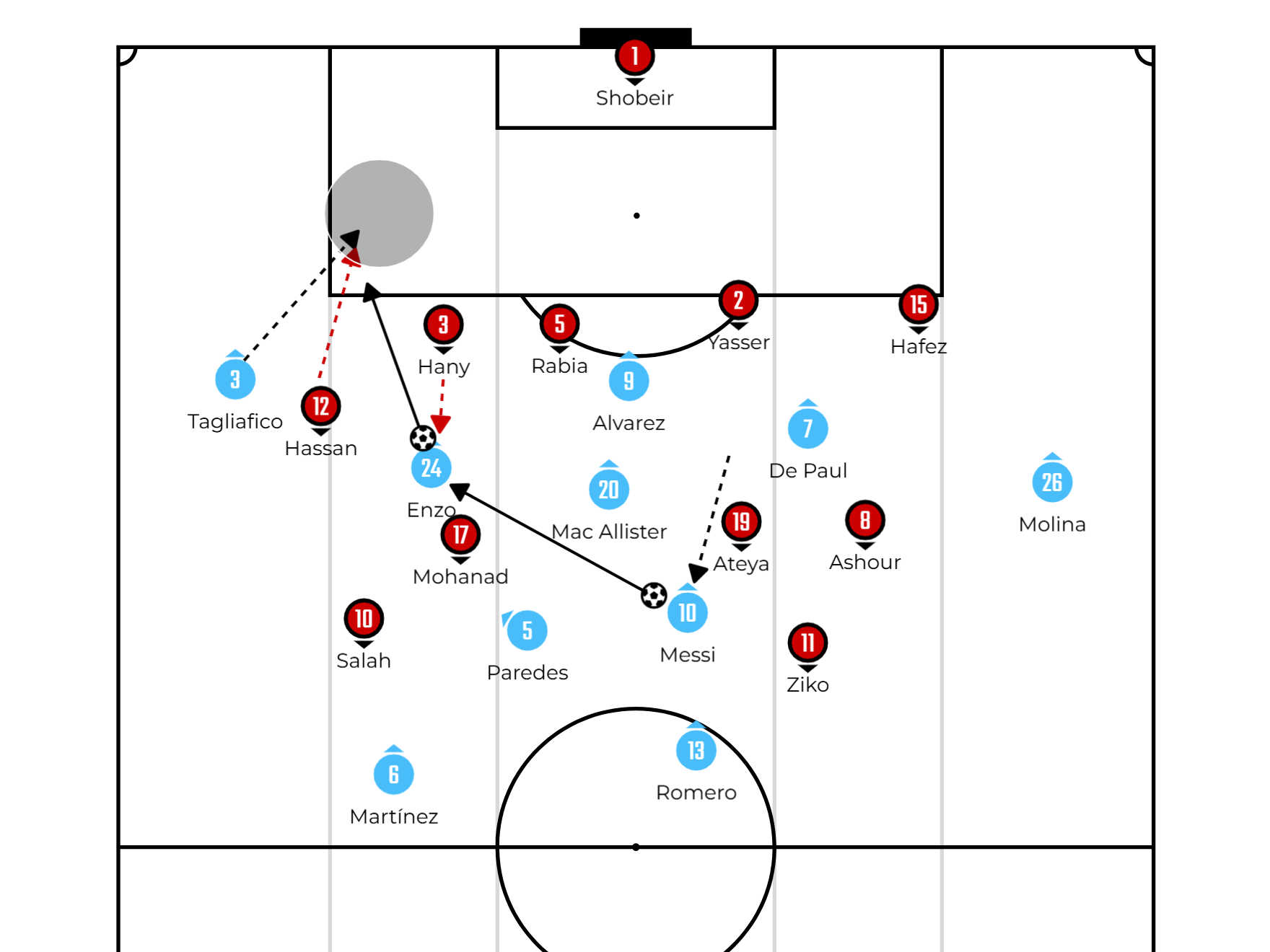
Tagliafico’s run into the space after Messi dropped deep to receive the pass.
Messi’s missed penalty didn’t change the momentum of the game. Argentina’s pressure continued. But as Argentina continued to put the pressure on, Egypt’s defensive line adjusted narrowly to limit the spaces between the lines. Argentina’s persistence to play through the central space favored Egypt towards the end of the first half.
At some point, the Egyptian mid-block neglected these wide areas where the fullbacks operated and squeezed the area close to the edge of the box. Whenever the Argentine players high up tried combination plays, Egypt nullified their intentions, frustrating Argentina.
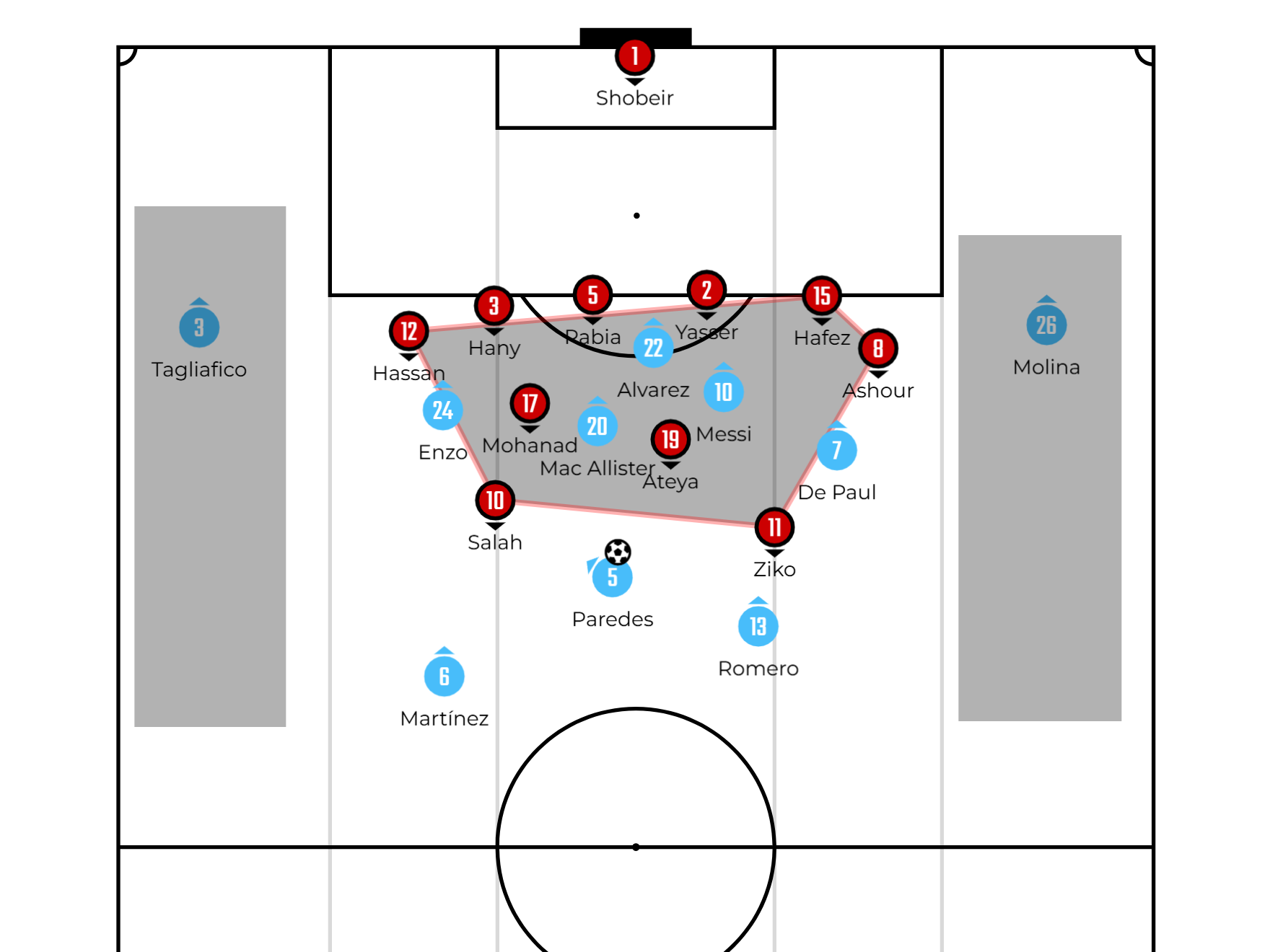
Egypt’s defensive focus: being tight and narrow to restrict central spaces between the block.
The Changes that changed the game
In the second half, Egypt changed their shape from a 4-2-3-1 to a 4-3-3. Salah operated as the striker while Ziko shifted to the left side of attack. This already laid out the intentions of Egypt, sit back and be a threat on the counter. Hassan, Salah and Ziko as the front three created problems for the Argentine backline in transitions.
Hassan’s ability to get past his man generated chances for Egypt. Egypt had a goal disallowed for a foul on Martinez, after Hassan got past three Argentine players in transition before laying a pass for Ziko to score. The Egyptian threat in transitions was real. Argentina’s attacking setup that allowed the fullbacks to push high, did not help these sequences when Egypt attacked with urgency.
Argentina conceded a second goal and this time, there was no infringement. Egypt’s attacking transitions kept being a threat and this time they made it count. Messi’s corner was headed away and the clearance came Salah’s way with space around him to run into space. Salah’s run got to the edge of the box where passed to Hassan. Hassan got past his marker and drilled in a cross to find Ziko in the box for a tap in.
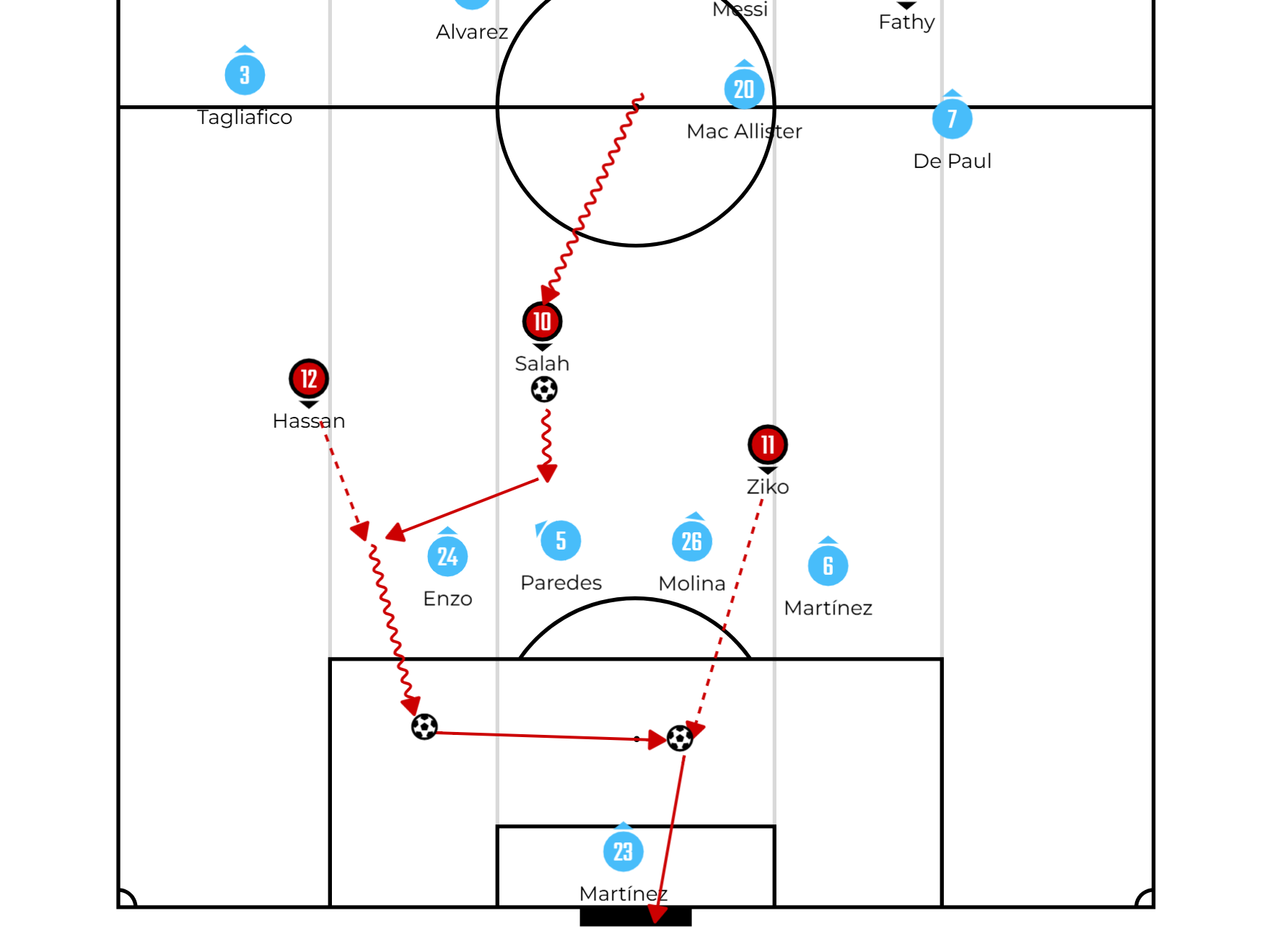
Egypt’s second goal; Salah’s pace with Hassan’s dribbling ability combines with Ziko’s run into the box.
Moments before the goal, Scaloni brought on Lautaro Martinez and Nico González. This attacking change brought more intensity to Argentina’s attack. Two goals down, Argentina needed more pressure on the ball. They did well to put pressure from the front with Alvarez and Lautaro, while Messi moved to the right side of the press.
Argentina’s urgency forced them to use the wide areas more with Nico on the left and Messi on the wide right. Argentina’s two goals both arrived from Messi putting in crosses from the right side of the pitch into the box. Within some minutes Argentina were back in the game.
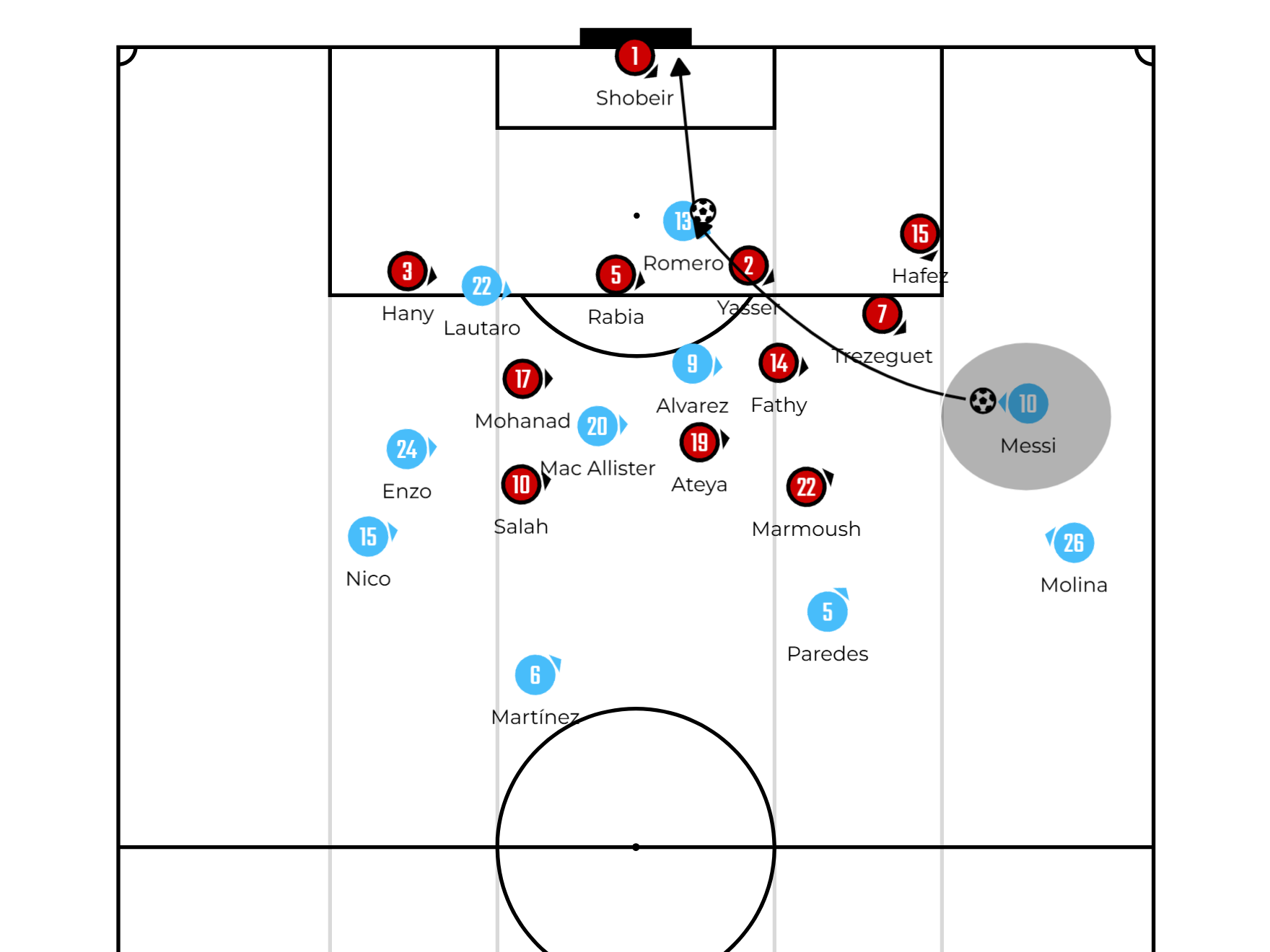
Romero’s goal, Messi crosses from out wide from the right to meet Romero’s header.
Argentina scored the winner after a controversial penalty shout for a challenge on Salah in Argentina’s penalty box. Lautaro latched on to the ball in transition to put in a cross for Enzo to score the winner. Argentina, eventually held through and won the game.
Takeaways
Argentina once again showed why they are world champions, overcoming adversity through tactical adjustments and relentless belief. Egypt’s disciplined defensive display and dangerous transitions caused Argentina major problems and nearly produced a famous upset. However, Scaloni’s second-half changes, combined with Messi’s influence from wide areas, shifted the momentum and inspired a remarkable comeback. Egypt leave the tournament with plenty of credit for a brave performance, but Argentina’s quality and resilience proved decisive when it mattered most.
Use the arrows to scroll through all available match plots. Click to enlarge.
Check the match plots page for plots of other matches.


Comments