
Brazil – Norway: Haaland and goalkeeper shines in historic win over Brazil’s passive approach (1-2)
Brazil were one of the teams that improved the most throughout the World Cup, but their reactive approach was not enough to stop Haaland’s two goals, from one of the most phenomenal strikers in the world, nor to beat goalkeeper Nyland, who may have produced the most important performance of his career. Clinical in both penalty areas, Norway secured a historic qualification and eliminated Brazil in Neymar’s dramatic farewell to the National Team.
Tactical analysis and match report by Marcus Arboés.
Carlo Ancelotti found his ideal team as the tournament progressed, but lost Paquetá to injury against Japan, while Raphinha was still not physically available. As a result, Brazil lined up with Alisson in goal; Danilo at right fullback and Douglas Santos on the left; Marquinhos and Gabriel Magalhães as the center back pairing; Casemiro and Bruno Guimarães in midfield alongside Martinelli, who has been playing as a midfielder under Ancelotti; Matheus Cunha started as the false nine, with Rayan on the right wing and Vinícius Júnior on the left.
Solbakken, meanwhile, also had just one absentee, forcing him into a change in the starting lineup without significantly altering either the team’s characteristics or its tactical structure. Nyland remained the starting goalkeeper; Pedersen was replaced by Ryerson at right fullback, while Wolfe played on the left; Ajer and Heggem formed the center back pairing; Sander Berge and Patrick Berg were the double pivot, with Odegaard as the attacking midfielder; Nusa played on the left wing and Sørloth, once again deployed out of position on the right wing, allowing Haaland to lead the line as the number nine.
Why were Brazil so defensive?
After the elimination, many Brazilian fans criticized the team’s defensive, passive and non-pressing approach, allowing Norway to enjoy long spells of possession. However, this reactive profile had already become one of Ancelotti’s team’s positive characteristics. The difference was that, against Norway, Brazil defended with a lower block, avoiding an open game that would favor Haaland and Sørloth, while focusing on counterattacks. In an exciting first half featuring a missed penalty and a disallowed goal, goalkeeper Nyland emerged as the unexpected protagonist.
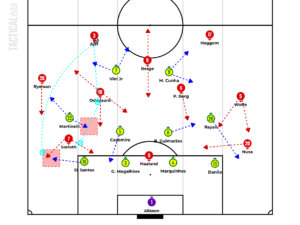
Norway attacking in a 4-3-3 shape against Brazil’s 4-4-2 formation, looking to intercept passes.
Within the opening minutes, Norway showed exactly what they had come to do by scoring from a quick attack, only for the goal to be ruled out for offside. Throughout the first half, they enjoyed more possession while playing in a positional 4-3-3 formation. Berge operated as the holding midfielder, with Patrick Berg as the left-sided midfielder, while Odegaard played as the number ten, organizing the team by dropping toward the right side while enjoying the freedom to drift inside.
On the left, Nusa stayed wide to dribble inside or appeared through the middle as a passing option, while fullback Wolfe made overlapping runs to drag defenders both inside and outside, depending on where space was available. He frequently rotated positions with Berg and could also become an option through the middle. On the right, the dynamics were different. Sørloth essentially played as a target man from the right wing, looking to secure possession for Ryerson’s overlapping runs and Odegaard’s support inside.
Anyone who only sees Haaland and Sørloth without knowing the rest of the squad might assume Norway are an extremely physical team, but they also have several technically gifted players. Even so, the main strengths of their star player, Haaland, are his aerial threat and his penetrating runs into open space. That was perhaps why Brazil chose to defend in a low block. However, beyond simply defending deeper, there was also a general perception that Brazil’s approach lacked aggression.
That impression came from Brazil’s defensive pattern, which focused on intercepting passes rather than pressing the ball carrier. This suits the characteristics of the players in the squad and has worked well whether defending in a high, medium or low block. Throughout the first half, it worked very effectively, with Bruno Guimarães, Matheus Cunha, Martinelli and Casemiro repeatedly winning possession in this manner before launching counterattacks. One of those transitions resulted in Ajer conceding a penalty on Matheus Cunha, which Bruno Guimarães failed to convert.
Whenever Norway attacked, they were not especially efficient. Douglas Santos contained and neutralized Sørloth’s actions, while Martinelli and Casemiro did an excellent job of limiting Odegaard’s creative influence. Norway’s left side looked more dangerous through Wolfe’s overlapping runs and Nusa’s dribbling, but Danilo, Marquinhos and Bruno Guimarães protected that area very well. Whenever Norway attacked with two players on the outside, Rayan consistently tracked back to help prevent crosses toward Haaland.
By the end of the first half, with Haaland being well handled by Gabriel Magalhães, despite Alisson having to make several saves, and Brazil creating dangerous counterattacks of their own, it seemed reasonable to believe Ancelotti’s side would come out on top in the second half. However, Nyland, who had already saved a penalty, looked inspired.
How did the substitutions affect the match?
With Norway’s wingers struggling to make an impact, Solbakken made two changes, bringing on Oscar Bobb on the right to add more technique, balance and dribbling, and Schjelderup on the left to introduce a natural wide player. The first substitution didn’t change much, as Douglas Santos remained very solid, but the second would eventually reward the coach in the closing stages. Norway’s attacking key still seemed to be down the left flank. Until then, however, Brazil remained the better side.
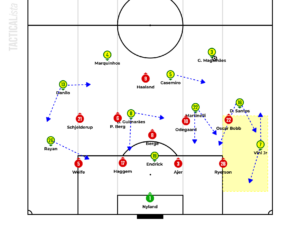
Brazil attacking through the left side with Vinícius Júnior against Norway’s 4-1-4-1/4-5-1 formation.
Despite the substitutions, Norway actually became even more rigid. Although they still managed to get forward at times, only Odegaard consistently attempted more ambitious passes. As a result, Brazil reduced the number of defensive actions aimed at creating counterattacks. On one of those rare opportunities, after a transition triggered by a mistake from Norway’s number ten, Vinícius Júnior set up Endrick, who had replaced Matheus Cunha, with a clear chance, but he failed to convert. He has probably not been able to sleep since missing that opportunity. The match looked to be firmly under Brazil’s control.
Ancelotti made a decision that seemed to make sense offensively. Rayan was not being productive on the right, and without Matheus Cunha, Brazil could no longer create close combinations and superiority down the left. So he took off the right winger and brought on Neymar to create attacking moves, while also introducing Danilo Santos in place of Martinelli to provide greater defensive security despite the tactical adjustment. This substitution improved Brazil’s ball circulation until it reached Vinícius Júnior, but it was not long before Ancelotti also had to replace the exhausted Bruno Guimarães with another holding midfielder, Ederson.
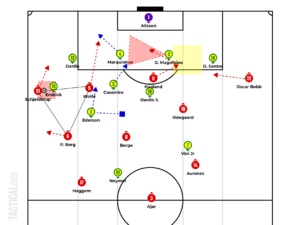
The situation leading to Norway’s first goal, with Schjelderup beating Endrick and taking advantage of Wolfe’s decoy run before crossing for Haaland, who attacked Gabriel Magalhães’ blind side to score with a header.
At the moment of Norway’s first goal, the match had settled into a quiet rhythm. Ederson was giving instructions to the other midfielders, perhaps explaining the defensive line, when Norway switched play to the left. To cover the central space, Endrick had tucked inside, leaving his natural position. Since he had become the player defending Brazil’s right side following Rayan’s substitution for Neymar, he was beaten in the combination on the left after failing to stop Schjelderup, leaving Danilo overloaded. Wolfe’s run drew Marquinhos’ attention, allowing the left winger to deliver the cross into the box.
During that movement, Haaland held his position before moving into Gabriel Magalhães’ blind side. A defender’s brain cannot process and focus on three different stimuli at the same time. While watching the ball and adjusting his positioning, Gabriel lost sight of Haaland, allowing Norway’s striker to attack the cross first and score with an excellent header, leaving Alisson, who had been having another strong performance, with no chance.
After that, with little time remaining, Brazil pushed forward and created at least two major scoring opportunities, whether through individual brilliance or well-worked attacks, especially through Neymar’s combinations with Vini Jr on the left. It was not enough, however, as they were repeatedly denied by Nyland. Then, in a completely unexpected moment late in the match, Haaland scored his second goal with a perfect strike from outside the box, taking advantage of Danilo’s distant attempt to block the shot.
Trailing by two goals, Brazil desperately searched for a way back into the match and eventually won a penalty, converted by Neymar after exchanging provocations with the goalkeeper. The goal came too late to change anything, marking a melancholic end to Neymar’s story with the Brazil National Team.
Takeaways
Ancelotti made mistakes in his decisions both before and during the match, and it’s possible that the team’s passive approach affected the players’ mentality when they needed to find a goal in the decisive moments. Brazil lacked efficiency in both penalty areas, even though Alisson performed well. Without tactically outperforming Brazil throughout the match, Haaland, Schjelderup and Nyland proved extremely decisive whenever it mattered. Their efficiency secured a historic qualification for Norway, who remain unbeaten against Brazil and will now face England in the quarterfinals.
Considering everything Brazil experienced before the World Cup, with four different head coaches implementing different playing ideas throughout the cycle, it’s fair to say they didn’t enter the tournament as genuine favorites, despite being the only five-time world champions. Even so, not everything should be viewed negatively. The squad Ancelotti inherited lacked confidence and defensive solidity, and under his leadership Vinícius Júnior finally became the protagonist for Brazil that we have long seen at Real Madrid. We could say that Brazil improved remarkably throughout the World Cup, but it was still not enough, and there’s plenty of work to do before 2030.
Use the arrows to scroll through all available match plots. Click to enlarge. Check the match plots page for plots of other matches.


Comments