

Argentina – Switzerland: Extra Time Decides Argentina’s Fate Once Again against Switzerland as They Book Semi Final Spot (3-1)
Switzerland dominated the period after Argentina’s opening goal. After much momentum, they eventually got an equalizer after being better in larger spells of the game. Argentina’s decision to sit back and defend deep while conceding momentum and possession gave Switzerland a lifeline. The red card given to Switzerland killed all their momentum later in the second half. Argentina used this to their advantage to turn the game around.
Tactical analysis and match report by Ebuka Ogoegbunam.
We decided to make this article free to read. If you want to support our work, consider taking a subscription.
Argentina’s route to the quarter-finals has been anything but straightforward, yet the reigning world champions have continued to demonstrate why they remain the team to beat. Lionel Scaloni’s side topped Group J with a perfect record before surviving two dramatic knockout tests, first overturning a two-goal deficit to defeat Cape Verde 3-2 and then producing an even more astonishing comeback against Egypt.
Trailing 2-0 with just 11 minutes remaining, Argentina scored three times through Cristian Romero, Lionel Messi and Enzo Fernández to claim a breathtaking 3-2 victory, keeping their title defence alive and reinforcing the resilience that has defined this squad. They’ve been the dream team of this tournament so far.
Switzerland were underdogs coming into this game but their four match winning streak, with one game going to penalties, was something they could build confidence from.
Lionel Scaloni started Emiliano Martínez in goal and a backline of Nahuel Molina as the right back, Cristian Romero and Lisandro Martínez as the center back pairing while Nicolás Tagliafico played on the left side of defence. Leandro Paredes played as the sole pivot with a three man midfield of Alexis Mac Allister, Enzo Fernández and Rodrigo De Paul ahead of him. Lionel Messi and Julián Álvarez started in attack for Argentina.
Murat Yakin named Gregor Kobel as his goalkeeper behind a back four of Denis Zakaria, Manuel Akanji, Nico Elvedi, and Ricardo Rodríguez. In midfield, Remo Freuler partnered Granit Xhaka at the base, allowing Fabian Rieder to operate in the number ten role behind the attack. Dan Ndoye and Djibril Sow provided the width from the flanks, while Breel Embolo spearheaded Switzerland’s attack in a 4-2-3-1 setup.
Argentina concede control to Switzerland Pressure
Argentina set up in their usual 4-1-3-2 shape on the ball against a Switzerland team that defended in a 4-4-2 block. Both teams started the game off very well, with Switzerland having less of the ball in the early stages. Although Switzerland didn’t have much possession early on, they pressed high and always put pressure on the Argentine defenders.
Switzerland’s press tried to limit Lisandro’s touches during Argentina’s build up. Embolo forced Martínez to go long or play through Romero by shadow marking Lisandro while putting pressure on Martínez. Martínez often went long to Álvarez who had a tough time holding up the ball against Elvedi and Akanji.
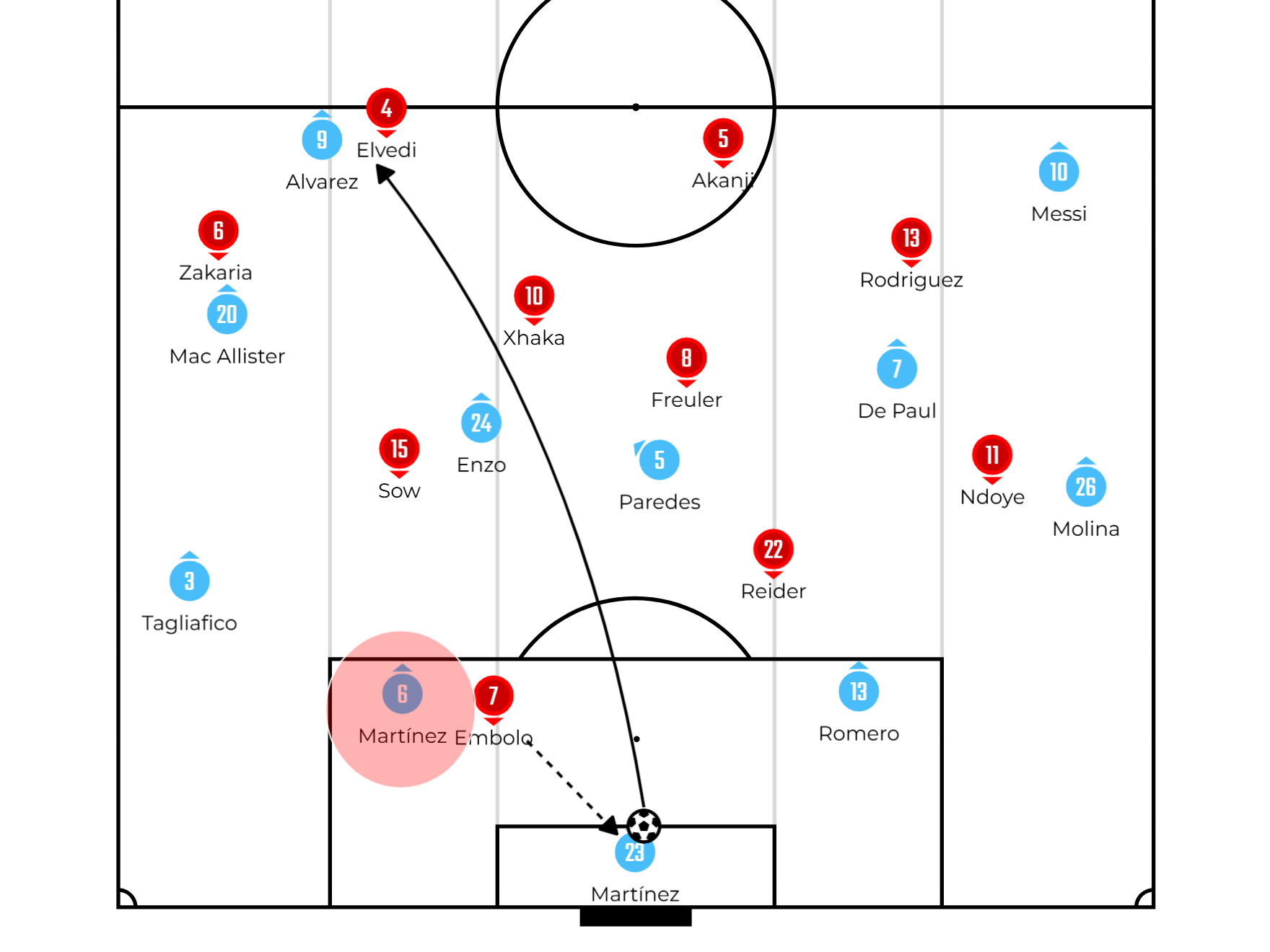
Embolo forced Martínez to play through the right hand side or go long when he put pressure on him.
Switzerland’s hybrid press had Embolo and Rieder leading the press while the wingers pressed zonally. Sow followed the movements of Enzo while Zakaria pushed up to press the fullback, who was Tagliafico. Argentina tried to exploit the space between Zakaria and the right center back to try and start attacks.
The Swiss center backs did well to control their markers and win their duels in that area of the pitch. This sequence made it hard for Argentina to gain rhythm with the ball. Paredes often dropped into the first line of the press making it hard for Switzerland to put pressure on the center backs. When this happened, Lisandro was able to get on the ball and go long, but this didn’t happen multiple times in the game.
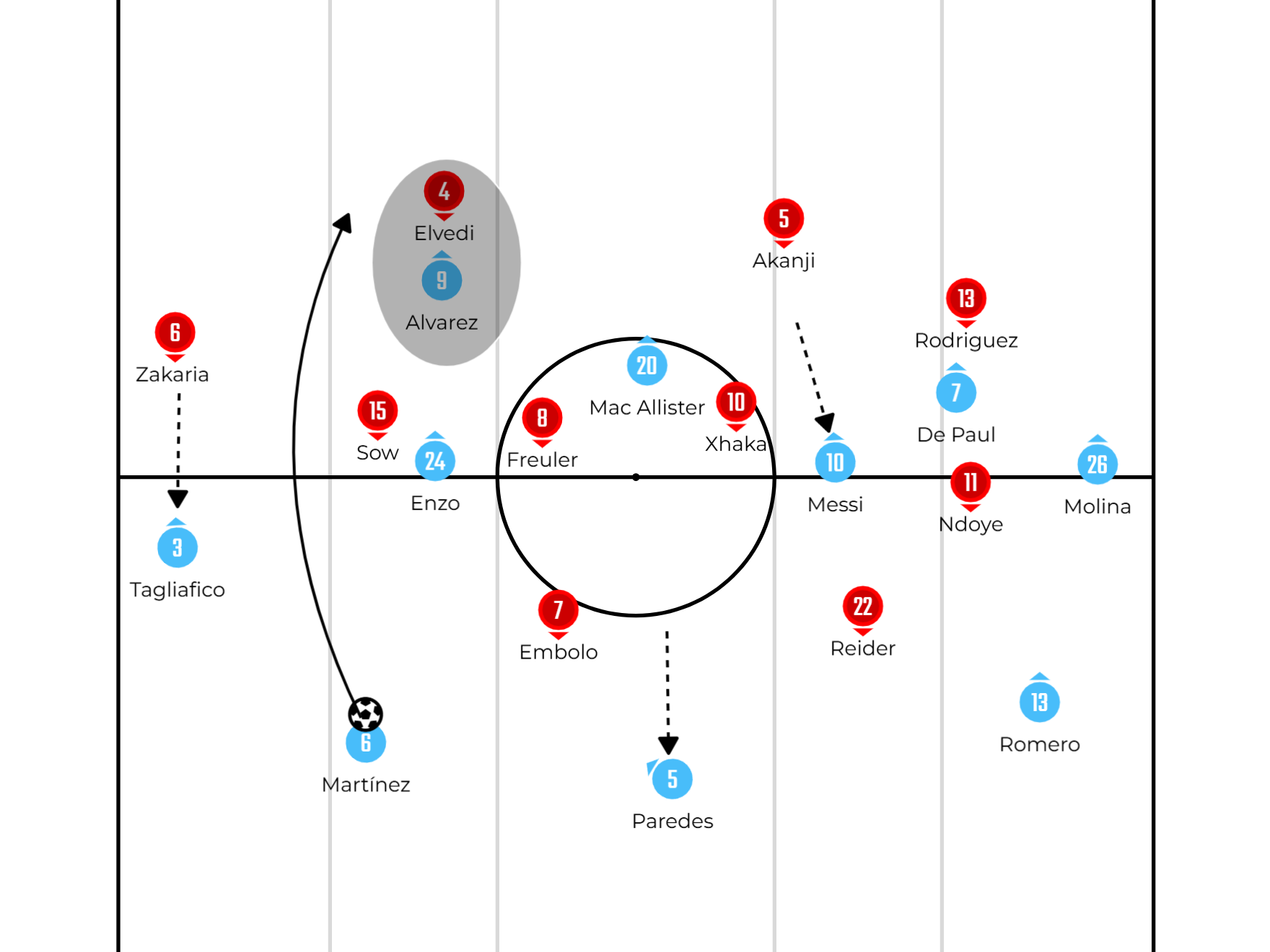
Martínez allowed to get on the ball due to Paredes’ movement to drop into the first line.
However, Argentina struggled to keep the ball after going long consistently. Switzerland won most of the second balls and used that opportunity to pin Argentina back. This didn’t stop Argentina from scoring. Mac Allister’s header into the back of the net from Messi’s corner delivery put Argentina in the lead. One nil-up in ten minutes was the ideal situation for Argentina as they had a lead to hold on to.
Momentum pays off
Switzerland exerted their dominance more as the game went by. Argentina were forced to sit and defend deep for long periods. Scaloni’s men defended very compact with the widest player being very narrow. Switzerland had numbers in the central areas as well. On the right side, Zakaria kept the width while Sow moved inside of the Argentine block. On the left side, Ndoye kept the width while Rodríguez stayed narrow.
Switzerland’s best moments occurred between the lines. Sow’s narrow position helped him receive the ball in that zone and initiate an attack.
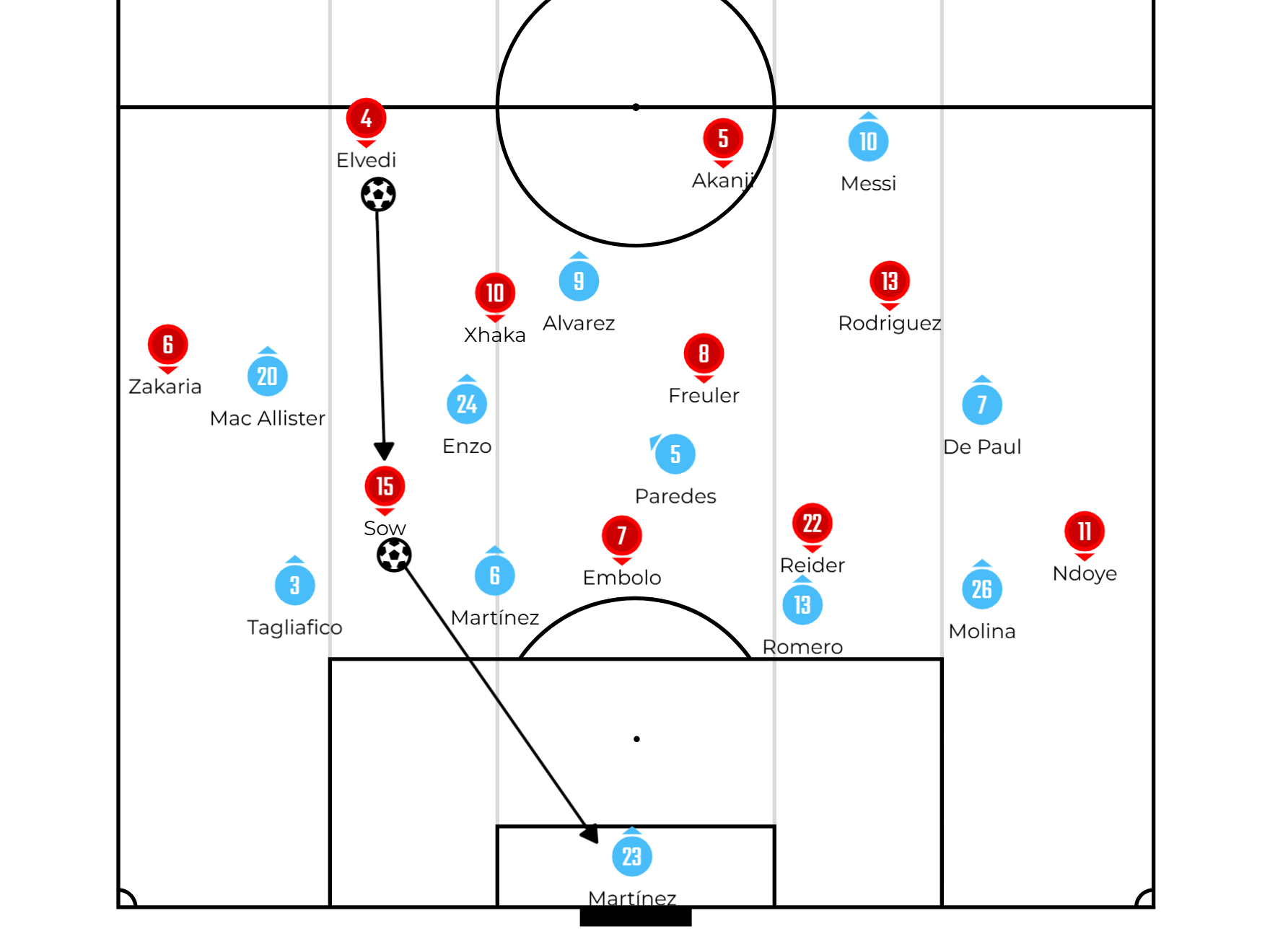
Sow’s movement in between the lines was a medium to attack for Switzerland.
In the second half, Switzerland got more openings between the lines of the Argentine mid-block. The Argentine defenders were tighter, hence, conceded more spaces between their block. Sow’s positioning drew out Tagliafico and Romero would want to jump to Rieder, when Paredes didn’t cover him.
This exposed the backline and although some of these sequences didn’t cause any panic, Argentina risked themselves at the back.
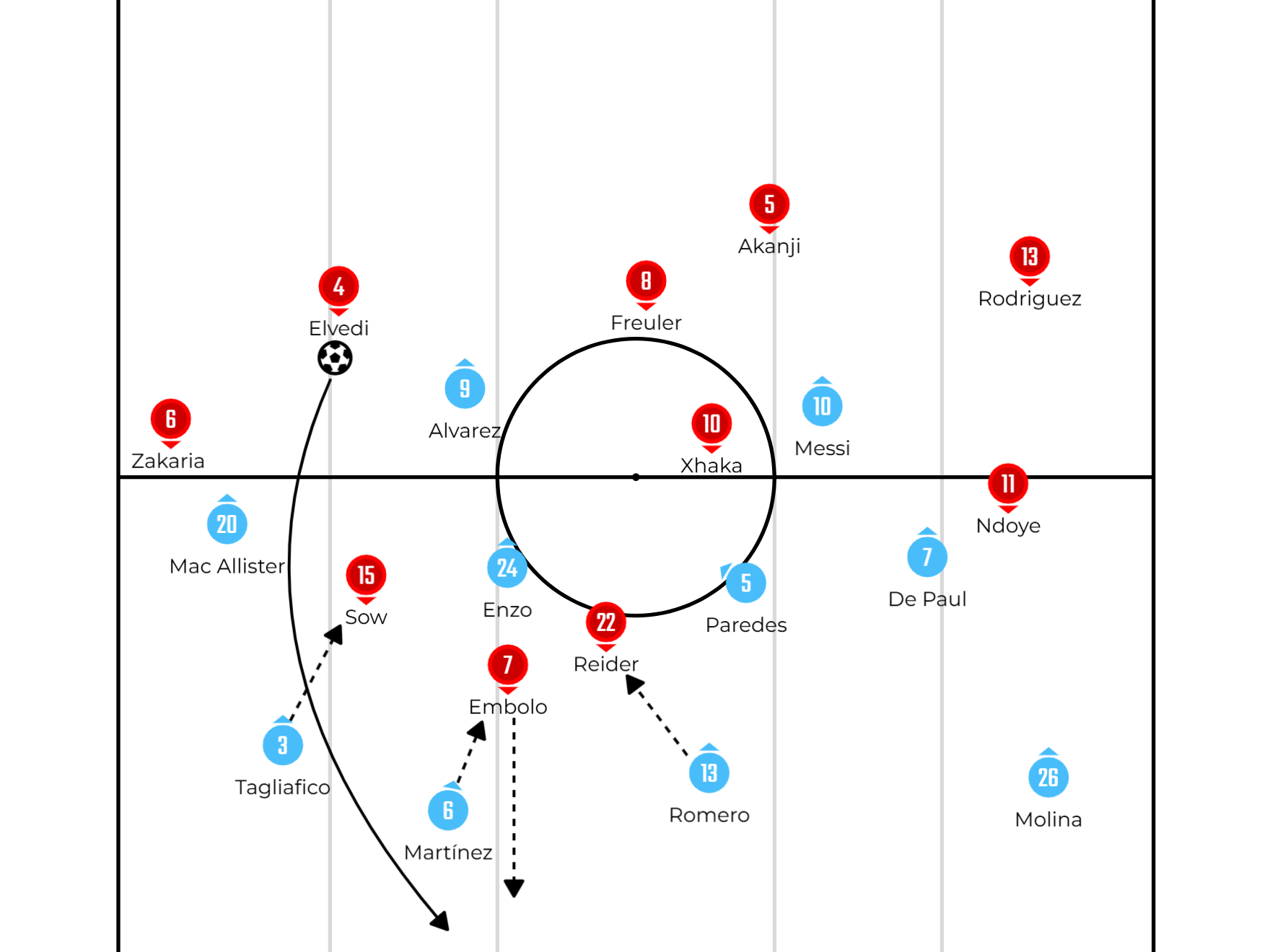
Sow and Rieder’s position attracted Romero and Tagliafico and this allowed Switzerland to get in behind.
Switzerland got their breakthrough with an equalizer after having momentum in that period. Ndoye’s combination pass with Rodríguez found him inside the penalty area as he slotted the ball past Martínez.
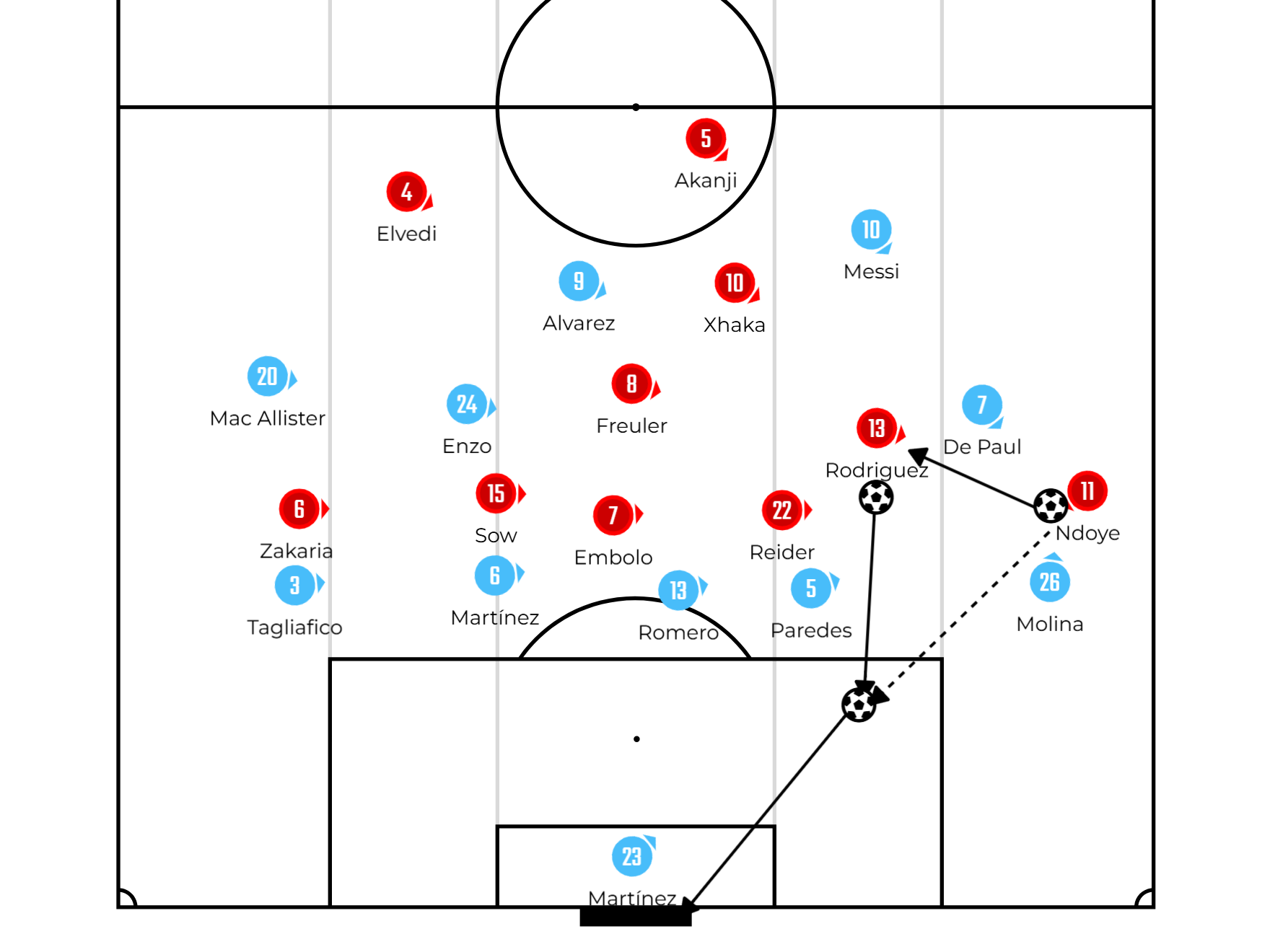
Switzerland’s goal: Ndoye runs through the Argentine block after a one-two pass with Rodríguez to finish from close range.
After a moment of belief for Switzerland, their hope was cut short after Embolo got a second yellow card for diving. Ten men Switzerland were handicapped for the rest of the game and were forced to defend. They defended with a 5-3-1 block, with no pressure on the ball. This allowed Argentina to regain back possession and control the game.
Switzerland withheld pressure and took the game to extra time. During second half of extra time, Argentina found a way through, after Álvarez curled a shot from the edge of the box to score. Switzerland’s hope diminished in that moment. Facing elimination, Switzerland pushed forward to attack and left themselves open at the back.
In the last seconds of added time, Argentina added a third goal from an attacking transition led by the substitutes, Lautaro Martínez and Thiago Almada. Almada’s run led to a shot that was saved by the goalie with the rebound landing straight to Lautaro to score the third goal.
Takeaways
Argentina’s victory was built on resilience rather than control. Switzerland’s aggressive pressing disrupted Argentina’s build-up early on, forcing Emiliano Martínez into long passes and limiting the influence of Lisandro Martínez in possession.
Although Alexis Mac Allister’s early goal handed the defending champions the lead, Scaloni’s side gradually lost control as they retreated into a compact mid-block, allowing Switzerland to dominate possession and exploit the spaces between the lines.
The Swiss deservedly equalised after sustained pressure, but Breel Embolo’s red card shifted the momentum completely. Against ten men, Argentina regained control of the ball, stretched Switzerland’s deep defensive block, and eventually found the breakthrough in extra time through Julián Álvarez before sealing the result on the counter-attack.
It was another display of Argentina’s adaptability, surviving difficult phases before capitalising when the game swung back in their favour.Their ability to absorb pressure, survive difficult periods, and punish opponents when opportunities arise has become the defining characteristic of their tournament.
From dramatic comeback victories over Cape Verde and Egypt to another knockout triumph requiring extra time, Argentina have consistently shown a champion’s mentality rather than simply relying on individual brilliance. However, they’ll face a harder test against England if they look towards another world up final.
Match plots would be added as soon as possible.


Comments