
Cruzeiro – Flamengo: Substitutions impact Cruzeiro’s comeback with a last-minute winner (2-1)
Cruzeiro and Flamengo have had a particular battle in Brazilian football over the past month, as the teams faced each other in the Copa Libertadores round of 16 and, in both matches, Leonardo Jardim’s tactics came out on top. With an away draw and a home win, Flamengo advanced, but on matchday 24, Artur Jorge’s side finally secured their first victory over Flamengo this year, playing at home, with the coach’s substitutions having a direct impact in a match defined by the similarities between the teams’ playing styles.
Tactical analysis and match report by Marcus Arboés.
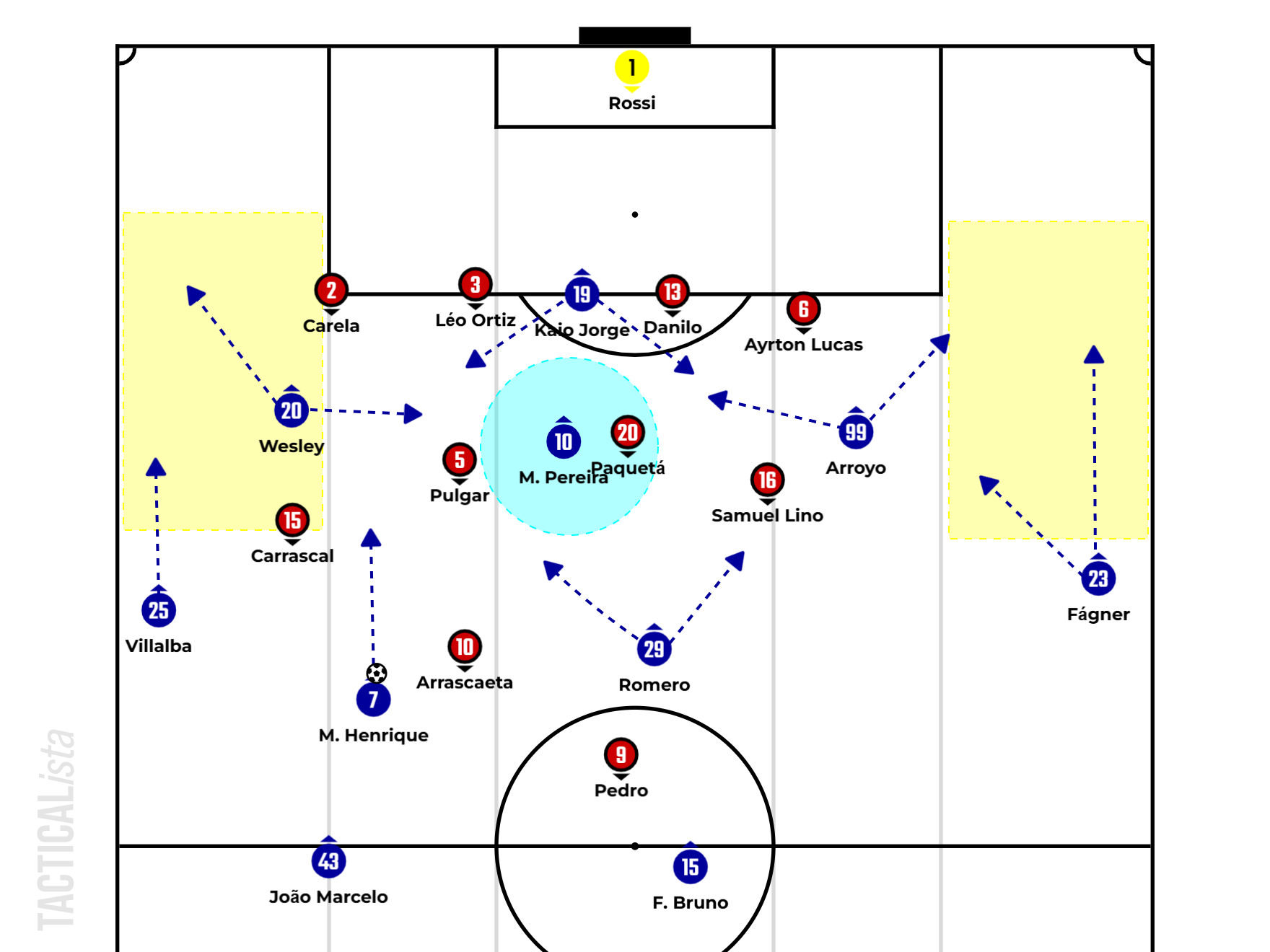
After two tactical defeats to Leonardo Jardim, fellow Portuguese coach Artur Jorge, Cruzeiro’s manager, managed to overcome him and secure his team’s recovery, making changes to the starting lineup while also dealing with the absences of Gabriel Pec and Sinisterra through injury and Jonathan Jesus through suspension due to yellow cards. As a result, the team lined up in a 4-2-3-1 formation: young goalkeeper Otávio Costa; Fágner at right fullback, Villalba on the left and the center back pairing of Fabrício Bruno (former Brazil National Team) and João Marcelo; the double pivot consisted of Romero and Matheus Henrique (former Sassuolo), who was given an opportunity in place of Gérson (former Flamengo); Matheus Pereira as the number ten and João Costa as the left midfielder; Keny Arroyo played on the right wing and Kaio Jorge (former Juventus) as the striker.
On the other side, Leonardo Jardim, who has been finding an effective and fluid way for his team to play, seems to have managed to get the best out of his key players, fitting them into an interesting starting lineup. Even with Alex Sandro, Vitão, De La Cruz and Léo Pereira unavailable, the coach also lined Flamengo up in a 4-2-3-1 outline: Rossi in goal; Varela at right fullback, Léo Ortiz and Danilo (Brazil National Team) as the center backs and Ayrton Lucas at left fullback; Pulgar (former Fiorentina) as the holding midfielder and Lucas Paquetá (former West Ham) as the second holding midfielder, forming the midfield alongside De Arrascaeta (Uruguay); up front, Carrascal played as the right midfielder, Samuel Lino (former Atleti) as the left winger and Pedro (former Brazil National Team) as the target man.
Flamengo’s superiority
Flamengo and Cruzeiro have more tactical similarities than it might seem at first glance, and that goes well beyond the fact that they are coached by two Portuguese managers who do not closely follow their country’s tactical culture. Both teams play in a more functional/relational 4-2-3-1 formation, with a number ten who has greater influence in the final third, using free wingers who can overload the opposite side of the pitch, with more differences in the center backs’ influence during the build-up and in the characteristics of the fullbacks and holding midfielders. It is no coincidence that Leonardo Jardim coached Cruzeiro last season.
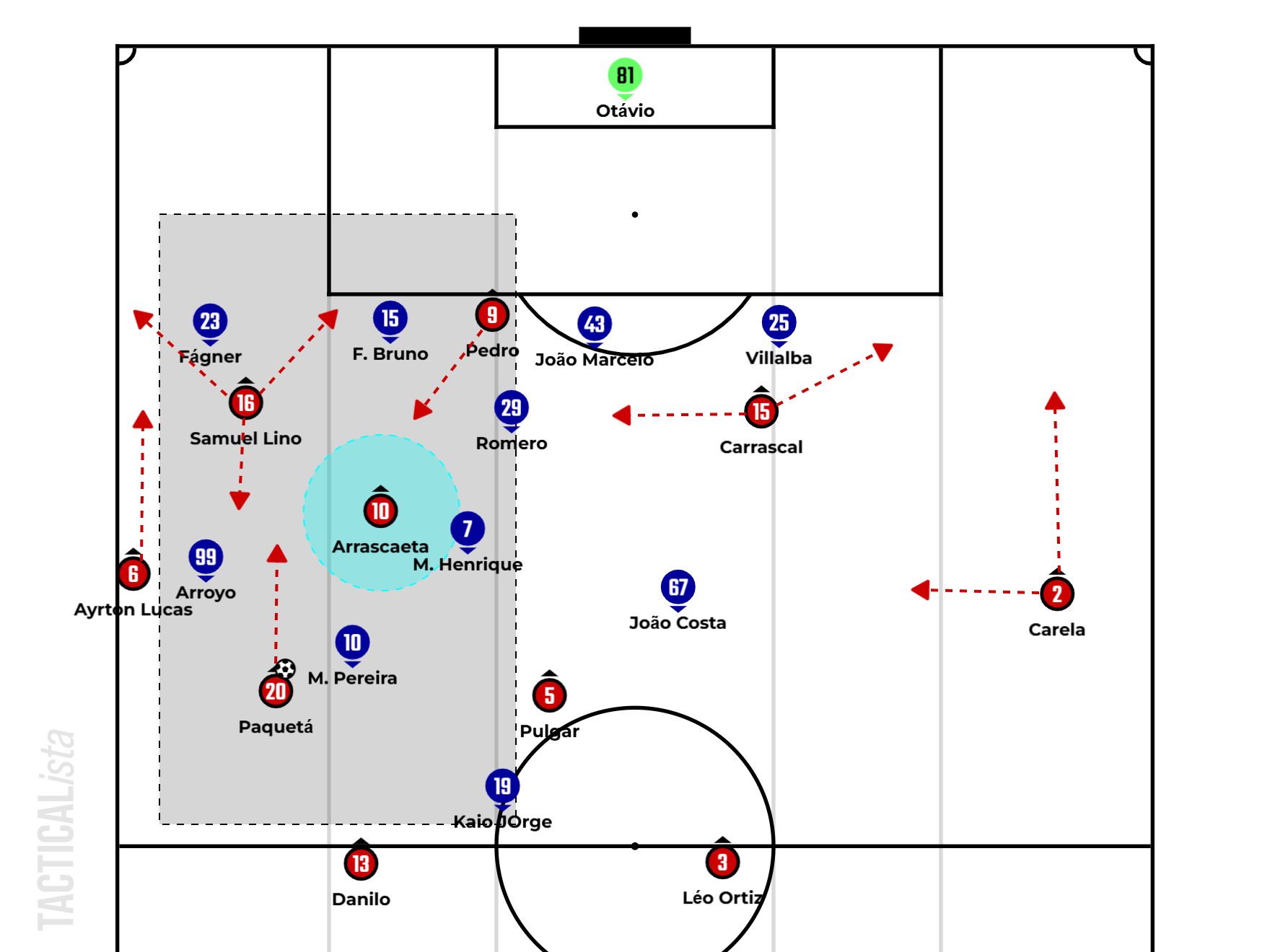
Flamengo attacking in a 4-2-3-1 shape, overloading one side of the pitch through the movement of the opposite winger.
In this battle of tactical similarities, the two teams have another point in common: they are asymmetrical, tending to attack more down one side than the other. Flamengo generally have greater technical superiority on the left when Paquetá, Arrascaeta and Samuel Lino combine. Their attacking dynamics usually involve supporting runs to attract defenders and create space for a third player to attack vertically, generally Samuel Lino or left fullback Ayrton Lucas.
This support can come from Paquetá, Arrascaeta, with both varying their height and role in the build-up, Pedro, playing with his back to goal as a target man, and even Samuel Lino when moving further inside. In addition, when the team attacks down the left, Carrascal does not remain wide on the opposite side. He moves closer inside and becomes an extra player in an attack congested on one side, freeing the opposite flank for Varela to advance.
During a relatively balanced first half, but with Flamengo having the greater advantage, Pulgar and Paquetá managed to manipulate Cruzeiro’s second line of pressure very well, facilitating the build-up for Danilo and Léo Ortiz, who are excellent ball-playing center backs. The quality of these players exploited another difference between the two teams: the way they protect the space in front of the defensive line.
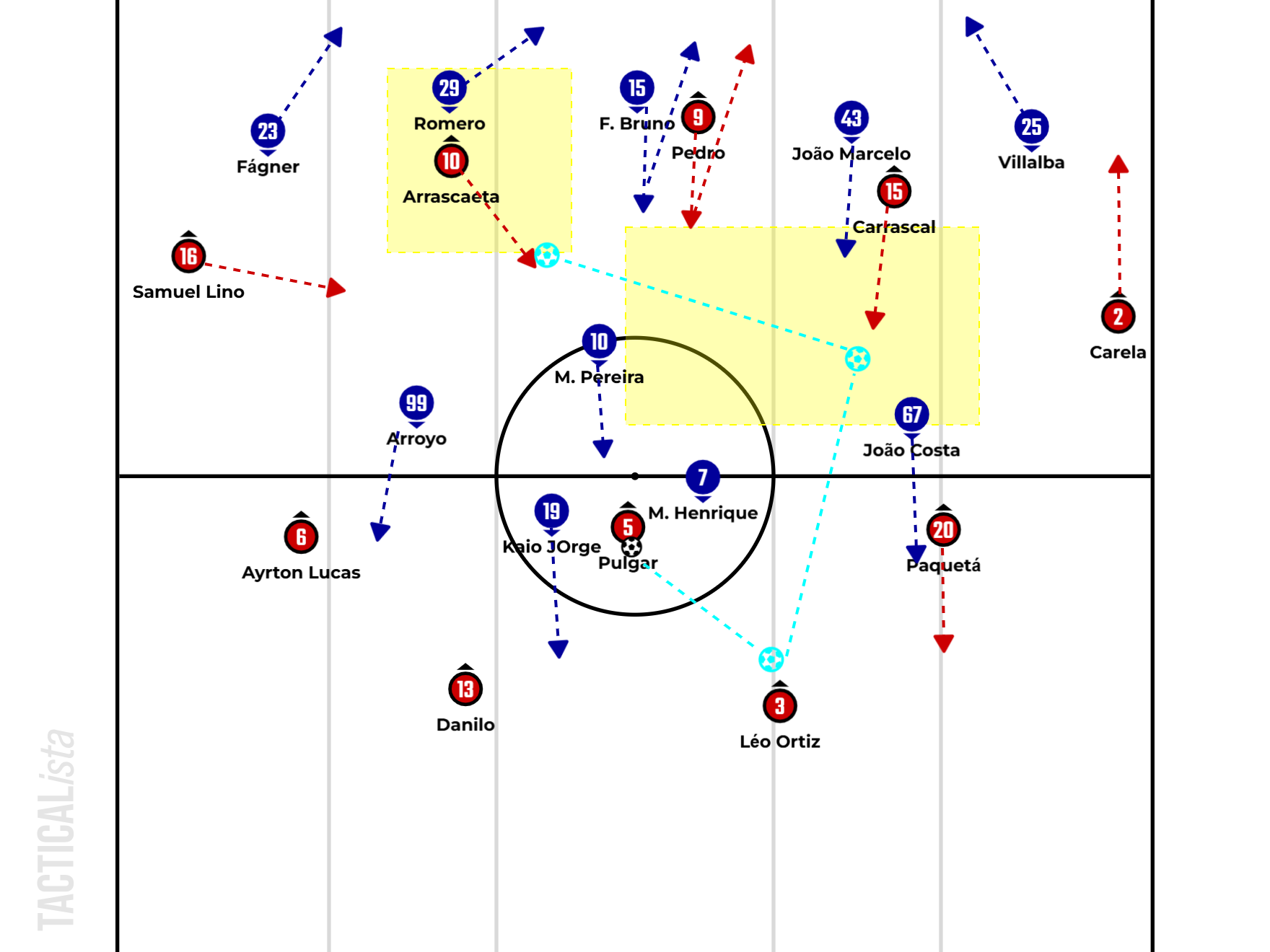
The tactical situation leading to Flamengo’s goal, exploiting counter-movements and Cruzeiro’s lack of compactness to progress through supporting runs.
Flamengo’s goal came from a moment of complete inattention from Cruzeiro’s defensive lines, which were totally disorganized. Matheus Henrique was positioned higher, and he and Matheus Pereira became confused by the temporary switch of roles, while Kaio Jorge, João Costa and Arroyo were drawn toward the ball. This initial confusion created a huge amount of space behind those five defenders, in addition to Romero remaining, as you can see in the first image, very close to the center backs, protecting the space in front of the first line.
Pulgar passed to Léo Ortiz, who controlled the ball, paused, drew the five advanced players forward and played a progressive pass. This is where the key to Flamengo’s vertical movement dynamics came into play. Carrascal dropped behind João Costa, who tracked Paquetá, and drew João Marcelo into a man-oriented matchup. Pedro dropped, attracted Fabrício Bruno and immediately moved into the space created by Carrascal’s movement, while Carrascal received Léo Ortiz’s pass and connected with Arrascaeta.
As Romero identified the possibility of Flamengo exploiting the space behind the center backs, he did not step forward to press Arrascaeta, who recognized this and did not move forward either, instead dropping to receive with open space ahead of him to progress, create further doubt for Romero and pass to Pedro from an ideal distance for him to control the ball and score Flamengo’s goal, once again putting Leonardo Jardim’s side ahead in a matchup against Cruzeiro.
How did Artur Jorge change the game?
The first half, in this clash of ideas, had been relatively balanced, but it is true that Cruzeiro struggled to create. While Flamengo prioritized attacking down the left, using their technical superiority, Artur Jorge’s side relied on the characteristics of the players operating on the right, the side from which some of the team’s goals have come during their recent good run.
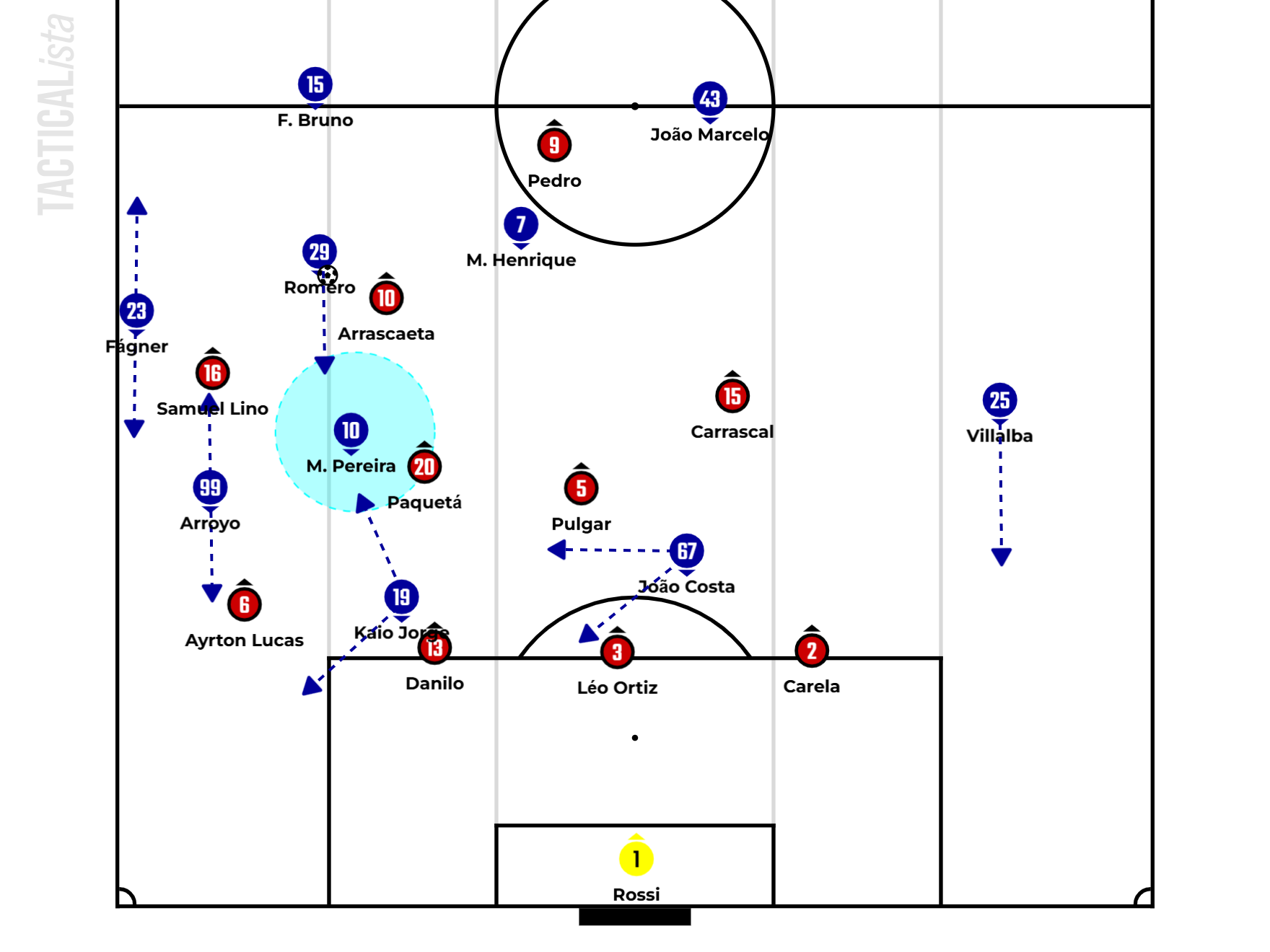
Cruzeiro attacking in a functional/relational 4-2-3-1 shape, using an overload on the right side.
In Cruzeiro’s attacks, the build-up started with Romero and Matheus Henrique, with team captain Romero having greater freedom to attack spaces. In Artur Jorge’s tactics, the close combinations down the flanks create doubt. Matheus Pereira and Kaio Jorge act as connecting players, with one operating as a playmaker, delivering incredible passes, and the other as a target man, providing support for players attacking while facing forward, or moving out to the right wing to drag defenders away.
Fágner, who has been providing good assists with medium and long-distance crosses, and Arroyo, excellent in one against one situations and very aggressive, alternated as the player receiving the ball within these combination dynamics, while Romero could also make overlapping runs. On the other side, João Costa, who is not a natural left winger, moved inside as another player joining the combinations and even attacking the box to add numbers and create doubt. As a result, the team became unbalanced, as Villalba was unable to receive good switches of play from the opposite side, making Flamengo’s defensive task easier. They defended in a horizontally compact 4-4-2 shape, even though they still faced some dangerous attacks.
Cruzeiro attacking in the second half with two skillful wingers in a 4-2-3-1 formation.
For the second half, one change was crucial and essential. Artur Jorge took off the Portuguese João Costa and brought on Wesley, giving Cruzeiro two skillful wingers who could unbalance the defense through dribbling and individual plays while still operating as good passers and helping Matheus Pereira in the build-up.
With this change, Cruzeiro’s two wingers began playing with complete freedom and moving further inside, allowing Keny Arroyo to appear between the lines, with Wesley doing the same. In some attacks, they were even together on the same side, creating even more doubt, but as a general pattern, their movements forced Flamengo’s compact 4-4-2 lines to drop deeper to protect the center of the pitch. This freed up more space for Matheus Henrique and Romero to build the attacks while facing forward.
By crowding central areas with Cruzeiro players, Flamengo ended up conceding space on the flanks. That was exactly how Matheus Henrique managed to find a good pass for Keny Arroyo, advancing down the right alongside Fágner’s overlapping run, which left Ayrton Lucas unsure of who to mark. Through an individual play, Arroyo managed to score a beautiful goal to equalize.
This became the pattern of the match over the following minutes. To regain control of the midfield, Flamengo introduced Jorginho (former Arsenal) and Gonzalo Plata, taking off Arrascaeta so Paquetá could play as the attacking midfielder, while defensively Pulgar operated almost as a center back. In addition, with Jorginho, the team gained greater control and defensive presence in midfield. Later, Carrascal moved into the central attacking midfield role, with Bruno Henrique replacing Paquetá and Evertton bringing fresh energy in place of Pulgar, also making use of his physical presence.
In response to the balance Flamengo had managed to restore at that point, Cruzeiro brought on Gérson for Romero, adding a player with greater creative ability and ball control, and Kenji for Arroyo, maintaining their one against one threat out wide, while also changing the profile of the number nine by introducing Neyser Villarreal in place of Kaio Jorge. The first two players were almost directly responsible for the winning goal.
In the final minutes, Ayrton Lucas started a counterattack down the left, but was well surrounded by Cruzeiro’s players. Instead of playing a through pass, he attempted a backheel pass and made it easier for Gérson to win the ball and launch the counterattack. Kenji received on the right, dribbled past Evertton and combined inside with Matheus Pereira. After a return pass led to a cross from the opposite side, Villalba attacked the box and headed the ball back, Matheus Pereira shot, benefited from a deflection and scored the comeback winner in the final minute.
Takeaways
The player labeled as a star who only shines on quiet nights was decisive in a big match. Matheus Pereira secured the home victory and all three points for Cruzeiro. With that, the team moved into fifth place in the Brasileirão standings after their fourth consecutive victory. In the next round, they face an important match against Vasco, who have just suffered a heavy defeat to Palmeiras.
And that emphatic victory, which gave the league leaders renewed confidence, also prevented Flamengo from taking their opportunity to move to the top of the Brasileirão standings. The gap, which had been reduced, returned to six points, although Flamengo still have a game in hand. To try to turn things around, they will face Botafogo, their rivals, who are also going through a difficult spell.
Use the arrows to scroll through all available match plots. Click to enlarge. Check the match plots page for plots of other matches.


Comments